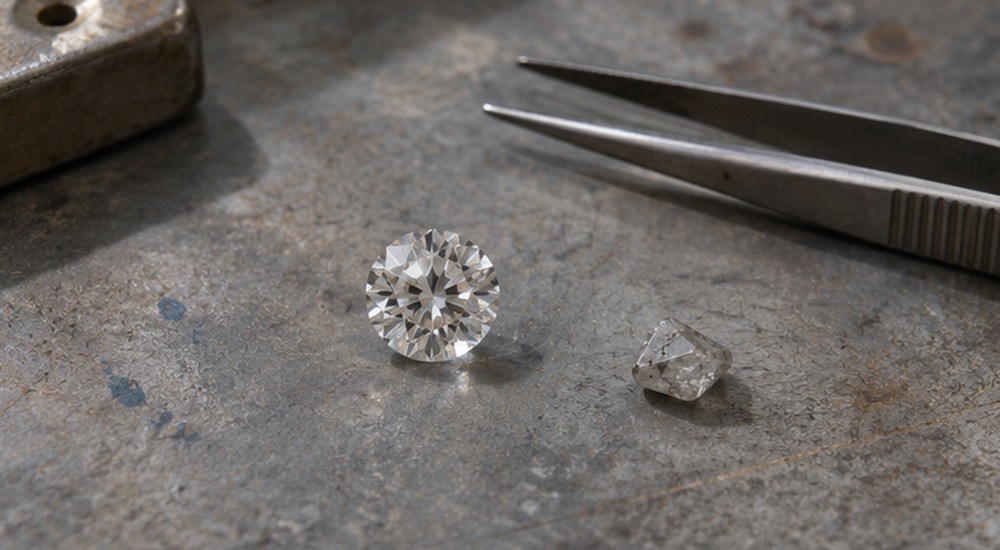
Sweden’s ASEA produced tiny diamond crystals in 1953, according to its research history. In the United States, H. Tracy Hall achieved a repeatable high-pressure synthesis at General Electric in December 1954. GE publicly announced its breakthrough in 1955. The first cuttable gem-quality crystals from GE followed in 1970, and the company unveiled faceted examples in 1971.
That is why the answer to “Who made the first lab grown diamond?” depends on what you mean by first. The earliest laboratory growth, the first widely publicized repeatable process, and the first diamonds that could be cut as gems are separate milestones. There was also early work on growing diamond onto an existing surface, which adds 1952 to the timeline.
When Was the First Lab Grown Diamond Made?
| Year | Milestone | What it established |
|---|---|---|
| 1952 | William Eversole at Union Carbide documented early diamond growth by chemical vapor deposition. | Diamond could grow from a gas onto an existing diamond surface. |
| 1953 | The Swedish company ASEA produced tiny diamond crystals during Project Quintus. | ASEA had achieved high-pressure diamond synthesis before GE’s December 1954 breakthrough. |
| 1954 | H. Tracy Hall achieved repeatable diamond synthesis at General Electric. | GE had a reliable way to produce diamond crystals at high pressure and high temperature. |
| 1955 | GE announced the breakthrough in February and published its research in Nature in July. ASEA also disclosed its earlier work in 1955. | The results entered the public record, with GE announcing its achievement first. |
| 1956 | GE made synthetic diamond commercially available for industrial use, according to GIA’s CVD history. | Manufacturers could use synthetic diamond as an industrial material. |
| 1970–1971 | GE grew crystals suitable for faceting in 1970 and publicly unveiled faceted examples in 1971. | Laboratory-grown diamond had reached gem quality. |
Before the Breakthrough: What Counted as Proof?
Once scientists established that diamond is a form of carbon, making it in a laboratory became a question of how to get carbon atoms to arrange themselves in the diamond structure. Graphite is also carbon, but its atoms are arranged differently. Converting carbon into diamond required scientists to control the conditions of growth and establish what they had actually recovered.
In the late nineteenth century, researchers including James Ballantyne Hannay and Henri Moissan claimed to have produced diamond. Their work helped define the problem, but later attempts failed to establish a repeatable method from those claims. A hard or transparent particle was an intriguing result. Researchers still had to identify the material, show that it had grown during the experiment, and reproduce the outcome.
This distinction matters whenever an early date appears in a diamond timeline. A reported experiment, an identified crystal, a verified growth event, and a dependable manufacturing method each require different evidence.
Sweden’s 1953 Diamond: The Achievement That Stayed Secret
ASEA, a Swedish engineering company, began a confidential research program known as Project Quintus. The effort grew out of Swedish inventor Baltzar von Platen’s high-pressure research. Erik Lundblad later led the team that carried the work to its successful 1953 experiments.
According to ASEA’s successor ABB, the team produced about 40 tiny crystals in February 1953, each around 0.1 millimeter across. Stockholm University examined four of them by X-ray and identified them as diamond. The Swedish team repeated the experiment later that year.
These were microscopic research crystals. Their significance was that they demonstrated diamond synthesis under controlled conditions. ASEA kept the work confidential while refining the process. GE therefore announced its own achievement first, and ASEA disclosed its earlier work later in 1955. Sweden has the earlier documented high-pressure result in this account, while the United States has the first public announcement of the two programs.
General Electric’s 1954 Breakthrough
General Electric’s Project Superpressure brought together researchers including H. Tracy Hall, Francis Bundy, Herbert Strong, and Robert Wentorf Jr. Their challenge was to build equipment that could maintain very high pressure and temperature long enough for diamond to grow. Hall’s belt press helped solve that problem. On December 16, 1954, he obtained a result that could be repeated.
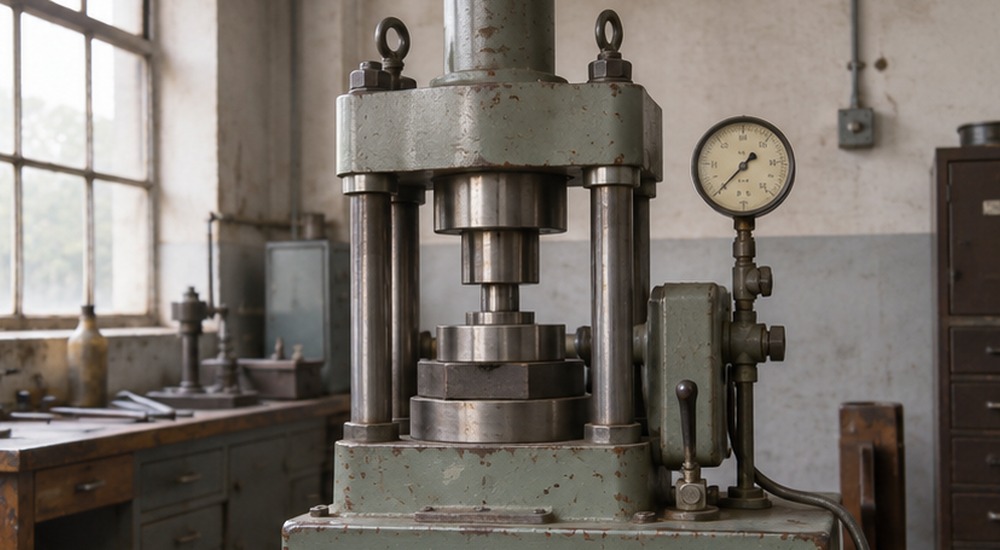
GE announced the breakthrough in February 1955. The four researchers published Man-Made Diamonds in Nature that July. Together, the announcement and the paper explain why many histories credit GE and why both 1954 e 1955 appear in accounts of the same achievement. One year marks the experiment. The other marks its public disclosure and scientific publication.
The Diamond That Turned Out to Be a Natural Fragment
An earlier GE run, Herbert Strong’s Experiment 151, recovered a diamond in December 1954. The question was whether it had grown in the press or come from one of the natural diamond seeds already present in the experiment.
Em 1993, members of the research team reported that modern spectroscopy had identified the recovered particle as a fragment of natural type Ia diamond. Hall’s repeatable December 16 result is the more useful milestone when explaining GE’s breakthrough. The correction also illustrates why proving a particle is diamond and proving it grew in a particular experiment are two separate tasks.
Why Some Histories Start in 1952
Em 1952, William Eversole at Union Carbide documented early diamond growth by chemical vapor deposition, ou DCV. His work addressed a different technical question from the high-pressure experiments in Sweden and the United States. It showed that a small amount of diamond could grow onto an existing diamond surface using a gas-phase process.
The distinction is easiest to see in the finished material. Depositing diamond on a surface demonstrated that the process could sustain diamond growth. Producing a crystal that could later be cut into a polished gem required further advances. Modern jewelry-grade CVD grew out of decades of work on that second challenge.
From Industrial Diamond to Gem Quality
The earliest commercially useful synthetic diamond belonged in cutting, grinding, and polishing tools. A tiny crystal could improve an industrial abrasive. For a jeweler, a crystal had to be large enough to facet, with enough usable material left after the cutter accounted for its shape and inclusions.
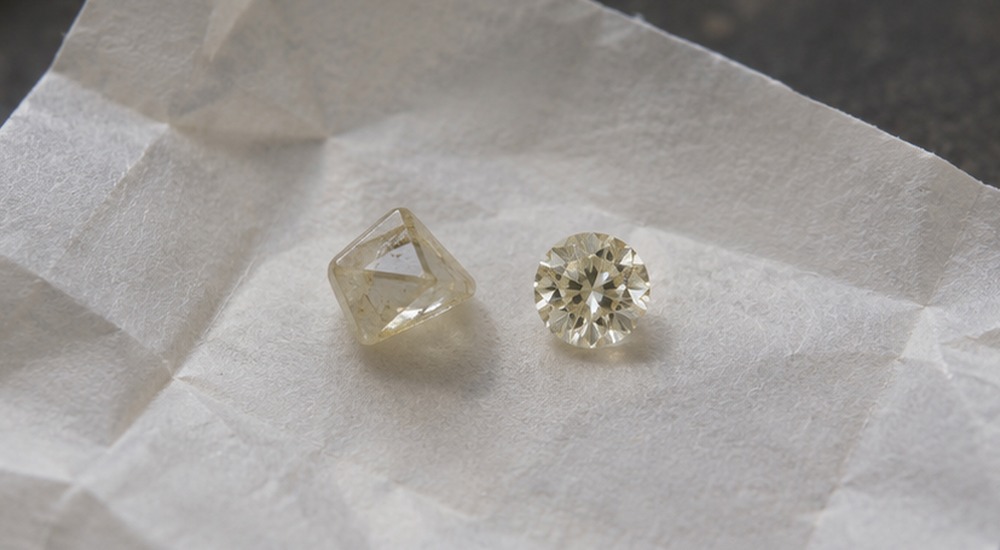
Em 1970, GE researchers produced small gem-quality crystals that could be faceted. GIA gemologist Robert Crowningshield examined early GE material, and his observations appeared in Gems & Gemology in 1971. GE publicly unveiled faceted examples that same year. In some early HPHT specimens, tiny particles of the metal used during growth became diamond inclusions that gemologists could see under magnification.
Producing a few cuttable crystals demonstrated what was technically possible. Making them available to jewelers at predictable prices required a different level of production. Growers had to improve the usable yield of each batch and produce repeatable sizes, colors, and clarities. An isolated research sample could demonstrate quality. A jewelry collection needed a supply of stones that could be ordered, matched, and replenished.
How Are Lab Grown Diamonds Made Today?
Modern production relies mainly on two methods. HPHT follows the high-pressure approach associated with the Swedish and GE breakthroughs. DCV follows the gas-phase approach explored by Eversole. Both methods can produce gem-quality diamond.
To understand how lab grown diamonds are made, start with what each method does with the same ingredient: a diamond seed.
| Método | How the crystal grows | What buyers should know |
|---|---|---|
| High Pressure, High Temperature (HPHT) | Carbon is carried through a molten metal solvent and crystallizes onto a diamond seed under high pressure and temperature. | Certain metallic inclusions or growth patterns can help a gemological laboratory identify HPHT growth. Evaluate the actual stone for color, clarity and proportions. |
| Chemical Vapor Deposition (CVD) | A plasma activates a carbon-containing gas in a low-pressure chamber. Carbon adds to the surface of a diamond seed as the crystal grows. | Some CVD diamonds receive post-growth treatment to improve color. Review growth method and treatment information where the grading report provides it. |
The method describes the stone’s origin. For a design or purchase, check the polished dimensions, cut, color and clarity of the stone you are actually considering. Two diamonds grown by the same method can differ across all of those characteristics.
Is a Synthetic Diamond a Real Diamond?
Yes. Synthetic diamond is the term many historical research papers use for diamond grown by people. Its carbon atoms form the diamond crystal structure. A laboratory-grown diamond can therefore be polished and faceted as a diamond, and it has the hardness and optical properties associated with the material.
A diamond simulant serves a different purpose. Moissanite and cubic zirconia can resemble diamond when set in jewelry, but each has its own composition and optical properties. A basic diamond tester, particularly one that measures thermal conductivity, also has limits. It cannot establish whether a diamond grew in the earth or in a laboratory. Gemological laboratories use growth features, fluorescence imaging and spectroscopy to determine origin.
What the History Means for Jewelry Buyers Today
The milestone that changed jewelry production was the ability to supply polished stones consistently. A single well-cut oval may work for a pendant. A pair of oval earrings needs two stones with comparable length, width, outline, color and face-up appearance. A repeat collection adds another requirement: the ability to source comparable stones again.
When requesting loose lab grown diamonds for a jewelry project, share the information that affects how the stones will look and fit:
- Design and setting. Identify the piece, the setting style and any tolerances imposed by the mounting.
- Shape and dimensions. Include the target measurements in millimeters alongside carat weight. For matched ovals, pears or emerald cuts, specify the desired length-to-width ratio.
- Color, clarity and finish. State the acceptable ranges. Ask for side-by-side images or video when face-up appearance and matching are especially important.
- Documentation. State whether individual grading reports are required. Review the report details against the supplied stone and confirm that the origin is disclosed.
- Quantity and repeat orders. Specify whether you need one center stone, a matched pair, a parcel or repeat supply for a collection.
Perguntas frequentes
Was the first synthetic diamond made in Sweden or the United States?
Sweden’s ASEA recorded successful high-pressure synthesis in 1953. General Electric achieved its repeatable breakthrough in the United States in December 1954 and made the first public announcement of the two programs in 1955. The country named in a short answer depends on whether the writer means the earlier experimental result or the first public announcement.
Who invented the lab grown diamond?
H. Tracy Hall is commonly credited with the repeatable experiment that established GE’s method. Francis Bundy, Herbert Strong and Robert Wentorf Jr. shared authorship of GE’s landmark 1955 paper. In Sweden, Erik Lundblad led the ASEA team that carried out the earlier successful experiments. Each name belongs to a specific contribution.
Was the first lab grown diamond used in jewelry?
The breakthroughs of the 1950s produced small crystals whose initial commercial uses were industrial. GE’s first cuttable gem-quality crystals came in 1970, and faceted examples were publicly shown in 1971. Broad jewelry availability developed later as growers improved quality, production volumes and cost.
Why do some sources give 1954 and others give 1955?
1954 refers to GE’s successful December experiment. 1955 refers to the February announcement and the July scientific paper. A timeline can use both dates if it labels the event that happened in each year.
When did lab grown diamonds become common in jewelry?
Availability expanded gradually and varied by market. Commercial producers brought gemstone material to market before lab grown diamonds became widely visible to consumers. By the mid-2010s, improved near-colorless material and broader retail adoption were attracting significant industry coverage. A stone being available from a specialist and a category being common in retail are different measures of adoption.