
Jewelry Hallmarks Explained: 750, 925, 585 & More Decoded
- Escrito por Equipe da Provença
- Updated on outubro 8, 2026
Índice
Turn over almost any piece of fine jewelry and you will find them: a few tiny letters, numbers or symbols pressed into the inside of a ring band, the back of a pendant or the clasp of a chain. These are jewelry hallmarks, and they are the fastest way to learn what a piece is really made of.
Most people never learn to read them. Is 585 gold or silver? Does GP mean real gold? Is a piece with no mark automatically fake? This guide answers all of it in plain language. As a fine jewelry manufacturer that applies these marks every day, we will also show you how hallmarks are made, what they can and cannot prove, and how to spot a mark that does not add up.
What Is a Jewelry Hallmark?
A hallmark is an official or declared mark that states the composition of a precious metal item. It exists because gold, silver and platinum cannot be identified by sight, weight or touch alone. A solid 18K gold ring and a base-metal ring with a thin gold coating can look identical on the day you buy them. Marking creates a record you can check.
In everyday speech, people use “hallmark” for any quality mark. Strictly speaking there are three different things:
- Hallmark (strict sense):applied after the item has been independently tested by an official assay or testing office.
- Quality stamp:applied by the maker, who declares the purity themselves.
- Maker’s mark or trademark:identifies who made the piece or who takes responsibility for the claim.
Systems differ worldwide. Some markets require independent testing of every item above a minimum weight. Others require the maker to stamp a purity mark together with a registered maker’s mark. Others leave marking largely voluntary. An international convention allows participating countries to recognise each other’s tested marks, but it is not universal, so the marks you meet will depend on where a piece was made and where it was sold.
The Four Types of Jewelry Marks at a Glance
Almost every mark you will find falls into one of four groups. Learn these and the rest becomes easy.
Mark type | What it tells you | Typical example | How common |
Purity (fineness) mark | The metal and its proportion of pure metal | 750, 925, PT950 | Almost always present |
Maker’s or sponsor’s mark | Who made the piece or stands behind it | Initials in a shield or a logo | Very common |
Assay or testing office mark | Which independent office tested the item | A small pictorial symbol | Only where independent testing applies |
Optional marks | Year, country of origin, commemorative event, convention control mark | A letter in a shaped shield | Varies by market and maker |
Metal Purity Marks: The Master Reference
Purity marks are the most important marks on a piece. Because pure gold and pure silver are too soft for everyday wear, jewelry metals are alloyed with other metals, and the mark states how much of the pure metal remains. Two systems express the same thing:
- Karats (K or ct)divide gold into 24 parts. 18K means 18 parts gold out of 24.
- Finura milésimocounts parts per thousand. 750 means 750 parts pure gold in 1,000.
They describe the same gold: 18K and 750 are identical (18 ÷ 24 = 0.75). Karat marks are common in some markets, three-digit fineness numbers in others, and many pieces carry both.
Gold purity marks
Quilate | Fineness mark | Gold content | Typical use |
24 mil | 999 | 99.9% | Bullion and investment pieces. Too soft for daily wear |
22 mil | 916 | 91.6% | High-purity traditional jewelry |
21K | 875 | 87.5% | Regional high-karat jewelry |
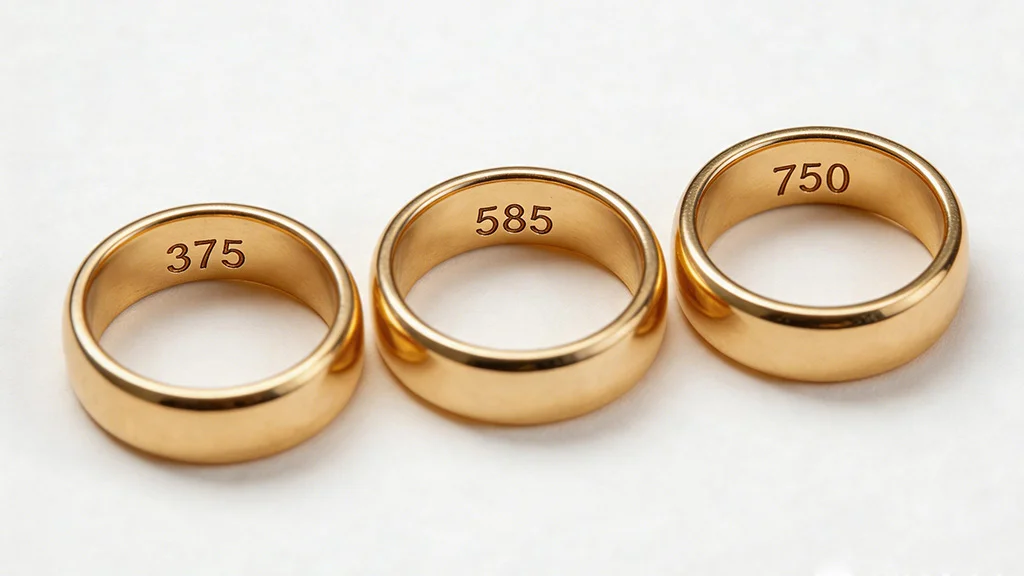
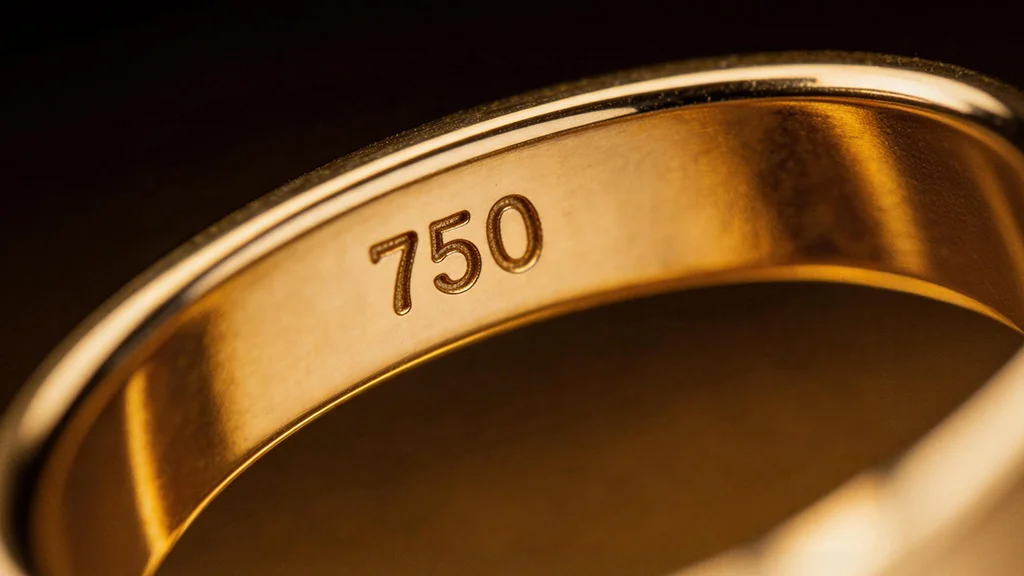
18 mil | 750 | 75% | Fine jewelry and gemstone settings, rich colour |
14 mil | 585 | 58.5% (58.3% exact) | Everyday, engagement and wedding rings; the durable all-rounder |
10 mil | 417 | 41.7% | Hard-wearing and budget-friendly; the lowest standard sold as gold in some markets |
9 mil | 375 | 37.5% | Entry-level gold in some markets |
8K | 333 | 33.3% | Sold as gold in only a few markets |
Silver purity marks
Mark | Nome | Conteúdo de prata | What to know |
999 | Fine silver | 99.9% | Very soft; used for bullion and some specialty pieces |
958 | High-grade (Britannia) silver | 95.8% | Higher purity than sterling, less common |
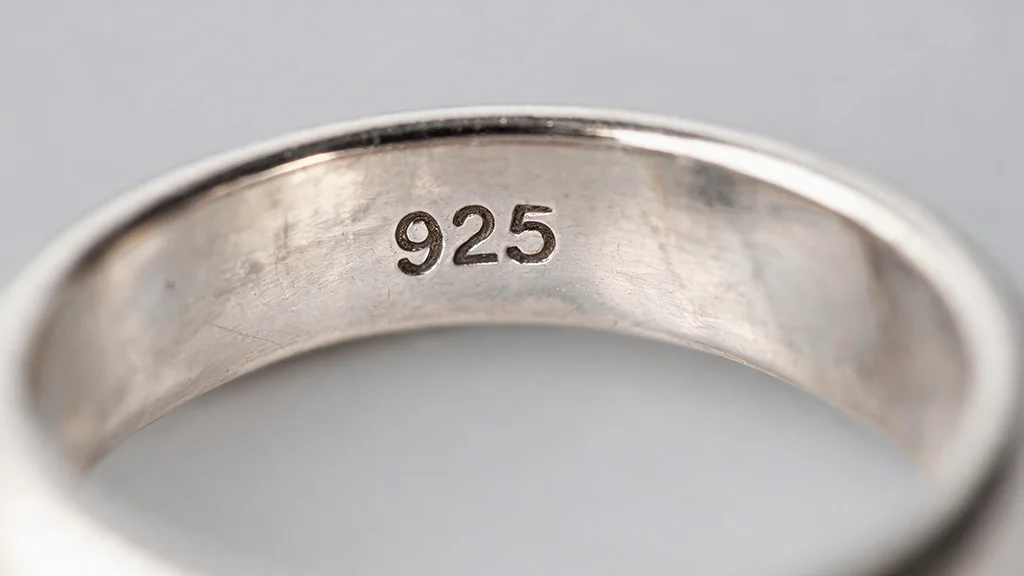
925 | Sterling silver | 92.5% | The global standard for quality silver jewelry. May also appear as “Sterling” |
900 | Coin silver | 90% | Seen on older pieces and tableware |
835 / 800 | Lower-grade silver | 83.5% / 80% | Common on some older and regional pieces |
Platinum and palladium purity marks
Mark | Metal | Content | What to know |
PT950 / 950 Plat | Platina | 95% | The standard for fine platinum jewelry |
PT900 | Platina | 90% | Still a fine-jewelry alloy; slightly more alloy content |
PD950 | Paládio | 95% | Lighter and often more affordable than platinum |
PD500 | Paládio | 50% | A lower palladium standard |
Plating and Base-Metal Codes: What Is Not Solid Gold
Some stamps tell you a piece is coated rather than solid. These are honest marks: they are a disclosure, not a defect. They simply mean the price and wear expectations should be different from solid gold.
Code | Stands for | What it means |
GP | Gold plated | A thin layer of gold over another metal |
GEP | Gold electroplated | Gold applied by electroplating. Same idea as GP |
HGE | Heavy gold electroplate | A thicker electroplated layer than standard plating. Still a coating |
GF | Gold filled | A much thicker layer of gold mechanically bonded to a base metal. Not solid gold |
RGP | Rolled gold plate | A bonded gold layer, generally thinner than gold filled |
18KGP, 14KGP | Gold plated with that karat | The karat describes the coating gold only, not the whole piece |
925 + GP code | Silver base with gold coating | Both marks can be true at once. Often sold as gold vermeil when the layer meets a minimum thickness (rules vary by market) |
Contradictory stamps are a red flag. A piece marked both 925 and 14K, for example, cannot be both sterling silver and 14K gold, and should be tested before you buy. For a deeper comparison of layered metals, see our guide to gold filled vs gold plated jewelry.
Maker’s Marks and Brand Stamps
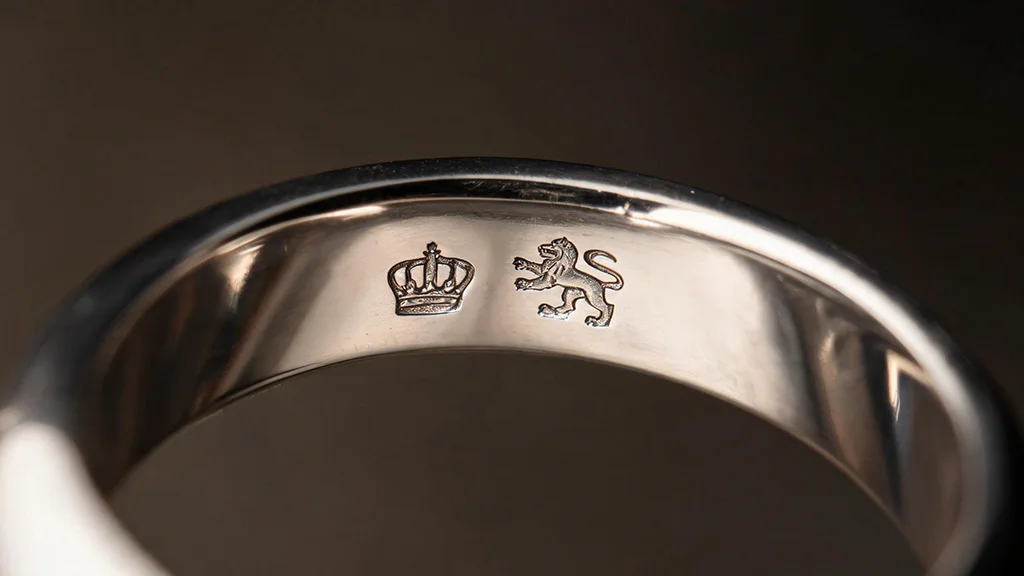
A maker’s mark is the signature of the workshop, brand or factory behind a piece. It is usually a set of initials, a name or a small logo, often enclosed in a shaped border. In systems with independent testing it is called the sponsor’s mark and is registered with the testing office; elsewhere it is typically a registered trademark.
Maker’s marks matter for three reasons. They create accountability, because a registered mark can be traced to a responsible company. They help date and attribute antique and designer pieces. And they can add value, since pieces from respected houses command premiums.
One caution: the same initials can belong to different makers in different places, so a short set of letters usually cannot be decoded by itself. Treat unknown initials as a lead to research, not a final answer.
Assay Office, Control and Country Marks
Where independent testing applies, an assay office samples and tests the metal and then applies its own mark. This is what separates a true hallmark from a maker’s stamp: a neutral third party has verified the claim. Each office has its own symbol, so the mark also tells you where the piece was tested.
Convention control marks. Countries that are members of the international hallmarking convention can apply a shared “common control mark”. It shows a standard fineness figure inside a shape that varies by metal, and it means the piece has been tested to a standard that other member countries recognise. When you see one, it is the strongest single sign of independent verification.
Country and origin marks are also common, such as a country name or code. These are origin claims. They do not change the purity of the metal and do not on their own prove where a piece was made.
How marking systems compare
System type | Who verifies purity | What you usually see | How much weight to give it |
Mandatory independent testing | An official testing office | Purity mark, maker’s mark, office symbol, sometimes a date letter or control mark | Strongest. A neutral party tested the metal |
Maker-declared marking | The maker, under trade rules | Karat or fineness mark plus a registered maker’s mark | Good, but it is the maker’s claim. Reputation and testing matter |
Voluntary or mixed marking | Varies by maker and market | Anything from a full set of marks to none at all | Check the maker, and test significant purchases |
Date Letters and Commemorative Marks
Some systems add a date letter: a single letter in a distinctive font and shield shape that changes every year, so an expert can identify the year the piece was tested. Commemorative marks celebrate a national or historic event and also help date a piece.
Modern pieces often omit both. Date letters have become optional in many systems, which is why a recent ring may carry only a purity mark and a maker’s mark. A missing date letter is normal on new jewelry.
Where to Find Hallmarks on Every Type of Jewelry
Marks are placed where they will not spoil the design or wear away quickly. Use a 10x loupe or the zoom on your phone camera.
Jewelry type | Where to look |
Anéis | Inside the band, usually near the centre. On wide bands, check near the shank edge |
Chains and necklaces | On or next to the clasp, on the small tag or jump ring, or on the end bar |
Pendants | On the back, or on the bail |
Bracelets and bangles | Near the clasp; on bangles, the inner surface or edge |
Brincos | On the post or the back; on hoops, the inner side or a flat section |
Watches and cases | Case back, lugs or inside the clasp |
Stamp vs Laser: How Hallmarks Are Applied
Behind every mark is a production decision. There are three common ways to apply one:
- Hand punch:a steel punch struck with a hammer. The traditional method, giving deep, slightly irregular impressions typical of antique pieces.
- Mechanical stamp or press:a machine presses the mark with uniform depth. Fast and consistent for solid, sturdy items.
- Laser marking:a laser engraves a crisp, tiny mark with no striking force.
Stamping can slightly distort hollow, thin, delicate or stone-set pieces, and on older rings a deep stamp can show through on the outside as the metal wears. That is why laser marking is now the standard choice for fine and stone-set jewelry. It is precise, can be very small and does not stress the setting.
Laser marks have one drawback: they are shallow. If a ring is resized, repaired or heavily polished, the mark can be polished away. In systems with independent testing, a lost official mark generally has to be re-applied by the testing office, not by the jeweler who did the repair. If your piece carries a hallmark you value, tell your jeweler before any resizing.
For manufacturers, marking is part of quality control. Alloy content is typically verified before marking, using methods such as X-ray fluorescence (XRF) analysis or fire assay, and marking is done late in production, after casting, setting and polishing, so the mark is not lost during finishing. A mark that is applied at the wrong stage, or applied to the wrong alloy, is one of the most common causes of rejected shipments in international trade.
How to Read a Hallmark in 5 Steps
- Find and magnify it.Check the usual spots (see the table above) and use a 10x loupe. Crisp, evenly cut characters are typical of a genuine mark, but sharpness alone proves nothing.
- Read the purity mark first.Look for a karat (14K, 18K) or a number (585, 750, 925, 950). This is the core information.
- Check for plating or base-metal letters.GP, GEP, HGE, GF or RGP mean the piece is coated, not solid gold.
- Identify the other marks.Initials or a logo are usually a maker’s mark. A small pictorial symbol suggests a testing office. A single letter in a shaped shield may be a date letter. A country name is an origin claim.
- Check that everything agrees.Do the marks contradict each other? Does the price match the metal? For anything significant, confirm with a jeweler or independent testing.
What a Hallmark Does and Does Not Tell You
A hallmark can tell you
- The metal that is claimed or certified, and its purity.
- Who made the piece, or who takes responsibility for it.
- In many systems, which office tested it, and sometimes the year.
A hallmark cannot tell you
- Whether the piece is entirely that metal.Clasps, posts, springs and solder can differ from the main body.
- Anything about the stones.A diamond, sapphire or moissanite is judged separately.
- That a stamp is genuine.A stamp is a claim, and counterfeit pieces can carry convincing marks.
- Whether a metal is safe for sensitive skin.Alloy content, including nickel, is not shown by a purity mark.
Hallmark, lab report, test or appraisal: which document covers what?
Document or check | O que abrange | Who provides it |
Hallmark | Metal purity, and often maker and origin | The maker or an official testing office |
Gemstone lab report | Stone identity, quality grades, treatments, sometimes origin | An independent gemological laboratory |
Metal testing (acid, XRF, fire assay) | Actual metal composition at the time of testing | A jeweler or assay laboratory |
Appraisal | Estimated replacement or market value | A qualified appraiser |
Fake and Misleading Hallmarks: Red Flags
A stamp is easy to copy, so treat it as one clue among several. Warning signs include:
- Blurry, shallow or uneven characters,or letters with inconsistent spacing and depth.
- Contradictory marks,such as 925 and 14K on the same piece.
- Numbers that are not recognised purity marks.Figures like 25, 125 or 188 are more likely sizes, weights, model numbers or part of a maker’s mark.
- Colour showing through at edges and high points,which suggests a coating over another metal.
- A price far below the value of the metal.
- No stamp at all on a modern, factory-made piecefrom a seller who cannot explain why.
An absent mark is not automatic proof of fakery. Antique, handmade and very small items are often unmarked. If a stamp raises doubt, a jeweler can test the metal in minutes. For step-by-step checks you can do yourself, read our guides on how to tell if gold is real and how to tell if silver is real.
Hallmarks on Lab-Grown Diamond and Moissanite Jewelry
Modern fine jewelry often combines a hallmarked metal with a lab-grown diamond, moissanite or natural gemstone. The two are documented separately, and it helps to know which mark speaks to which part.
- The hallmark covers the metal only,such as 750 for the 18K gold setting.
- The stone has its own documentation:a grading or identification report from a gemological laboratory, and for many lab-grown diamonds a microscopic laser inscription on the girdle that links the stone to its report.
A complete, trustworthy piece therefore has both: a clearly marked metal and a stone whose identity is stated and documented. If a seller offers one without the other, ask for the missing half.
Perguntas frequentes
Jewelry hallmarks are stamps or laser marks on precious metal that show its purity, such as 750 for 18K gold or 925 for sterling silver. Many also identify the maker, the testing office, the year or the country of origin. They describe the metal, not the gemstones.
925 means sterling silver: 92.5% pure silver, mixed with about 7.5% of another metal, usually copper, for strength. It is the global standard for quality silver jewelry. Some pieces carry the word “Sterling” instead of the number.
Yes. 750 means 750 parts pure gold in 1,000, which is 75% gold. That is exactly 18 parts in 24, so 750 and 18K describe the same gold. Some pieces carry both marks.
Gold. 585 means 58.5% gold, sold as 14K. A 585 piece can look silver-coloured because white gold is gold alloyed with white metals. If a silver-looking piece is stamped 585 and you doubt it, have it tested.
No. GP means gold plated: a thin layer of gold over another metal. The surface is real gold but the piece is not solid gold. GF (gold filled) and HGE (heavy gold electroplate) are also layered, not solid.
Not necessarily. Antique, handmade and very small pieces are often unmarked, and some markets do not require marking. Equally, a mark does not prove a piece is real. An unmarked piece is a reason to ask questions or test, not to assume.