
Old Mine Cut vs Old European Cut: Full Comparison Guide
- Escrito por Equipe da Provença
- Updated on setembro 24, 2026
Índice
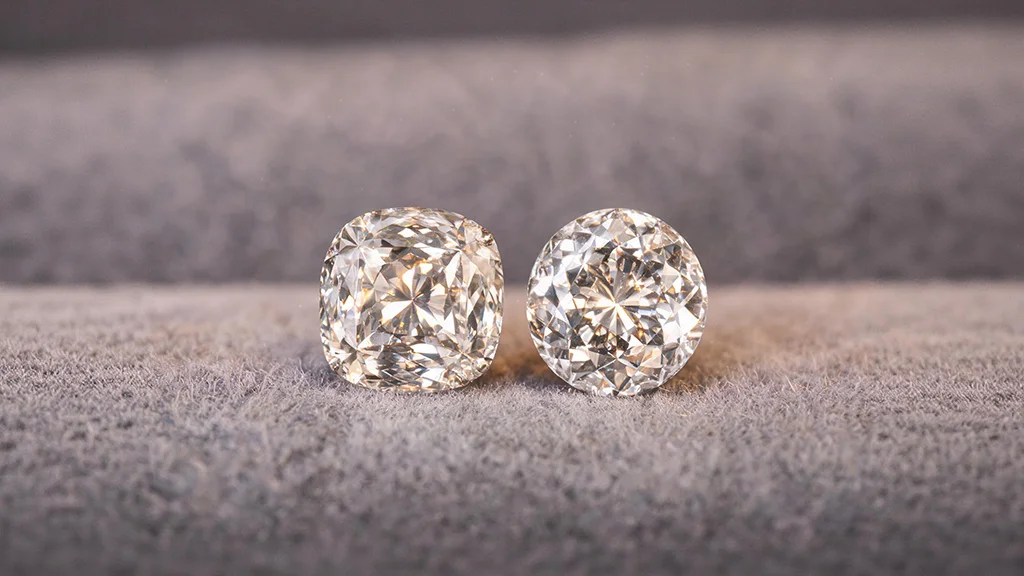
Old Mine Cut and Old European Cut diamonds are both antique precursors to the modern round brilliant, but they are not the same cut. The Old Mine Cut has a cushion-like outline with softly rounded corners and irregular, hand-shaped proportions, while the Old European Cut is rounder, more symmetrical, and represents a later stage in the evolution toward today's round brilliant diamond.
Both cuts share a family resemblance — small tables, high crowns, deep pavilions, and open culets — which is why they're so often confused. But once you know what to look for, telling them apart (and choosing between them) becomes straightforward.
Old Mine Cut vs Old European Cut at a Glance
| Recurso | Corte da Mina Antiga | Corte europeu antigo |
|---|---|---|
| Outline | Cushion-like, square/rectangular with rounded corners | Round, closer to a modern circular outline |
| Popular era | Roughly 1700s–1880s (Georgian to mid/late Victorian) | Roughly 1890s–1930s (late Victorian, Edwardian, Art Deco) |
| Table size | Small, typically 40–50% of diameter | Small to moderate, typically 45–55% of diameter |
| Crown height/angle | High crown, steep angle (often 40°+) | High crown, slightly less steep than Old Mine on average |
| Pavilion depth | Deep, often 45–55%+ of diameter | Deep, but marginally more controlled than Old Mine |
| Culet | Large, clearly visible flat facet | Present and visible, generally smaller and more centered than Old Mine |
| Facet count | Typically 58, larger and less uniform | Typically 58, more evenly arranged |
| Symmetry | Noticeable natural variation, hand-cut irregularity | More consistent, though still hand-finished |
| Light performance | Broad, soft flashes; more shadow and contrast | More radial, organized flashes; closer to balanced brilliance and fire |
| Cutting method | Fully hand-cut and hand-polished | Hand-cut but aided by improved bruting and sawing tools |
These are tendencies rather than fixed rules — antique stones don't always sort neatly into one category, and transitional examples exist that blend features of both.
The Lineage of Antique Diamond Cutting
Understanding where these two cuts sit in diamond-cutting history makes the differences much easier to picture:
- Point Cut and Table Cut (14th–16th century) — the earliest faceted styles, following the natural octahedral shape of rough diamond crystals with minimal reshaping.
- Old Single Cut (16th–18th century) — a simple 18-facet cut, an early attempt at symmetry and light return.
- Corte da Mina Antiga (roughly 1700s–1880s) — the first true antecedent of the brilliant cut, cushion-shaped and cut to preserve carat weight from the rough crystal, optimized for candlelight.
- Old European Cut (roughly 1890s–1930s) — rounder, more standardized, developed as cutting equipment (bruting machines, better saws) allowed for greater precision and as gas and early electric lighting changed how diamonds needed to perform.
- Transitional Cut (roughly 1920s–1940s) — a bridge style with a rounder outline and shallower pavilion, closer still to modern proportions.
- Modern Round Brilliant (from the 1920s–1930s onward) — standardized by mathematical models (most famously Marcel Tolkowsky's 1919 analysis) to maximize brilliance and fire through precise angle and proportion control.
Old Mine and Old European Cuts sit at two different points on this timeline, which is the real source of most of their differences: everything else — shape, light behavior, facet regularity — follows from the tools and lighting conditions each generation of cutters was working with.
What Is an Old Mine Cut Diamond?
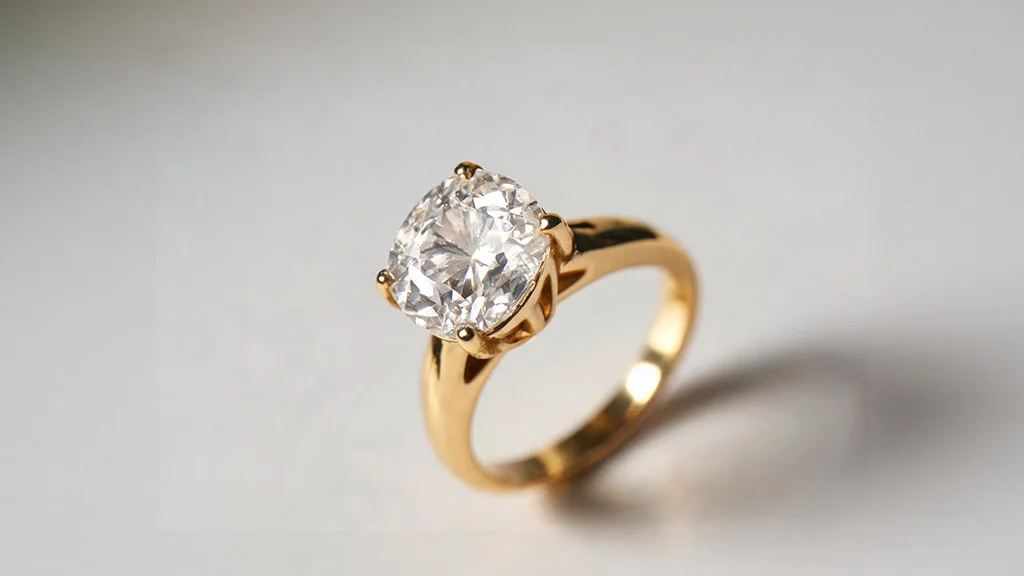
An Old Mine Cut diamond is the earlier of the two antique styles, generally associated with diamonds cut from the early 1700s through the late 1800s.
Key characteristics:
- Shape: A cushion-like outline — square or rectangular with softly rounded corners — designed to follow the natural shape of the rough crystal and retain as much carat weight as possible.
- Table: Small relative to modern cuts, which concentrates light into fewer, broader flashes rather than many small ones.
- Crown: High and steep, contributing to a soft, glowing appearance rather than sharp sparkle.
- Pavilion: Deep, which adds weight and depth but can allow more light leakage than a modern cut.
- Culet: Large and clearly visible — originally a practical feature that reduced the risk of the diamond chipping at its point.
- Facets: Larger and less uniform than later cuts, a direct result of hand-cutting with basic tools by candlelight.
Because each stone was shaped around its individual rough crystal rather than to a standardized formula, no two Old Mine Cut diamonds look quite the same. That irregularity is generally considered a feature, not a flaw — it's part of what gives the cut its historical character.
What Is an Old European Cut Diamond?
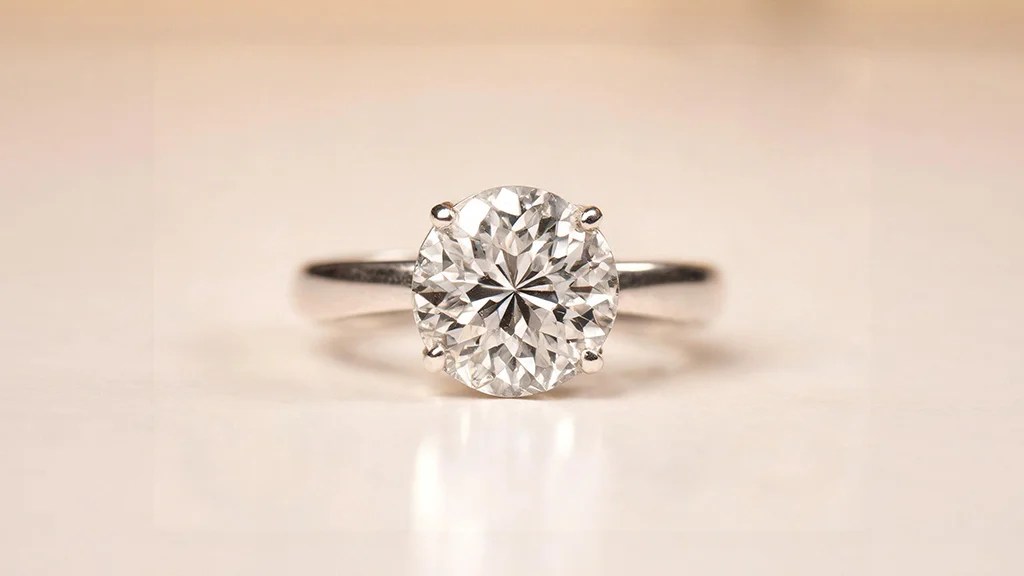
An Old European Cut diamond evolved from the Old Mine Cut and became the dominant antique cutting style from roughly the 1890s through the 1930s.
Key characteristics:
- Shape: Round, rather than cushion-like — the clearest visual distinction from the Old Mine Cut, and the feature most people use to tell the two apart at a glance.
- Table: Still small by modern standards, though often slightly larger on average than an Old Mine Cut's table.
- Crown: High, though cutters had begun refining crown angles as tools improved.
- Pavilion: Deep, similar to the Old Mine Cut, which is why both styles share that warm, antique light pattern.
- Culet: Present and usually visible, but typically smaller and more precisely centered than in an Old Mine Cut.
- Facets: Still around 58, but arranged with more consistency thanks to improved bruting (girdle-shaping) technology.
The Old European Cut is often described as the direct forerunner of the modern round brilliant, and it's easy to see why: strip away the deep pavilion, high crown, and small table, and you're looking at the rough blueprint of today's standard diamond shape.
Facet-by-Facet Technical Comparison
Looking at proportions side by side makes the practical differences clearer than shape alone:
| Measurement | Corte da Mina Antiga | Corte europeu antigo |
|---|---|---|
| Table % of diameter | ~40–50% | ~45–55% |
| Crown angle | ~40–45° | ~35–45° |
| Pavilion depth % | ~45–57% | ~43–50% |
| Total depth % | Often 58–65%+ | Often 55–62% |
| Culet size | Large, often visibly open | Moderate, more refined |
| Girdle | Often thin and irregular | Slightly more consistent |
Ranges vary meaningfully between individual stones, since neither cut followed a standardized cutting formula the way modern diamonds do. Two Old Mine Cuts from different cutters, decades, or regions can differ more from each other than a well-cut example of each style differs from the other category on average — this is part of why direct, side-by-side comparison of actual stones matters more than relying on averages alone.
How Each Cut Behaves Under Light
Diamond light performance is usually described in terms of brilho (the white light reflected back to the eye) and fogo (light dispersed into spectral color).
- Old Mine Cut: Large, irregular facets and a deep pavilion produce broad, soft flashes with more visible dark-and-light contrast as the stone moves. The pattern reads as less structured, more organic — appropriate for a stone cut to catch candlelight from many angles rather than a single overhead source.
- Old European Cut: More consistent faceting produces a more radial, organized light pattern. Flashes tend to be more evenly distributed around the stone's circular outline, and the improved symmetry generally gives a marginally better balance of brilliance to fire than an Old Mine Cut, without approaching the crisp, high-contrast sparkle of a modern round brilliant.
You'll sometimes see sources claim one cut has "more fire" than the other in absolute terms — in practice, this varies enough by individual stone (crown angle, pavilion depth, polish quality) that broad claims should be treated cautiously. The more reliable generalization is that both cuts trade the modern brilliant's sharp, high-contrast sparkle for a softer, warmer, more diffused light pattern, and that the Old European Cut's more standardized proportions generally produce slightly more even light distribution than the Old Mine Cut's greater variability.
How These Cuts Are Reproduced Today
Not every Old Mine or Old European Cut diamond on the market is a genuine antique — both styles can be, and are, cut new. Understanding how matters if authenticity or budget is part of the decision.
Reproducing these cuts today is a deliberately different process from cutting a modern round brilliant:
- Rough selection: Cutters or manufacturers typically choose rough crystals whose natural shape suits a cushion-like (Old Mine) or more circular (Old European) outline, since the goal is to work with the stone's shape rather than force it into a standardized template.
- Faceting approach: A true reproduction is finished with larger, hand-adjusted facets and a deliberately high crown, small table, and deep pavilion — proportions that a modern cutting operation would normally avoid, since they reduce light return by contemporary standards.
- Tooling: Some workshops still hand-facet these styles to preserve authentic asymmetry; others use CAD modeling to plan the rough and guide early-stage cutting, then finish by hand to reintroduce the slight irregularity that distinguishes an antique-style cut from a symmetrical modern one.
- Quality control: Because there's no standardized proportion grade for these cuts, consistency depends heavily on the cutter's experience with historical faceting patterns rather than automated angle measurement — which is why sourcing from a manufacturer with genuine experience in antique-style cutting matters more here than it does for standard round brilliants.
For jewelry brands sourcing old-cut-style diamonds or moissanite for a collection, this distinction between hand-finished reproduction and simplified "vintage-look" faceting is often the difference between a stone that reads as authentically antique and one that merely approximates the look.
Certification and Grading: What to Expect
Grading reports for these cuts work a little differently than for modern diamonds:
- Cut grade: Major labs do not assign a cut grade (such as GIA's Excellent-to-Poor scale) to Old Mine or Old European Cut diamonds, because that scale was built around modern round brilliant proportions. A report will typically list the stone as "Old Mine Cut" or "Old European Cut" (or a related historical designation) without a cut grade.
- Color and clarity: These are graded using the same scales as modern diamonds. Antique stones often show warmer color grades and inclusions that were considered acceptable in their era but may register more visibly on a modern scale.
- Measurements: A report will still list table %, depth %, and measurements in millimeters — useful for direct comparison between candidate stones even without a cut grade.
- Authenticity vs. grading: A grading report describes the diamond's characteristics; it does not confirm the stone's age. If genuine antique provenance matters to a purchase, that's a separate question from the grading report and may require additional documentation or expert appraisal.
Which Cut Suits Your Style and Setting?
An Old Mine Cut may suit you if you're drawn to:
- A cushion-like or softly squared silhouette rather than a round one
- Visible, individual hand-cut character and asymmetry
- A ring with an early, romantic antique feel (Georgian- or Victorian-inspired design)
- Bold, broad flashes of light and shadow over uniform sparkle
An Old European Cut may suit you if you prefer:
- A round shape that still reads as clearly antique
- More balanced, evenly distributed light
- A design that bridges vintage character with a more contemporary silhouette
- Versatility across a wider range of settings, from solitaires to halos
Neither cut is objectively "better" — the right choice comes down to which silhouette and light pattern you prefer, and which setting style you have in mind. A cushion-like stone tends to suit sculptural bezels, fine claw settings, or cluster designs, while a round Old European Cut adapts easily to solitaires, halos, or six-prong settings.
Old Mine and Old European Cuts vs. Modern Equivalents
If you're also considering a modern diamond, it helps to know how these antique styles compare to their closest contemporary counterparts:
- Old Mine Cut vs. modern cushion cut: A modern cushion cut is faceted for maximum brilliance, with a larger table, shallower pavilion, and far more precise symmetry. An Old Mine Cut trades that crisp sparkle for a softer, more antique glow and visible individuality.
- Old European Cut vs. modern round brilliant: A modern round brilliant is engineered around mathematically optimized angles for maximum light return. An Old European Cut has a noticeably higher crown, smaller table, and deeper pavilion, producing a warmer, softer sparkle rather than the sharp scintillation of a modern cut.
If uncompromising brilliance and precise symmetry are the priority, a modern cut will generally outperform either antique style on that specific measure. If historical character and a distinctive, less uniform light pattern are the priority, both antique cuts offer something a modern diamond cannot replicate.
Perguntas frequentes
No. It's an earlier, related style with a smaller table, higher crown, deeper pavilion, and a visible culet — features a modern round brilliant is specifically cut to avoid.
The Old Mine Cut is older, generally associated with the 1700s through the late 1800s. The Old European Cut developed later, becoming popular from the 1890s through the 1930s.
Shape is the fastest indicator: a cushion-like, squared outline points to an Old Mine Cut, while a round outline points to an Old European Cut. Culet size and facet regularity are secondary clues.
Neither is definitively "better" — they simply produce different light patterns. Old Mine Cuts show broader, more contrasted flashes; Old European Cuts show a more even, radial pattern. Both are noticeably softer than a modern round brilliant.
No. Both styles can be, and are, cut new by workshops that specialize in historical faceting. A grading report will describe the stone's characteristics but won't confirm its age — separate documentation or appraisal is needed for that.
Yes. Both cuts can be set in contemporary designs, as long as the setting is built around the stone's actual proportions rather than adapted from a standard modern-cut template.
Prioritize overall visual balance rather than mechanical symmetry. Some natural irregularity is part of the authentic character of both cuts; it only becomes a concern if it visibly distorts the outline or creates an off-balance appearance.
Considerações finais
The core distinction is straightforward: the Old Mine Cut is the earlier, cushion-shaped, more individually irregular style, while the Old European Cut is the later, rounder, more standardized one that led directly to the modern round brilliant. Both share the deep pavilions, high crowns, and open culets that give antique diamonds their distinctive warm glow — the difference lies mainly in outline, proportion consistency, and how evenly each distributes light.
Whether you're sourcing loose stones, working with a manufacturer on a reproduction old-cut collection, or simply choosing between two candidate diamonds for a design, understanding these technical differences makes it possible to evaluate stones on their actual merits rather than by cut name alone.