
Qualités de taille des diamants : Tableau complet et guide d’achat (2026)
- Écrit par Équipe Provence
- Updated on septembre 17, 2026
Table des matières
A diamond cut grade tells you how well a stone was cut to return light — not what shape it is. The GIA scale runs Excellent, Very Good, Good, Fair and Poor, and it is the only one of the 4Cs determined entirely by human decision rather than nature. Cut is also the grade you can see with your own eyes across a room, which is why most buyers should not go below Très bien in a round brilliant, and why Excellent is usually worth more than an extra clarity step. This guide gives you the full grade chart, the actual proportion ranges behind each grade, how the major laboratories differ, and what to do about fancy shapes that receive no cut grade at all.
Réponse rapide
Best overall value: Very Good to Excellent in a round brilliant.
Best possible light performance: Excellent cut with Excellent polish and Excellent symmetry — often written as 3EX or "triple Excellent".
Avoid: Fair and Poor. The loss of brightness is visible without magnification and the resale market discounts them heavily.
Fancy shapes: no official cut grade exists. Judge polish, symmetry, depth %, table % and length-to-width ratio instead.
What Is a Diamond Cut Grade?
A cut grade is a laboratory's verdict on how effectively a diamond's facets collect light, bounce it around inside the stone and send it back to your eye. Rough diamond leaves the ground as a dull, semi-opaque crystal. Everything that makes a finished diamond look like a diamond — the white flash, the rainbow sparks, the contrast pattern that shifts as your hand moves — is manufactured by a cutter choosing angles, and the cut grade is the score on that work.
This is worth separating from two terms it is constantly confused with.
Term | What it means | Example |
Qualité de coupe | Quality score for light performance and craftsmanship | Excellent, Very Good, Good |
Forme | The outline of the stone viewed face-up | Round, oval, pear, emerald |
Cut style | The faceting pattern used to build that shape | Brilliant, step, mixed, rose |
A princess cut and an emerald cut are shapes built with different cut styles. Either one can be beautifully cut or badly cut. "Princess cut" tells you nothing about quality — only the grade does.
The seven components laboratories assess
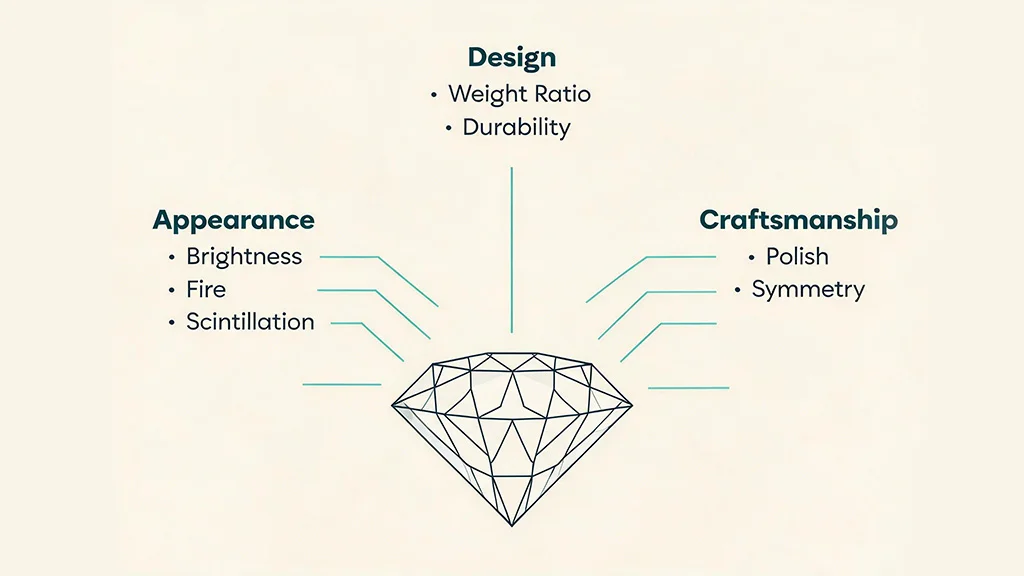
The GIA cut grading system for standard round brilliants evaluates seven components, which fall into three groups. Three are about how the diamond looks face-up. Four are about the design and craftsmanship decisions behind that appearance.
Group | Component | What it measures |
Apparence | Brightness | Total white light reflected back to the viewer |
Apparence | Feu | White light split into spectral colours — the rainbow flashes |
Apparence | Scintillation | The pattern of light and dark, and the sparkle as the stone moves |
Design | Weight ratio | Whether the stone carries excess weight for its face-up size |
Design | Durabilité | Risk from extremes such as an extremely thin girdle |
Craftsmanship | Polish | Smoothness of the finished facet surfaces |
Craftsmanship | Symmetry | Precision and alignment of the facet arrangement |
Each component is weighted, and the overall grade is capped by the weakest one. A stone with flawless proportions but visible polish lines will not reach Excellent. This is why you should read the three separate marks on a report — cut, polish and symmetry — rather than the headline grade alone.
The Diamond Cut Grade Chart
Here is the full scale with what each grade actually looks like in the hand, rather than in marketing language.
Grade | Light return | What you see face-up | Idéal pour |
Excellent | Maximum | Even, intense brightness with strong contrast and vivid fire; no visible dark zones | Solitaires, any stone that will be examined closely |
Très bien | Very high | Nearly indistinguishable from Excellent to an untrained eye; marginally softer contrast | The value sweet spot for most buyers |
Bien | Haut | Bright but less lively; some light leaks through the pavilion, mild dullness under the table | Accent stones, halos, budget-led centre stones |
Équitable | Modéré | Patchy or mottled brilliance with grey areas near the crown or a dark centre | Rarely recommended; melee and closed settings only |
Pauvre | Faible | Noticeably dull or glassy; light escapes the pavilion and culet | Not recommended at any price point |
Excellent
An Excellent cut returns very nearly all the light that enters it. The face-up appearance is uniformly bright, the contrast pattern between light and dark facets is crisp rather than muddy, and the stone throws colour when it moves. Within Excellent there is still meaningful variation, because the grade covers a broad band of proportion sets — two Excellent stones can look noticeably different from one another, and both are correctly graded. Look for Excellent polish and Excellent symmetry alongside it.
Très bien
Very Good sits just outside the ideal proportion band, usually by a degree or two of crown or pavilion angle, or a table a little wider or narrower than optimal. In practice most people cannot separate a strong Very Good from an Excellent without putting the two side by side. Because the price step is real and the visual step is small, this is where a large share of well-informed buyers land.
Bien
A Good cut has proportions that are clearly off the ideal band — commonly a stone cut deep to preserve weight from the rough, or cut shallow for face-up spread. Light escapes through the pavilion rather than returning to the eye, which produces dark areas under the table and a slightly flat look. These stones still sparkle. They just do less with the same carat weight, and the difference becomes obvious next to a better-cut stone.
Équitable
Fair cuts are weight-driven. The cutter prioritised keeping carat over optics, and the result is uneven brilliance: grey ringing around the crown, dullness across the table, sometimes both. A Fair stone can look acceptable in isolation under bright retail lighting and disappointing in a living room.
Pauvre
Poor cuts leak light out of the pavilion, the culet, or both. Fire and scintillation drop away sharply and dark zones dominate the face-up view. We do not produce or supply Poor-cut centre stones, and we would advise against buying one regardless of how attractive the carat-to-price ratio looks.
Diamond Proportions by Cut Grade
Grade names describe an outcome. Proportions describe the cause. This table gives the measurement bands that typically produce each grade in a standard round brilliant — the data almost no retail guide publishes, and the numbers you will find on the proportion diagram of a grading report.
Measurement | Excellent | Très bien | Bien |
Table % | 54–57% | 52–53% or 58–60% | 51% or 61–64% |
Total depth % | 59–62.3% | 58–58.9% or 62.4–63.5% | 57.5–57.9% or 63.6–64.5% |
Crown angle | 34.0–34.9° | 32.1–33.9° or 35.0–35.9° | 30.1–32.0° or 36.0–37.9° |
Pavilion angle | 40.6–41.0° | 40.0–40.5° or 41.1–41.5° | 39.4–39.9° or 41.6–42.0° |
Girdle thickness | mince à légèrement épais | Very thin to thick | Extremely thin to very thick |
Culet | None or very small | Small | Moyen |
Star length | 45–65% | 40–44% or 66–70% | Outside 40–70% |
Lower half length | 70–85% | 65–69% or 86–90% | Outside 65–90% |
How to read this table
These bands interact. A crown angle of 34.5° is ideal on its own but will not produce an Excellent grade if it sits above a 41.4° pavilion — the pairing is what matters, not either number alone.
Crown and pavilion angle are the two most influential figures on the report. If you only check two numbers, check those.
This is why laboratories grade the whole stone rather than publishing a pass/fail proportion formula, and why every grade covers a range of valid proportion sets.
Two practical consequences follow. First, a stone cut deep looks smaller face-up than its carat weight suggests, because the extra weight is hidden in the pavilion where you cannot see it — you pay for carat you do not display. Second, an extremely thin girdle raises chipping risk at the setting bench, which is a durability concern we take seriously in production, not just a grading footnote.
How to Read the Cut Section of a Grading Report
Most buyers glance at the four grades and stop. The cut information on a report is richer than that, and it is where you verify what a seller is telling you.
- Grading results. Cut grade, polish and symmetry appear as three separate lines. All three at the top grade is what the trade abbreviates as 3EX, or "triple Excellent". A stone marked Excellent cut with Good symmetry is not a 3EX stone, and should not be priced as one.
- Proportion diagram. The profile drawing carries the numbers from the table above — table %, depth %, crown angle, pavilion angle, girdle description, culet size. Compare them against the Excellent bands yourself.
- Given as minimum diameter × maximum diameter × depth in millimetres. In a round brilliant, a large gap between the two diameters signals an out-of-round stone even when symmetry grades well.
- Comments section. Extra facets, naturals on the girdle and similar notes live here. They rarely change the grade but they tell you about the cutter's decisions.
Always verify the report number on the issuing laboratory's own database rather than trusting a scanned image or a seller's transcription. A grading report belongs to a specific stone; it is only evidence if the stone in front of you matches the inscription and measurements on it.
GIA vs IGI vs Retailer Cut Scales
Cut grade vocabulary is not standardised across the industry, and this is where a great deal of shopping confusion originates. "Ideal" means one thing on a laboratory report and something quite different on a retailer's filter menu.
Scale | Grades, highest to lowest | Status |
GIA | Excellent · Very Good · Good · Fair · Poor | Laboratory grade. Round brilliants only, D–Z colour |
IGI | Ideal · Excellent · Very Good · Good · Fair | Laboratory grade. Note Ideal sits above Excellent here |
AGS | 0 (Ideal) · 1 · 2 · 3 … 10 (Poor) | Laboratory grade, numeric, light-performance based |
Retailer house scales | Super Ideal · Ideal · Very Good · Good · Fair · Poor | Marketing terms, not laboratory grades |
Three things follow from that table and they are worth stating plainly.
- IGI's Ideal is a grade above its Excellent, whereas GIA's Excellent is its top grade. An IGI Excellent stone is therefore not equivalent to a GIA Excellent stone, and comparing them as if they were is a common and expensive mistake.
- "Super Ideal" is not issued by any laboratory. Retailers use it to describe stones that hold top marks across cut, polish and symmetry, sometimes with additional in-house optical criteria. Definitions differ from seller to seller, so ask what the term means on that specific site.
- A stone's cut grade is a property of the report that graded it. The same diamond submitted to two laboratories can return two different grades. Compare stones graded by the same laboratory wherever possible.
What to ask a seller
Which laboratory issued the report, and what is the report number?
What are the separate polish and symmetry grades?
If the listing says Ideal or Super Ideal, is that the laboratory's word or the retailer's?
Why Fancy Shapes Don't Get a Cut Grade
This surprises most buyers: the GIA cut grading system applies only to standard round brilliants in the D-to-Z colour range. Order a report on an oval, pear, marquise, emerald, cushion, radiant, princess, heart or Asscher and there will be no overall cut grade on it. Polish and symmetry are still graded. The cut line is simply absent.
The reason is technical rather than commercial. Round brilliant faceting is standardised enough that a light-performance model can be built for it. Fancy shapes vary enormously in facet count, outline proportion and design intent, and no single model of "correct" exists for them. An elongated oval and a squat one are both legitimate.
What to evaluate instead
- Polish and symmetry. Still graded on every report. Very Good or better is a reasonable floor.
- Depth and table percentages. Extreme figures in either direction signal weight retention or excessive spread.
- Length-to-width ratio. This governs the outline you actually see and is entirely a matter of taste — but ratios outside the usual bands look unbalanced to most eyes.
- Shape-specific faults. A bow-tie is the dark band across the centre of elongated brilliants such as ovals, pears and marquises; every one has some, and the question is whether it is distracting. Windowing, where you can see straight through a shallow stone, is the step-cut equivalent.
Typical length-to-width ratios by shape, for reference:
Forme | Common ratio range | Note |
Ovale | 1.30–1.50 | Below 1.30 reads rounded; above 1.55 exaggerates bow-tie |
Poire | 1.45–1.75 | Symmetry of the point and shoulders matters more than the ratio |
Marquise | 1.85–2.10 | Highly sensitive to bow-tie |
Émeraude | 1.30–1.50 | 1.00 gives the square emerald look |
Radiant | 1.00–1.35 | Square at 1.00–1.05, elongated above 1.20 |
Coussin | 1.00–1.20 | Above 1.20 is marketed as elongated cushion |
Princesse | 1.00–1.05 | Should read square face-up |
Cœur | 0.95–1.05 | Lobe symmetry and cleft definition are the real tests |
Cut Styles vs Cut Grades
Cut style is the faceting architecture. It is a design choice, not a quality ranking, and a step cut is not a "worse cut" than a brilliant — it is built for a different optical result.
Brilliant cut
Triangular and kite-shaped facets radiating from the centre, engineered to maximise light return. The round brilliant carries 57 facets, or 58 when a culet facet is present, and remains the benchmark against which cut grading itself is defined. Ovals, pears, marquises, hearts and cushions are modified brilliants using the same logic adapted to a different outline.
Step cut
Long, parallel, rectangular facets arranged in tiers like steps, as in emerald and Asscher cuts. Step cuts trade scintillation for a broad, mirror-like flash and an architectural look. Because they have fewer, larger facets and open tables, they reveal inclusions and body colour more readily — which is why clarity and colour usually deserve a higher priority in a step cut than in a brilliant.
Mixed cut
Brilliant faceting in one zone and step faceting in another, as in the radiant and many princess cuts. The design targets brilliant-cut liveliness in a square or rectangular outline.
Rose and antique cuts
Rose cuts have a flat base and a domed, faceted top, giving a soft, low-profile glow rather than sparkle. Old mine and old European cuts were shaped by hand before modern tooling, with small tables, high crowns and large culets; they produce a warmer, chunkier fire that many people prefer precisely because it does not look modern. None of these should be judged against a modern round brilliant's grading standard.
Cut Grade in Lab-Grown Diamonds and Moissanite
Cut matters more in lab-grown stones than in natural ones, and the reason is structural. Colour and clarity in a lab-grown diamond are substantially controllable during growth, so high grades in those categories are widely available and command less of a premium. Cut is the one variable that still depends entirely on the cutter. In a lab-grown stone, cut quality is doing most of the work that distinguishes an ordinary stone from an outstanding one.
Lab-grown diamonds are graded on exactly the same cut scale as natural ones, and the same proportion tables above apply. Most lab-grown material is graded by IGI, so remember that Ideal sits above Excellent on that scale. There is no physical reason a lab-grown diamond cannot be cut to the highest standard — where cut quality is sacrificed, it is a commercial decision about yield, identical in kind to the one made on natural rough.
Moissanite is cut to different targets
Moissanite has a higher refractive index and roughly two and a half times the dispersion of diamond. Applying diamond proportions to it produces an intense, sometimes overwhelming rainbow effect that some buyers love and others find showy. Well-cut moissanite therefore uses adjusted crown and pavilion angles to temper dispersion and lift white brilliance. Moissanite does not receive a diamond cut grade; suppliers describe it with their own terminology, so ask for actual angle and proportion figures rather than accepting a grade-sounding label.
How Cut Grade Affects Price
Because currency and market conditions differ by region, the useful way to think about cut pricing is in relative terms. Holding carat, colour and clarity constant, the pattern across the trade is consistent.
Étape | Typical price effect | Typical visual effect |
Excellent → Very Good | Modest reduction | Very hard to see without direct comparison |
Very Good → Good | Meaningful reduction | Visible in good light once you know what to look for |
Good → Fair | Large reduction | Obvious; brightness is patchy |
Fair → Poor | Large reduction | Obvious; stone reads dull |
The value curve is not linear. Savings from dropping below Very Good are real but you are buying back very little of what makes a diamond look like one, and poorly cut stones are discounted hardest when resold. Modern laser cutting has narrowed the price gap between the top grades compared with the hand-cutting era, which makes high cut grades more accessible than they once were.
Where to spend and where to save
- Spend on cut. It is the grade you see from across a room and the one that cannot be improved after the fact.
- Save on colour before you save on cut. In a white metal setting, a step or two down the colour scale is far less noticeable than a step down in cut.
- Save on clarity in a brilliant cut, where facet patterning masks small inclusions. Do not apply that logic to a step cut, whose open table shows everything.
- Watch carat thresholds. A stone cut deep to land on a round carat number can look smaller face-up than a well-cut stone of lower weight.
How We Assess Cut Quality on the Bench
As a manufacturer we see cut quality from the other side of the transaction — at stone selection, at setting, and in the returns that come back. A few things look different from here.
The yield decision
Every cut grade is the visible end of an invisible trade-off. A cutter looking at a piece of rough can take a well-proportioned stone of lower weight or a heavier stone with compromised angles, and the heavier stone often sells for more per piece. Deep pavilions and thick girdles are usually not accidents; they are weight retention. Knowing this changes how you read a proportion diagram.
Optical tools, not adjectives
On incoming inspection we assess light return with reflector tools rather than by eye alone. An Idealscope or ASET view shows where light is being returned and where it is leaking, which catches stones that grade well on paper but under-perform optically. Hearts-and-arrows patterning, visible through a simple viewer in stones with precise optical symmetry, is a further check — it is not a laboratory grade, but it is difficult to fake.
Where cut meets durability
Girdle thickness is a grading input and a setting problem at the same time. Extremely thin girdles chip under prong pressure, and we flag them before setting rather than after. Sharp corners on princess and radiant stones need protective settings. A pointed culet with no facet is vulnerable in any design that seats the stone low. These are the considerations that turn a grading report into a manufacturing brief.
How to Choose the Right Cut Grade
Work from your priority rather than from a universal answer.
If maximum sparkle is the goal
Round brilliant, Excellent cut, Excellent polish, Excellent symmetry. Confirm crown angle near 34–35° and pavilion angle near 40.6–41.0° on the report. Consider a hearts-and-arrows check if the seller can provide one.
If you want the largest stone your budget allows
Hold cut at Very Good as your floor and take the savings from colour and clarity instead. Avoid deep-cut stones, which spend carat weight where it cannot be seen; check depth percentage before you check the price.
If you prefer the step-cut look
Cut grade will not appear on the report, so set your standards on polish and symmetry at Very Good or better, and raise your colour and clarity requirements to compensate for the open table. Choose the length-to-width ratio deliberately.
If you are sourcing for a collection or a brand
Write measurable minimums into the specification: laboratory, cut grade, polish, symmetry, table and depth ranges, girdle description, and a rejection threshold for out-of-round measurements. Specify matched parameters for melee and side stones so a finished piece reads consistently, which grade names alone will not deliver.
Foire aux questions
Excellent on the GIA scale, or Ideal on the IGI scale, is the highest grade available. For most buyers the best decision is Excellent or a strong Very Good with Excellent polish and symmetry, since the visual difference is small and the price difference is not.
Usually yes, if you are balancing budget across the 4Cs. Very Good sits just outside the ideal proportion band and is very difficult to distinguish from Excellent without a side-by-side comparison. If the stone will be a solitaire examined closely and often, Excellent is worth the premium.
A stone graded Excellent for cut, Excellent for polish and Excellent for symmetry — abbreviated 3EX. It is not a separate grade issued by a laboratory; it describes three top marks appearing together on one report.
Yes, on the same scale as natural diamonds. Most are graded by IGI, where Ideal is the top grade and Excellent sits below it. Cut carries proportionally more weight in a lab-grown stone because colour and clarity are more controllable during growth.
GIA issues overall cut grades only for standard round brilliants in the D-to-Z colour range. Fancy shapes vary too widely in design for a single light-performance model. Judge them on polish, symmetry, depth and table percentages, length-to-width ratio and shape-specific faults such as bow-tie.
A pattern of eight hearts and eight arrows visible through a specialised viewer in round brilliants with exceptional optical symmetry. It indicates precise facet alignment beyond what a symmetry grade alone captures. It is a trade term, not a laboratory grade.
Indirectly, yes. Durability is one of the seven components assessed, and features such as an extremely thin girdle raise chipping risk during setting and wear. A stone can be optically fine and still need a protective setting.
For visible beauty, generally yes. Most clarity differences at the upper and middle grades are invisible without magnification, while cut quality is visible at conversational distance. The exception is step cuts, whose open tables show inclusions readily.
Side by side in good light, yes — the Good stone looks flatter, with darker zones under the table. In isolation the difference is subtler, which is precisely why the grade exists.