
The List of Brown Gemstones: Types, Names & Buying Guide
- Scritto da Team Provenza
- Updated on Settembre 30, 2026
Sommario
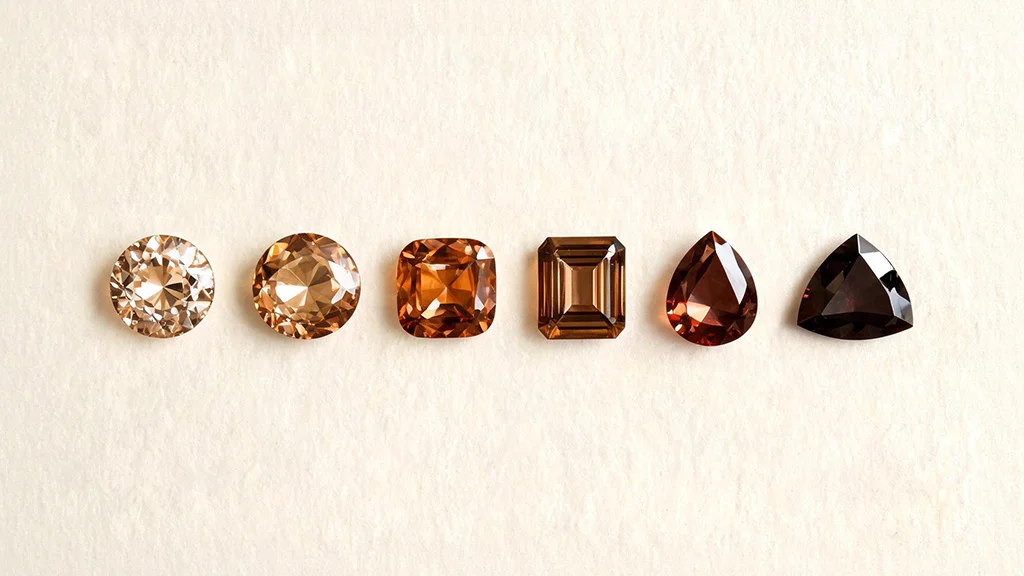
Brown gemstones are often overlooked next to vivid blues, reds and greens, yet they include some of the most wearable, versatile and surprisingly valuable stones in jewelry. Warm, earthy and easy to pair with almost any metal or outfit, they range from pale champagne quartz to deep cognac diamonds and honey-eyed chrysoberyl.
What are brown gemstones? Brown gemstones are gem materials whose main visible color is brown, from pale honey and smoky gray-brown to cinnamon, cognac, chocolate and near-black. Brown is a color category rather than a single mineral, so the group includes diamond, sapphire, quartz, tourmaline, topaz, zircon, opal, amber and many more. Each has its own hardness, rarity, treatment history and price.
This guide compares more than 30 brown gemstones by color, hardness, durability and price. It explains which are safe for rings and which are better as pendants, shows how to spot treated, lab-grown and imitation stones, and adds practical notes from the jewelry bench on how brown stones are set, cleaned and repaired.
Brown Gemstones at a Glance: Quick Comparison Chart
Use this chart to shortlist stones. Mohs hardness measures scratch resistance only. Cleavage and brittleness, covered later in this guide, also decide whether a stone suits a ring.
Pietra preziosa | Typical brown shades | Mohs | Transparency | Ring suitability | Price tier | Best jewelry forms |
Brown diamond | Champagne, cognac, chocolate | 10 | Transparent | Eccellente | $$$–$$$$ | Rings and all jewelry |
Brown sapphire | Light golden to deep brown | 9 | Transparent to translucent | Eccellente | $$–$$$ | Rings and all jewelry |
Cat’s eye chrysoberyl | Honey brown | 8.5 | Translucent | Eccellente | $$$ | Cabochon rings, pendants |
Heliodor / golden beryl | Honey to golden brown | 7,5–8 | Transparent | Molto bene | $$ | Rings, pendants |
Brown topaz | Sherry, cognac | 8 | Transparent | Good, protect from knocks | $–$$ | Orecchini, pendenti, anelli protetti |
Dravite tourmaline | Yellow-brown to dark chocolate | 7–7,5 | Transparent to translucent | Bene | $$–$$$ | Anelli, orecchini, pendenti |
Hessonite garnet | Honey to reddish brown | 7–7,5 | Transparent to translucent | Bene | $–$$ | Rings, pendants |
Smoky quartz | Pale smoke to dark brown | 7 | Transparent | Bene | $ | All jewelry, large statement stones |
Tiger’s eye | Golden to red-brown | 6,5–7 | Opaque | Good as cabochon | $ | Beads, bracelets, cabochons |
Brown jasper / agate | Tan, rust, banded brown | 6,5–7 | Opaque to translucent | Good as cabochon | $ | Beads, cabochons, inlays |
Brown zircon | Honey, cinnamon, reddish brown | 6–7,5 | Transparent | With care | $–$$ | Earrings, pendants |
Andalusite | Olive, gold, red-brown | 6,5–7,5 | Transparent | With care | $$ | Earrings, pendants, collector pieces |
Brown moonstone | Champagne to chocolate | 6–6.5 | Translucent | With care | $–$$ | Earrings, pendants |
Boulder opal | Brown ironstone with colorful opal | 5,5–6,5 | Opaque with opal veins | Protected settings only | $$–$$$ | Pendants, protected rings |
Amber | Honey to deep cognac | 2–2.5 | Transparent to translucent | Not recommended | $–$$ | Necklaces, beads, earrings |
Types of Brown Gemstones, Grouped by Look and Behavior
Instead of an A–Z list, these brown gemstones are grouped by how they look and behave. That makes it easier to match a stone to the jewelry you have in mind.
Transparent and faceted brown gemstones
Brown diamond (champagne, cognac, chocolate). Diamond is the hardest natural gem (Mohs 10). In most natural brown diamonds the color comes from distortion in the crystal lattice rather than a trace element. Strongly colored stones are graded on the fancy color scale, while “champagne,” “cognac” and “chocolate” are marketing terms, not grades. Brown diamonds may be natural, lab-grown or treated, so disclosure matters.
Brown sapphire. Sapphire belongs to the corundum family (Mohs 9), so brown stones are among the toughest choices for daily rings. Shades run from light golden brown to deep chocolate. Heat treatment is common across sapphire, so ask for it to be stated.
Smoky quartz. Transparent quartz (Mohs 7) whose smoky brown-to-gray color comes from natural or artificial radiation. It is affordable even in large sizes and can be cut into almost any shape. Keep it away from strong heat, which can lighten the color.
Brown topaz (sherry topaz). Warm yellow-brown to cognac stones with a Mohs hardness of 8. Topaz has perfect cleavage, however, and can split from a sharp knock, so bezels and other protective settings suit it best.
Dravite tourmaline. The magnesium-rich brown tourmaline (Mohs 7–7.5), in shades from yellow-brown to dark chocolate. It often shows pleochroism, meaning a different color from different angles, and holds up well in rings, earrings and pendants.
Brown zircon. A natural mineral with diamond-like brilliance and fire, in honey, cinnamon and reddish-brown shades. It is unrelated to cubic zirconia. Zircon is brittle and its facet edges can abrade, so it is better for earrings and pendants. Heat treatment is common in the zircon market.
Andalusite. A pleochroic gem that can flash olive green, gold and red-brown as the stone turns (Mohs 6.5–7.5). It is lesser known and appeals to collectors who enjoy natural color play.
Hessonite garnet (cinnamon stone). A grossular garnet in honey-yellow to reddish-brown shades (Mohs 7–7.5) with high brilliance. It typically shows visible internal features, which are part of its character.
Heliodor and golden beryl. Yellow to honey-brown members of the beryl family, which also includes emerald and aquamarine (Mohs 7.5–8). They are usually clean and durable enough for rings.
Madeira citrine. Deep reddish-brown to orange-brown quartz (Mohs 7), usually produced by heat-treating other quartz. It offers a warm, saturated color at an accessible price.
Chatoyant, banded and opaque brown stones
Tiger’s eye. Golden-brown to red-brown fibrous quartz with chatoyancy, a silky band of light that moves as the stone turns (Mohs 6.5–7). It is usually cut as a cabochon or bead. Red tiger’s eye is typically heat-treated golden material.
Cat’s eye chrysoberyl. Honey-brown chrysoberyl with a sharp, silky band of light, often described as “milk and honey.” At Mohs 8.5 it is tough and among the most durable cat’s eye gems, and fine stones are premium-priced. Do not confuse it with tiger’s eye or quartz cat’s eye.
Pietersite. A rare aggregate with swirling chatoyant fibers that turns brown when tiger’s eye dominates (Mohs 6.5–7). It is cut as cabochons to show off the swirls.
Brown jasper. Opaque microcrystalline quartz (Mohs 6.5–7) in tan, ochre, rust and brown, with bands and patterns such as picture jasper and zebra jasper. Jasper trade names are used inconsistently, and some material is dyed or stabilized.
Brown agate and fire agate. Banded chalcedony, translucent to opaque (Mohs 6.5–7). Dyeing and heating are established agate treatments. Fire agate adds iridescent flashes over a brown body.
Mahogany obsidian. Volcanic glass with reddish-brown streaks (Mohs 5–5.5). It is soft, so it suits pendants, cabochons and carvings better than rings.
Bronzite. A bronze-sheened material in brown to brown-black (Mohs about 5–6), used mainly as beads and cabochons.
Play-of-color and phenomenal brown gemstones
Boulder opal. Precious opal veins running through brown ironstone, cut with the host rock left in place (Mohs 5.5–6.5). Colorful flashes appear against a chocolate backdrop. It suits pendants and protected ring settings.
Chocolate opal. Dark brown opal with play of color, associated with Ethiopian deposits. Many Ethiopian opals absorb water, so avoid soaking them and ask whether the stone has been treated.
Brown moonstone. Feldspar with a soft, glowing adularescence (Mohs 6–6.5). It cleaves, so it is best in earrings, pendants and protected rings.
Organic and fossil brown materials
Amber. Fossilized tree resin in honey to deep cognac (Mohs 2–2.5). It is very light and warm to the touch, and imitations made from plastic, glass and copal are widespread. Amber suits necklaces, beads and earrings, not daily rings.
Brown cultured pearls. Cream-brown, copper and chocolate tones that may be natural in color or treated. Pearls are soft and react to perfume, cosmetics and household chemicals.
Petrified wood. Wood replaced by silica, preserving the grain in brown patterns. It is used in beads, cabochons and inlays.
Rare and Collector Brown Gemstones
These stones rarely appear in everyday jewelry because they are soft, brittle or scarce, but they appeal to collectors and custom-design clients.
- Sinhalite:brown to greenish-brown (Mohs 6.5–7), recognized as its own mineral in 1952 after being mistaken for peridot.
- Painite:red-brown and once listed as the rarest mineral on earth. Gem-quality crystals are extraordinarily scarce and mostly held in collections.
- Axinite:brown, violet or blue-brown with a glassy shine and axe-shaped crystals.
- Kornerupine:brown to green with strong pleochroism (Mohs 6.5–7).
- Cassiterite:the main ore of tin, in brown to black with adamantine luster and high fire, but brittle.
- Sphalerite:a zinc ore with extraordinary fire in yellow, orange and brown, but soft (Mohs 3.5–4) and cleavable. A collector’s stone only.
- Enstatite:brown to green-brown and relatively soft (Mohs 5–6), best in pendants and earrings.
Light, Dark, Reddish and Golden: Understanding Brown Tones
Brown is not one color. Tone (light to dark) and secondary hue (yellow, red, orange, green or gray) change how a stone looks and which jewelry suits it.
- Light browns (champagne, beige, honey):pale smoky quartz, light champagne diamond, light agate and brown moonstone. Soft and neutral, they suit minimalist designs.
- Golden and honey browns:tiger’s eye, heliodor, sherry topaz, cat’s eye chrysoberyl and amber. They glow beside yellow gold.
- Reddish and orange browns (cinnamon, cognac, rust):hessonite garnet, madeira citrine, reddish zircon, sard, red tiger’s eye and cognac diamond. Rich and spicy, they pair well with rose gold.
- Dark browns (chocolate, espresso):dark smoky quartz, dravite, chocolate diamond, brown sapphire and obsidian. Very dark stones can look black indoors, so check them in strong light.
- Greenish and olive browns:andalusite, kornerupine, some tourmaline and sinhalite, often with visible pleochroism.
View any brown stone in both daylight and warm indoor light before buying. The same stone can shift from smoky to golden.
Durability: Which Brown Gemstones Are Best for Rings, Bracelets and Earrings?
Hardness on the Mohs scale measures scratch resistance. Two other properties decide whether a stone survives daily wear: toughness, or resistance to chipping and breaking, and cleavage, a tendency to split along flat internal planes. A stone can be hard yet fragile. Topaz scores 8 but cleaves cleanly, diamond scores 10 but can chip along its cleavage, and zircon’s brittle facet edges wear down quickly.
A practical rule: household dust contains quartz particles at Mohs 7, so stones below 7 slowly lose their polish with everyday wear. Rings and bracelets take the most knocks, while earrings and pendants take the fewest.
Brown gemstone wear matrix | Squillo | Braccialetto | Orecchini | Pendente |
Brown diamond | Best | Best | Best | Best |
Brown sapphire | Best | Best | Best | Best |
Cat’s eye chrysoberyl | Best | Bene | Best | Best |
Smoky quartz | Bene | Bene | Best | Best |
Dravite tourmaline | Bene | Bene | Best | Best |
Hessonite garnet / heliodor | Bene | Bene | Best | Best |
Tiger’s eye, jasper, agate | Bene | Best | Bene | Best |
Brown topaz | Careful | Careful | Bene | Best |
Brown zircon | Careful | Careful | Bene | Best |
Boulder and chocolate opal | Careful | Careful | Bene | Best |
Brown moonstone | Careful | Careful | Bene | Bene |
Brown cultured pearl | Careful | Careful | Bene | Best |
Amber | Avoid | Careful | Bene | Best |
Natural, Treated, Lab-Grown and Imitation Brown Stones
Four terms cover almost every brown stone on the market:
- Natural:formed in the earth without laboratory manufacture. Cutting and polishing do not make a stone synthetic.
- Treated:natural material altered to improve color, clarity or stability. Heat, irradiation, dyeing and impregnation are the most common methods.
- Lab-grown (synthetic):manufactured with essentially the same chemistry and structure as the natural stone.
- Imitation:a different material made to look like the stone, such as glass, resin or plastic.
Common treatments in brown gemstones
- Heating:widely used on sapphire, zircon, topaz, citrine and tiger’s eye.
- Irradiation:creates or deepens the color of smoky quartz and some other stones.
- Dyeing:common in agate, jasper and pearls.
- High-pressure, high-temperature (HPHT) processing and irradiation:used to change or enhance the color of some diamonds.
Lab-grown and simulant brown options
Brown diamond and brown sapphire can be grown in a laboratory, and simulants such as cubic zirconia can be produced in champagne and cognac tones. These options offer consistent color and lower cost, as long as they are labeled honestly as lab-grown or simulated. For a closer look at the differences, see our guides to lab-grown versus natural diamonds.
Trade-name traps
- “Smoky topaz”is smoky quartz, not topaz.
- “Chocolate” or “champagne”describes color and is not a quality grade.
- “Jasper”is applied loosely to many silica-rich rocks, some dyed or composite.
Reputable sellers state the species, whether the stone is natural or lab-grown, and any treatment. For valuable stones, ask for an independent gemological laboratory report.
From the Jewelry Bench: How Brown Gemstones Are Set and Repaired
Manufacturing experience shows how much a stone’s behavior at the bench affects the finished piece.
- Most natural stones are set after casting.Casting and soldering temperatures can crack or discolor many gems. Only heat-stable stones, such as diamond, sapphire and some lab-grown materials made for it, can be cast in place.
- Heat sensitivity matters in repairs.Topaz, tourmaline, zircon, opal, amber, pearl and quartz colored by irradiation or heating may need to be removed or shielded before soldering. Laser welding close to the stone is also a risk.
- The setting should match the stone.Bezels and protective prongs suit cleavage-prone stones such as topaz and moonstone. Cabochons sit securely in bezels, and bead bracelets are best knotted between stones so a single break does not lose the strand.
- Color varies from lot to lot.Matched pairs and multi-stone designs need agreed tone and saturation ranges, checked against physical reference swatches under daylight-balanced light. Lab-grown stones and simulants make consistent color easier for larger orders.
- Skip ultrasonic cleaning for fractured, filled, porous or cleavage-prone stones.Warm soapy water and a soft brush is the safer default.
Real or Fake? How to Identify a Brown Gemstone
Start with transparency, color distribution, pattern, luster and how light moves through the stone. Under magnification, natural inclusions look different from the round bubbles and swirl marks of glass. A tiger’s eye with perfectly uniform, repeating bands may be fiber-optic glass, and a photograph cannot settle the question.
These clues build a shortlist, not a verdict. Avoid scratch tests, acids and flame tests, which can damage jewelry and prove little. If identity affects price, insurance or resale, use a qualified gemological laboratory.
Brown Gemstone Meanings and Symbolism
Brown has no universal gemstone meaning. In color symbolism it is linked to earth, wood, stability and reliability. Modern crystal traditions associate brown stones with grounding and the root chakra, and link individual stones to particular qualities: tiger’s eye with courage and focus, smoky quartz with calm and protection, and jasper with nurturing. Several brown-toned gems, including topaz, citrine, zircon, tourmaline, garnet and sapphire, are also traditional birthstones.
Treat these meanings as cultural belief and personal interpretation. There is no scientific evidence that gemstones influence health, luck or energy, so choose a stone for its beauty and quality first.
Brown Gemstones FAQs
Smoky quartz and tiger’s eye are the most widely worn brown gemstones because they are affordable, durable and available in many styles. In fine jewelry, brown diamond is the best-known brown stone, especially in champagne and cognac shades.
Painite is often cited as one of the rarest gem minerals, and sinhalite is also scarce in gem quality. Among stones used in mainstream jewelry, fine cat’s eye chrysoberyl and deeply saturated natural brown diamonds are the hardest to find.
Brown is the most common natural diamond color, so brown diamonds usually cost far less than colorless stones or rare fancy colors such as pink and blue of similar size. Deep, evenly saturated stones with a good cut still command premium prices, and origin and lab reports strongly affect value.
Brown diamond, brown sapphire and cat’s eye chrysoberyl are the most durable choices. On a lower budget, dravite tourmaline, hessonite garnet and smoky quartz work well with a protective setting. Avoid amber, pearl and other soft materials for everyday rings.
Both can be transparent and warm brown, but they are different minerals. Topaz is harder (Mohs 8 versus 7), denser and has perfect cleavage, while quartz has none. “Smoky topaz” is a misleading name for smoky quartz. A gemologist can separate them reliably.
Yellow and rose gold emphasize the warmth of brown stones and make golden and cognac shades glow. White gold, platinum and silver create contrast and a cooler, smokier look. The best choice depends on the stone’s undertone and the wearer’s style.