Bangle vs Bracelet: Key Differences, Sizing & How to Choose
- Escrito por Equipo de Provenza
- Updated on octubre 28, 2026
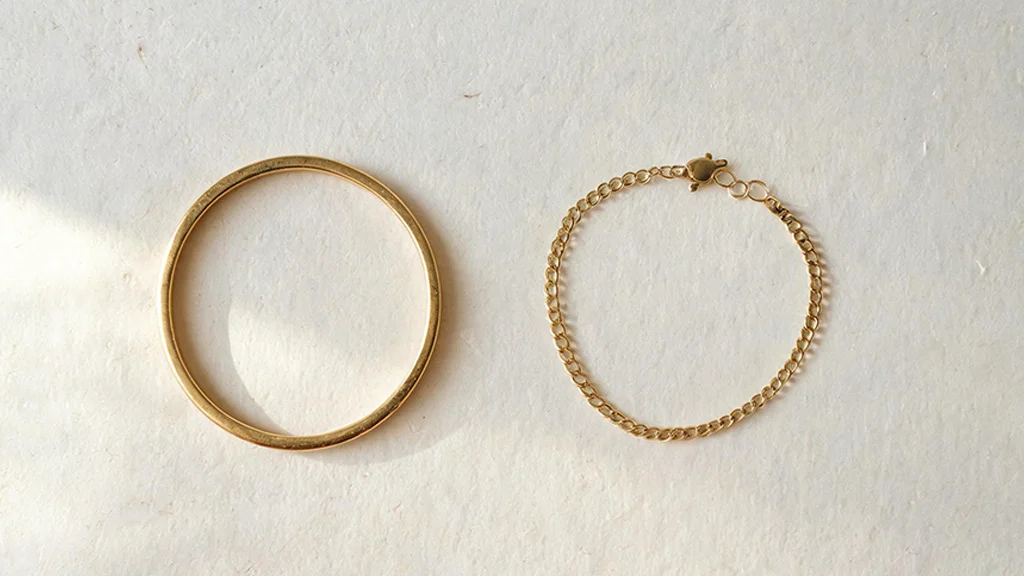
Tabla de contenido
Shop for wrist jewelry for long enough and the two words start to blur. Product pages use them interchangeably, friends swap them mid-sentence, and a gift recipient may genuinely not know which one she or he received. The distinction matters, though. It decides how a piece is measured, how it feels at a desk or in the gym, whether it stacks well, and how well it holds up over years of daily wear.
This guide settles the difference in plain terms, adds the cuff to the comparison (the piece most people confuse with a bangle), and shows you exactly how to size each style. It also explains how both are made, because construction explains most of what you feel on the wrist.
Bangle vs Bracelet at a Glance
Característica | Brazalete | Pulsera |
Structure | Rigid, holds its shape | Flexible, moves with the wrist |
Closure | None, or a hinge or gap | Clasp, buckle, slide or stretch |
How it goes on | Slips over the hand, or opens at a hinge or gap | Wrapped around the wrist and fastened |
Fit | Sits loosely and slides along the forearm | Follows the wrist, sits closer |
Sizing method | Measure the hand at its narrowest pass-through point | Measure the wrist, then add ease |
Adjustability | Fixed, unless it is an open style | Often adjustable by link, extender or sliding clasp |
Stacking | Excellent, with a clean, rhythmic look | Good, but links and clasps can tangle |
Materiales típicos | Metal, plus wood, glass, resin, enamel | Chain, beads, leather, cord, fabric, metal links |
Main wear risk | Dents or warping from knocks | Worn clasps, stretched links, broken chains |
Lo mejor para | Statement pieces, stacks, low-maintenance daily wear | Delicate styles, charms, adjustable comfort |
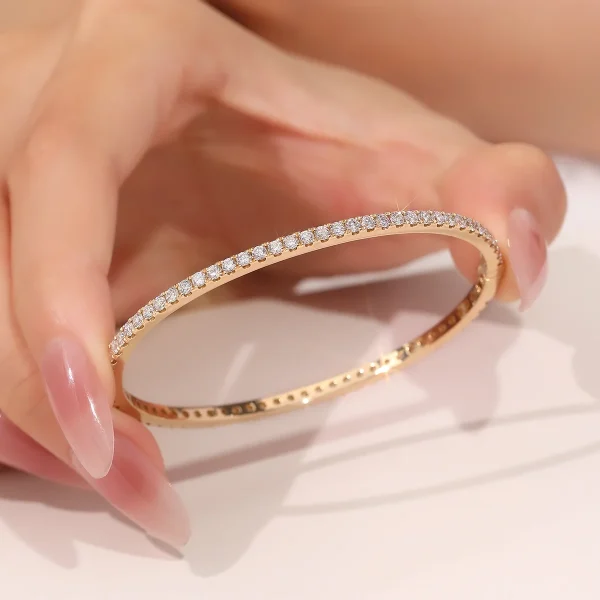
A bangle is a rigid, ring-shaped piece of jewelry worn on the wrist. It has no flexible links, no fastener and no stretch, so it keeps its shape whether it is on the arm or on the table. Most bangles are metal, but they are also made in wood, glass, resin, ceramic and enamel.
The word is generally traced to the Hindi word bangri (a glass bracelet), a reminder that rigid wrist rings have been worn and valued across many cultures for a very long time. Today the style is global, and it shows up in everything from fine gold pieces to everyday fashion.
Because there is nothing to open, a classic closed bangle must pass over the widest part of your hand, the knuckles and the base of the thumb, before it settles on the wrist. That single fact drives almost everything about how bangles are sized and worn.
What Is a Bracelet?
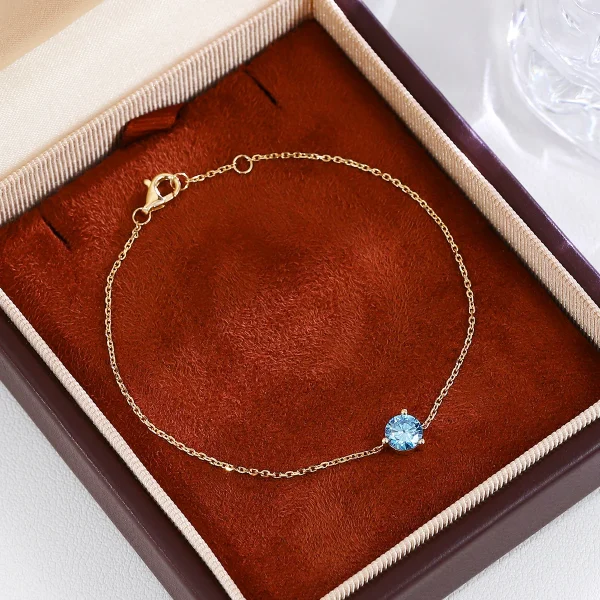
A bracelet is the broader category. It is any ornament worn around the wrist, and the defining trait is flexibility. Bracelets are built from connected parts, such as metal links, beads, charms, woven strands or cord, and they usually close with a clasp. That construction lets them bend, drape and follow the shape of the wrist.
Common bracelet styles include chain, tennis (a continuous line of set stones), beaded, charm, cord and woven designs, plus link styles with a box, lobster or toggle clasp. Technically a bangle is a rigid type of bracelet, and many retailers file both under the single heading “bracelets”. In everyday shopping, the practical question is simply: is it rigid or flexible?
Bangle vs Bracelet vs Cuff
The cuff is the most common source of confusion, because it is rigid like a bangle but opens like a bracelet. The difference comes down to the shape of the band.
Closed bangle | Open bangle / cuff | Hinged bangle | |
Forma | Complete circle | Circle with a gap | Looks closed, opens on a hinge |
Goes on by | Sliding over the hand | Sliding sideways onto the wrist | Opening, wrapping, snapping shut |
Sizing | Strict, must pass the hand | Forgiving, gap allows adjustment | Fairly forgiving |
Typical look | Clean, continuous | Statement, often wider | Wide, heavy or gem-set |
In practice the terms overlap. A narrow open band is often sold as an “open bangle”, while a wide one is called a cuff. If you are unsure which you are looking at, check whether the band is a full loop and whether it has a hinge. Those two features tell you how it will fit.
Types of Bangles and Bracelets
Common bangle types
- Closed (solid) bangle:a seamless loop. It gives the cleanest line and is the classic base for stacks.
- Open or split bangle:a small gap in the circle. It is easier to put on and more forgiving on size.
- Hinged bangle:opens on a hinge and closes with a catch, which makes wider or heavier designs easy to wear.
- Stackable bangle:very slim bands designed to be worn in multiples.
- Gem-set bangle:stones set across the top, around the full circumference or at stations along the band.
Common bracelet types
- Chain bracelet:metal links in styles such as cable, curb, rope or box.
- Tennis bracelet:a continuous row of identically sized stones set in a flexible line.
- Beaded bracelet:gold or metal beads, or gemstone beads, on a flexible strand.
- Charm bracelet:a chain that carries small pendants, collected over time.
- Cord or woven bracelet:casual, lightweight, often adjustable with a sliding knot.
How Bangles and Bracelets Are Made
Construction is the part most guides skip, and it is the best predictor of how a piece will wear. As a jewelry manufacturer, we see the same few decisions shape every bangle and bracelet.
Bangles: solid, hollow and everything between
A solid bangle is formed from a full-thickness band of metal. It is heavier and more resistant to dents, and it uses more precious metal, so it costs more. A hollow or tube bangle has the same visual volume with far less metal inside. It is lighter and more affordable, but a hard knock can dent it, and repairs are harder. Between the two sit semi-hollow y stamped constructions, which balance weight, cost and strength.
The joint matters just as much. A closed bangle is formed into a circle and joined, then finished so the seam disappears. A hinged bangle adds a hinge, a tongue or catch and often a safety latch. Those moving parts are the first places to check on any hinged piece, and the details that separate a well-made bangle from a fragile one.
Bracelets: links, joints and clasps
A bracelet is only as strong as its weakest link, literally. Each link is shaped, soldered or interlocked, then polished, and the clasp is fitted last. Clasp choice shapes comfort and security more than most buyers expect. A lobster clasp is secure and common, a box clasp with a safety catch suits heavier pieces, and a toggle is easy to fasten but less secure on fine chain. If you want to compare options, our guide to bracelet clasp types goes into each one.
How to Size a Bangle
Because a closed bangle cannot be adjusted, getting the size right before you buy is essential. This is the method jewelers use.
- Make a cone with your hand.Bring your fingers together and tuck your thumb against your palm, so the hand is as narrow as it can be.
- Measure around the widest part.Wrap a soft tape around the knuckles and the base of the thumb, in that cone position. No tape? Use a strip of paper, mark the overlap and measure it against a ruler.
- Add ease.Add about 1 to 1.5 cm (0.4 to 0.6 in) so the bangle slides on without pinching. This gives the circumference of the bangle’s inner edge.
- Between sizes? Go up.A slightly loose bangle is comfortable. One that will not pass the hand is unusable.
Hand measurement (cone position) | Inner circumference to look for | Approx. inner diameter (round bangle) |
17.5 cm / 6.9 in | 18.5 to 19 cm / 7.3 to 7.5 in | 5.9 to 6.0 cm / 2.3 to 2.4 in |
19 cm / 7.5 in | 20 to 20.5 cm / 7.9 to 8.1 in | 6.4 to 6.5 cm / 2.5 to 2.6 in |
20.5 cm / 8.1 in | 21.5 to 22 cm / 8.5 to 8.7 in | 6.8 to 7.0 cm / 2.7 to 2.8 in |
22 cm / 8.7 in | 23 to 23.5 cm / 9.1 to 9.3 in | 7.3 to 7.5 cm / 2.9 in |
Treat the table as a guide. Sizing conventions vary between makers, and oval bangles measure differently from round ones, so always check the specific size chart for the piece.
Round or oval?
Round bangles suit rounder wrists and give a classic look. Oval bangles are shaped to follow the natural cross-section of the wrist, so they often feel more comfortable and sit more securely. Open and hinged styles reduce the sizing pressure on both shapes.
How to Size a Bracelet
Bracelets are easier to size, because the clasp and links give you adjustability, but the allowance still matters.
- Measure your wrist.Wrap a soft tape just below the wrist bone, where the bracelet will sit.
- Choose a fit.Add 1 cm (0.4 in) for a snug fit, 1.5 to 2 cm (0.6 to 0.8 in) for a comfortable standard fit, or 2.5 to 3 cm (1 to 1.2 in) for a looser, flowing drape.
- Check the finished length.Look at the full length including the clasp, not just the chain, since the fastener adds or takes away usable length.
A quick check: you should be able to slide one or two fingers under a worn bracelet. Too loose, and it catches on things or slips toward the hand. Too tight, and it is uncomfortable and puts strain on the links. Many chain bracelets can be lengthened or shortened by adding or removing a link.
For a full chart, see our bracelet size guide.
Bangle or Bracelet: Which Should You Choose?
Neither is better. The right one depends on how you live and what you want from the piece.
Choose a bangle if you…
- want a low-maintenance piece with no clasp to fail or snag.
- love a stacked look. Rigid bands sit neatly together.
- prefer a bold, architectural statement.
- would like a piece that does not need adjusting through the day.
Choose a bracelet if you…
- want adjustable sizing, or are buying a gift and are unsure of the size.
- like delicate, flowing styles, or want to add charms.
- need a closer fit that stays put during active days.
- have a wrist that varies in size through the day or year.
Situation | Better fit |
Gift, size unknown | Bracelet with an extender, or an open bangle |
Daily wear at a desk | Slim, smooth bangle, so keys and surfaces catch nothing |
Active lifestyle | Close-fitting bracelet or very slim, snug bangle |
Wearing a watch | Slim bangles or a fine bracelet that do not crowd the dial |
Small wrist | Slim or open bangle, or a bracelet shortened by a link |
Larger hand or wrist | Hinged or open bangle, or a bracelet with extender |
How to Wear and Stack Them
- Start with a hero piece.Anchor the stack with one standout piece, such as a gem-set bangle, then build around it.
- Use odd numbers.Three or five tends to look deliberate. A single bangle worn alone is always correct.
- Vary width and texture.Mix a plain polished band, a textured one and a sparkling one to create rhythm.
- Mix metals confidently.Let one tone lead, around 60 percent of the stack, and let others support it.
- Pair with a watch.Keep bangles slim, and cluster them on one wrist or spread across both.
- Mix both styles.A fine bracelet between two bangles adds movement to a rigid stack. If you enjoy layering, our guide to stacking rings uses the same principles.
There is no rule about which wrist to wear them on. Most people choose the non-dominant hand for comfort, but personal preference decides. Bangles and bracelets are worn by people of every gender, so choose width and weight to suit your own style.
Preguntas frecuentes
Technically yes, since both are worn on the wrist. In everyday shopping, a bangle is the rigid style and a bracelet is a flexible one, though many retailers group them under the one heading “bracelets”.
A bangle is a complete circle, while a cuff is open at the back. Both are rigid. A cuff slides sideways onto the wrist, so it is more forgiving on size.
Both can be comfortable when sized properly. Slim, smooth bangles suit desk work. Close-fitting bracelets suit active days. Comfort depends more on fit than on style.
Yes. A fine bracelet between two bangles adds movement to a rigid stack. Keep metal tones coordinated and vary widths.
Either. Many people choose the non-dominant wrist, but there is no rule.
Choose the right size. A correctly fitted bangle rests above the wrist bone. A slightly smaller size, or grouping several bangles together, helps keep them in place.