
Pendant vs Necklace: The Real Difference, Explained
- Escrito por Equipo de Provenza
- Updated on octubre 13, 2026
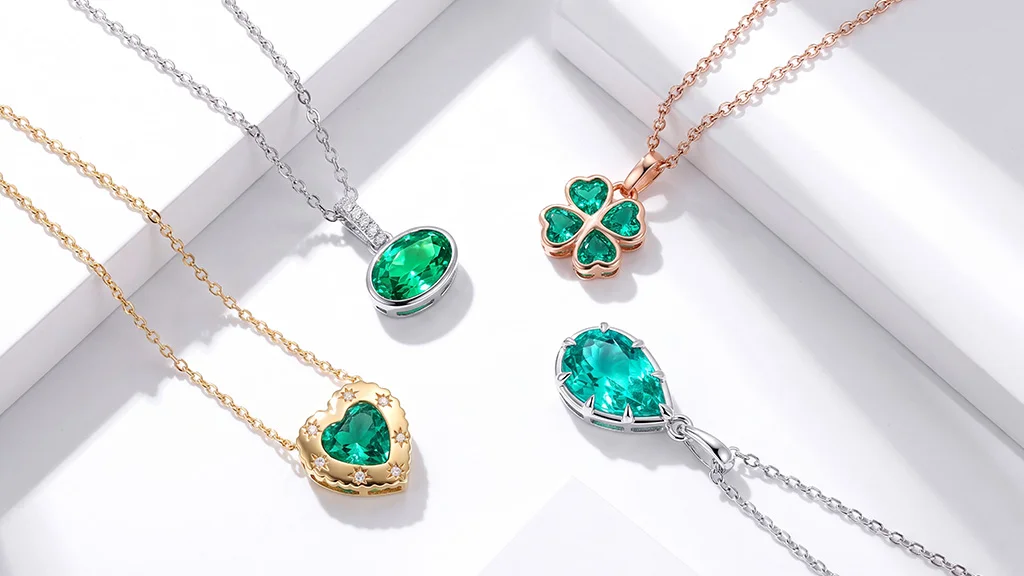
Tabla de contenido
A necklace is the complete piece of jewelry worn around the neck. A pendant is the decorative element that hangs from it. Put the two together and you have a pendant necklace, which is why the words are so often used as if they mean the same thing.
They don’t, quite, and the difference matters more than it sounds. It affects what you are actually buying, whether a chain is included, how a piece wears, whether you can swap one chain for another, and how you build a collection over time.
This guide gives you the simple answer first, then goes further than most: how pendants attach to chains, how to match the two, and what to check before you buy. It is written from the bench of a fine jewelry manufacturer, so you will also see how these pieces are actually made.
Pendant vs Necklace at a Glance
The table below sets the two side by side. The rest of the guide explains each row.
Característica | Colgante | Collar |
Definition | A decorative element that hangs from a chain or cord | A complete piece of jewelry worn around the neck |
Worn on its own? | Not as intended. It needs a chain, cord, or other support | Sí |
Role in the design | The focal point | The whole composition |
Typically sold as | A pendant alone, or with a chain as a pendant necklace | A finished, ready-to-wear piece |
Ejemplos | Solitaire, birthstone, initial, locket, cross, medallion | Chain, tennis, pearl strand, station, collar, choker |
Interchangeable? | Often, if the bail and chain are compatible | Usually worn as it is |
Main wear point | The bail and attachment | The clasp and the links |
What Is a Necklace?
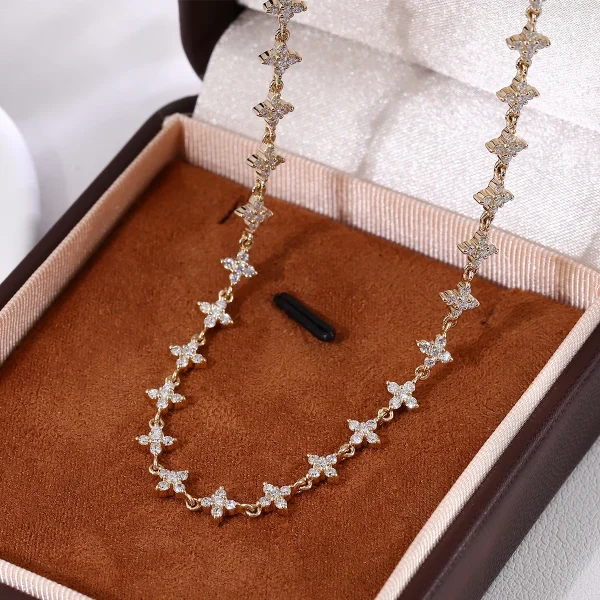
A necklace is any piece of jewelry designed to be worn around the neck as a finished, wearable object. It can be as simple as a fine gold chain or as elaborate as a diamond collar. The defining feature is that it is complete: you can put it on and wear it without adding anything.
Common types of necklaces
- Chain necklaces:links in one metal, from fine cable to heavy curb. The chain itself is the design.
- Strands:pearls, beads, or gemstones threaded on silk, nylon, or wire.
- Station necklaces:small stones or motifs fixed at set intervals along a chain.
- Tennis (line) necklaces:a continuous, flexible line of identically set stones.
- Collars and chokers:close-fitting designs that sit at the base of the neck.
- Bib and statement necklaces:wide designs that spread across the collarbone and chest.
- Pendant necklaces:a chain carrying a pendant (covered below).
Necklace lengths
Necklaces typically range from about 14 in (35 cm) for a choker to 36 in (90 cm) or more for an opera or rope length. A common length for pendant necklaces is 16–18 in (40–45 cm), which places the pendant at or just below the collarbone. Length decides where a piece falls on the body, so it is worth reading our Necklace Length Guide before you choose.
What Is a Pendant?
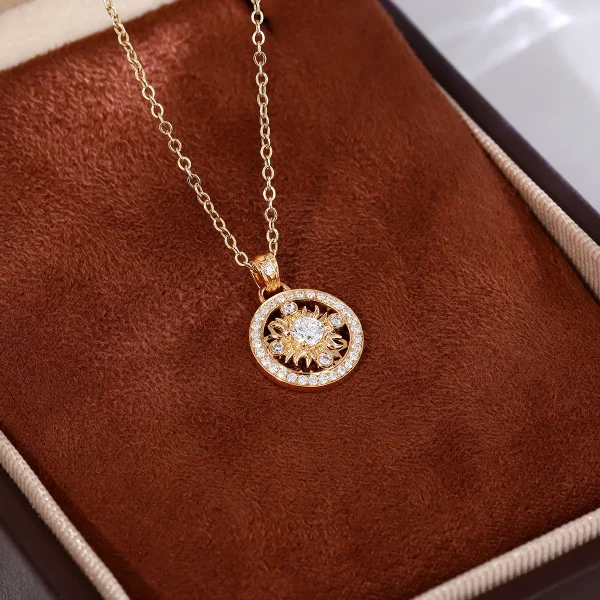
A pendant is a decorative element designed to hang from a chain, cord, or other support. The word comes from the Latin pendere, “to hang”, which is the whole definition in one verb.
On its own, a pendant is a component. It becomes a wearable piece once something carries it.
The anatomy of a pendant
- Focal element:the stone, setting, motif, or engraved form that people see.
- Bail:the small loop or connector at the top that the chain passes through.
- Jump ring or connector:an optional ring or link between the bail and the pendant body.
- Chain, cord, or ribbon:the support. Strictly speaking, this belongs to the necklace, not the pendant.
Popular pendant styles
- Solitaire and gemstone pendants:a single diamond, moissanite, or colored stone as the centerpiece.
- Halo and cluster pendants:a center stone surrounded by smaller stones for added sparkle.
- Initial and name pendants:letters or names in metal, often with stones.
- Birthstone pendants:a stone chosen for a birth month.
- Symbolic and religious pendants:crosses, hearts, knots, and other motifs with personal meaning.
- Lockets:hinged pendants that open to hold a photo or keepsake.
- Medallions and coin pendants:flat, disc-shaped pendants, often engraved.
Pendant Necklace: Where the Two Terms Meet
When a pendant and a chain are worn together as one piece, the result is a pendant necklace. Most pendants are worn this way, which is why “pendant” often gets used to mean the whole finished piece. People also say “necklace pendant”, which simply means a pendant intended for a necklace. It is not a separate category.
You will sometimes read that a pendant must be removable to count as a pendant. That is not how most jewelers use the word. A pendant is defined by its role, a decorative element that hangs from a chain, not by whether it can be taken off. Some pendants slide freely, some are fixed in place, and some detach. All three are pendants.
Format | How it is attached | How it wears | Can you swap chains? |
Sliding | The chain passes through a bail | Settles at the lowest point of the chain and moves slightly | Yes, if the bail fits the new chain |
Fixed | The chain is joined to the pendant at one or two points | Stays centered. Reads as one integrated piece | Not without alteration |
Detachable | A bail or fastening opens, or the chain can be threaded off | Can sit on other compatible chains, or the chain can be worn alone | Yes, after compatibility checks |
How a Pendant Attaches to a Chain
Two pendants with the same focal shape can look and wear very differently depending on the hardware above them. The attachment decides how the pendant hangs, how much it moves, and how much visible drop it adds.
Attachment | What it is | Look and wear |
Fixed bail | A loop formed with the pendant, or soldered or laser-welded to its top | A permanent loop. The chain slides through it, and the pendant hangs from the lowest point |
Pinch bail | A bail with small prongs that clamp onto the top of a drilled or flat pendant | Common for pearls, beads, and flat stones. Compact and neat |
Hidden bail | A bail placed behind the pendant, or a channel built into its structure | Clean from the front. The chain appears to pass behind the focal element |
Jump ring or articulated link | A small ring or link between the pendant and its bail or chain | Adds controlled movement and a little visible drop, helping the pendant hang naturally |
Fixed-point attachment | The chain is attached directly to the pendant at one or two points | Keeps the pendant centered. The whole assembly reads as a single design |
The attachment also changes how a pendant sits. A compact bail keeps the pendant close to the chain. A longer or articulated one adds space between the chain and the focal element, so two pendants of similar size can sit at different heights on the chest even on chains of the same length.
From the Bench: How Pendants and Necklaces Are Made
Pendants and necklaces look simple, but they are built very differently, and the differences explain why they fail in different places.
A pendant is a small, concentrated structure. The focal setting, the bail, and any connectors are formed by casting, stamping, or fabrication, then set and joined. The bail is the highest-stress point. It carries the whole weight of the pendant and constantly rubs against the chain. Whether it is formed with the pendant or made separately and soldered or laser-welded on, that join has to be clean and strong.
A necklace spreads the work along its length. A chain is made of many repeated links, each a potential wear point, plus a clasp. Station and tennis necklaces add settings along the length, so flexibility and spacing matter as much as the stones.
What a careful quality check looks for
- The bail opening is large enough for its intended chain, and for the clasp if the pendant is meant to slide on and off.
- Bail and solder joints are smooth, with no sharp edges or weak joins.
- The pendant hangs flat and faces forward instead of twisting.
- Chain links are closed and uniform, and the clasp closes securely.
- Stones are secure after setting and finishing.
- Fineness marks are clear and legible.
For brands and retailers: specify the attachment, not just the pendant. A spec sheet that says “pendant” leaves bail size, joining method, and chain compatibility open, and those are exactly where returns and complaints tend to come from.
How to Match a Pendant to a Chain
A good match makes both pieces look and last better. Work through these steps in order.
- Check the bail opening first.The chain, and the clasp if the pendant will slide on or off, must pass through easily. If you plan to swap chains, the opening has to clear the widest point of every chain involved.
- Match weight to strength.Heavier pendants need chains that hold their shape and resist stretching and kinking.
- Match scale.Pair dainty pendants with fine chains. Larger or statement pendants need a chain with enough visual weight to balance them, without overpowering the pendant.
- Match metal and finish.Use the same color and karat for a unified look, or contrast them on purpose.
- Think about wear, not just looks.A thin chain under a heavy pendant stretches and wears faster, especially where it contacts the bail.
Pendant type | Chain character | Why it works |
Light and delicate (small stone, initial, tiny motif) | Fine cable or fine box chain | Keeps proportions balanced. Low weight does not strain the links |
Medium (solitaire, birthstone, mid-size motif) | Cable, curb, or box chain in a medium gauge | Reliable everyday strength with a clear pass-through for the bail |
Heavy or statement (large gemstone, medallion, locket) | Rope, thick cable, or curb chain | Dense, interlocked construction resists stretching and kinking under load |
You will often hear that rope chains are the strongest choice for pendants. They are very durable thanks to their dense, interlocked links, but strength depends on thickness and build quality as much as on style. A well-made medium cable chain can outperform a thin, lightly built rope.
One more point: if a pendant was designed around a particular chain, replacing that chain can change how it hangs. Check the bail, clasp, and scale before you swap.
Pendant vs Charm vs Locket vs Medallion vs Drop
These terms overlap, and they cause most of the confusion when people shop. Here is how they relate.
Term | What it is | Usually worn on | How it differs from a pendant |
Colgante | A decorative element that hangs from a chain or cord, usually the focal point | Necklaces. Sometimes bracelets or anklets | The baseline term the others refine |
Encanto | A small decorative item, often one of several, attached with a ring or holder | Charm bracelets and charm necklaces | Smaller and usually collected. A pendant is typically a single focal piece |
Locket | A pendant that opens, usually on a hinge, to hold a photo or keepsake | collares | A specific kind of pendant, defined by the opening |
Medallion | A coin or disc-shaped pendant, often engraved or embossed | collares | A style of pendant, usually larger and flatter |
Gota | A pendant with an elongated or teardrop form that hangs below the chain | Collares y pendientes | Describes shape and hang, not a different category |
Pendant or Necklace: How to Choose
Start with one question: where should the eye go?
- One focal point:choose a pendant or a pendant necklace.
- Interest across the neck:choose a complete necklace such as a station, tennis, collar, or strand.
Then ask how much flexibility you want.
- Flexibility:choose a sliding or detachable pendant, and build a small set of chains around it.
- Ready to wear:choose a finished necklace or a fixed pendant necklace.
Neither format is better. They solve different problems, and many people own both.
Situation | Lean toward | Por qué |
Everyday, minimal | A fine chain with a small pendant, or a simple chain necklace | Low effort and light to wear |
Capas | Chains of different lengths, with one pendant as the focal point | The pendant gives the stack a center. Varied lengths prevent tangling |
A meaningful gift | A pendant (initial, birthstone, symbol) | The personal meaning lives in the pendant |
A ready-to-wear gift | A complete pendant necklace or finished necklace | Nothing to match or buy separately |
Formal or special occasion | A tennis, station, or pearl necklace, or a gemstone pendant on a refined chain | Continuous sparkle versus a single focal stone, depending on the look |
Building a collection | Several pendants and two or three chains | Pendants can be rotated across chains |
Preguntas frecuentes
Not exactly. A necklace is the complete piece worn around the neck. A pendant is the decorative element that hangs from it. A pendant and its chain together make a pendant necklace, which is why the words are often used interchangeably.
Not on its own, because it has to hang from something. That support does not have to be a metal chain: pendants are also worn on cords, leather, silk, or ribbon, and some are attached to bracelets or anklets.
No. Chain-only necklaces, pearl strands, tennis necklaces, station necklaces, and collars are all complete necklaces without a pendant.
It depends on the listing. Some are sold as complete pendant necklaces, others as pendants only. Check the product description to see what is included.
No. The bail opening must fit the chain (and the clasp, if the pendant is meant to slide on and off), the chain must support the pendant’s weight, and the two should suit each other in scale.
A charm is usually smaller, often one of several, and attached with a ring or holder. A pendant is typically a single focal piece that hangs from a chain.
Choose a dense, sturdy construction such as rope, thick cable, or curb, in a thickness that suits the pendant’s weight. Strength depends on build quality and thickness as well as chain style.