
Earring Size Guide: Studs, Hoops, Drops & Gauge Chart
- Geschreven door Provence Team
- Updated on september 28, 2026
Inhoudsopgave
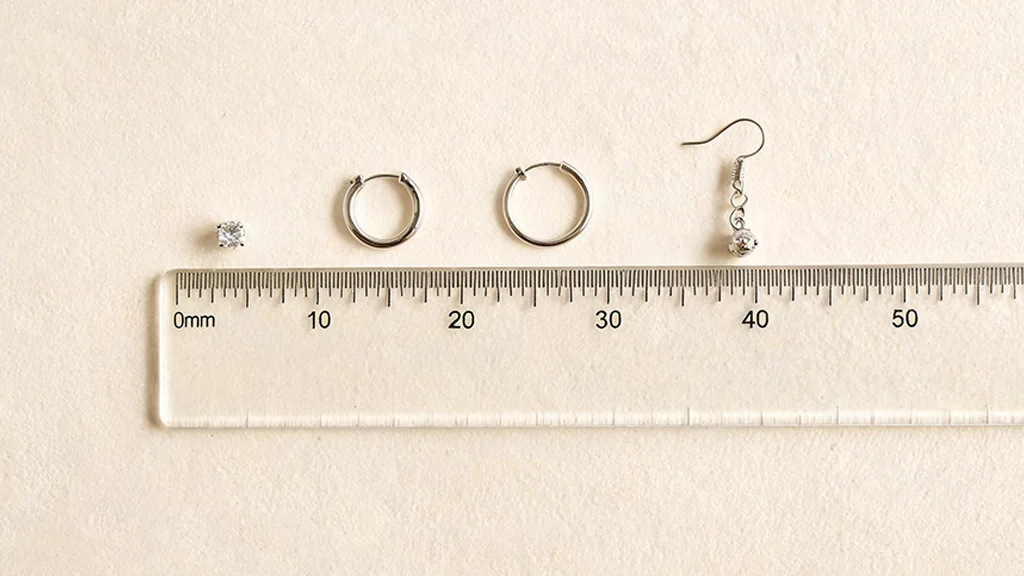
Buying earrings online is harder than it looks. A 10mm hoop can seem tiny on one screen and oversized on another. A 6mm stud might cover a lobe or barely show. And a post that is a fraction of a millimetre too thick simply will not go through the piercing.
This guide explains every measurement that matters, in millimetres and inches: gauge, post length, hoop diameter, stud size and drop length. You will find clear charts, a simple way to measure your own ears at home, and advice on matching size to piercing placement, proportions and material.
Quick answer: the most common earring sizes
- Everyday stud:5–6mm across (about 0.20–0.24")
- Tiny stud for second or third piercings:3–4mm
- Huggie hoop:6–9mm inner diameter
- Small everyday hoop:10–14mm inner diameter
- Standard drop earring:4–6cm (1.6–2.4") long
Standard lobe post: 0.8–1.0mm thick (20–18 gauge), 6–8mm long
Earring Size Cheat Sheet
Start here if you want the short version. Every row is explained in detail further down. Hoops are listed by inner diameter, the space inside the hoop, and drops by length measured from the piercing.
Earring type | Common size | Inches | Het beste voor |
Tiny stud | 3–4mm | 0.12–0.16" | Second or third piercings, subtle sparkle |
Everyday stud | 5–6mm | 0.20–0.24" | Main lobe piercing, daily wear |
Statement stud | 7mm and up | 0.28" and up | A bolder look that covers much of the lobe |
Huggie hoop | 6–9mm (inner) | 0.24–0.35" | A snug fit on the lobe or cartilage |
Small hoop | 10–14mm (inner) | 0.39–0.55" | Minimalist everyday wear |
Medium hoop | 15–25mm (inner) | 0.59–0.98" | Classic, day to evening |
Large hoop | 30–50mm+ (inner) | 1.18–1.97"+ | Statement and evening looks |
Short drop | 2–3cm | 0.8–1.2" | Understated movement |
Standard drop | 4–6cm | 1.6–2.4" | A balanced length for most ears |
Long drop | 7–9cm | 2.8–3.5" | Reaches the jawline or below, statement wear |
How to Measure Your Ears at Home
Every ear and every piercing is different, so the most useful number is your own. You only need a millimetre ruler and a mirror. If you do not have a ruler, a standard bank card is 85.6mm long and 54mm tall, and its edges make a handy guide.
- Measure your lobe.Hold the ruler against your ear and measure in a straight line from the centre of the piercing hole to the bottom edge of the lobe. Write it down in millimetres.
- For hoops, add a little room.Add about 1mm to your measurement for a snug huggie fit, or 2mm or more for a looser, classic hoop. If your piercing sits 6mm from the edge of your lobe, a 7–8mm hoop is a good starting point.
- For studs, decide how much lobe to cover.Look at the flat area of your lobe around the piercing. A 3–4mm stud leaves plenty of skin showing, 5–6mm is balanced, and 7mm or more will cover most of a smaller lobe.
- For drops, choose where you want the earring to end.Measure from your piercing down to the jawline, mid-neck or collarbone. That distance is your target drop length.
- For cartilage, measure the same way.Measure from the piercing to the nearest edge of the cartilage. Cartilage hoops usually work best at 6–10mm.
The Four Measurements Every Earring Has
Most sizing confusion comes from mixing up these four terms. Understanding them makes every product page easier to read.
Measurement | What it means | Typical range | Why it matters |
Gauge | The thickness of the post or wire that passes through the piercing | 0.6–2.0mm (22g–12g) | It must match your piercing or the earring will not fit comfortably |
Post length | The length of the pin that goes through the ear, not counting the decorative top | 6–8mm for most lobes; 8–10mm for thicker ears or cartilage | Too short pinches; too long snags and sits awkwardly |
Inner diameter | The open space inside a hoop or huggie | 6mm to 50mm+ | Decides how snugly a hoop sits |
Outer diameter | The full width of a hoop, including the thickness of the wire | Inner diameter plus twice the wire thickness | Decides how big the hoop looks |
A common mix-up: some brands list hoop size by inner diameter and others by outer diameter. A hoop with a 20mm outer diameter and 2mm wire has an inner diameter of only 16mm. Check which measurement a product page uses before you compare sizes.
Earring Gauge Chart
Gauge describes how thick the post is. The numbering runs backwards: the higher the gauge number, the thinner the post. Most standard earlobe earrings sit between 20 and 18 gauge, while cartilage piercings are often 18 to 16 gauge.
Gauge | Millimetres | Inches | Typical use |
22g | 0.6mm | 0.025" | Ultra-fine wire, some threaders and delicate pieces |
20g | 0.8mm | 0.032" | Fine lobe earrings and small studs |
18g | 1.0mm | 0.040" | Common for lobes and some cartilage piercings |
16g | 1.2mm | 0.051" | Common for cartilage, such as helix, tragus and conch |
14g | 1.6mm | 0.064" | Heavier styles and some larger piercings |
12g | 2.0mm | 0.081" | Thick posts, less common in fine earrings |
If you are not sure of your gauge, a professional piercer can tell you quickly. Never force a post through a piercing. A post that is too thick can irritate the skin and damage the piercing, while one that is too thin can feel loose and shift around.
Stud Earring Sizes
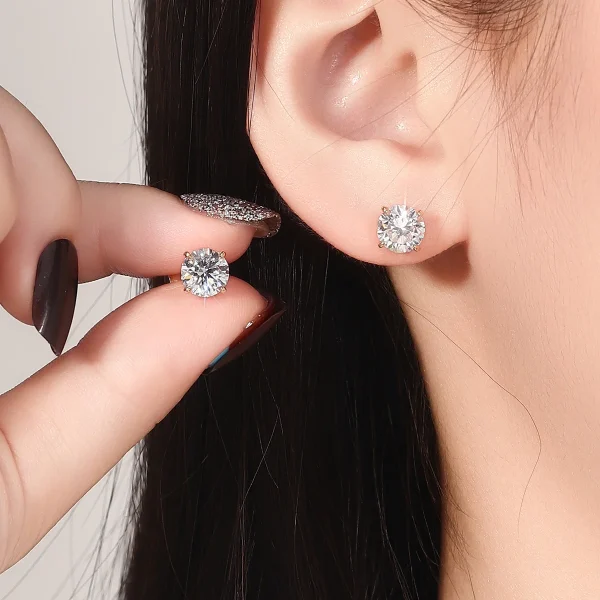
Studs are measured across the widest part of the stone or design. Sizes fall into three broad tiers:
- 3–4mm, tiny:subtle and delicate, ideal for second and third piercings or a quiet everyday sparkle.
- 5–6mm, everyday:noticeable but understated, the classic choice for a main lobe piercing.
- 7mm and up, statement:these cover a large part of the lobe and make a clear impression.
Diamond and lab-grown diamond studs: carat to millimetres
Diamond studs are usually sold by carat weight rather than size, which makes them hard to picture. The table below shows the approximate diameter of a round brilliant stone per earring. Lab-grown and natural diamonds of the same weight have the same dimensions.
Carat weight (per earring) | Approx. diameter | How it looks |
0.10 ct | 3.0mm | Tiny and delicate |
0.25 ct | 4.1mm | Subtle everyday sparkle |
0.50 ct | 5.1mm | The classic everyday stud |
0.75 ct | 5.8mm | A clear step up in presence |
1.00 ct | 6.5mm | Bold, a real statement |
1.50 ct | 7.4mm | Large, very noticeable |
2.00 ct | 8.2mm | Dramatic |
Watch the wording. Carat weight is often quoted as total weight (t.w.) for the pair. A 1.00 ct t.w. pair is two 0.50 ct stones, each about 5.1mm across. Fancy shapes such as oval, pear and princess look different from round stones of the same weight, so check the listed dimensions.
Moissanite studs
Moissanite is lighter than diamond, so it is sold by millimetre size rather than carat. The comparison below shows the approximate diamond equivalent weight for round stones.
Moissanite size | Approx. diamond equivalent weight |
4.0mm | About 0.25 ct |
5.0mm | About 0.50 ct |
6.0mm | About 0.75 ct |
6.5mm | About 1.00 ct |
7.5mm | About 1.50 ct |
8.0mm | About 2.00 ct |
Cubic zirconia, gemstones and pearls are sized directly in millimetres. Pearl studs are commonly 6–9mm, and 6–8mm is a popular range for everyday wear.
Hoop and Huggie Earring Sizes
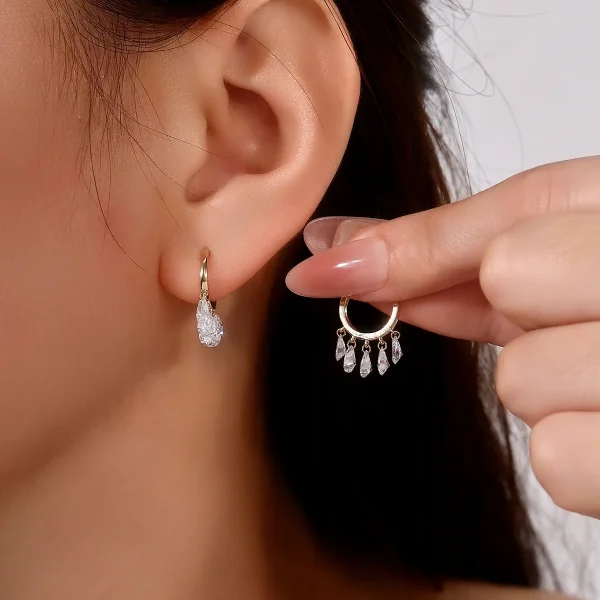
For hoops, inner diameter is what determines fit. Use the measurement from your lobe (see the section on measuring at home) and add 1mm for a snug huggie or 2mm or more for a looser hoop.
Inner diameter | Inches | How it sits | Het beste voor |
6–8mm | 0.24–0.31" | Hugs the lobe or cartilage closely | Huggies, helix, tragus, second lobe piercings |
9–12mm | 0.35–0.47" | Sits snugly at or just below the lobe | Everyday lobe wear, minimalist looks |
15–20mm | 0.59–0.79" | A visible gap, hangs below the lobe | Classic day-to-evening hoops |
25–30mm | 0.98–1.18" | Reaches towards the jawline | Bold everyday statement |
35–50mm+ | 1.38–1.97"+ | Jawline length or beyond | Evening and fashion looks |
Wire thickness changes the look. A thin 1–1.5mm wire looks delicate and light, while a 2–3mm wire looks bolder and feels heavier. A thick hoop also looks smaller than its measurement suggests because the wire takes up more of the opening.
Drop and Dangle Earring Lengths
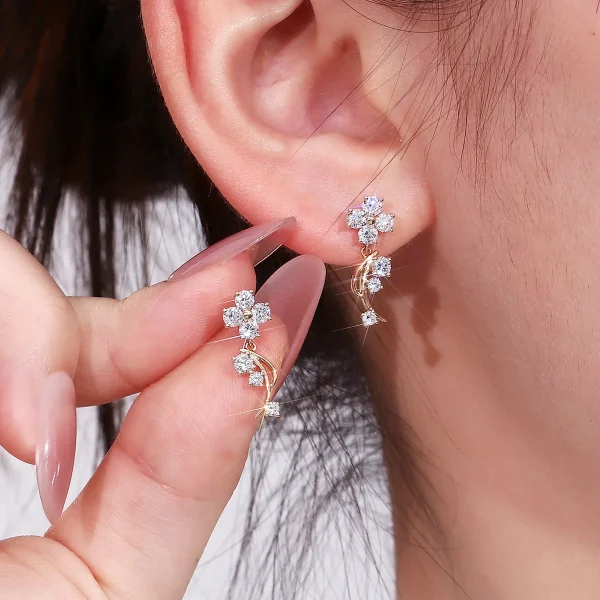
Hangende oorbellen, threaders and chandeliers hang below the lobe, so length is the key measurement. The chart shows roughly where each length ends on an average ear and neck.
Lengte | Inches | Where it ends | Stijl |
2–3cm | 0.8–1.2" | Around or just below the lobe | Subtle movement |
4–6cm | 1.6–2.4" | Between the lobe and the jawline | A comfortable range for most people |
7–9cm | 2.8–3.5" | At or just below the jawline, towards the neck | Statement and evening wear |
10cm and up | 4" and up | Mid-neck to shoulder | Dramatic, special occasions |
Brands measure drop length differently. Some measure from the bottom of the lobe and others from the top of the ear wire, which can add several millimetres. If a listing does not say, treat the length as the full length of the earring. For threaders, check the chain length, since a short chain sits at the lobe while a long one falls towards the jaw. Very long or heavy drops can also pull on the lobe, so lightweight construction matters as length increases.
Earring Size by Piercing Placement
Different piercings usually need different gauges, post lengths and hoop sizes. The ranges below are typical guides for fine jewellery, and individual anatomy varies.
Plaatsing | Typical gauge | Post length | Hoop inner diameter |
Earlobe | 20–18g (0.8–1.0mm) | 6–8mm | 8–12mm |
Second or third lobe | 20–18g (0.8–1.0mm) | 6–8mm | 6–8mm |
Helix | 18–16g (1.0–1.2mm) | 6–8mm | 6–10mm |
Tragus | 18–16g (1.0–1.2mm) | 6–8mm | 6–8mm |
Conch | 16g (1.2mm) | 6–10mm | 10–12mm |
Rook | 16g (1.2mm) | 8–10mm | 6–8mm |
Daith | 16g (1.2mm) | 6–8mm | 8–10mm |
A new or recently pierced ear may swell, which is why a slightly longer post is often used at first. If you are unsure, ask your piercer to recommend a size for your specific placement.
Earring Backs and Post Length
The back holds the earring in place, and the right one depends on the style, weight and value of the piece.
- Butterfly (push) backs:the most common friction back, well suited to lightweight studs.
- Screw backs:a threaded back that locks in place, a good choice for heavier stones and valuable diamond studs.
- Flat backs:a small flat disc sits against the ear, comfortable for cartilage piercings and sleeping.
- Leverbacks, ear wires and huggie clasps:these are used on drops, hoops and huggies. Leverbacks close with a small hinged lever, while huggies close with a hinged clasp.
The back should sit snugly against the ear without squeezing, leaving a little room for the ear to move and swell during the day. The heavier the earring, the more secure the back should be.
Choosing a Size That Suits You
Once fit is sorted, size is a matter of proportion and taste. These guidelines are a starting point, not rules:
- Angular faces:rounded shapes such as hoops and circular studs soften strong lines.
- Round faces:longer drops and narrower hoops add length and draw the eye downward.
- Square or broad faces:larger earrings help balance strong features.
- Oval faces:most sizes and shapes work, so choose by occasion.
Ear size, hairstyle and neckline matter too. Petite ears often suit smaller pieces, and wearing your hair up shows off larger earrings that hair would otherwise hide.
Size, Weight and Material
Size and weight go together. A large earring in solid gold or set with heavy stones can weigh noticeably more than the same design in a lightweight alloy. Heavier earrings work best with a slightly thicker post, around 1.0mm or above, and a secure back so the weight is supported rather than dragging on the lobe.
Material matters for comfort as well. Solid gold, platinum, titanium and good-quality sterling silver are commonly considered friendly to sensitive ears, while nickel is a common cause of skin reactions. If you have sensitive skin, look for nickel-free earrings and posts.
Why Accurate Sizing Matters: A Manufacturer's View
As a fine jewellery manufacturer making earrings for retail customers and brand partners, we see how small dimensions decide whether a piece feels right. A post that is 0.1mm too thick, a hoop with an uneven inner diameter or a back that does not grip properly are the details that turn a beautiful design into a returned order.
That is why size is specified in millimetres at the design stage, checked during production and confirmed before a piece is finished. Consistent gauge, post length and hoop diameter across a pair, and across an entire order, are a mark of careful manufacturing.
Earring Size FAQs
For most people, 5–6mm studs and 10–14mm hoops are safe everyday choices. For the best fit, measure from your piercing to the edge of your lobe and choose hoops 1–2mm larger than that measurement.
Studs of 5–6mm are the most common everyday size. Smaller 3–4mm studs suit second and third piercings, and 7mm and above is considered a statement size.
Measure from the centre of your piercing to the bottom edge of your lobe, then add 1mm for a snug fit or 2mm or more for a looser hoop. Always check whether the product lists inner or outer diameter.
Most lobe earrings have posts of 6–8mm. Cartilage piercings often use 6–10mm depending on placement and how thick the tissue is.
Most lobe earrings are 20 to 18 gauge, or about 0.8–1.0mm thick. Cartilage piercings are often 18 to 16 gauge, or about 1.0–1.2mm.
A 6mm earring is about 0.24 inches across, roughly the width of a small pea. It is a popular everyday stud size that is noticeable without being overpowering.
Inner diameter is the open space inside a hoop and determines how it fits. Outer diameter includes the thickness of the wire and determines how large the hoop looks. Outer diameter equals inner diameter plus twice the wire thickness.
Check that the gauge matches your piercing and that the post length suits your ear. If an earring feels tight, painful or hard to insert, do not force it. Choose a different size or ask a piercer for advice.