
Diamond Resale Value: What You Actually Get Back
- Verfasst von Provence-Team
- Updated on September 11, 2026

Inhaltsverzeichnis
Diamonds are marketed as forever — but almost every buyer eventually wonders what their stone would fetch if they sold it. The honest answer disappoints most people, and the reasons why are rarely explained clearly. This guide breaks down exactly how diamond resale value is determined, why it differs so sharply from retail price, and what actually moves the number up or down — from someone who sits on the manufacturing side of the supply chain, not just the retail side.
Quick Answer: Diamond Resale Value at a Glance
- Natural diamonds typically resell for 20%–60% of their original retail price.
- Lab-grown diamonds typically resell for 1%–10% of their original retail price, and continue falling as production costs drop.
- Moissanite and cubic zirconia have negligible resale value — they are priced and sold as affordable alternatives, not as tradable assets.
- An insurance appraisal is not a resale estimate — appraisals run 50%–100%+ above what any buyer will actually pay.
• Certification (GIA, IGI) typically improves resale offers by 15%–25% compared with uncertified stones of similar quality.
Why Diamonds Lose Value the Moment You Buy Them
Every diamond sold at retail carries several layers of cost that have nothing to do with the stone itself. Understanding this stack is the fastest way to understand resale value, because resale strips almost all of it back out.
As a manufacturer that cuts, sets, and finishes diamond jewelry for retail and wholesale partners, we see this markup structure from the inside. A typical retail diamond price includes:
- The wholesale cost of the rough or polished stone itself
- Cutting, polishing, and setting labor
- Grading and certification fees
- Brand markup, showroom overhead, and sales commissions
- Marketing spend and the retailer's profit margin
When a diamond re-enters the market as a used stone, none of the retail-side costs travel with it. A buyer — whether a jeweler, dealer, or private collector — is only paying for the stone's wholesale trading value, minus a margin for their own risk and resale effort. That is the entire explanation for the gap between what you paid and what you're offered. It isn't a scam, and it isn't specific to any one seller; it's how every finished-goods market with heavy retail markup behaves, from cars to consumer electronics to jewelry.
The 4Cs and How Each One Moves Resale Value
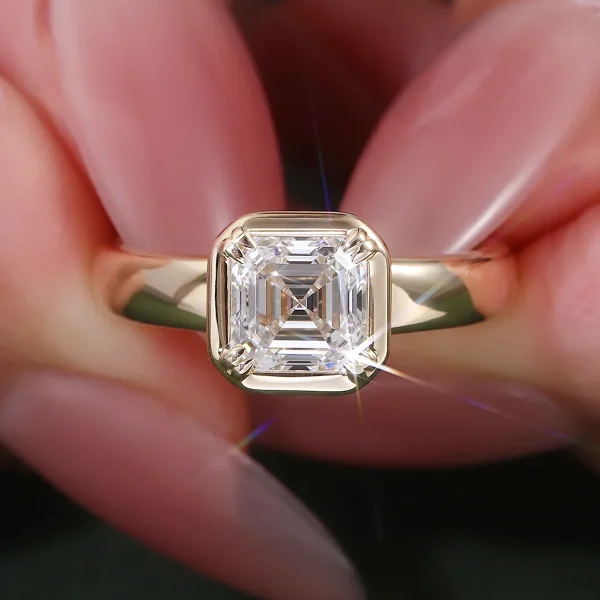
Every professional buyer — whether appraising a natural diamond or a lab-grown one — starts with the same four benchmarks: Carat, Color, Clarity, and Cut. Resale value isn't a flat percentage; it shifts meaningfully depending on where a stone sits on each scale.
Karatgewicht
Value does not scale in a straight line with size. Diamonds priced just above a round number — 1.00 carat, 2.00 carats — command a disproportionate premium over stones just under that threshold, even when the visual difference is invisible to the naked eye. A stone at 0.99 carats can resell for meaningfully less per carat than one at 1.01 carats of otherwise identical quality.
Farbe
Color is graded from colorless to noticeably tinted. Stones in the colorless-to-near-colorless range hold their resale value best, because demand for them is broadest. As color grades move toward the visibly tinted end of the scale, resale offers drop step by step — and the discount compounds with each grade.
Klarheit
Clarity measures internal and surface characteristics. Stones with only minor, invisible-to-the-eye inclusions resell close to their graded value. Heavily included stones face steeper discounts, particularly if the inclusions affect durability or visible brilliance rather than just grading paperwork.
Schneiden
Cut is the most commonly underestimated factor. A precisely cut stone returns more light and sparkle than a larger or higher-clarity stone that was cut for weight retention rather than brilliance. Buyers notice this immediately, and a poor cut grade drags down an offer regardless of how strong the other three Cs look on paper.
How a Resale Offer Is Actually Calculated: A Worked Example
Most articles on this topic list the factors that affect resale value but never show the math. Here is how a professional buyer typically works through an offer, step by step, using relative percentages rather than fixed prices so the logic applies no matter what currency or market you're in.
- Start with the wholesale benchmark. Every diamond is priced against an industry-standard wholesale price list for its exact combination of carat, color, clarity, and cut. Call this figure 100% — it represents what a dealer could buy an equivalent new stone for from a supplier, with full trade terms and no risk.
- Apply a discount-to-wholesale. A used stone virtually never sells at the full wholesale benchmark. Buyers typically offer somewhere between 70% and 90% of that benchmark, because they're taking on resale risk, tying up capital, and need room for their own margin.
- Adjust for liquidity and shape. A highly liquid shape and size — a round brilliant near a full-carat threshold — stays close to the top of that range. A less liquid combination — an unusual shape, strong fluorescence, or a size that's hard to move — pushes the offer toward the bottom.
- Adjust for documentation. A verified grading report keeps the offer near the top of the range. Without one, the buyer must assume the worst plausible grade to protect themselves, which can shave another 15%–25% off the number.
- Apply the channel margin. The final number depends on who's buying. A pawn shop needs a much larger margin to protect against resale risk than a specialist diamond dealer does, which is why the same stone can receive very different offers depending on where you take it.
The result: a diamond with a wholesale benchmark equivalent to 100% of a fictional reference price might realistically return somewhere between 45% and 65% of its original retail price once every one of these adjustments is applied — consistent with the 20%–60% range professional buyers quote, once you account for how much retail markup was baked into the original purchase.
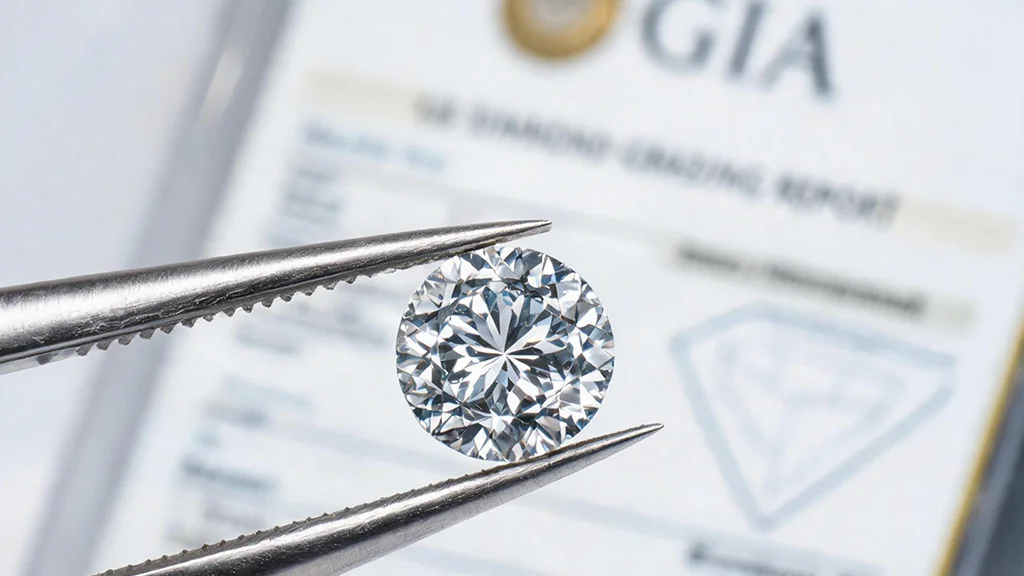
A grading report from a recognized laboratory — most notably GIA, with IGI and other labs also broadly accepted — turns a diamond from a subjective object into a documented, verifiable asset. This matters more at resale than at purchase, because the buyer wasn't there when the stone was cut and has no way to independently confirm its quality without either trusting the paperwork or re-grading the stone themselves.
Certified diamonds typically sell for 15%–25% more than otherwise-identical uncertified stones, because certification removes uncertainty from the transaction. Without a report, buyers protect themselves by assuming a lower grade than the stone might actually deserve — which is the single most common reason sellers feel their diamond was undervalued.
If you don't have a report and are planning to sell, having the stone independently graded before you approach buyers is one of the few actions that reliably increases the offers you receive, often by more than the cost of the grading itself.
Natural, Lab-Grown, and Simulant Resale Value Compared
The type of stone is the single biggest lever on resale value — larger than any individual C. Here's how the three main categories compare:
Gesteinsart | Typical Resale (% of Retail) | Warum |
Natural diamond | 20% – 60% | Finite supply; scarcity supports long-term wholesale demand |
Lab-grown diamond | 1% – 10% | Production costs fall yearly, so new supply is always cheaper than existing stock |
Moissanit | Negligible / no established resale market | Sold as an affordable simulant, not traded on a wholesale diamond exchange |
Cubic zirconia | No resale value | Low-cost synthetic with no wholesale trading market |
Natural diamonds are a genuinely finite resource, which is why a functioning wholesale resale market exists for them at all. Lab-grown diamonds are a manufactured product whose production cost drops as technology improves — the same dynamic that makes electronics cheaper every year — so a lab-grown stone bought today will very likely cost less to produce again in a year or two, and resale offers reflect that directly. Moissanite and cubic zirconia were never positioned as investment-grade materials; they're chosen for affordability and appearance, and buyers should treat them accordingly rather than expecting any meaningful resale return.
Where You Sell Changes What You're Offered
The same diamond can receive very different offers depending on the channel. Each channel takes on a different amount of risk and effort, and prices its offer accordingly.
Kanal | Typical Return (% of Retail) | Abtausch |
Pawn shop | 20% – 30% | Fastest cash, lowest offer, minimal documentation needed |
Jeweler / dealer cash offer | 20% – 40% | Fast, straightforward, but priced for the dealer's resale margin |
Consignment or online marketplace | 40% – 60% | Better return, but takes longer and may involve fees |
Peer-to-peer / direct sale | 50% – 70% | Highest return, but requires more effort and carries more risk |
Auction house (rare/high-value stones) | Varies widely | Best suited to exceptional stones with unusual size, color, or provenance |
There's no universally 'best' channel — the right choice depends on how quickly you need funds versus how much effort you're willing to put into securing the highest return. Getting quotes from more than one type of buyer before committing is the simplest way to confirm you're getting a fair number for your specific stone.
How to Protect and Maximize Resale Value Over Time
Resale value isn't fixed the day you buy — how a diamond is cared for and documented afterward has a real effect on what it returns later. A handful of habits make a measurable difference:
- Keep the original certification, receipt, and any appraisals together — missing paperwork is one of the most common reasons for a lowball offer.
- Have the setting checked periodically to make sure prongs and mounts are secure — loose settings suggest neglect and invite a more conservative offer.
- Clean the stone professionally before seeking offers — a dirty diamond can visually present as one or two color/clarity grades worse than it actually is.
- Avoid impacts and store pieces separately to prevent chips and surface abrasions, which reduce both grade and buyer confidence.
- If a stone is re-cut, reset, or repaired, keep records of the work — undocumented alterations raise questions a buyer would rather not have to resolve themselves.
None of this changes the fundamental math of retail markup versus wholesale trading value, but it does ensure you're getting the strongest offer available within that range rather than losing ground to avoidable condition or documentation issues.
Common Myths About Diamond Resale Value
Myth: "My appraisal says it's worth more, so I should get that much." An appraisal for insurance purposes is designed to reflect full retail replacement cost, not what any buyer will pay in cash. The two numbers measure entirely different things.
Myth: "Diamonds are a good investment." Diamonds are best understood as a luxury purchase or a meaningful personal symbol. Even high-quality natural stones typically underperform simple financial assets as an investment vehicle, and lab-grown or simulant stones are not investment-oriented at all.
Myth: "Any certificate is as good as another." Market trust varies by lab. Reports from the most widely recognized laboratories carry more weight with professional buyers than reports from lesser-known labs, and can affect how quickly — and how confidently — an offer is made.
Myth: "A beautiful setting means a better resale offer." Most buyers value the diamond and the metal separately. A striking design doesn't add to the diamond's own trading value, though the metal will typically be assessed and paid for on its own merits.
Häufig gestellte Fragen
Yes. Natural diamonds retain real resale value — typically 20% to 60% of original retail price — because natural supply is genuinely limited. Lab-grown diamonds and simulants have little to no meaningful resale market by comparison.
Because the two figures measure different things. An appraisal reflects what it would cost to replace the piece at full retail; a resale offer reflects the wholesale trading value of the stone alone, with retail markup removed.
Yes — certified stones typically command 15%–25% more than uncertified stones of similar visual quality, simply because a report removes the buyer's need to guess or protect themselves against an unverifiable grade.
Not necessarily — it depends on your priority. Lab-grown diamonds offer more size and clarity for the price at the point of purchase; they simply shouldn't be chosen with resale or investment return in mind.
Get the stone properly certified (or locate the original report) and have it professionally cleaned before seeking offers. These two steps address the most common reasons buyers lowball an offer.
Most professional buyers evaluate the diamond and the metal setting separately. Removing the stone before selling — or being open to the buyer doing so — often produces a cleaner, more confident offer.
The Bottom Line
Diamond resale value isn't arbitrary, and it isn't a sign that you were overcharged — it's the predictable result of how retail markup, wholesale trading, and market liquidity interact. Natural diamonds hold meaningfully more value than lab-grown stones or simulants; certification, condition, and documentation all move the number within that range; and the channel you choose determines how much of that range you actually capture.
Whether you're buying with future resale in mind or preparing to sell a piece you already own, understanding this structure — rather than relying on an appraisal figure or a single buyer's first offer — is what puts you in a position to make a confident, informed decision.