
Diamond Table and Depth: Ideal Percentages by Shape
- Verfasst von Provence-Team
- Updated on Oktober 12, 2026
Inhaltsverzeichnis
When people shop for a diamond, the conversation usually starts with carat weight, color and clarity. Yet the factor that decides whether a stone looks lively or lifeless is its cut, and two of the quickest numbers for judging cut appear on almost every certificate: the table percentage and the depth percentage.
This guide explains what these two measurements are, how to calculate them yourself, which ranges suit each diamond shape, and why the ranges you find online so often disagree. You will also learn what table and depth cannot tell you, how they apply to lab-grown diamonds and moissanite, and how to use them as a practical filter when buying or sourcing stones.
What Is a Diamond Table?
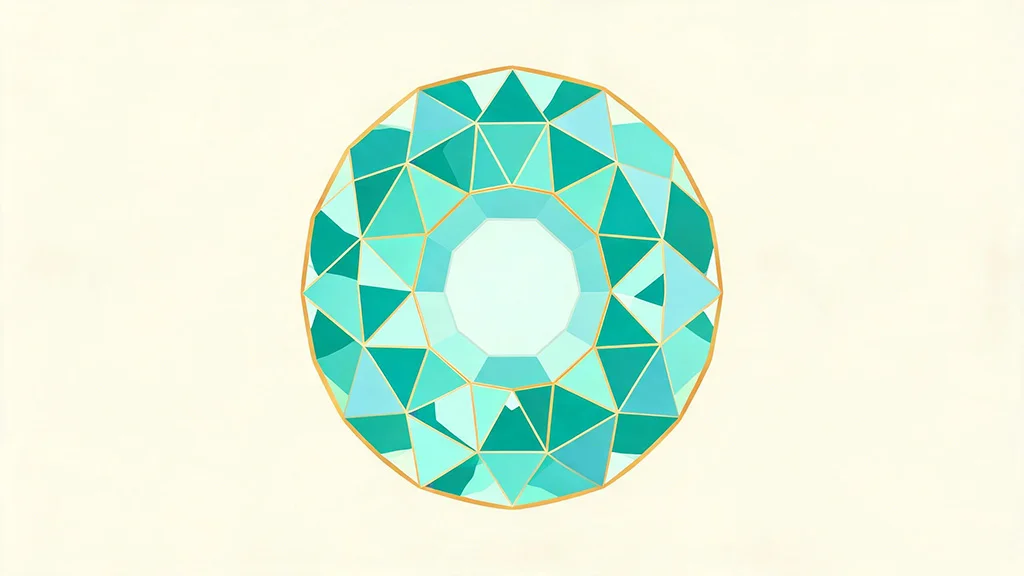
The table is the large, flat facet on the top of a diamond, the one you look straight down at. On a round brilliant it is an eight-sided facet at the centre of the crown, surrounded by the star, bezel and upper girdle facets. Think of it as the main window of the stone: light enters through it, and it is also the window through which you see light returning from inside.
How table percentage is calculated
Because diamonds come in every size, the table is expressed as a percentage so that stones can be compared fairly:
FORMULA
Table % = table width ÷ average girdle diameter × 100 Example: a table 3.65 mm wide on a stone 6.50 mm across has a table percentage of 3.65 ÷ 6.50 = 56.2%.
Why bigger is not always better
A larger table lets in more light and produces broader flashes of white light, which we call brilliance. But it leaves less room on the crown for the surrounding facets to break that light into colored flashes, which we call fire. A smaller table does the opposite: more crown facets, more fire, but less white light and sometimes a busier, less open look.
So the aim is balance, not an extreme. That is why every shape has a recommended range instead of a single “best” number.
What Is Diamond Depth?
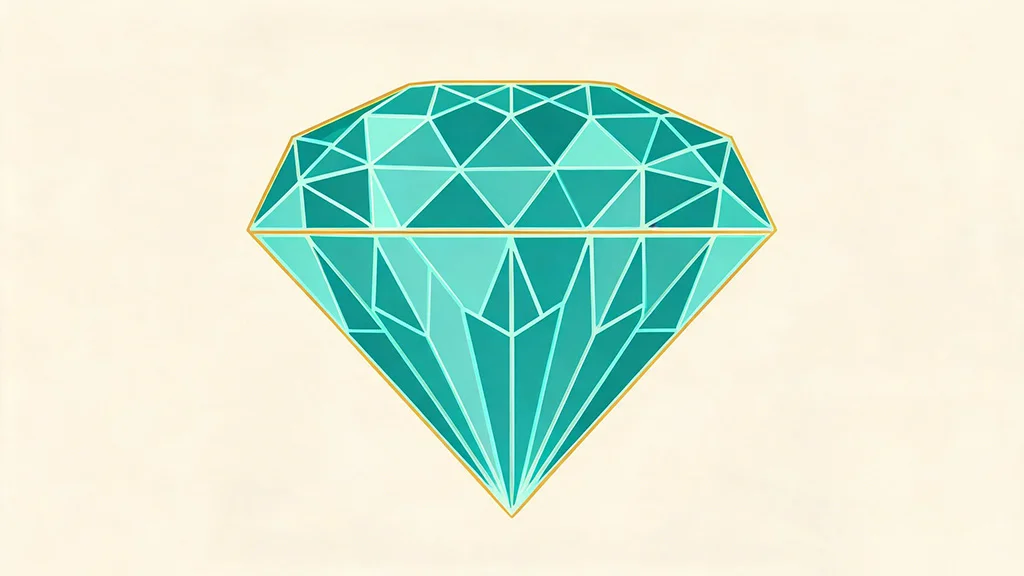
Depth, sometimes called total depth or height, is the distance from the table at the top of the diamond to the culet, the tiny point or facet at the bottom. It is made up of three parts: the crown height above the girdle, the thickness of the girdle itself, and the pavilion depth below it.
Depth is also shown as a percentage of the stone’s width so that different sizes can be compared:
FORMULA
Depth % = total depth ÷ average girdle diameter × 100 (for fancy shapes, the stone’s width is used) Example: a stone 4.00 mm deep and 6.50 mm across has a depth percentage of 4.00 ÷ 6.50 = 61.5%.
GIA defines total depth as a percentage of the average girdle diameter
Most certificates list the measurements in millimetres as well as the percentages. That means you can check the math yourself in a few seconds, which is a handy sanity check on any stone.
Depth and hidden weight
Everything below the girdle is hidden when the stone is set and viewed face-up. A deeper stone carries more of its carat weight underneath, where you cannot see it. A shallower stone spreads that weight across a wider face. This is why two diamonds of identical carat weight can look noticeably different in size, and why depth deserves attention even when the price looks attractive.
Why Table and Depth Matter: How Light Moves Through a Diamond
A well-cut diamond behaves like a carefully arranged set of mirrors. Light enters through the crown, travels to the pavilion, reflects from the pavilion facets, and returns up through the top toward your eye. Table and depth are two of the main proportions that set the angles in this light path. When they are balanced, most of the light returns to the viewer. When they are not, some of it leaks out of the bottom or the sides.
What happens outside the ideal range
Condition | What happens to the light | What you tend to see |
Too shallow | Light strikes the pavilion at too shallow an angle and escapes through the bottom instead of reflecting back. | A glassy or washed-out centre, sometimes called a “fisheye” or “window” effect. The stone can look wide for its weight. |
Too deep | Light can leak out of the sides of the pavilion before it returns to the viewer. | A darker centre and a smaller face-up appearance than other stones of the same carat weight. |
Table too large | More light enters and returns as white light, but the crown has less room to disperse it. | Bright, but with less fire and a flatter look. |
Table too small | The crown breaks light into more colored flashes, but less white light returns. | Plenty of fire, but the stone can look less bright or busier. |
Face-up size versus carat weight
Carat is a measure of weight, not size. Because a deep stone hides weight in its pavilion, its diameter can be smaller than that of a better-proportioned stone with the same carat weight, and even a fraction of a millimetre is visible when the two are placed side by side. A very shallow stone shows the opposite problem: it looks large, but its sparkle suffers. The best choice is usually a well-balanced stone, not the one that merely looks the biggest on paper.
Ideal Table and Depth by Shape
The chart below summarizes commonly used guideline ranges for popular shapes. Treat it as a starting filter that helps you set aside poorly proportioned stones, not as a pass-or-fail test. A diamond just outside a range can still be beautiful if its other proportions are right, and a diamond inside every range can still disappoint.
Form | Table % | Depth % | What to watch |
Rundbrillant | 54–60 | 59–62.5 | The most studied shape. A table of about 54–57% is the classic balanced zone. |
Oval | 53–63 | 58–63 | Check length-to-width ratio and look for a dark “bow-tie” across the centre. |
Birne | 53–63 | 58–64 | Bow-tie and symmetry of the two shoulders matter as much as the numbers. |
Kissen | 58–68 | 61–68 | Varies with the cut style (squarer or more elongated, chunky or crushed-ice). Judge the look. |
Prinzessin | 64–75 | 64–75 | Sources disagree most here. Prefer stones in the middle of the range and check the corners. |
Smaragd / Asscher | 60–68 | 60–68 | Step cuts rely on clean “hall of mirrors” flashes. Some sources allow tables up to about 72%. |
Strahlend | 61–69 | 61–67 | A hybrid of brilliant and step cutting. Depth beyond the range tends to look small face-up. |
Marquise | 53–63 | 58–62 | Check the bow-tie and the evenness of both points. |
Herz | 56–62 | 56–62 | Limited published data. Judge by symmetry of the lobes and light return. |
Why you will see different numbers on different websites
If you have researched this topic, you have probably noticed that the “ideal” range for the same shape changes from site to site. There are good reasons for this:
- Different grading systems define “ideal” differently.Laboratories evaluate cut by combining several proportions rather than judging table and depth in isolation.
- The numbers interact with the angles.A larger table can work well with one pavilion angle and poorly with another, so there is no single perfect box for table and depth.
- Some sites publish a tight “ideal” range, others the wider zone where good stones occur.Both are correct, but they answer different questions.
- Fancy shapes have no formal lab standard.Many laboratories do not issue an overall cut grade for them, so the ranges come from trade experience instead.
The practical takeaway: use the chart to eliminate clearly poor candidates, then let angles, certificates and real images make the final call.
Round Brilliant Diamonds in Detail
The round brilliant is the most studied diamond shape, and its proportions have a long history. In 1919, Marcel Tolkowsky published a mathematical model of the “ideal” round brilliant, with a table of about 53% and a total depth of about 59.3%. Later research using light-performance modelling showed that several combinations of proportions can perform beautifully, which is why modern well-cut stones are found across a somewhat broader band than Tolkowsky’s single recipe.
For a round brilliant, a table of about 54–60% and a depth of about 59–62.5% covers most well-cut stones. How the two numbers combine tells you more than either one alone:
- Moderate table with depth inside the range:the classic profile, with a good balance of brilliance and fire.
- Large table with shallow depth:often a wide, flatter-looking stone that can look glassy.
- Small table with high depth:weight sits in the pavilion, so the stone can look smaller and darker than its carat weight suggests.
These are tendencies, not rules. They are exactly why the next section matters.
Table and Depth Are Only Half the Story
Table and depth describe the overall shape of a diamond, but light is controlled by the angles of its facets. Total depth is simply the sum of the crown height, the girdle thickness and the pavilion depth, and the same total can be built in different ways. A stone with a steep crown and a shallow pavilion can show the same 61% depth as one with a shallow crown and a deep pavilion, yet the two will not sparkle the same way.
The other numbers to check
- Crown angle:for round brilliants, roughly 34–35° is commonly considered ideal.
- Pavilion angle:for round brilliants, roughly 40.6–41° is commonly considered ideal.
- Crown height and pavilion depth:the individual parts that add up to total depth.
- Girdle thickness:very thin girdles are more vulnerable to chipping, and very thick ones add hidden weight and inflate depth.
- Polish and symmetry:even perfect proportions can look dull if the facets are poorly finished or misaligned.
One more caution: some trade reports describe cutters adding extra facets near the girdle in ways that can slightly lower the reported depth percentage. This is one more reason not to rely on a single percentage, and to check the angles and a real image of the stone as well.
Fancy Shapes
Shapes other than the round brilliant are often called fancy shapes. Their table and depth ranges are broader, and the numbers alone say even less about how the stone will look. Three points are worth remembering:
- Length-to-width ratio matters.Elongated shapes such as ovals, pears and marquise cuts look very different at different ratios, and the right one is largely a matter of taste.
- Watch for the bow-tie.Ovals, pears, marquise and heart shapes can show a dark band across the centre. Table and depth cannot reveal this, but a photo or video can.
- Step cuts behave differently.Emerald and Asscher cuts are judged on clean, open flashes and clarity rather than on sparkle, so proportion ranges and expectations differ.
Because many laboratories do not give fancy shapes an overall cut grade, the safest approach is to combine the proportion ranges in the chart with high-quality images or video and, where possible, a look at the stone in person.
Lab-Grown Diamonds, Moissanite and Other Stones
Table and depth are not limited to natural diamonds, but how they apply depends on the material.
- im Labor gezüchtete Diamantenare real diamonds with the same chemical composition and optical behaviour as natural ones. The same proportion guidelines and grading approach apply.
- Moissanithas a higher refractive index and a stronger dispersion than diamond, so it shows more fire and a different style of sparkle. It is also doubly refractive, which means cutters pay attention to crystal orientation. Its best proportions are not identical to a diamond’s, so a diamond chart should not be applied to moissanite as a strict rule.
- Cubic zirconiahas a lower refractive index than diamond. Its proportions are usually set by standard cutting patterns, and the diamond ranges are only a rough guide.
In every case, the principle is the same: proportions decide how much light returns to the viewer. What changes is the material’s own optical properties.
How to Read Table and Depth on a Diamond Certificate
Reputable laboratories list a stone’s proportions on its grading report. Here is a simple routine for using them:
- Find the proportions section.Look for table percentage, depth percentage and total depth in millimetres. For round brilliants, the report usually also lists crown angle, pavilion angle and girdle.
- Check the math.Divide the depth in millimetres by the diameter or width and confirm that it matches the stated depth percentage.
- Compare with the shape range and the angles.Use the chart above as a filter, then check that the angles and girdle are also reasonable.
- Confirm with your eyes.Look at a high-quality video, photographs or the stone itself. If it looks lifeless or has an obvious bow-tie, the numbers do not matter.
A Manufacturer’s Perspective: Why Poorly Proportioned Stones Exist
If well-proportioned stones perform so much better, why do deep or shallow ones exist at all? The answer is economics. Rough diamond is expensive, and cutters face a constant trade-off between yield (how much weight they keep from the rough) and proportions (how well the finished stone performs). Leaving extra weight in the pavilion or keeping a thicker girdle can produce a heavier finished stone from the same rough, and heavier stones are easier to sell by carat weight. A better-proportioned stone often means giving up some of that weight.
This is exactly why certificate numbers matter to buyers. They reveal where along that trade-off a particular stone sits.
What to put in a stone specification
For brands and retailers sourcing stones or finished jewelry in volume, clear specifications prevent surprises. A useful stone spec sheet includes:
- Shape and size range in millimetres
- Acceptable table and depth ranges
- Crown and pavilion angle ranges (for round brilliants)
- Length-to-width ratio range (for fancy shapes)
- Minimum polish and symmetry grades, and girdle range
- A requirement for supplier images or video on approval
Häufig gestellte Fragen
It depends on the shape. For a round brilliant, a table of roughly 54–60% and a depth of roughly 59–62.5% is a good guideline. Other shapes have different ranges, listed in the chart above.
For a round brilliant, yes. It falls within the usual guideline range. For fancy shapes, check the range for that specific shape.
No. A deeper stone hides more weight in the pavilion, can look smaller face-up, and may leak light out of the sides. A very shallow stone can look glassy. Balance is the goal.
Not necessarily. A larger table can add brightness but reduce fire, and a smaller table does the reverse. A balanced table works best with the right angles.
Yes. Lab-grown diamonds are real diamonds with the same optical properties as natural ones, so the same proportion principles apply.
The idea is the same, but the ideal values differ because moissanite has a higher refractive index and dispersion. Do not apply a diamond chart as a strict rule.
The cut grade, where one is given, is a summary of several proportions and the quality of finish. Table and depth are useful pieces of that picture, but the overall look of the stone should have the final say.