OEM vs ODM Jewelry: Differences, Costs & How to Choose
- Verfasst von Provence-Team
- Updated on Oktober 22, 2026
Inhaltsverzeichnis
If you are starting a jewelry brand, expanding a range or switching suppliers, one question comes up before almost any other: should you work with a factory on an OEM basis, an ODM basis, or something in between?
The answer affects how much you spend before your first sale, how quickly you can launch, how unique your pieces are and who controls the designs. Yet the terms are used loosely across the industry, and two factories can mean different things by the same word.
This guide explains OEM, ODM and private label jewelry manufacturing in plain language. It compares them on cost, minimum order quantity (MOQ), lead time and ownership, covers the extra considerations that apply to fine jewelry in solid gold, lab-grown diamonds and gemstones, and gives you a framework for choosing. It is written from the manufacturer’s side of the bench, where we run these models every day.
OEM vs ODM Jewelry: Quick Comparison
Use this table as a reference, then read the sections below for the detail behind each row.
Faktor | OEM | ODM | ODM+ (modified) | Private label |
Who designs | You or your designer | Factory design team | Factory base design, changed by you | Factory design team |
Design ownership | You (confirm in writing) | Factory | Shared; depends on agreement | Factory |
Tooling and development cost | Höchste | Niedrig | Low to medium | Keiner |
Typical MOQ per design | Höher | Untere | Low to medium | Niedrigster |
Time to first sample | Longest | Medium | Medium | Shortest |
Anpassung | Full | Limited: metal, stone, size, finish | Moderate: proportions, layout, detailing | Branding and packaging only |
Exclusivity | Exclusive to you | Shared unless agreed | Partial | Niedrig |
Am besten geeignet für | Signature collections, design-led brands | Fast, lower-risk range building | Standing out on a budget | Testing a market |
What Is OEM Jewelry Manufacturing?
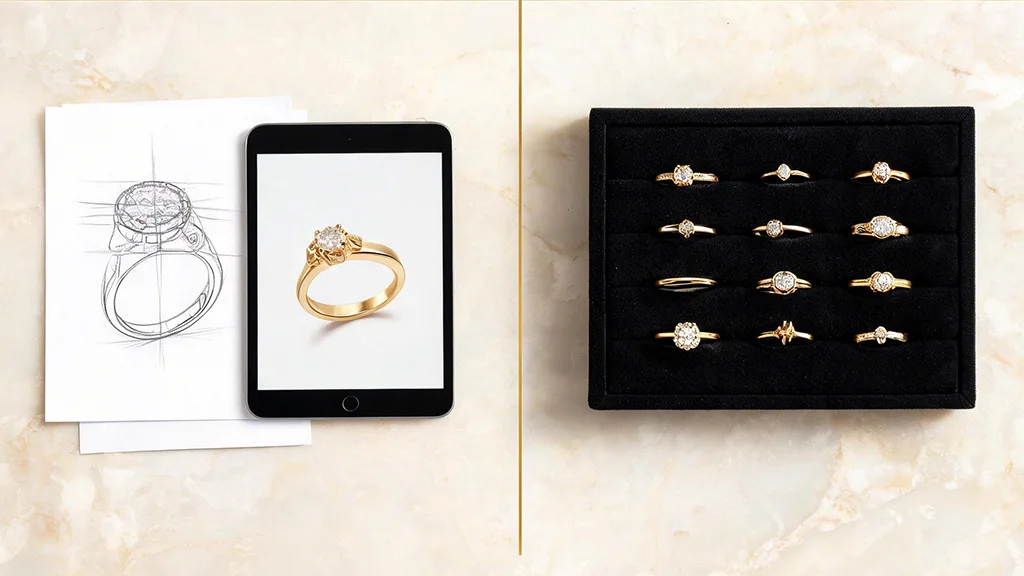
OEM stands for Original Equipment Manufacturer. In jewelry, it means the factory produces pieces to your design and specification. You own the concept. The manufacturer provides the production capability.
What you bring: a design (a sketch, reference images or a finished CAD or 3D file) and a specification covering metal and purity, stone type, size and grade, finish, dimensions and target quantities. Many manufacturers also have CAD designers who can turn a sketch into a production-ready model, usually as a development service.
How an OEM jewelry project works
- Brief and specification.You define the design, materials, dimensions and quantities.
- CAD or 3D model.The design is modeled and rendered for your approval.
- Master and tooling.A 3D-printed or hand-carved master is made and, where needed, molds are produced.
- Prototype sample.A cast and finished sample is checked for fit, weight, stone setting and comfort.
- Revisions and approval.Adjustments continue until you sign off a pre-production sample.
- The full order is made to the approved sample.
- Quality control.Pieces are inspected against the approved sample and specification.
- Packaging and shipping.Finished jewelry is packed, including your branded packaging.
Pros of OEM
- Full creative controlover shape, proportions, materials and finish.
- Exclusivity:the design is yours, which supports a distinctive brand identity and stronger pricing power.
- Ownership of design assets,including CAD files, when agreed in writing.
Cons of OEM
- Higher upfront costfor development, masters, molds and sampling rounds.
- Longer lead timebecause design development and approval come before production.
- Design risk:a design that looks right in a render may need changes to be castable, durable and comfortable to wear.
Ideal für: design-led brands, signature collections, brands with proven demand for a style, and anyone for whom exclusivity is part of the value.
What Is ODM Jewelry Manufacturing?
ODM stands for Original Design Manufacturer. The factory’s in-house design team creates collections, and you select pieces from the catalog, make agreed modifications and sell them under your brand.
How an ODM jewelry project works
- Browse the catalogand shortlist styles that fit your customers.
- Specify your changes,such as metal, stone, size, finish or engraving.
- Review a samplemade to your specification.
- Approve and produce.The order goes into production with quality control and shipping as in OEM.
Pros of ODM
- Lower cost to start,because molds and designs already exist.
- Faster launch,with no design stage.
- Lower MOQs,which suits testing new styles or markets.
- Lower design risk,because the designs are already production-proven.
Cons of ODM
- Less exclusive:other buyers may sell the same or similar designs.
- Limited customization,usually small changes rather than a new design.
- Brand identity depends on you:differentiation has to come from selection, styling, packaging and service.
How to reduce the sameness risk
The biggest ODM risk is not quality. It is sameness. You can reduce it by:
- Asking for exclusive variations, such as a unique stone, metal color, size or engraving combination.
- Agreeing a written exclusivity periodfor a design in your market, or buying the design outright.
- Asking how long a design has been in the catalogand whether it has been sold to others.
- Building a distinct look through packaging, photography and styling,not only product.
ODM+ and Private Label: The Middle Ground
Between pure OEM and pure ODM sits a model many brands actually use. ODM+ (modified ODM) starts from a factory design, but you change enough, such as proportions, stone layout, clasp or detailing, that the result is distinctive. Who owns your modifications depends on your agreement, so confirm it.
Private label is the lightest model. You choose ready-made pieces and apply your brand through a logo stamp, tags and packaging. There is little or no design change. It is the fastest and lowest-cost way to put products on sale, and a sensible way to test a category before investing in development.
The practical difference: ODM lets you change the design, while private label usually limits you to branding. Industry terms such as white label and contract manufacturing are also used loosely, so always ask a manufacturer to list exactly what you can change and who owns what.
Cost, MOQ and Lead Time Compared
Faktor | OEM | ODM | Private label |
Upfront development and tooling | Hoch | Niedrig | Keiner |
Typical MOQ per design | Höher | Untere | Niedrigster |
Time to first sample | Longest | Medium | Shortest |
Time to launch | Longest | Medium | Shortest |
Pricing power | Highest (unique product) | Medium | Lower (easier to compare) |
Cost, MOQ and Lead Time Compared
Where the money goes
- Design and CAD:modeling, rendering and revisions.
- Masters and tooling:the physical patterns and molds used to make the piece.
- Sampling:one or more rounds before you approve production.
- Materialien:metal weight and stones are often the largest share of the cost of fine jewelry.
- Labor:casting, finishing and especially stone setting.
- Quality control and packaging.
Why OEM can still make sense at volume
OEM costs are front-loaded. One-off development and tooling are spread across every piece you order, so the per-piece impact shrinks as quantity grows.
Lieferzeiten
As a general pattern, private label can ship from existing stock or a short production run. ODM needs time for your modifications and sample approval. OEM adds design development, master making and sampling rounds before production begins. Exact timelines depend on design complexity, revision rounds, stone availability and factory capacity, so ask any manufacturer for a stage-by-stage timeline.
Fine Jewelry Considerations: Solid Gold, Lab-Grown Diamonds and Gemstones
Most OEM vs ODM advice is written for fashion, silver or plated jewelry. Fine jewelry adds factors that change the decision.
Metal weight and pricing
In solid gold, metal is a major cost, so design weight matters. OEM lets you engineer thickness, hollowing and proportions to hit a target weight and price point. ODM designs come with fixed weights, which you can compare but rarely change. Because gold prices move, ask how quotes are calculated and how long a quote stays valid.
Gold purity options
Purity is expressed in karats: 9K is 37.5% gold, 10K is 41.7%, 14K is 58.5% and 18K is 75%. Higher purity is softer and costs more; lower purity is harder and more affordable. Confirm which purities each model supports for a given design, and that purity is tested and marked correctly.
Stone sourcing and specification
Lab-grown diamonds, moissanite, cubic zirconia and natural gemstones are specified by size, shape and quality grade. Catalog (ODM) designs are typically built around standard stone sizes that are readily available, which supports faster delivery. Custom (OEM) designs with unusual sizes, cuts or matched sets can extend sourcing time and cost. Lab-grown stones should always be clearly identified as such.
Setting complexity
Prong, bezel, pavé and cluster settings need skilled stone setting and careful inspection. A more complex OEM design raises labor cost and quality-control requirements, so review settings with your manufacturer before you finalize a design.
IP, Tooling and Design Ownership
Ownership is where many jewelry projects go wrong, and it is often the least discussed topic. Before you commit, get clear answers to these questions.
- Who owns the CAD files?In OEM, the answer should be you.
- Who owns the masters and molds,and can the factory use them for other customers?
- Can you move production elsewhereand take your files and molds with you?
- Is there an NDAand a written commitment not to reuse your designs?
- What exclusivity appliesto ODM or ODM+ designs, for how long and in which markets?
- May the factory show your piecesin its portfolio or marketing?
Protect your brand as well as your designs. Trademark and design-right rules differ by country, so register your brand name and logo in the markets where you will sell and take qualified legal advice on contracts. This article is general information, not legal advice.
Which Model Should You Choose?
Work through these questions and see where your answers lean.
Question | If yes, lean toward |
Do you have finished designs or CAD files that are central to your brand? | OEM |
Do you need products on sale in weeks rather than months? | ODM or private label |
Is exclusivity essential to how you position the brand? | OEM, or ODM with a written exclusivity agreement |
Is your budget for development and tooling limited? | ODM or private label |
Are you still learning what your customers want? | Private label or ODM |
Do you have proven bestsellers and plan to sell at volume? | OEM for those styles |
By stage of business
- New brand:start with private label or ODM to launch quickly and learn what sells.
- Growing brand:use ODM+ or OEM for hero pieces while keeping ODM for range depth.
- Established brand:move signature and best-selling styles to OEM for exclusivity and control, and use ODM for seasonal or test pieces.
Which Model Should You Choose?
Few brands stay in one model for long. A common path looks like this:
- Test:launch with private label or ODM to learn which styles, price points and sizes sell.
- Learn:use sales and customer feedback to identify your best performers.
- Invest:commission OEM versions or modified designs of those winners.
- Blend:keep ODM or private label for filler lines and seasonal drops.
Working with one manufacturer that runs all three models avoids re-sampling and lost knowledge when you move up. When an ODM piece performs well, ask about buying the design for exclusive use, and always keep your own copies of final CAD files and approved samples.
How Provence Jewellery Works with OEM and ODM Clients
Provence Schmuck is a fine jewelry manufacturer producing solid gold jewelry, lab-grown diamond jewelry, moissanite, cubic zirconia and natural gemstone pieces. We work with retail brands and wholesale partners on all three models: OEM from your designs, ODM from our collections with your modifications, and private label.
OEM project | ODM project | Private label | |
What we need from you | Design files or sketches and a specification | Chosen styles and any modifications | Chosen styles and branding assets |
What happens next | CAD, master, sample, revisions, approval | Customized sample and approval | Branding sample and approval |
Then | Production, quality control, packaging and shipping | Production, quality control, packaging and shipping | Production, quality control, packaging and shipping |
Häufig gestellte Fragen
With OEM, you supply the design and the factory builds it to your specification. With ODM, the factory supplies a ready-made design that you customize and brand.
ODM is usually cheaper to start because molds and designs already exist. OEM has higher upfront development and tooling costs, although their per-piece share shrinks as order quantity grows.
They are similar but not identical. Private label is mainly your branding on ready-made pieces. ODM also lets you modify the design, such as stones, metal, size or finish.
Yes, if the manufacturer supports lower MOQs. Expect development and tooling to represent a larger share of each piece’s cost on small orders.
In OEM, the design should belong to you, and the manufacturer should confirm this in writing. In ODM, the factory generally owns the design unless you agree otherwise.
Yes. Many brands start with ODM or private label, then commission OEM versions of their bestsellers once they understand their customers.
Private label is typically fastest, ODM is in the middle, and OEM takes longest because of design development, tooling and sampling. Ask for a stage-by-stage timeline for your specific design.