
What is October’s Birthstone? Opal & Tourmaline Guide
- Written by Provence Team
- Updated on September 1, 2026
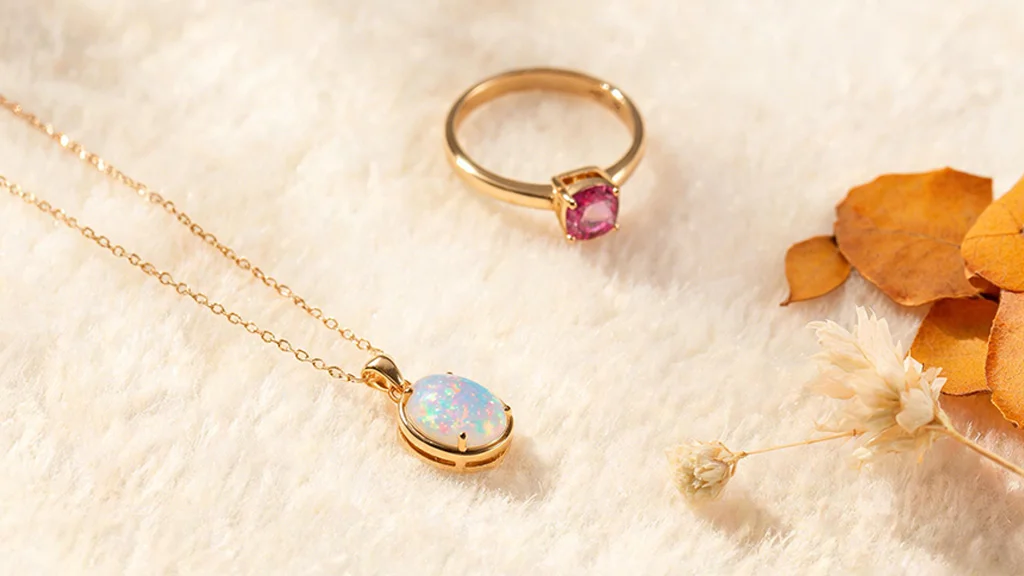
Table of Contents
Most months have a single birthstone, but October — along with March, June, August, and December — has more than one. The tradition dates back to 1912, when the National Association of Jewelers (NAJ) of the United States formalized a modern birthstone list. Opal, the historical October gem, had long been prized for its beauty but was considered soft and delicate. To give October-born jewelry lovers a more durable, everyday-wearable option, the NAJ added tourmaline — typically pink tourmaline — alongside it.
Today, both stones are recognized worldwide as October's birthstones, giving buyers a choice based on budget, durability needs, and personal style.
Opal: The Traditional October‘s Birthstone
Meaning & History
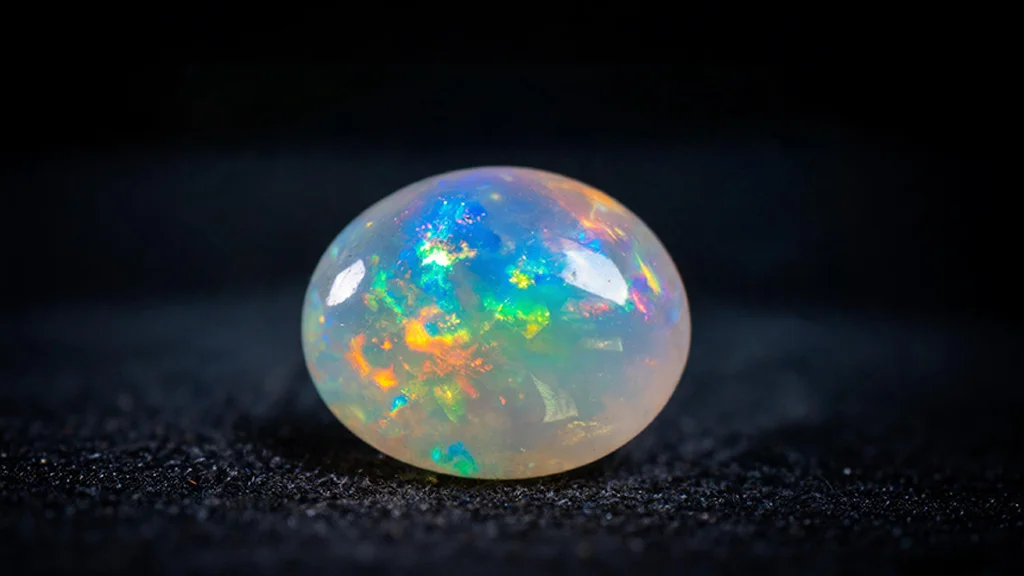
The name "opal" is believed to trace back to the Sanskrit word upala, meaning "precious stone," which became opalus in Latin and opallios in Greek — roughly translating to "to see a change in color." That name captures opal's defining trait: play-of-color, a shimmering rainbow effect caused by the diffraction of light through microscopic silica spheres inside the stone.
Ancient cultures wove rich mythology around opal. The Bedouins believed the stone fell from the sky during lightning storms. Ancient Greeks thought opal granted the gift of prophecy and protected against disease. Europeans regarded it as a symbol of purity, hope, and truth. Even Queen Victoria was famously fond of opal jewelry, helping revive its popularity in the 19th century.
Opal is also the gemstone traditionally given to mark a 14th wedding anniversary.
Where Opal Is Found
Opal deposits exist on nearly every continent, but a handful of regions dominate production:
- Australia — the world's largest source, producing roughly 90–95% of the world's precious opal. Lightning Ridge, New South Wales, is famed for rare black opal; Coober Pedy and Andamooka in South Australia produce white and crystal opal; Queensland yields boulder opal found nowhere else.
- Ethiopia — Wollo Province is the source of vivid "Welo opal," known for strong play-of-color and rising popularity since the early 2010s.
- Mexico — Querétaro state produces fire opal in yellow, orange, and red hues.
- Other sources — Brazil, Honduras, Indonesia, Madagascar, Peru, Turkey, and parts of the United States.
Opal Colors & Rarity
Opal falls into two broad classes: precious opal, which displays play-of-color, and common opal (or "potch"), which does not. Within precious opal, black opal is the rarest and most valuable, followed by boulder and crystal opal; white and grey opal are the most widely available. No two opals share the same pattern — the rarest, the harlequin pattern, features a broad, angular mosaic of color.
Hardness & Care
Opal ranks 5 to 6.5 on the Mohs hardness scale, making it noticeably softer than diamonds, sapphires, rubies, or emeralds — all of which can scratch it. Because of this, opal jewelry should be stored separately from harder stones and treated gently:
- Clean only with warm, soapy water and a soft cloth.
- Avoid ultrasonic and steam cleaners.
- Keep away from high heat and sudden temperature changes, which can cause cracking.
Note that opal doublets and triplets (thin slices bonded to a backing) are especially sensitive to prolonged water exposure, which can weaken the adhesive.
Tourmaline: The Modern October‘s Birthstone
Meaning & History
Tourmaline's name comes from the Sinhalese word toramalli, meaning "stone of mixed colors" — a fitting description for a gem that can display more color variety than almost any other. For centuries, tourmaline was mistaken for other gemstones: a 16th-century Spanish explorer found green tourmaline in Brazil and believed it was emerald, and one of the "rubies" in the Russian crown jewels later turned out to be red tourmaline. Scientists didn't recognize tourmaline as a distinct mineral species until the 1800s.
Tourmaline is the gift traditionally associated with an 8th wedding anniversary.
Where Tourmaline Is Found
- Brazil — the most significant historical source, particularly the pegmatite deposits of Minas Gerais; Paraíba State is the origin of rare, copper-bearing "paraíba" tourmaline discovered in the late 1980s.
- Africa — Nigeria and Mozambique also produce paraíba-type copper-bearing tourmaline; Kenya and Madagascar are additional sources.
- United States — Maine (Mount Mica, the Dunton mine) and California (Himalaya mine, San Diego County) have long, historic tourmaline mining traditions.
- Other sources — Afghanistan and Pakistan.
Color Range
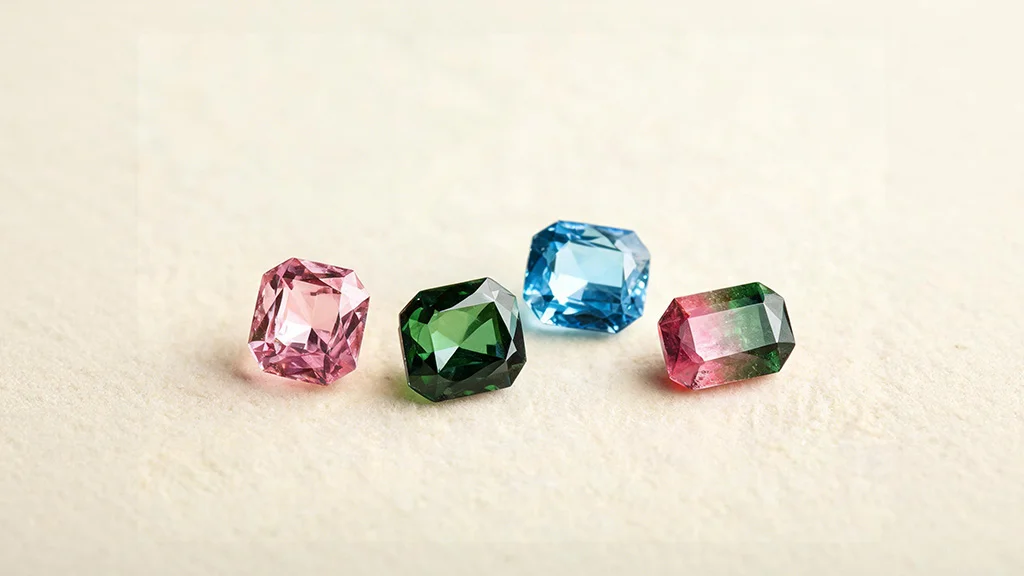
Tourmaline occurs in nearly every color, often within a single crystal. Notable varieties include rubellite (pink to red), indicolite (blue), chrome tourmaline (emerald green), watermelon tourmaline (pink core with a green edge), and paraíba tourmaline — the rarest and most valuable, prized for its intense neon blue-green hue caused by trace copper.
Hardness & Care
Tourmaline rates 7 to 7.5 on the Mohs scale, making it considerably more durable than opal and well-suited to daily wear, including rings and bracelets.
- Clean with warm, soapy water and a soft brush.
- Avoid ultrasonic cleaners, which can risk fracturing some heat- or irradiation-treated stones.
Protect from extreme or sudden temperature changes.
Opal vs Tourmaline: Side-by-Side Comparison
Choosing between October's two birthstones often comes down to lifestyle, budget, and how the jewelry will be worn. Use this comparison as a quick reference:
|
Attribute |
Opal |
Tourmaline |
|---|---|---|
|
Mohs Hardness |
5 – 6.5 (soft, needs care) |
7 – 7.5 (durable, everyday wear) |
|
Best For |
Earrings, pendants, occasional-wear rings |
Rings, bracelets, daily-wear jewelry |
|
Color Range |
Rainbow "play-of-color" on white, black, or crystal base |
Nearly every color; pink, green, blue, watermelon bi-color |
|
Rarest Variety |
Black opal (Lightning Ridge, Australia) |
Paraíba tourmaline (copper-bearing, neon blue-green) |
|
Typical Price Range* |
$10–$1,000+ per carat (black opal can exceed this) |
$50–$800+ per carat (fine paraíba far higher) |
|
Zodiac Association |
Libra |
Libra, Scorpio |
|
Wedding Anniversary |
14th anniversary |
8th anniversary |
|
Care Method |
Warm soapy water only; avoid heat, chemicals, ultrasonic cleaners |
Warm soapy water and soft brush; avoid ultrasonic cleaners and heat |
Lab-Grown & Synthetic Opal: A Modern Alternative
Unlike diamonds, opal has been successfully synthesized since the 1970s, offering a more affordable and consistently available alternative to natural stone. Lab-grown opal is created by precipitating silica spheres in a controlled environment, replicating the same microstructure responsible for natural opal's play-of-color — often over a period of months rather than the millions of years natural opal formation requires underground.
Tourmaline, by contrast, is not commercially synthesized in a way that competes with natural material; nearly all tourmaline on the market is natural, though color-enhancing treatments such as heat and irradiation are common industry practice and should always be disclosed.
For jewelry brands and retailers, understanding whether a supplier offers natural, treated, or synthetic material — and whether that distinction is clearly disclosed to the end customer — is an essential part of responsible sourcing.
How to Choose Between Opal and Tourmaline
- Choose opal if: you want one-of-a-kind color movement, plan to wear the piece occasionally (earrings, pendants, evening jewelry), and don't mind extra care.
- Choose tourmaline if: you want a gem tough enough for daily wear, prefer a wide color palette to match personal style, or are shopping on a range of budgets, from affordable pink tourmaline to investment-grade paraíba.
- Consider both: many October birthstone collections pair opal and tourmaline in the same piece, celebrating the full duality of the month.
Buying October Birthstone Jewelry: A Global Guide
October birthstone jewelry is purchased differently depending on where in the world the buyer is shopping and celebrating.
Approximate retail price ranges across markets:
|
Jewelry Type |
USD |
|---|---|
|
Opal stud earrings (silver) |
$60 – $150 |
|
Opal pendant (14K gold) |
$220 – $600 |
|
Pink tourmaline ring (14K gold) |
$300 – $900 |
|
Fine paraíba tourmaline piece |
$1,500+ |
A Note for Southern Hemisphere Buyers
Much of the cultural imagery around October birthstones — fall foliage, pumpkin spice, Halloween — is a Northern Hemisphere frame of reference. In Australia, the world's largest opal producer, October falls in spring, not autumn. For brands marketing globally, it's worth noting that October birthstone buyers in the Southern Hemisphere may connect more with opal's mining heritage and provenance story than with autumnal seasonal messaging.
Gifting Customs
In the UK and EU, birthstone jewelry is commonly gifted for birthdays and as a personalized, sentimental alternative to diamond jewelry. In the US, birthstone rings and pendants are popular push-present and graduation gifts as well. Multi-stone "mother's jewelry" featuring birthstones of children is a growing category across all three markets.
October's Birthstone FAQ
Both are official. Opal is the traditional, older birthstone; tourmaline was added in 1912 as a modern alternative. Neither is more "correct" than the other.
It's not recommended for rings worn daily, since opal ranks only 5–6.5 on the Mohs scale and can scratch or chip. Opal earrings and pendants, which see less impact, hold up better in daily rotation.
Black opal (from Lightning Ridge, Australia) and paraíba tourmaline (copper-bearing, neon blue-green) are considered the rarest and most valuable varieties of each stone.
Generally, yes, for comparable quality — though fine paraíba tourmaline can exceed the price of high-grade black opal per carat.
Both opal and tourmaline are associated with Libra (September 23–October 22); tourmaline is also linked to Scorpio.
Yes. Many October birthstone collections deliberately pair both stones in the same piece to represent the full month.
 English