
IGI vs GIA: Which Diamond Certification Should You Trust?
- Written by Provence Team
- Updated on June 23, 2026
Table of Contents
If you've spent any time comparing diamonds online, you've probably noticed that two stones with seemingly identical specs — same carat, same color grade, same clarity grade — can carry very different price tags. More often than not, the explanation isn't the diamond. It's the lab that graded it.
IGI and GIA are the two most commonly cited grading laboratories in the diamond trade, and the debate between them shows up constantly in engagement ring forums, on retailer FAQ pages, and in conversations between jewelers and the manufacturers who supply them. This guide breaks down what each lab actually does differently, where the grading gap comes from, and how to use that knowledge — whether you're buying one ring or sourcing stones for a jewelry business.
Quick answer: GIA (Gemological Institute of America) is a nonprofit lab founded in 1931, known for conservative grading and dominance in the natural diamond market. IGI (International Gemological Institute) is a for-profit lab founded in 1975, known for its global reach, faster turnaround, and leadership in grading lab-grown diamonds and finished jewelry. Neither certificate is “fake” or unreliable — they simply serve different corners of the diamond trade, and the right one depends on what you're buying.
IGI and GIA are the two most commonly cited grading laboratories in the diamond trade, and the debate between them shows up constantly in engagement ring forums, on retailer FAQ pages, and in conversations between jewelers and the manufacturers who supply them. This guide breaks down what each lab actually does differently, where the grading gap comes from, and how to use that knowledge — whether you're buying one ring or sourcing stones for a jewelry business.
The Gemological Institute of America (GIA) was founded in 1931 by Robert M. Shipley, a jeweler who saw an industry with no shared language for describing diamond quality. At the time, every jeweler graded diamonds by their own internal standard, which made it nearly impossible for buyers to compare stones or trust a seller's claims.
Shipley's solution became the foundation of the modern diamond trade: a standardized scale built around four measurable characteristics. In 1953, GIA formalized this into the 4Cs — cut, color, clarity, and carat weight — and began issuing the diamond grading reports that, in structure, still look much the same today.
GIA operates as a nonprofit organization headquartered in Carlsbad, California, with laboratories in major diamond trade centers worldwide. Its nonprofit status is part of its identity: GIA positions its mission around research and consumer education rather than commercial throughput, and that framing has helped it become the most widely recognized name in diamond certification.
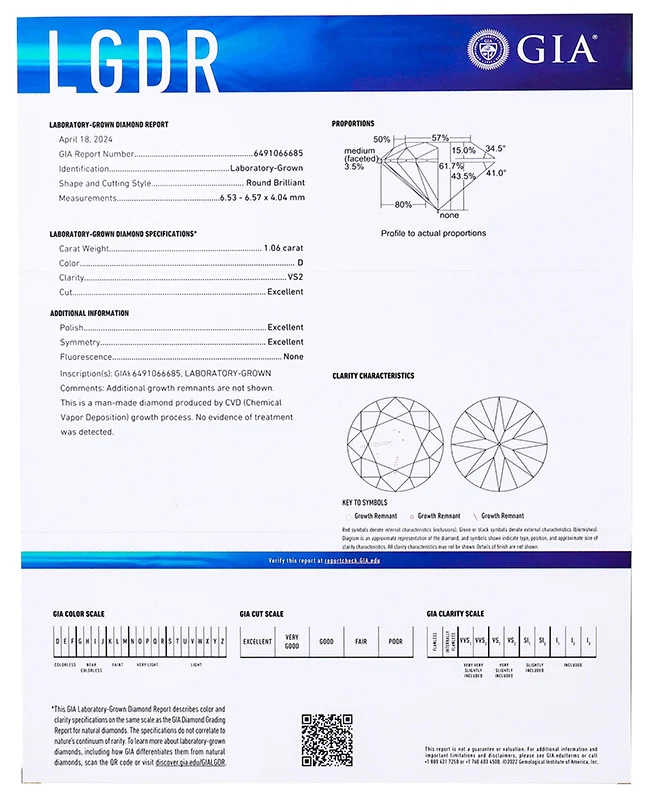
How GIA Grades a Diamond
A GIA grading report is built around a structured, multi-stage process designed to minimize bias:
- Diamonds are reviewed anonymously where possible, so graders evaluate the stone rather than the submitter.
- Color is assessed under controlled lighting against master comparison stones, using GIA's D-to-Z scale.
- Clarity is graded under 10x magnification, plotting inclusions and blemishes on a diagram included in the report.
- Cut grade (Excellent to Poor) is calculated from proportions, symmetry, and polish — but only for round brilliant diamonds; fancy shapes receive a description rather than a formal cut grade.
- Multiple graders independently evaluate color and clarity, and discrepancies are reconciled before a final grade is issued.
This redundancy is a major reason GIA has a reputation for conservative, consistent grading. GIA is generally considered less likely to “overgrade” a stone — that is, to assign a more flattering color or clarity grade than an independent appraiser might. That consistency is precisely what the resale and appraisal markets have come to rely on.
GIA grades both natural and lab-grown diamonds today, though it came to lab-grown grading later than IGI — GIA began issuing full grading reports for lab-grown stones only in 2020, years after IGI had already established itself in that segment.
The International Gemological Institute (IGI) was founded in 1975 in Antwerp, Belgium — one of the world's most significant diamond trading hubs. Unlike GIA, IGI operates as a for-profit company, and that commercial structure has shaped much of how it grew.
IGI built a global network faster than most competitors, eventually operating roughly 20 laboratories across major cutting and trading centers, with a particularly heavy concentration in India, where a large share of the world's diamond cutting and polishing takes place. IGI also expanded into gemology education, running schools at many of its locations.
The defining moment for IGI's modern reputation came with the rise of lab-grown diamonds. IGI was the first major laboratory to offer full grading reports for lab-grown stones, and it built deep institutional expertise in identifying growth method (CVD versus HPHT) and distinguishing lab-grown from natural material at scale — including melee-sized stones, the small accent diamonds used throughout fine jewelry manufacturing.
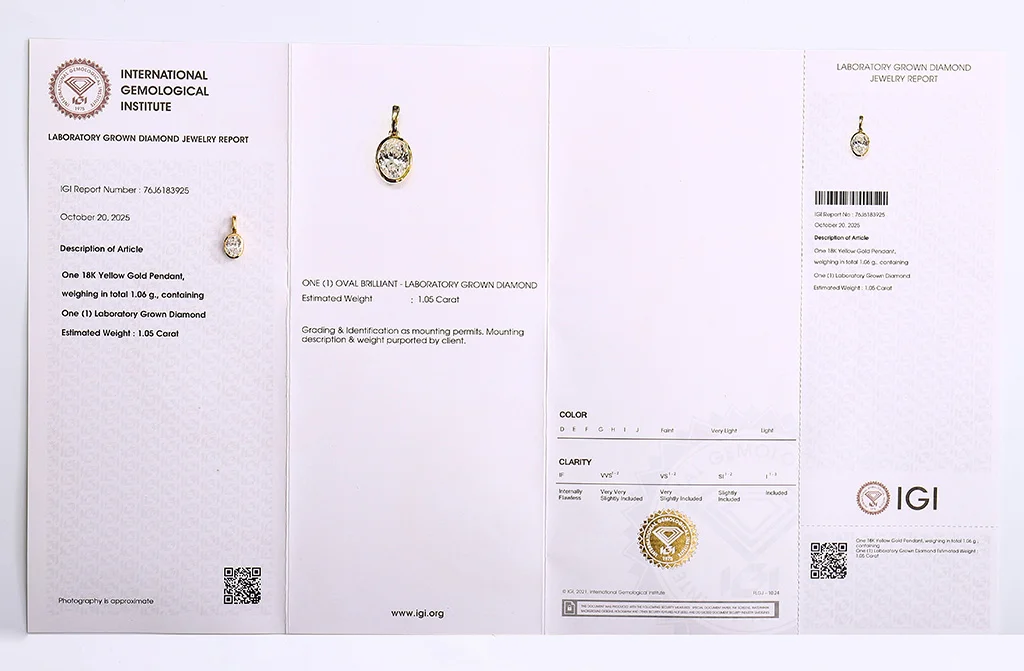
How IGI Grades a Diamond
IGI's grading methodology follows the same broad 4Cs framework that GIA established, but with some differences in practice and reporting:
- An initial screening confirms whether a stone is natural or lab-grown and flags any detectable treatments before formal grading begins.
- Color and clarity are graded under comparable conditions to GIA — controlled lighting, master stones, and 10x magnification — though IGI's color and clarity calls are widely viewed in the trade as running slightly more generous than GIA's for a comparable stone.
- IGI reports frequently include more granular detail than a standard GIA report, such as more descriptive symmetry and fluorescence notes.
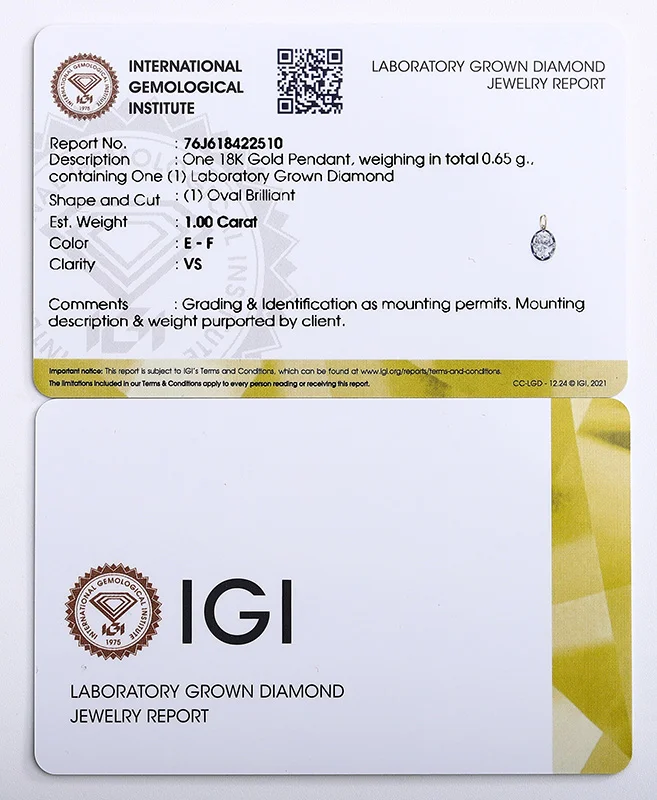
- Lab-grown reports are printed on a distinct (often yellow) report format and include the growth method, and the girdle of the diamond itself is typically laser-inscribed with “laboratory grown” as a built-in consumer safeguard.
- IGI is one of the only major labs that also grades and appraises finished jewelry, not just loose stones — useful for manufacturers and retailers selling set pieces rather than loose diamonds.
IGI's reputation for thoroughness on lab-grown stones is well earned. For natural diamonds, however, the trade consensus — echoed across nearly every major retailer's educational content — is that IGI's grading runs measurably more lenient than GIA's.
IGI vs GIA: Side-by-Side Comparison
The table below summarizes where the two labs genuinely differ. Treat it as a starting reference, not a verdict — the right choice still depends on the type of diamond and what you plan to do with it.
|
Feature |
GIA |
IGI |
|---|---|---|
|
Founded |
1931, Carlsbad, California |
1975, Antwerp, Belgium |
|
Status |
Nonprofit |
For-profit |
|
Primary specialty |
Natural diamonds; created the 4Cs system |
Lab-grown diamonds; finished jewelry appraisal |
|
Grading tendency |
Conservative; rarely overgrades |
Comparatively lenient on color/clarity |
|
Report detail |
Concise; focused on the 4Cs plus plot |
Often more granular (fluorescence, symmetry notes) |
|
Cut grading scope |
Round brilliants only |
Round brilliants only |
|
Lab network |
Fewer locations; concentrated in major trade hubs |
~20 labs worldwide, concentrated in India |
|
Price impact |
Tends to command a premium, especially on naturals |
Generally lower-cost reports and stones |
|
Best suited for |
High-value natural diamonds, resale-conscious buyers |
Lab-grown diamonds, budget-conscious buyers, finished jewelry |
The Grading Strictness Gap, Explained
This is the detail that actually matters for your wallet: it is widely documented across the diamond trade that the same physical diamond can receive a noticeably different grade depending on which lab evaluates it.
A diamond that earns an H color grade from GIA might be labeled G color by IGI. A clarity grade of VS2 under GIA's standard might appear as VS1 on an IGI report for the same stone. Neither lab is being dishonest — grading involves trained human judgment operating within each lab's own internal calibration, and small differences in how “borderline” calls are made compound into a real, observable pattern industry-wide.
IGI and GIA are the two most commonly cited grading laboratories in the diamond trade, and the debate between them shows up constantly in engagement ring forums, on retailer FAQ pages, and in conversations between jewelers and the manufacturers who supply them. This guide breaks down what each lab actually does differently, where the grading gap comes from, and how to use that knowledge — whether you're buying one ring or sourcing stones for a jewelry business.
The practical impact of this is straightforward: an IGI-graded diamond marketed as “G color, VS1” may, in GIA's system, actually be closer to an H color, VS2 stone. That's not a problem if you understand it going in and are comparing prices accordingly — but it becomes a problem if you're comparing an IGI-graded stone to a GIA-graded stone as though the grades mean exactly the same thing.
This is also precisely why the grading gap does not change a diamond's actual physical characteristics. The carbon doesn't move. What changes is how confidently you can compare it to other diamonds on the market, and how much a future buyer, appraiser, or insurer will trust the number on the report.
Natural vs. Lab-Grown: Which Lab Fits Which Stone
Natural Diamonds
For natural diamonds, particularly anything intended as a long-term purchase, an heirloom piece, or a stone you may want to resell or trade up later, GIA remains the de facto standard. Its report carries the most weight with independent appraisers, insurers, and resale buyers, largely because of its long track record of conservative, repeatable grading.
Lab-Grown Diamonds
For lab-grown diamonds, the calculus shifts. IGI has the deeper institutional history with lab-grown grading and a reporting format built specifically around growth-method disclosure. GIA now grades lab-grown stones too, using the same rigorous standards it applies to naturals, but it entered this segment later than IGI.
Because lab-grown diamonds are produced rather than mined, rarity isn't the primary driver of value the way it is for natural stones — supply can scale, and prices have trended downward as production has expanded. That means the certificate matters slightly differently here: it's less about resale premium and more about verifying specifications match what you're paying for.
Price and Resale Value: What the Numbers Actually Show
Every major retailer touches on this, but rarely with real numbers. Here's the more concrete version:
- On natural diamonds, a GIA report is consistently associated with a price premium over an equivalent IGI report — buyers and the resale market alike treat the GIA grade as the more conservative, trustworthy baseline.
- Because IGI's grading runs more leniently, two diamonds advertised at the same grade (say, both “VS1, G color”) are not necessarily equivalent in actual quality if one is GIA-graded and the other IGI-graded. This is the single most common point of confusion for first-time buyers comparing prices across retailers.
- On lab-grown diamonds, the certificate has far less impact on price than it does for naturals. Lab-grown pricing is driven primarily by production cost, carat size, and the specific 4Cs — not by which lab issued the report.
- Resale value for any diamond, lab-grown or natural, is rarely close to retail price regardless of certification. A grading report documents quality; it does not guarantee a resale floor.
If you're budget-conscious and buying a lab-grown stone, the lab name on the certificate matters far less than the specifications themselves. If you're buying a natural diamond as a long-term investment or heirloom piece, paying the premium for a GIA report is generally the safer call.
Beyond IGI and GIA: Where HRD and Other Labs Fit In
If you're shopping in Europe, you'll likely encounter a third name: HRD Antwerp. Operated by the Antwerp World Diamond Centre, HRD is a major European grading authority, particularly influential for diamonds that pass through Belgian cutting and trading channels. It applies a grading system similar in structure to GIA's, and it carries strong regional recognition across the EU that IGI and GIA don't fully replicate.
You may also see AGS (American Gem Society), known for its sophisticated light-performance cut grading and often paired with GIA reports on high-end stones; EGL, a name that has historically carried less consistency across its various regional branches; and GCAL, a smaller lab known for issuing guaranteed (rather than opinion-based) certifications.
None of these labs replaces IGI or GIA — they simply reflect that the diamond trade is genuinely international, and different regions have built trust around different institutions. If you're buying from a European jeweler or manufacturer and a stone carries an HRD report instead of IGI or GIA, that's not a red flag; it may simply reflect where the diamond was cut and traded.
How Manufacturers and Jewelers Think About Certification
Most consumer guides on this topic are written entirely from the buyer's chair — understandably, since that's who's searching for the comparison. But certification plays a different, equally important role earlier in the supply chain, and understanding it helps explain why retailers source the way they do.
For an OEM or ODM jewelry manufacturer producing at volume, certification isn't just a label that goes on a finished piece — it's a quality control checkpoint built into sourcing. A few things typically matter at that stage:
- Consistency across a batch. When a manufacturer is sourcing dozens or hundreds of stones for a production run, having all of them graded by the same lab, under the same standard, matters more than which specific lab is used — it keeps the batch internally comparable.
- Melee and accent-stone screening. Finished jewelry often uses small diamonds in pavé, halo, or accent settings, and verifying that these batches are accurately identified as natural or lab-grown at scale is a real operational task, not just a retail talking point.
- Matching the certificate to the market. A manufacturer producing for the US wholesale market may lean toward GIA-graded centerpiece stones because that's what buyers expect to see; the same manufacturer producing for price-sensitive lab-grown lines may use IGI as the standard, simply because it's the more established lab for that category.
- Report format compatibility. Retailers integrating grading data into product listings, e-commerce filters, or appraisal documentation need reports that are consistently formatted and easy to verify — another reason large buyers often standardize around one or two labs rather than mixing several.
This is also where a manufacturer's own quality control adds a layer the certificate alone doesn't cover. A grading report describes the stone; it doesn't guarantee the setting, the metal purity, or the craftsmanship around it. Buyers evaluating a finished piece of jewelry, not just a loose stone, are really evaluating two things at once: the diamond's grading report and the manufacturer's own production standards.
How to Verify an IGI or GIA Certificate
Both labs offer free online verification tools, and checking a report takes less than a minute:
- Locate the report number printed on the certificate. It's often laser-inscribed on the diamond's girdle as well, viewable under magnification.
- Visit the issuing lab's official verification page directly — gia.edu for GIA reports, igi.org for IGI reports — rather than clicking a link from a third-party site or marketplace listing.
- Enter the report number. The tool will display the diamond's recorded specifications, which you can compare against what the seller has advertised.
- If the listing's claimed specs don't match the lab's official record, treat that as a serious red flag and ask the seller to explain the discrepancy before purchasing.
Which Should You Choose?
There's no universal right answer — only the right answer for your specific purchase. Use this as a quick framework:
Choose GIA if:
- You're buying a natural diamond, especially above 0.50 carats.
- Resale value, insurance documentation, or long-term investment matters to you.
- You want the most conservative, broadly trusted grading available.
Choose IGI if:
- You're buying a lab-grown diamond.
- Budget is a primary consideration and you understand the grading gap.
- You're purchasing finished jewelry that needs an appraisal of the complete piece, not just a loose stone.
Consider HRD or AGS if:
- You're purchasing through European trade channels (HRD).
- Cut precision and light performance are your top priority on a high-end natural diamond (AGS).
Whichever lab issued the report, the certificate is a tool for comparison — not a guarantee of value. Pair it with a reputable seller, an independent appraisal for significant purchases, and (if you're buying finished jewelry) confidence in the manufacturer's own production standards.
Frequently Asked Questions
IGI is a legitimate, internationally recognized grading laboratory, and its reports are reliable documentation of a diamond's characteristics. It is not, however, regarded as equivalent to GIA in grading strictness for natural diamonds. The two organizations serve different parts of the market: GIA is the long-standing benchmark for natural stones, while IGI has built its reputation primarily around lab-grown diamonds and finished jewelry. “Good” depends on what you are buying and why.
GIA's grading process is widely regarded as more conservative, and its nonprofit, education-focused reputation carries decades of trade trust, especially in the resale and appraisal markets. That trust is reflected in pricing: a GIA report on a natural diamond can add meaningfully more market confidence — and often more dollars — than an equivalent IGI report on the same diamond. IGI's lower-cost grading model has made it the default for lab-grown stones, where rarity and resale value work differently than they do for natural diamonds.
It is a widely discussed pattern in the trade that IGI reports can run a grade or so more generous than GIA on the same stone, particularly for color and clarity. This does not mean IGI reports are inaccurate — grading still involves trained human judgment within a defined standard — but buyers comparing diamonds across labs should expect IGI's stated grade to sit at the more favorable end of what a GIA grader might assign to the identical stone.
Either is acceptable, but IGI has historically been the more common choice for lab-grown stones and was the first major lab to issue full grading reports for them. GIA began grading lab-grown diamonds more recently and applies the same conservative standards it uses for natural stones. If resale value or insurance documentation matters to you, a GIA report on a lab-grown diamond can carry slightly more weight in some markets, though the price gap on the certificate itself is usually smaller than on naturals.
Yes. Both labs operate internationally and their reports are recognized by jewelers, appraisers, and insurers across the US, UK, and EU. In Europe, you will also frequently encounter HRD Antwerp, a grading authority with strong regional recognition, particularly for diamonds sourced or cut through Belgian trade channels. None of the three replaces the others; each is simply more dominant in certain regions and certain segments of the market.
Both organizations offer free online report verification. Enter the report number printed on the certificate (and often laser-inscribed on the diamond's girdle) into the lab's official verification tool, and it will confirm the stone's recorded specifications. Always verify directly on the issuing lab's own website rather than through a third-party link.
Indirectly, yes. Insurers typically work from an independent appraisal rather than the grading report itself, but appraisers use the grading report as their starting reference. A GIA report's conservative grading is less likely to be revised downward on appraisal, while an IGI grade may occasionally be adjusted by an independent appraiser working from a different reference standard. Either way, keep the original grading report with your insurance documentation.
Final Thoughts
IGI and GIA aren't competitors fighting over the same exact customer — they're two laboratories that have grown into different, complementary roles across the diamond trade. GIA's conservative grading and nonprofit pedigree make it the standard-bearer for natural diamonds and resale confidence. IGI's speed, global reach, and early leadership in lab-grown grading make it the practical choice for a fast-growing segment of the market that GIA only recently began serving.
Neither certificate makes a diamond “better” on its own. What matters is understanding which standard you're reading, comparing grades within the same lab rather than across labs, and choosing the report that matches what you're actually buying — a natural stone built to last generations, or a lab-grown diamond built to deliver more carat for your budget today.
 English