
The 4Cs of Diamonds: Your Complete Buying Guide
- Written by Provence Team
- Updated on May 21, 2026
Table of Contents
Every diamond tells a story — of immense geological pressure, of centuries underground, of a craftsman's careful hands coaxing light from raw stone. But before a diamond becomes a ring, a promise, or a keepsake passed between generations, it must be understood. And understanding begins with four simple letters: Cut, Color, Clarity, and Carat.
The 4Cs are the universal language of diamond quality. Developed by gemologist Richard T. Liddicoat at the Gemological Institute of America (GIA) in the 1940s, this grading system gave buyers — for the first time — an objective way to evaluate and compare diamonds anywhere in the world. Before the 4Cs, purchasing a diamond was largely a matter of trust and guesswork. Today, the 4Cs are the foundation on which every reputable jeweler, gemologist, and buyer relies.
At Provence, we believe the best diamond purchase is an informed one. This guide will walk you through each of the four Cs in depth — not just what they are, but what they actually mean for how your diamond looks and what it costs. We'll also show you how to balance them intelligently against your budget, which is the one thing most guides leave out.
Here's what we'll cover the 4Cs of diamonds
|
The 4 Cs |
What It Measures |
Why It Matters |
|---|---|---|
|
Cut |
Proportions, symmetry & facet quality |
Determines sparkle and brilliance |
|
Color |
Presence or absence of body color |
Affects visual purity and rarity |
|
Clarity |
Internal inclusions & surface blemishes |
Impacts appearance and structural integrity |
|
Carat |
Weight of the stone |
Influences size and price |
Let's start with the C that matters most.
Diamond Cut: The Most Important of the 4Cs
If you could only master one of the four Cs, make it cut.
Cut is the single greatest determinant of a diamond's beauty. It's what separates a stone that seems lit from within — catching every ray of light and throwing it back in a dazzling display — from one that looks flat, glassy, and lifeless despite being technically flawless and colorless. And yet cut is also the most misunderstood of the 4Cs, often confused with a diamond's shape.
Cut and shape are not the same thing. Shape refers to the diamond's outline: round, oval, princess, emerald, pear, cushion, and so on. Cut refers to the quality of the craftsmanship — the precise arrangement of angles, proportions, and facets that govern how light travels through the stone.
How Light Behaves in a Diamond
When a ray of light enters a diamond, one of three things happens depending on the quality of the cut:
- Brilliance — white light reflects back through the top of the diamond (the "table"), creating that bright, mirror-like gleam.
- Fire — light disperses into spectral colors (the rainbow flashes you see), caused by the diamond acting like a prism.
- Scintillation — the pattern of light and dark as the diamond or the light source moves, creating sparkle.
An excellently cut diamond maximizes all three. Light enters, bounces between the angled facets, and exits back through the top. In a poorly cut diamond — one that is too shallow or too deep — light "leaks" out through the sides or bottom, escaping before it can be reflected back to your eye. The result is a dull, dark stone that no color or clarity grade can save.
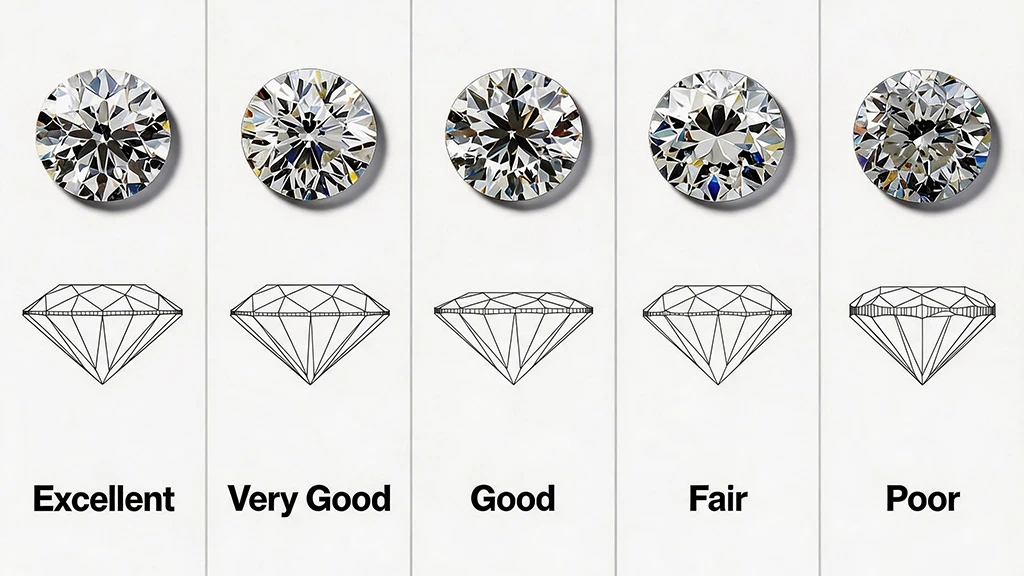
The GIA Cut Scale (Round Brilliants)
The GIA grades cut on a five-point scale for round brilliant diamonds: Excellent → Very Good → Good → Fair → Poor.
|
Grade |
Description |
|---|---|
|
Excellent |
Maximum light return, exceptional sparkle. The top 3% of diamonds. |
|
Very Good |
Slightly less precise proportions, still outstanding to the eye. |
|
Good |
Noticeably less brilliance; a compromise for buyers prioritizing size or color. |
|
Fair |
Significant light leakage; visible reduction in sparkle. |
|
Poor |
Poorly proportioned; not recommended for fine jewelry. |
At Provence, we only offer Excellent and Very Good cut grades. The difference between a Good and an Excellent cut is immediately visible under normal lighting. The premium for an Excellent cut is almost always worth it — it's the aspect of a diamond that no amount of money can fake after the fact.
What About Fancy Shapes?
Fancy shapes — ovals, cushions, pears, emeralds, marquises, and more — are not officially graded by GIA on cut quality (only round brilliants receive a cut grade). This makes selecting a well-cut fancy shape more nuanced. When evaluating fancy shapes, look for:
- Polish and Symmetry grades of Excellent or Very Good (GIA does grade these for all shapes)
- Length-to-width ratio — this determines the shape's visual proportions (e.g., a "classic" oval is typically 1.30–1.50)
- No bow-tie effect — an optical flaw common in elongated fancy shapes (ovals, pears, marquises) where a dark shadow resembling a bow tie appears across the center of the stone. Always view a video of the diamond before purchasing.
Provence's perspective: When we evaluate diamonds for our collection, cut is the first filter we apply. A lesser color or clarity grade in a beautifully cut stone will outperform a higher-graded stone with mediocre cut every single time.
Diamond Color: Understanding the D–Z Scale
There is a beautiful irony at the heart of diamond color grading: the "best" color grade for a white diamond means no color at all. The GIA color scale runs from D (perfectly colorless) to Z (light yellow or brown), and the closer a diamond is to D, the rarer — and more valuable — it is.
In practice, the color differences between adjacent grades are extraordinarily subtle — so subtle that even trained gemologists evaluate stones upside-down in a controlled laboratory environment, comparing them against master stones, to detect the difference between, say, an E and an F. Face-up in a ring on a finger, the gap between a D and a G is nearly invisible.
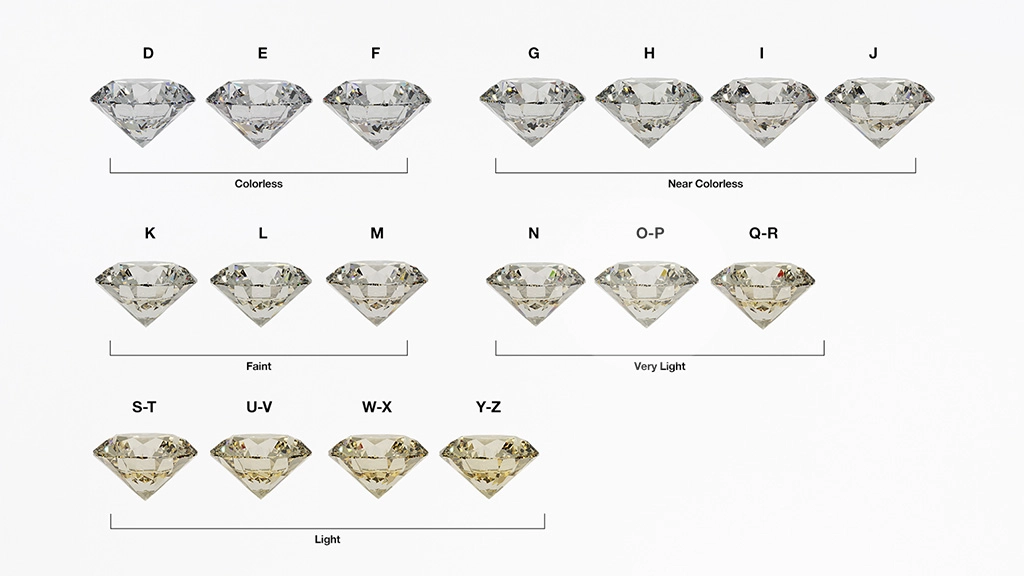
The GIA Color Scale
The GIA D-to-Z color scale runs from D (perfectly colorless) to Z (light yellow or brown), and the closer a diamond is to D, the rarer — and more valuable — it is.
|
Grade Range |
Category |
What It Looks Like |
|---|---|---|
|
D, E, F |
Colorless |
Icy white, virtually indistinguishable from each other face-up |
|
G, H, I, J |
Near Colorless |
Slight warmth detectable only when compared directly to colorless stones |
|
K, L, M |
Faint Color |
Noticeable warmth visible to the naked eye, especially in larger stones |
|
N-Z |
Light to Very Light Color |
Visible yellow or brown tint |
For most buyers, the sweet spot is the G–I range. These diamonds appear white to the naked eye, face-up in a ring, but are typically priced 20–40% below D–F stones. That savings can go directly toward a better cut or larger carat weight.
The Metal Effect: Your Most Underrated Decision
Here's something most guides don't tell you: the color of your setting metal has a dramatic impact on how diamond color reads to the eye.
White gold and platinum reflect cool, white light into the stone. This amplifies any warmth or color tint in the diamond. If you're setting in platinum or white gold, prioritize D–F (colorless) or at minimum G–H (near colorless) to avoid the diamond looking noticeably yellow against the bright metal.
Yellow gold and rose gold do the opposite — the warmth of the metal blends with and masks any subtle yellow tint in the diamond. A G, H, or even I-color diamond will look perfectly white in a yellow gold setting, and often even richer and more brilliant than a D-color stone competing with the cooler metal. This means buyers choosing yellow or rose gold can comfortably save on color and redirect that budget elsewhere.
What About Fancy Color Diamonds?
Beyond the D–Z white diamond scale, diamonds can also occur in vivid natural colors: yellow, pink, blue, green, orange, red, and more. These "fancy color" diamonds are graded on an entirely different scale (from Faint to Fancy Vivid) and operate by inverse rules — the more intense and saturated the color, the more valuable the stone. Fancy color diamonds are entirely separate from white diamond color grading and are prized precisely for their color, not despite it.
Provence's perspective: We think of color grade as an indication of rarity rather than desirability. A G-color diamond is not a compromise — it's an excellent choice. In most settings, in most lighting conditions, it looks identical to a D.
Diamond Clarity: What You Can (and Can't) See
Every diamond is a natural miracle — formed under extraordinary heat and pressure over billions of years. It's no surprise that most carry the marks of that violent origin: tiny crystals trapped inside, microscopic fractures, wisps of internal cloud, or minuscule surface irregularities. These are called inclusions (internal) and blemishes (external), and together they determine a diamond's clarity grade.
The critical question clarity tries to answer is not "is this diamond perfect?" — almost none are. The real question is: can you see the imperfections with your naked eye?
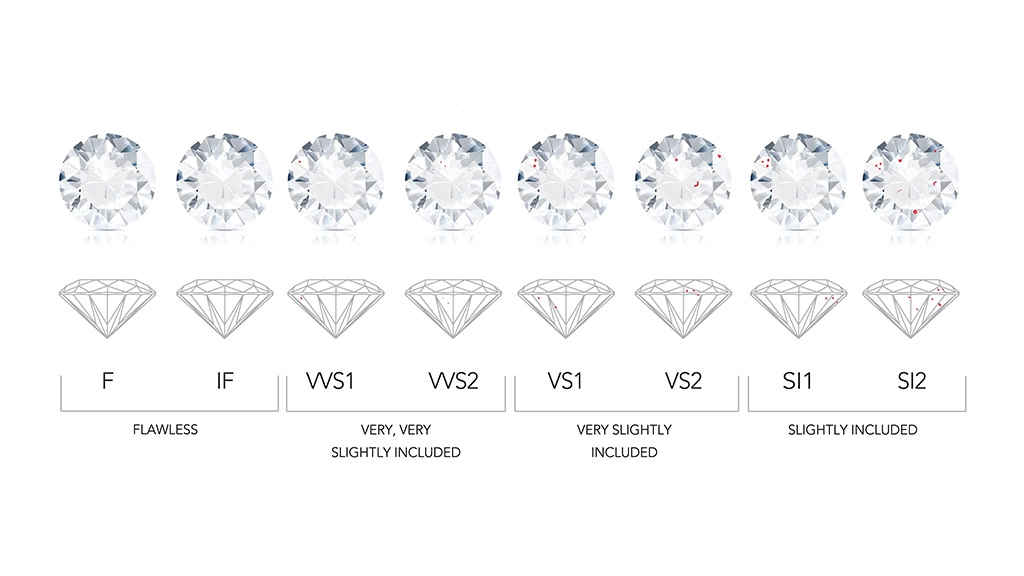
The GIA Clarity Scale
The GIA clarity scale has 11 grades, ranging from FL (Flawless) to I3 (Included).
|
Grade |
Name |
What It Means |
|---|---|---|
|
FL |
Flawless |
No inclusions or blemishes visible under 10× magnification |
|
IF |
Internally Flawless |
No inclusions; only minor blemishes under 10× |
|
VVS1 / VVS2 |
Very Very Slightly Included |
Inclusions extremely difficult to see under 10× magnification |
|
VS1 / VS2 |
Very Slightly Included |
Minor inclusions, difficult to see under 10× |
|
SI1 / SI2 |
Slightly Included |
Inclusions noticeable under 10× magnification |
|
I1 / I2 / I3 |
Included |
Inclusions visible to the naked eye; may affect durability |
The Most Important Concept in Clarity: Eye-Clean
An eye-clean diamond is one where no inclusions are visible to the naked eye when the stone is viewed face-up at arm's length under normal lighting — without magnification. This is the standard that actually matters in everyday wear.
A flawless (FL) diamond and an eye-clean VS2 look identical in a ring on a finger. The difference only emerges under a 10× loupe or microscope. For most buyers, paying for FL or IF clarity is paying for an attribute that exists only in a laboratory setting.
The practical guide to clarity by grade:
- FL to VVS: Exceptional purity. Recommended if this matters to you philosophically, or for important heirloom pieces. The premium is significant.
- VS1 to VS2: Excellent choice. Almost always eye-clean. The sweet spot for buyers who want confidence without overpaying.
- SI1: Often eye-clean, but requires careful selection. Always view the actual diamond (or a high-quality video) to verify. A well-placed SI1 inclusion — hidden under a prong, away from the center of the table — is invisible in a ring.
- SI2: Some are eye-clean; many are not. Proceed with caution, and never buy without seeing the diamond.
- I1 and below: Not recommended. Inclusions are visible to the naked eye and may affect the structural integrity of the stone.
How Cut Style Affects Clarity
The style of cut matters for how visible inclusions are. Brilliant-cut diamonds (round, oval, cushion, pear) have facet patterns that create a lot of "noise" — the movement of light masks inclusions effectively. Step-cut diamonds (emerald cut, Asscher cut) have large, open facets like windows that offer a clear view into the stone's interior. Step cuts require a higher clarity grade — typically VS1 or better — to appear eye-clean, while an SI1 might look completely clean in a round brilliant.
A Note on Clarity Treatments
Some diamonds on the market have undergone clarity treatments — laser drilling to remove dark inclusions, or fracture filling to hide cracks. These treatments can improve the appearance of a lower-clarity stone but they don't improve its actual quality, and filled fractures can be damaged by heat during jewelry repair.
At Provence, we only offer natural, untreated diamonds. Every stone in our collection is accompanied by its full GIA or IGI grading report.
Provence's perspective: VS2 is our personal recommendation for buyers who want genuine quality without paying the FL/VVS premium. For buyers watching their budget carefully, a hand-selected SI1 in a round brilliant is one of the best values in diamonds.
Diamond Carat Weight: Size vs. Value
Of all the 4Cs, carat is the one most people have heard of — and the one most frequently misunderstood. Carat is a measure of weight, not size. One carat equals 200 milligrams. The word itself derives from "carob" — ancient traders used carob seeds as a counterweight on their scales because the seeds were remarkably consistent in weight.
Weight and visual size are closely related but not identical, and the difference matters enormously to buyers.
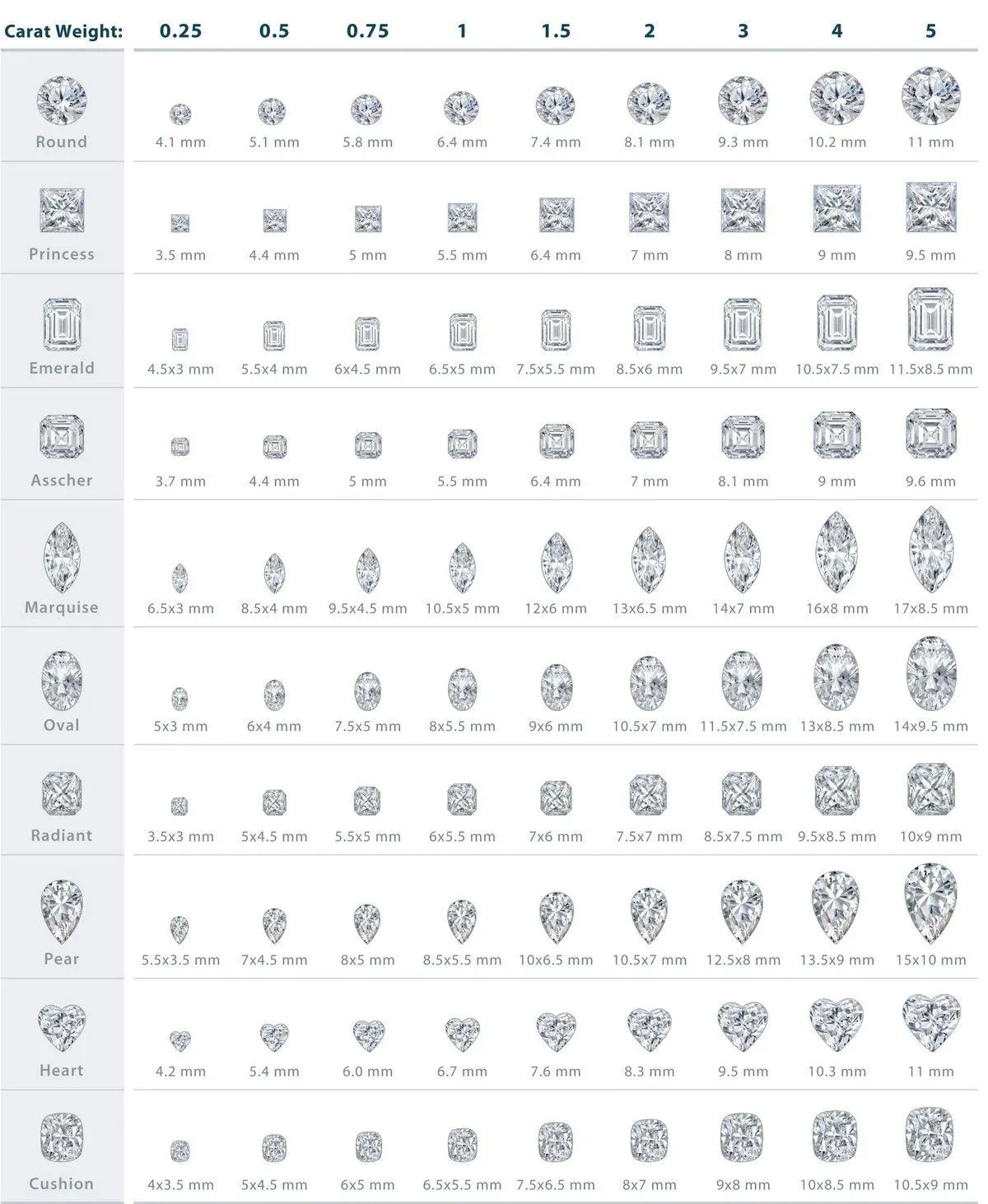
Carat Weight vs. Actual Size
Two 1-carat round diamonds can have noticeably different face-up diameters depending on their cut proportions. A well-cut 1.00ct round brilliant has a diameter of approximately 6.5mm. A poorly proportioned 1.00ct stone — one that is cut too deep — might measure only 6.0mm across, appearing smaller despite weighing exactly the same.
This is another reason cut matters so much. When you sacrifice cut quality to get a larger carat number, you may actually end up with a diamond that looks smaller, not larger.
The "Magic Size" Phenomenon
Diamond prices don't increase smoothly as carat weight climbs — they jump at psychologically significant weights, commonly called "magic sizes": 0.50ct, 0.75ct, 1.00ct, 1.50ct, and 2.00ct.
A 0.99ct diamond and a 1.00ct diamond look virtually identical to the naked eye (a difference of roughly 0.1mm in diameter), but the 1.00ct stone can cost 15–30% more simply because it crosses the magic threshold. Savvy buyers shop just below these boundaries — 0.90–0.95ct instead of 1.00ct, for instance — and redirect the savings toward cut, color, or clarity.
How Diamond Shape Affects Perceived Size
Elongated shapes — oval, pear, and marquise — appear larger per carat than round brilliants because their silhouette covers more finger surface area. A 1.00ct oval diamond will typically look noticeably larger than a 1.00ct round brilliant of the same quality, making elongated shapes a popular choice for buyers who want maximum visual impact per dollar.
Finger Size Matters Too
A 1.00ct diamond looks dramatically different on a size 4 finger versus a size 8 finger. On a smaller hand, a 0.75ct stone can appear as prominent as a 1.00ct stone on a larger hand. Consider the wearer's finger size as a practical variable — it's one of the most overlooked factors in choosing the right carat weight.
Provence's perspective: Carat is the C that matters most to the eye but least to the soul of a diamond. We'd always rather help a client find a beautifully cut 0.90ct stone than a mediocre 1.10ct stone. The sparkle tells the story — the number on the certificate doesn't.
Balancing the 4Cs: Getting the Most from Your Budget
This is the section most diamond guides never write — and the one buyers need most.
Each of the 4Cs contributes to a diamond's beauty and price. In an ideal world, every diamond would be an Excellent-cut, D-color, Flawless, 2-carat stone. In the real world, every purchase involves trade-offs. Understanding how to make those trade-offs intelligently is what separates buyers who feel confident and thrilled with their purchase from those who feel they overpaid or underbought.
The single most important principle: never sacrifice cut. Cut is the only one of the 4Cs that is entirely within human control. Color and clarity are accidents of nature — they're whatever the diamond grew to be. But cut is craftsmanship. And because cut is the primary driver of sparkle, compromising on it to gain carat weight or a higher color grade on paper almost always results in a less beautiful diamond.
With that foundation in place, here is how we suggest thinking about trade-offs at different budget levels:
Suggested Sweet Spots by Budget
Under $3,000 Focus everything on cut. Accept slightly warmer color (H–I) and lower clarity (SI1, eye-clean selected). A beautifully cut 0.70–0.85ct diamond at H/SI1 will outshine a larger, poorly cut D/VS1 stone every time.
- Recommended: Excellent cut | H–I color | SI1 clarity | 0.70–0.85ct
$3,000–$6,000 You have room to balance. Prioritize cut, then move toward near-colorless grades. VS2 gives you genuine confidence in clarity without the FL premium.
- Recommended: Excellent cut | G–H color | VS2 clarity | 0.90–1.10ct
$6,000–$10,000 Significant flexibility. A diamond in this range can be genuinely exceptional across all four Cs. Consider going up in cut quality and color, and shopping just below the 1.50ct magic size.
- Recommended: Excellent cut | F–G color | VS1 clarity | 1.20–1.45ct
$10,000+ The full range opens up. Work with a jeweler directly to evaluate individual stones — at this level, the specific character of a particular diamond matters more than its certificate grades alone.
- Recommended: Excellent cut | D–F color | VVS2–VS1 clarity | 1.50ct+
A Word on Lab-Grown Diamonds
Lab-grown diamonds are chemically, physically, and optically identical to mined diamonds. They are graded using the exact same 4Cs scale by GIA, IGI, and other leading labs. The difference is origin — lab-grown diamonds are created in a controlled environment, a process that takes weeks rather than billions of years.
Lab-grown diamonds are typically priced significantly lower than their mined equivalents — often 50–70% less for the same grade and carat weight — which means buyers can access larger or higher-grade stones at any given budget. For buyers who prioritize size, sparkle, and ethical transparency, lab-grown diamonds represent a compelling option.
We offer lab-grown diamonds at Provence, and we're happy to walk you through the considerations for either.
Ready to find your diamond? Our team at Provence can help you navigate these trade-offs in real time, with your specific priorities and budget in mind. Book a Free Consultation →
Diamond Certification: Why It Matters
If the 4Cs are the language of diamond quality, a grading certificate is the dictionary. It's a third-party, independent assessment of your diamond's characteristics — a document that tells you exactly what you're buying, free from the seller's bias.
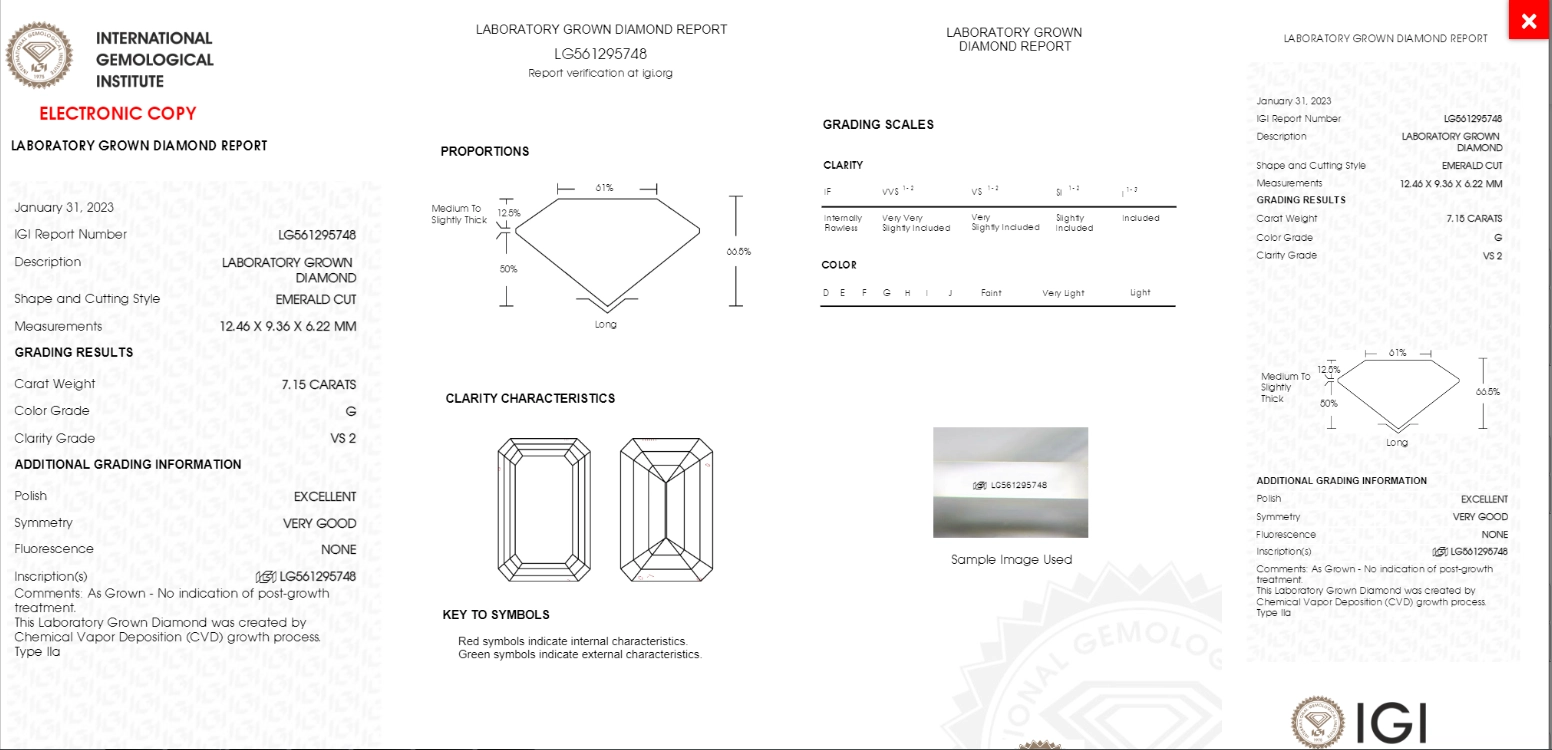
Why You Should Always Buy a Certified Diamond
A diamond without a certificate is a diamond whose quality you're taking on faith. Certificate grades are not opinions — they're the findings of trained gemologists using precision instruments and standardized methods. Without a certificate, you have no reliable way to verify cut, color, clarity, or carat weight, and no protection if the diamond was misrepresented.
The Major Grading Laboratories
Not all certificates carry the same weight. Here's what you need to know:
GIA (Gemological Institute of America) The global gold standard. GIA invented the 4Cs grading system and maintains the most rigorous, consistent grading standards in the world. A GIA certificate is universally trusted by jewelers, appraisers, and buyers worldwide. If you're buying a mined diamond, GIA certification is our strong recommendation.
AGS (American Gem Society) The only lab that grades cut on a numerical 0–10 scale with extraordinary precision. AGS is particularly valuable for buyers prioritizing cut quality. Their cut grading methodology is arguably even more detailed than GIA's.
IGI (International Gemological Institute) The leading grading laboratory for lab-grown diamonds. IGI has significantly improved its standards in recent years and is now widely accepted and trusted, particularly in the lab-grown diamond category.
EGL (European Gemological Laboratory) We advise caution with EGL certificates. EGL grading has historically been inconsistent — stones certified at a given color or clarity by EGL may grade one to two grades lower at GIA. An EGL-certified stone at a price that seems too good may simply be a lower-quality stone that was over-graded.
What a Certificate Contains
A standard GIA Diamond Grading Report includes:
- Shape and cutting style (e.g., round brilliant)
- Measurements (diameter and depth in millimeters)
- Carat weight
- Color grade
- Clarity grade
- Cut grade (round brilliants only)
- Polish and symmetry grades
- Fluorescence (how the diamond responds to UV light)
- A plotting diagram showing the location of inclusions
- A unique report number that can be verified on GIA's website
At Provence, every diamond we sell comes with its full GIA or IGI grading report. We believe you should know exactly what you're buying before you fall in love with it.
Frequently Asked Questions About the 4Cs
Cut is widely considered the most important of the 4Cs. It has the greatest influence on a diamond's beauty and sparkle. A well-cut diamond will always outperform a poorly cut one, regardless of how high the color or clarity grades are. We recommend prioritizing cut above all other factors, especially within a limited budget.
For most buyers, G or H is the sweet spot. These near-colorless diamonds look white to the naked eye in virtually any setting, and they're significantly less expensive than D–F colorless stones. If you're choosing a yellow or rose gold setting, you can comfortably go to I or even J — the warm metal masks any subtle tint.
In almost all cases, no. VS2 inclusions are small and typically positioned where they're difficult to see face-up. The vast majority of VS2 diamonds are eye-clean — they appear flawless to the naked eye without any magnification. That said, every diamond is individual. Always ask to see the diamond (or a high-resolution video) before purchasing.
Not necessarily. Two diamonds of the same carat weight can look quite different in size depending on how they're cut. A well-cut stone maximizes face-up diameter; a poorly cut deep stone carries much of its weight in its belly, hidden below the setting. Cut quality is a more reliable predictor of visual size than carat weight alone.
Shape refers to the outline of the diamond — round, oval, emerald, cushion, pear, marquise, etc. Cut refers to the quality of the craftsmanship: the precision of the angles, proportions, facets, and finish that determine how the stone interacts with light. You can have a round diamond with an Excellent cut or a Poor cut — the shape is the same, the cut quality is entirely different.
Yes, completely. Lab-grown diamonds are graded using the identical 4Cs standards as natural diamonds by GIA, IGI, and other labs. The grading report for a lab-grown diamond uses the same cut, color, clarity, and carat weight scales. The only difference noted on the certificate is that the stone is identified as laboratory-grown.
We recommend Excellent cut for round brilliant diamonds. The difference between Excellent and Very Good is subtle but visible in person, and the premium is modest relative to the overall diamond price. For fancy shapes (oval, cushion, pear, etc.), look for Excellent or Very Good polish and symmetry grades as a proxy, since GIA doesn't issue an overall cut grade for these shapes.
It can be an exceptional value — but it requires careful selection. SI1 inclusions are visible under 10× magnification but are often completely invisible to the naked eye. The key is to evaluate the specific diamond, not just the grade. Look at the diamond's actual inclusion plot on the certificate (preferably with the inclusions located near the edges or under a prong), and always view a high-quality photo or video. A well-selected SI1 in a brilliant cut can look identical to a VS2 at a significantly lower price.
Eye-clean describes a diamond that shows no visible inclusions to the naked eye when viewed face-up at a normal viewing distance (about arm's length) under standard lighting, without magnification. It is not an official GIA grade — it's a practical standard used by buyers and jewelers to describe diamonds that appear flawless in everyday wear, regardless of their technical clarity grade.
Every GIA report includes a unique report number (which you can verify at gia.edu), the diamond's shape, measurements, carat weight, color grade, clarity grade, cut grade (for round brilliants), polish, symmetry, and fluorescence. The diamond plot diagram shows the location of inclusions. When reviewing a certificate, pay close attention to the cut grade first, then color and clarity. The report number should match the laser-inscribed number on the diamond's girdle — always verify this when receiving your stone.
Finding Your Diamond at Provence
The 4Cs are a framework, not a formula. They give you vocabulary and a foundation — but the right diamond for you is ultimately the one that moves you when you see it, that fits your values and your budget, and that will mean something every time it catches the light.
At Provence, we hand-select every stone in our collection with the same criteria we'd apply to a diamond for our own families: exceptional cut quality, verified certification, and that indefinable quality of life and light that no certificate can fully capture but every great diamond possesses.
Whether you're buying for an engagement, an anniversary, or simply because you've fallen in love with a stone, our team is here to guide you through every step — without pressure, without jargon, and with your best interests at heart.