
Diamond Fluorescence: Good, Bad, or Just Misunderstood?
- Written by Provence Team
- Updated on July 13, 2026
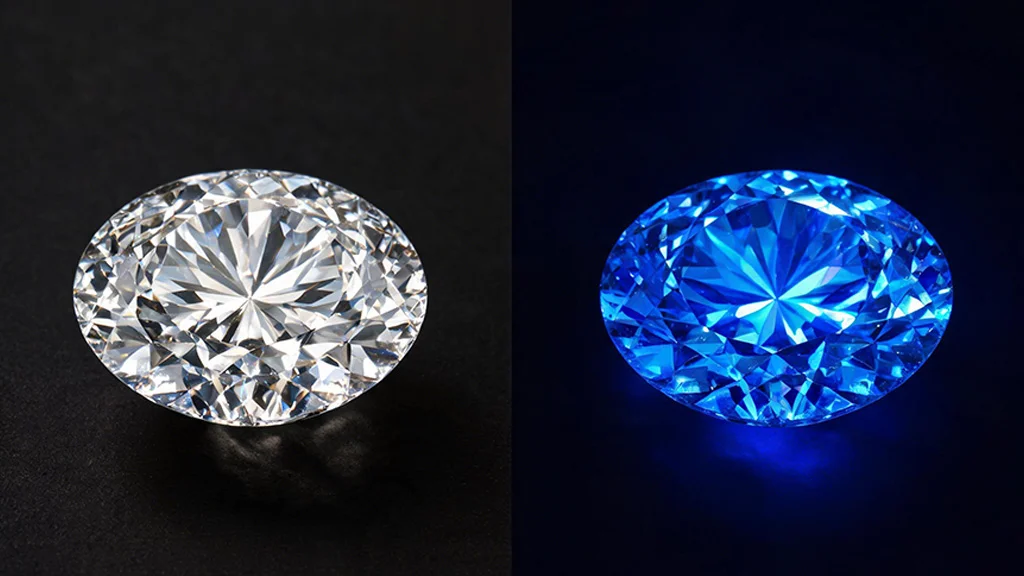
Table of Contents
Diamond fluorescence has confused shoppers — and divided experts — for decades. Some guides call it a hidden upgrade. Others call it a hazard to avoid. Both are half right. Here's what the science, the grading standards, and the market data actually say, and how to use fluorescence to your advantage whether you're buying one diamond or sourcing thousands.
What Is Diamond Fluorescence?
Diamond fluorescence is the visible glow certain diamonds emit when exposed to long-wave ultraviolet (UV) light — the kind found in sunlight, black lights, and some indoor lighting. The glow appears the instant UV hits the stone and disappears the moment the UV source is removed.
The cause is structural, not artificial. As a diamond crystallizes deep within the earth, it can trap trace amounts of other elements within its lattice. Nitrogen is by far the most common, and it produces a blue glow. Rarer trace elements, such as boron, can produce yellow, orange, or green fluorescence. It is a naturally occurring characteristic, not a treatment, defect, or sign of lower quality.
Roughly 25% to 35% of diamonds show some degree of fluorescence under long-wave UV. Of those, more than 95% fluoresce blue. Yellow, green, white, and — in extremely rare cases like the Hope Diamond's red glow — other colors make up the remainder.
Fluorescence is not one of the 4Cs, and it is not a quality grade. It's an identifying characteristic that GIA and other major labs record separately on a diamond's grading report, rated purely on intensity:
|
Grade |
What It Means |
Approx. Share of Diamonds |
|---|---|---|
|
None |
No visible glow under long-wave UV. The baseline — no premium or discount. |
~65–75% |
|
Faint |
A very slight glow, virtually undetectable in normal lighting or to the naked eye. |
~10% |
|
Medium |
Clearly visible under UV; may have a mild effect on face-up color in daylight. |
~10% |
|
Strong |
A bold, obvious glow. Warrants a closer look at clarity and transparency. |
~5–8% |
|
Very Strong |
An intense glow. Rarest grade; carries the largest price discount. |
<2% |
When a diamond's fluorescence is graded Medium, Strong, or Very Strong, GIA reports also note the fluorescence color (for example, "Strong Blue"), since color affects how the glow interacts with the diamond's own body color.
The Big Debate: Does Fluorescence Actually "Whiten" a Diamond?
This is where most fluorescence guides contradict each other — and where a lot of outdated advice still circulates. Here's the claim you'll see repeated across the diamond industry:
- Blue and yellow are complementary colors. Warmer diamonds (I–M color range) have a faint yellow body tone, and a blue fluorescent glow is said to cancel it out, making the diamond face up whiter than its printed color grade.
That explanation is intuitive, widely repeated, and — for modern grading reports — misleading.
What actually changed in 2008
Prior to 2008, diamond color grading was performed under lighting specifically designed to exclude UV, so any whitening effect from fluorescence genuinely wasn't reflected in the printed color grade. Since 2008, GIA and other major labs grade diamond color under daylight-equivalent lighting that includes a UV component — comparable to a bright, sunny day.
That single change matters enormously: the color grade on a modern report is already measured under lighting that triggers fluorescence. Any whitening effect the fluorescence produces is already baked into the grade you're looking at. It is not a bonus effect layered on top.
So what should you actually expect?
In practice, this means a few things for buyers:
- A diamond's printed color grade already accounts for its fluorescence under standard grading light. You should not expect a fluorescent stone to look meaningfully whiter than a non-fluorescent stone of the same graded color.
- Real-world lighting still varies. Indoor lighting typically has very little UV beyond a few inches from the bulb, while outdoor daylight has significant UV. This means a fluorescent diamond can genuinely look slightly different indoors versus outdoors — not because fluorescence is adding a hidden upgrade, but because the amount of UV in the room is changing.
- For Very Strong blue fluorescence, GIA research indicates diamonds can appear as much as two color grades better than their measured color when viewed under strong UV — and correspondingly a bit warmer under UV-poor indoor lighting.
- For most buyers, in most lighting, the difference is subtle enough that independent observer studies have found average shoppers can't reliably tell fluorescent and non-fluorescent diamonds of the same grade apart.
The honest takeaway: fluorescence is not a guaranteed whitening trick, and it's not a guaranteed flaw either. Its visual effect is diamond-specific and lighting-specific. Treat any claim that it will make a diamond "look a full grade whiter for free" with healthy skepticism — and treat any claim that it will automatically look hazy the same way.
Does Fluorescence Cause a Hazy or Milky Appearance?
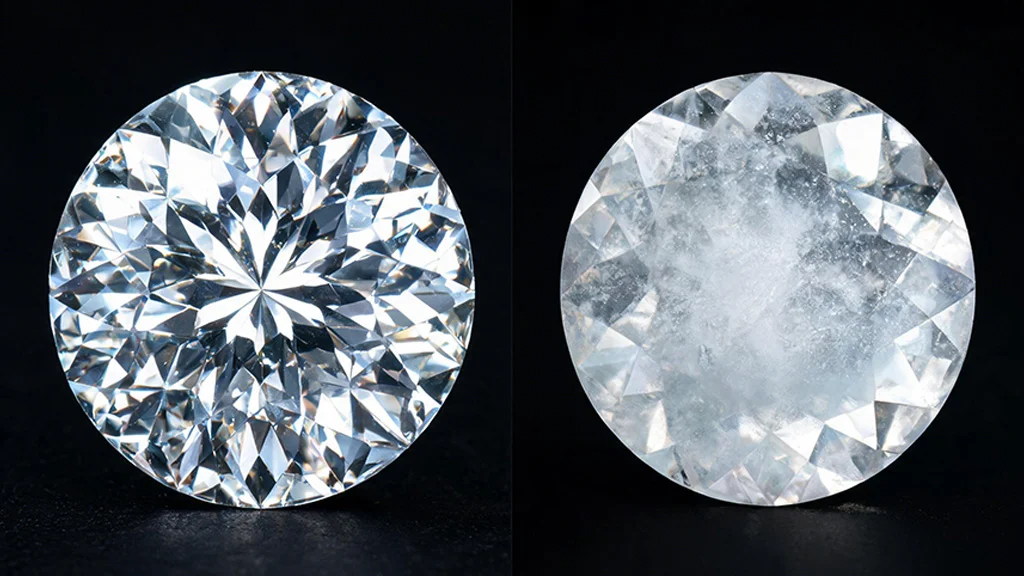
This is the most persistent fear around fluorescent diamonds, and it's largely overstated. GIA's own research found that fewer than 0.2% of the fluorescent diamonds it examined showed any haziness attributable to fluorescence.
Where haziness does occur, it's typically linked to pre-existing internal characteristics — microscopic clouds or graining — that were already present in the diamond. Strong fluorescence can make that existing haziness more visible under UV-rich lighting, but the fluorescence itself is not the root cause.
The practical implication is simple: haziness is rare, it isn't listed as a separate line item on standard grading reports, and it can only be reliably ruled out by viewing the specific stone — in person, or via high-resolution video — under a few different lighting conditions, including daylight.
Fluorescence and Price: What You Can Actually Save
The diamond trade has historically treated fluorescence with caution, especially in the highest color grades where buyers pay a premium for absolute consistency. That caution shows up directly in pricing — fluorescent diamonds are typically discounted relative to otherwise identical non-fluorescent stones.
|
Fluorescence Level |
Typical Discount vs. Non-Fluorescent |
Most Relevant Color Range |
|---|---|---|
|
Faint |
Little to no discount |
All grades |
|
Medium |
0% – 8% |
Most noticeable value in G–J |
|
Strong |
8% – 15% |
Best value in H–M; inspect D–G |
|
Very Strong |
15% – 25%+ |
Rarest grade; inspect carefully at any color |
Prices in this range typically hold in USD, GBP, and EUR alike — the discount is a percentage of the base stone value, not a fixed regional figure. As a rough illustration at 1 carat, VS2 clarity, excellent cut:
Buying Guide: Choosing Fluorescence by Color Grade
D–F (Colorless)
Choose None or Faint if a consistently icy, crisp appearance across all lighting is the priority. Medium is usually safe. Strong or Very Strong is where inspection matters most — request high-resolution video or view the stone in person before committing, and check the clarity plot for clouds or graining.
G–H (Near-Colorless)
Milkiness is less common at this range, and Medium to Strong fluorescence can offer meaningful savings with minimal visual risk. Still worth a quick visual check for stones at the Strong end.
I–M (Faint Yellow to Light Yellow)
This is the range where fluorescence carries the least risk and the most potential upside. Because the color grade already reflects UV-inclusive grading, don't expect fluorescence to dramatically transform the stone's appearance — but the price discount at this range is real, making Medium to Strong fluorescence a legitimate value strategy for budget-conscious buyers.
A Simple Rule of Thumb
The stronger the fluorescence, the more the stone deserves a direct look before purchase — regardless of color grade. A certificate tells you the odds; only your own eyes (or a trusted supplier's video) confirm the actual stone.
Fluorescence in Lab-Grown vs. Natural Diamonds
Most lab-grown diamonds are Type IIa, meaning they contain very few of the trace elements — nitrogen in particular — responsible for fluorescence in natural stones. As a result, the overwhelming majority of lab-grown diamonds are graded None for fluorescence.
This is a useful data point for buyers comparing lab-grown, natural, and moissanite options side by side: fluorescence is a natural-diamond consideration far more than a lab-grown one, and it's effectively a non-issue for moissanite, which has its own distinct optical properties unrelated to UV fluorescence.
Certification and Disclosure: What Global Buyers Should Know
Fluorescence itself isn't subject to metal-purity regulations like the UK Hallmarking Act — that legislation governs precious metal content, not gemstone characteristics. But disclosure and grading-report standards do vary in practice across markets, and international buyers should know what to look for regardless of where they're purchasing:
- United States: The FTC's Jewelry Guides require accurate, non-deceptive representation of a diamond's characteristics on any accompanying documentation, including fluorescence when stated.
- United Kingdom & EU: Reputable retailers and OEM partners typically supply internationally recognized certification (GIA, IGI, or HRD) alongside any local consumer protection disclosures, ensuring fluorescence grading is consistent regardless of the country of sale.
- Across all markets: A GIA or IGI report is the common language. Whether you're buying in London, Los Angeles, or Berlin, the fluorescence grade on a recognized lab report means the same thing.
For buyers and partners sourcing across borders, the practical guidance is consistent: insist on a report from a recognized lab, and treat the fluorescence line item the same way regardless of currency or country — as a characteristic to evaluate on the individual stone, not a red flag or bonus feature by default.
A Manufacturer's Perspective: How We Evaluate Fluorescence
As an OEM/ODM manufacturer producing fine jewelry across gold, lab-grown diamond, moissanite, and gemstone lines, Provence Jewellery evaluates fluorescence as part of standard stone sourcing — not as an afterthought. For production runs, that means:
- Screening incoming stones for correlated clarity characteristics (clouds, graining) alongside fluorescence intensity, rather than relying on the fluorescence grade alone.
- Matching fluorescence profiles to the intended color grade and price tier of a collection, so retail and wholesale partners get consistent, predictable results across a batch rather than stone-by-stone surprises.
- Providing full certification and fluorescence disclosure on every stone supplied to retail and B2B partners, regardless of destination market.
For brand partners and wholesale buyers building a collection around value-driven diamond jewelry, fluorescence-informed sourcing is a legitimate lever — it can meaningfully improve price-to-perceived-quality ratio across a product line when handled by an experienced sourcing team.
Frequently Asked Questions
No. Fluorescence is a natural characteristic, not a defect. It only becomes a practical concern in a small percentage of Strong or Very Strong fluorescent diamonds where it correlates with pre-existing haziness — and even then, careful inspection resolves the question stone by stone.
Yes, typically as a discount. Strong and Very Strong fluorescence commonly reduce price by 10–25% compared to an otherwise identical non-fluorescent stone, particularly in colorless (D–F) grades.
Only under UV-rich conditions — direct sunlight, black lights, or certain club and stage lighting. Under typical indoor lighting, fluorescence is not visible to the naked eye.
Not necessarily. For near-colorless and faint yellow grades especially, fluorescence can represent genuine value with minimal visual risk. The only grades that warrant real caution are Strong and Very Strong in the colorless (D–F) range, and even there, inspection — not avoidance — is the right response.
Rarely. Most lab-grown diamonds are Type IIa and lack the trace elements responsible for fluorescence, so the vast majority are graded None.
 English