
How to Tell If Gold is Real or Fake: 9 Expert Tests
- Written by Provence Team
- Updated on July 10, 2026
Table of Contents
Gold has been faked for as long as it has been valued. Today's counterfeiters are more sophisticated than ever — fake hallmarks, tungsten-filled bars, and gold-plated base metals that pass a casual glance all circulate in a global market worth trillions. Whether you inherited a ring, spotted a bargain at a market stall, or you're sourcing gold jewellery for resale, knowing how to tell real gold from fake protects both your wallet and your reputation.
This guide walks through the tests jewellers, appraisers, and manufacturers actually use — from a five-second magnet check to laboratory-grade XRF analysis — and explains how purity is marked differently depending on where in the world you're buying. We'll also flag the tests that are popular online but unreliable or unsafe, so you don't damage a genuine piece chasing a myth.
Understanding Gold Purity: Karat vs. Fineness
Before you can tell if gold is real, it helps to know what "real" actually means on a label. Pure gold (24 karat) is soft and rarely used in jewellery — it's alloyed with metals like copper, silver, or zinc for strength and colour. Two labelling systems are used worldwide to describe how much of that alloy is actually gold:
- Karat system — used mainly in the US and parts of Asia (10K, 14K, 18K, 24K)
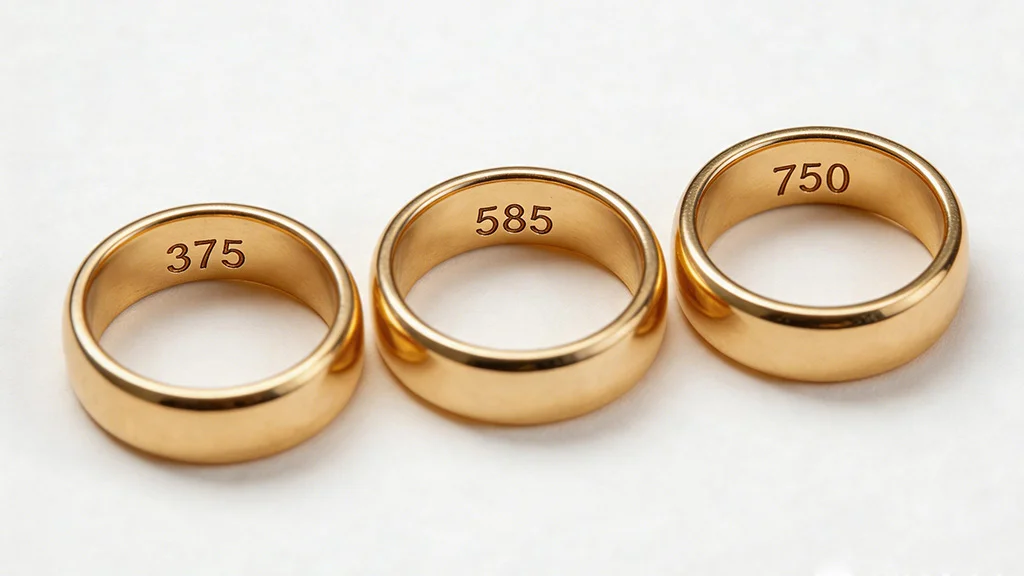
- Millesimal fineness — used across the UK, EU, and most international markets (417, 585, 750, 999), expressing purity as parts per thousand
Both describe the same thing. A piece stamped "585" and a piece stamped "14K" contain an identical 58.5% gold content — the numbers are just regional conventions.
|
Karat |
Fineness Stamp |
% Gold |
Legal Minimum? |
Typical Market |
|---|---|---|---|---|
|
9K |
375 |
37.5% |
UK minimum; not legal as "gold" in the US |
UK, Ireland |
|
10K |
417 |
41.7% |
US minimum for the word "gold" |
United States |
|
14K |
585 / 583 |
58.3–58.5% |
Widely accepted |
US, Europe |
|
18K |
750 |
75.0% |
Widely accepted |
Europe, Middle East, fine jewellery globally |
|
22K |
916 / 917 |
91.6% |
Widely accepted |
Middle East, South Asia |
|
24K |
999 |
99.9% |
Recognised as pure gold |
Bullion, investment pieces |
Why the UK and EU Hallmark Differently
In the United Kingdom, hallmarking isn't just customary — it's a legal requirement under the UK Hallmarking Act for gold items over 1 gram sold as gold. A compliant UK hallmark includes three elements: the fineness mark (e.g. 750), an assay office mark — a leopard's head for London, an anchor for Birmingham, a castle for Edinburgh, or a rose for Sheffield — and a date letter. Genuine hallmarks are crisp, evenly struck, and consistent in depth. Faint, uneven, or oddly spaced stamps are a signal to test further.
Across the EU, member states apply their own conventions, but the three-digit millesimal fineness number (750, 585, 417) is the universal thread. Buyers sourcing gold jewellery for EU markets should also be aware that nickel content is separately regulated under EU REACH Annex XVII, which caps nickel release from any item in prolonged skin contact — relevant not for spotting fake gold itself, but for the alloy safety of the piece underneath any plating.
Visual and Physical Clues Before You Test Anything
Look for Hallmarks and Stamps
Turn the piece over. Rings are usually stamped on the inside of the band; necklaces and bracelets near the clasp; earrings on the post or back. Use a jeweller's loupe or your phone's macro camera to read it clearly. Common marks that indicate the piece is NOT solid gold include:
- GP or GEP — Gold Plated / Gold Electroplated
- GF — Gold Filled (thicker plating, mechanically bonded, still mostly base metal)
- HGE — Heavy Gold Electroplate
- Vermeil — gold plating over a sterling silver base (look for an accompanying 925 mark)
A hallmark is a strong positive signal, but it is never proof on its own — stamps can be faked, and legitimate antique or handmade pieces sometimes carry none at all. Treat the hallmark as your starting point, not your conclusion.
Weight, Colour, and Wear
Gold is dense — noticeably heavier in the hand than brass, copper, or steel of the same size. Genuine gold also holds a warm, consistent tone; it doesn't flake, discolour, or reveal a different metal underneath after normal wear. If a "gold" piece has started showing silver or yellow-brown patches at edges and high-contact points, the plating has worn through.
6 DIY Tests You Can Do at Home
No single home test is conclusive on its own. Run at least two or three before drawing a conclusion, and treat all of them as screening tools rather than final verdicts.
- The Magnet Test
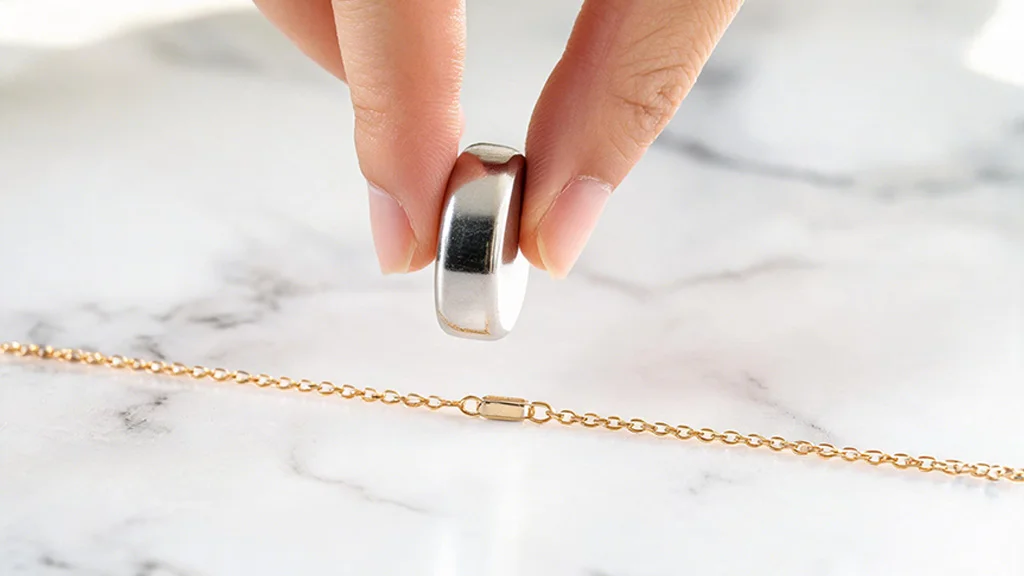
Hold a strong magnet — ideally a neodymium magnet — close to the piece. Gold is diamagnetic and will not be attracted to a magnet under any karat or alloy combination sold as jewellery.
- Sticks or jumps to the magnet → contains iron or another ferrous metal. Not solid gold.
- No reaction → could be real gold, but non-magnetic base metals like brass, copper, and aluminium will also pass this test.
- The Float / Density Test
Fill a glass with water and gently lower the piece in.
- Weigh the item on a digital scale (grams).
- Submerge it and note the water level rise (mL = volume in cm³).
- Divide weight by volume to calculate density.
Compare your result to the expected density range below. Genuine gold sinks immediately and sits at the bottom without hesitation; if it floats, hovers, or the density reading falls well short of the expected range, be suspicious. Note: hollow pieces will give a misleadingly low density even if the shell itself is real gold — this test works best on solid items.
|
Karat |
Expected Density (g/cm³) |
|---|---|
|
10K |
11.3 – 11.6 |
|
14K |
12.9 – 13.6 |
|
18K |
15.2 – 15.9 |
|
24K |
~19.3 |
- The Ceramic Scratch (Streak) Test
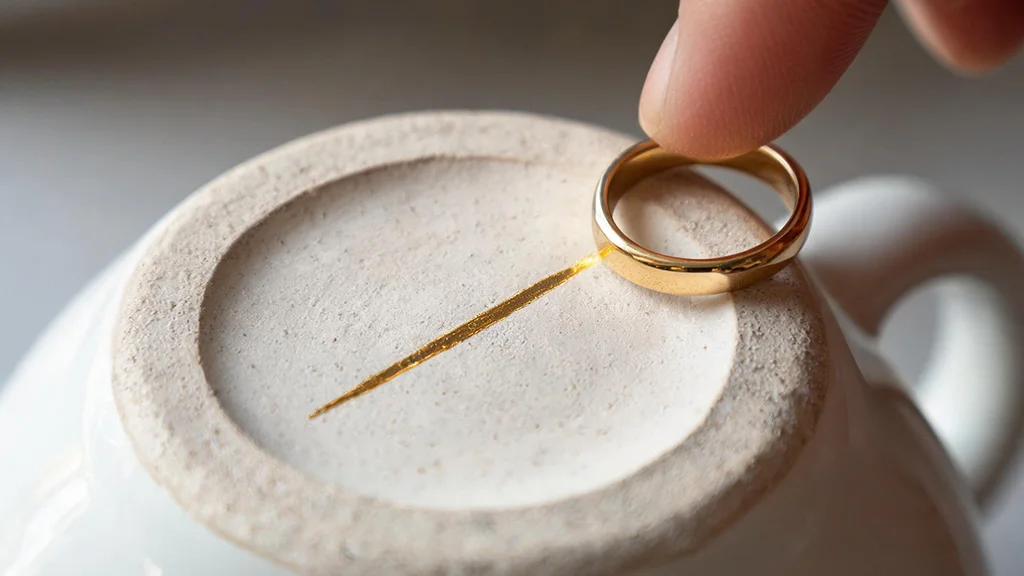
Find an unglazed ceramic surface — the underside of a mug or tile works. Drag the piece firmly across it for about an inch.
- Gold-coloured streak → positive sign, likely real gold or a well-made plated piece.
- Black or dark streak → typically brass, pyrite, or a copper alloy. Fail.
Caution: this test can leave a faint scratch, so use an inconspicuous spot — inside a ring band or near a clasp — and skip it entirely on sentimental or high-value pieces.
- The Skin Discoloration Test
Wear the piece for a day or two, especially somewhere warm or during exercise. Base metals like copper and nickel react with sweat to form copper chloride, which leaves a greenish or blackish mark on skin. Genuine gold, even alloyed at 14K or 18K, will not cause this reaction.
- The Vinegar Test
Apply a few drops of white vinegar to an inconspicuous spot and wait several minutes. Real gold shows no reaction. Discoloration, fizzing, or a colour change indicates a base metal or heavily plated piece.
This test is fast and low-risk, but it is not definitive — some non-gold metals also resist vinegar. Use it only alongside the magnet and hallmark checks, never as a standalone verdict.
- What to Skip: Flame and "Bite" Tests
Several gold-testing articles still recommend holding jewellery to an open flame or biting into it. We don't recommend either. A butane torch can damage soldered joints, gemstone settings, and plated finishes on genuinely valuable pieces, and biting metal risks your teeth for a test that gold-plated items can pass anyway. Stick to the six methods above, or move to professional testing below.
Professional Testing Methods
Acid Testing
A jeweller scratches a small sample onto a testing stone and applies nitric acid at a strength matched to the suspected karat. Genuine gold resists the acid; lower-purity or fake metal reacts, discolouring or dissolving. Affordable and accurate, though it requires removing a tiny amount of material.
Electronic Testers
These measure electrical conductivity at the surface. Fast and non-destructive, but they only read the outer layer — meaning a thickly plated fake can still pass. Best used as a supplementary check rather than a final word.
XRF (X-Ray Fluorescence) Testing
XRF is the closest thing to a gold standard for authentication. A focused X-ray beam causes the metal's atoms to emit characteristic fluorescent X-rays, which a detector reads to identify every element present and its exact percentage — non-destructively, in seconds. This is the method reputable manufacturers and refineries rely on to certify purity before a piece ever reaches a retailer.
Common Myths, Debunked
"Real gold always sinks in water"
Mostly true, but hollow jewellery — common in lightweight chains and bangles — can float or hover even when the shell itself is genuine gold. Density testing works best on solid pieces.
"Pure gold never scratches"
Gold is soft, especially at 22K and 24K. It scratches more easily than harder alloys, not less. A scratch on its own tells you nothing about authenticity.
"One test is enough"
The magnet test can pass fake, non-magnetic base metals. The vinegar test can miss certain alloys. No single home test is conclusive — combine at least two before deciding, and get professional verification for any high-value purchase.
Red Flags When Buying Gold Jewellery
Price Below Melt Value
Gold trades on a transparent global spot price. Before buying, do a rough sanity check: multiply the item's weight in grams by its purity percentage, then by the current spot price per gram in your currency. A legitimate retail price sits above that floor — significantly below it is a red flag in any market.
- USD: spot price per gram × weight × purity %
- GBP: same formula using the London spot fix
- EUR: same formula using the Frankfurt/ECB reference price
Missing or Inconsistent Hallmarks
Reputable manufacturers stamp every compliant piece. An item marketed as solid gold with no hallmark anywhere — or one with a blurry, shallow, or misaligned stamp — deserves closer inspection.
No Documentation
Ask for a receipt specifying karat and weight, a certificate of authenticity, or the seller's willingness to test the piece in front of you. Hesitation or evasiveness on this point is itself a signal.
A Manufacturer's Perspective: What to Ask Before You Buy Wholesale
Authenticity testing isn't only a consumer concern — it's a sourcing concern. Retailers and boutique brands buying gold jewellery from an OEM/ODM manufacturer should build verification into the purchase process itself, not leave it to chance after the goods arrive. Before placing a wholesale order, ask your manufacturer for:
- XRF test reports or batch certification for each production run
- Hallmarking compliant with the destination market (UK Assay Office marks, EU fineness stamps, US karat minimums)
- Documented alloy composition, particularly nickel content for pieces entering the EU under REACH Annex XVII
- A sample policy that allows independent third-party testing before a full order ships
At Provence Jewellery, every production run is verified before it leaves Wuzhou, with documentation matched to the hallmarking and safety requirements of the US, UK, and EU markets our clients sell into. That verification is what lets a retailer stand behind a hallmark with confidence — rather than hoping it holds up.
Frequently Asked Questions
No. Pure gold and all standard alloys (9K through 24K) are non-magnetic. If a piece is attracted to a strong magnet, it contains iron, nickel, or another ferrous metal and is not solid gold.
These are millesimal fineness numbers showing parts of pure gold per thousand: 750 = 18K (75% gold), 585 = 14K (58.5% gold), 417 = 10K (41.7% gold). They're the international equivalent of karat stamps and appear on jewellery sold across the UK, EU, and much of Asia.
It's a useful supporting check, not a definitive one. Real gold won't react to vinegar, but some non-gold metals also resist it. Pair it with the magnet test and a hallmark check for a more reliable read.
No — pure gold and quality alloys (14K, 18K) don't react with skin. Green or black discoloration comes from copper or nickel in a low-purity alloy, or from a gold-plated piece where the base metal is exposed.
Professional XRF analysis at a reputable jeweller or manufacturer. It's non-destructive, accurate within seconds, and gives an exact percentage breakdown of every metal present — something no at-home test can match.
Yes, generally. 24K gold is 99.9% pure and quite soft, which makes it prone to bending and scratching with daily wear. Most jewellery — especially rings and bracelets — is made in 14K or 18K for a better balance of purity and durability.