
What is June’s Birthstone? Pearl, Alexandrite & Moonstone
- Written by Provence Team
- Updated on August 3, 2026
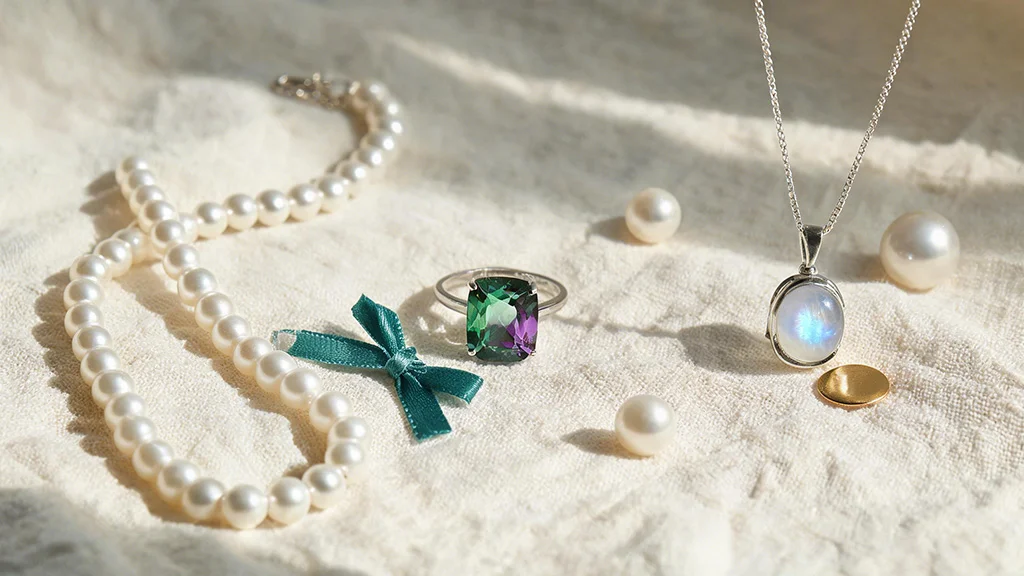
Table of Contents
June is one of only three months with more than one official birthstone — the others being August and December. If you were born in June, you have three gems to call your own: pearl, alexandrite, and moonstone. They share almost nothing in common except a birthday. Pearl is organic and ancient. Alexandrite is a geological rarity that changes color in different light. Moonstone looks like it has a glow trapped just beneath its surface.
June's Birthstone at a Glance:
|
Stone |
Color |
Rarity / Price Tier |
Best For |
|---|---|---|---|
|
Pearl |
White, cream, pink, gold, black |
Widely available (cultured); rare in natural form |
Everyday wear, brides, classic gifts |
|
Alexandrite |
Green in daylight, red-purple indoors |
Extremely rare in natural form; among the priciest colored gems |
Collectors, milestone gifts, those who want something unusual |
|
Moonstone |
Milky white with a blue or rainbow sheen |
Widely available, most affordable of the three |
Symbolic gifts, graduations, new beginnings |
If you just want the short answer: pearl is June's primary and most traditional birthstone, with alexandrite and moonstone as official alternatives. Here's the full picture on all three — what they are, where they come from, what they mean, and how to choose between them.
Why Does June Have Three Birthstones?
Most months have a single birthstone. June, August, and December are the exceptions, and the reason comes down to history layering on top of history rather than any single decision.
Birthstone traditions are much older than most people assume, with roots going back to ancient and medieval gem lists tied to astrology and religious symbolism. Pearl and moonstone were both established as June's stones long before there was any single "official" modern list. In 1912, the National Association of Jewelers (now Jewelers of America) published a standardized birthstone chart for the United States, and pearl — alongside moonstone — was confirmed as June's gem.
Alexandrite is the newcomer. It wasn't discovered until 1830, so it couldn't have been part of any ancient list. It was formally added as an official June birthstone in a 1952 revision by what is now the American Gem Trade Association, largely to give buyers at every price point a genuine option — natural pearls had become historically expensive, and alexandrite offered a striking, modern alternative.
The short version: June's birthstone list grew because tastes, availability, and price points changed over more than a century, and rather than replacing the older stones, jewelers simply added to the list.
Pearl: June's Primary Birthstone
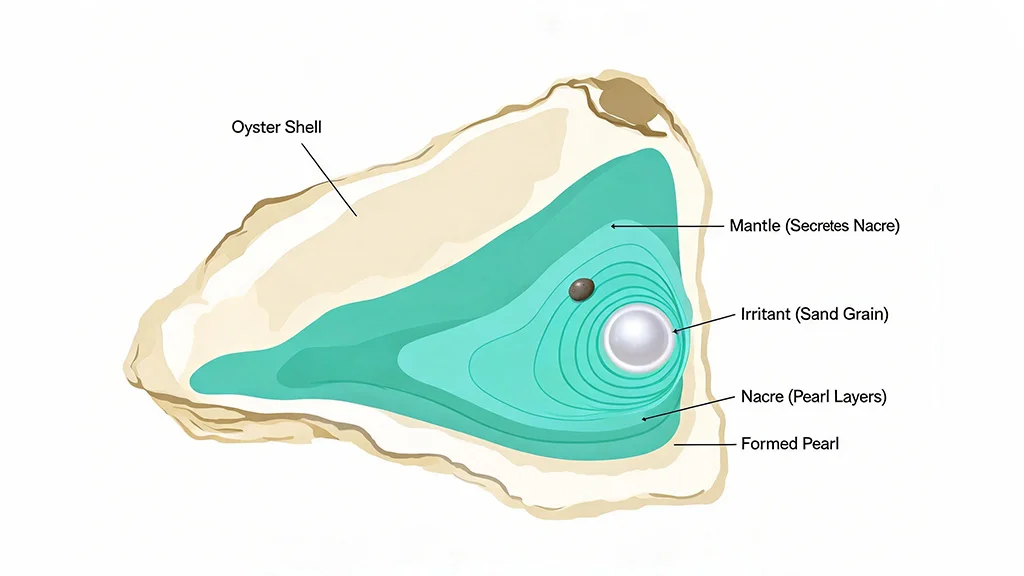
Pearl is the original and still the most popular birthstone for June — and it holds a genuinely unique distinction: it's the only gemstone that comes from a living creature. Every diamond, ruby, and sapphire forms through geological pressure inside the earth. A pearl forms inside a mollusk.
How Pearls Form
When an irritant — a grain of sand, a parasite, sometimes surgically implanted tissue — enters a mollusk's soft body, the creature responds by coating it in layer after layer of nacre, a crystalline substance secreted specifically for that purpose. Over months or years, those layers build into a pearl. That internal layering is what gives a fine pearl its glow from within, a quality jewelers call orient — it's the difference between a pearl that looks alive and one that just looks white.
Natural pearls, formed entirely without human involvement, are exceptionally rare today; centuries of pearl fishing depleted most natural beds. Nearly every pearl sold now is cultured — meaning a technician starts the process by introducing the irritant, and the mollusk does the rest. Cultured pearls are genuine pearls, not imitations, and they account for the overwhelming majority of pearl jewelry worldwide.
Types of Pearls
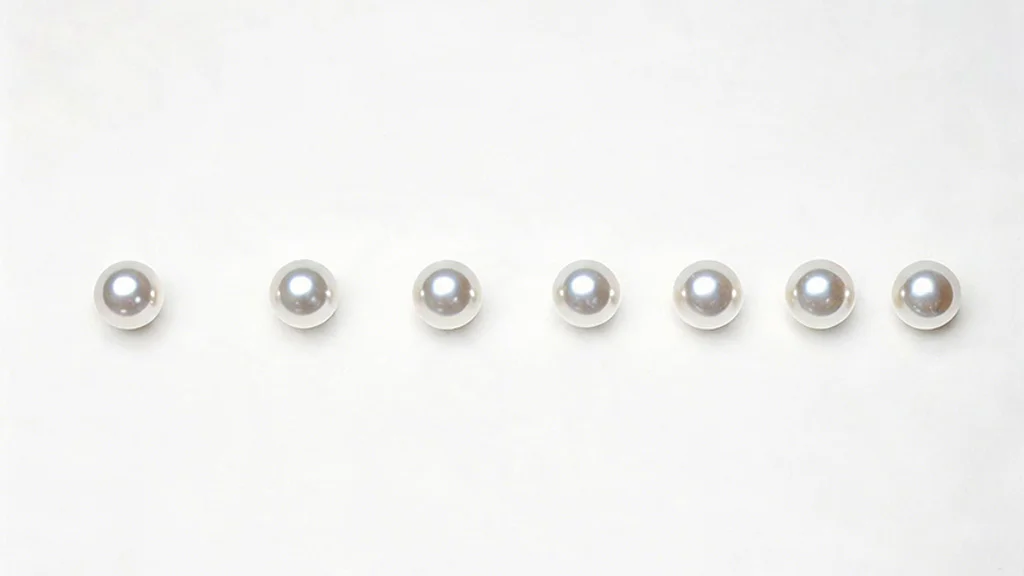
- Akoya — The classic bright-white strand pearl, prized for its crisp, mirror-like luster. Primarily cultured in Japan and China.
- Freshwater — The widest range of natural shapes and colors, and typically the most accessible price point. China is the dominant global source.
- Tahitian — Naturally dark pearls grown in black-lipped oysters, ranging from peacock green to deep inky black. Cultured mainly in French Polynesia's atolls and lagoons.
- South Sea — The largest and most luminous pearl type, grown in white or gold-lipped oysters across northern Australia, Indonesia, and the Philippines.
Pearl History and Symbolism
Pearls have been prized on nearly every continent for at least 5,000 years. Ancient Middle Eastern cultures believed they were teardrops fallen from heaven; Chinese folklore held that pearls came from the brain of a dragon. Roman women wore them layered as public displays of wealth, and by the 20th century pearls had become inseparable from a certain kind of timeless elegance — worn by everyone from royalty to screen icons.
Symbolically, pearls are associated with purity, wisdom, humility, and loyalty — meanings that have stayed remarkably consistent across cultures and centuries. They're the traditional gift for 30th wedding anniversaries and remain one of the most common choices for bridal jewelry worldwide.
Pearl Colors
While white and cream are the most familiar, pearls naturally occur in a wide color range: pink, gold, silver, gray, green, blue, and the deep black of Tahitian pearls. This range is part of why pearl works across so many styles and occasions.
Caring for Pearl Jewelry
Pearls rate just 2.5–3.0 on the Mohs hardness scale, making them one of the softer gems in regular jewelry use. A few habits protect them for a lifetime:
- Put pearls on last, after perfume, lotion, and hairspray — these products can damage the nacre surface
- Wipe pearls with a soft, damp cloth after each wear
- Store separately from harder gemstones and metal jewelry to prevent scratching
- Never store pearls in a plastic bag — plastic can emit chemicals that damage the surface over time
- Avoid ultrasonic and steam cleaners
Alexandrite: The Color-Changing Rarity
Alexandrite does something no other major gemstone does convincingly: it changes color depending on the light source. Under daylight or fluorescent light, it reads a vivid green to bluish-green. Under incandescent light, it shifts to a deep red to purplish-red. Jewelers have a phrase for it — "emerald by day, ruby by night."
The Science Behind the Color Change
Alexandrite is a rare variety of the mineral chrysoberyl. Its unusual chemistry causes it to absorb light in a way that sits almost exactly on the boundary between red and green wavelengths, so the eye reads a different dominant color depending on whether the light source is rich in blue-green wavelengths (daylight) or red wavelengths (incandescent). Some stones also display chatoyancy — a "cat's-eye" effect — when fine parallel inclusions catch the light.
Origins and Sources
Alexandrite was first discovered in Russia's Ural Mountains around 1830. According to popular account, miners initially believed they'd found emeralds — until the stones were examined by candlelight that evening and appeared red instead. It was named after the young Alexander II, heir to the Russian throne, whose coming-of-age coincided with the discovery. The stone's green-and-red color shift happened to mirror the military colors of Imperial Russia, which helped cement the connection.
The original Russian deposits are now largely mined out. Today, most alexandrite comes from Brazil, Sri Lanka, and East Africa. Because fine natural material is scarce — especially in larger sizes — quality alexandrite ranks among the more expensive colored gemstones in the world, often compared to top sapphires and rubies at similar sizes.
Alexandrite Meaning
Alexandrite is associated with luck, balance, and prosperity — meanings that draw directly from its dual nature. It's also the traditional gemstone for 55th wedding anniversaries, and for June birthdays it makes a distinctive gift for someone drawn to rarity.
Caring for Alexandrite
At 8.5 on the Mohs scale with excellent toughness, alexandrite is one of the more durable colored gemstones — a good choice for rings and pieces worn daily. Warm, soapy water is the safest cleaning method, though ultrasonic and steam cleaners are generally considered safe as well.
Moonstone: The Stone That Glows From Within
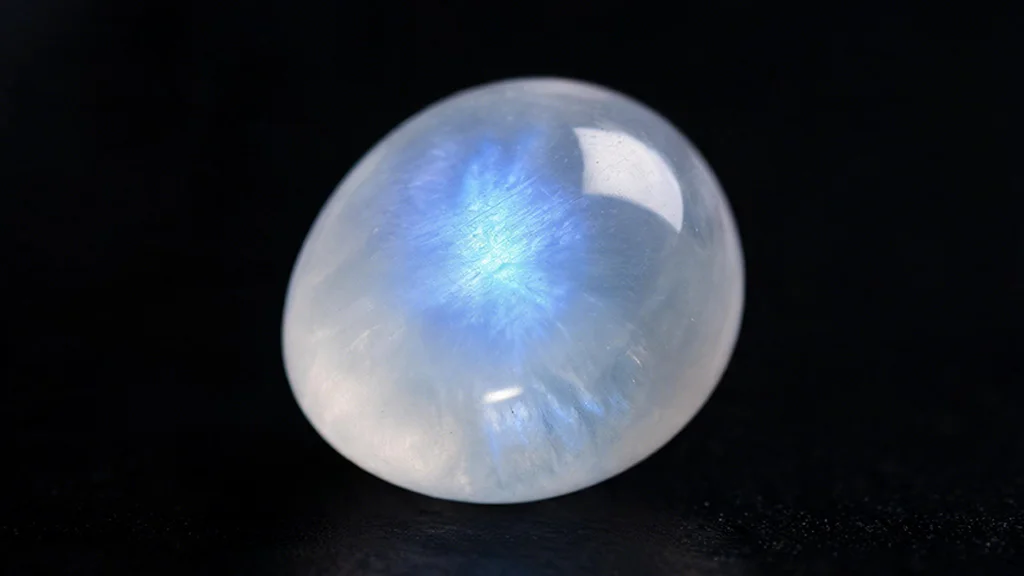
If alexandrite is dramatic, moonstone is quietly mysterious. It belongs to the feldspar mineral family and is known for adularescence — a soft, billowing glow that seems to float and move beneath the surface as the stone is turned in the light. The finest moonstones show a blue sheen against a colorless or milky-white body.
Moonstone History and Mythology
Ancient Rome believed moonstone was formed from solidified moonlight. Hindu tradition held it sacred as a stone linked to intuition and feminine energy. It found a major moment in fine jewelry during the Art Nouveau era (1890s–1910s), when designers like René Lalique and Louis Comfort Tiffany built pieces around its ethereal glow, and it resurfaced again with the 1960s counterculture movement and again with 1990s design revivals.
Moonstone Meaning
Moonstone is associated with intuition, balance, and new beginnings — making it a popular choice for gifts tied to transitions: graduations, new jobs, moves, or simply a fresh chapter.
Where Moonstone Is Found
Moonstone is mined in several regions, with India and Sri Lanka as the most significant sources; Brazil, Madagascar, Myanmar, and Tanzania also produce it. Smaller deposits exist in parts of the United States, including New Mexico, North Carolina, and Virginia.
Caring for Moonstone
Moonstone rates just 6–6.5 on the Mohs scale and has relatively poor toughness — it can crack under sudden heat or impact. Clean it only with warm, soapy water and a soft brush; skip ultrasonic and steam cleaners entirely, and store it away from harder gems that could scratch its surface.
How to Choose Between June's Three Birthstones
There's no rule that says a June birthday has to settle on just one stone — but if you're choosing:
Pick pearl if you want something elegant, versatile, and steeped in history. It suits nearly every age, skin tone, and occasion, and works equally well as an everyday piece or a once-in-a-lifetime gift for a wedding, milestone birthday, or graduation.
Pick alexandrite if rarity and drama matter more than tradition. It's a genuine conversation piece, well suited to a collector or someone who wants a gemstone almost nobody else will have.
Pick moonstone if you're drawn to symbolism over sparkle. It tends to resonate with people marking a transition or drawn to its mythology and soft, otherworldly glow — and it's the most budget-friendly of the three.
Many June-born buyers eventually own pieces in all three; pearl and moonstone in particular pair beautifully together for a soft, luminous look.
How to Verify Authenticity
Because all three June birthstones have common imitations on the market, a few basics help buyers shop with confidence:
- Pearls: Genuine pearls (natural or cultured) have a slightly gritty texture when lightly rubbed against a tooth's edge; imitation glass or plastic pearls feel smooth. Reputable jewelers will disclose whether a pearl is natural or cultured, and cultured pearls should be sold as such — in the US, this disclosure is required under FTC guidelines for gemstone marketing (16 CFR Part 23).
- Alexandrite: Genuine natural alexandrite is rare enough that any large, inexpensive "alexandrite" is almost certainly lab-created or a color-change simulant — ask directly whether a stone is natural or lab-grown, and request documentation for higher-value pieces.
- Moonstone: True moonstone shows adularescence that shifts and moves with the angle of light — a fixed, static sheen is a sign of glass or synthetic imitation.
Buyers in the UK should also confirm that any piece over the legal weight threshold set out in the Hallmarking Act 1973 carries a proper UK hallmark when purchased in precious metal.
June's Birthstone FAQs
Pearl is the primary and most traditional June birthstone, with the longest recorded history of the three. Moonstone and alexandrite are official alternatives.
Pearl and moonstone were established as June's stones on early birthstone lists, including the 1912 US standardization. Alexandrite, discovered in 1830, was added in a 1952 revision to give buyers more options across price points.
It depends which one you mean. Pearl ranges from white and cream to pink, gold, gray, and black. Alexandrite is green in daylight and shifts to red-purple indoors. Moonstone is milky white with a blue or rainbow inner glow.
Fine natural alexandrite is among the most expensive gemstones in the world at comparable sizes to sapphire or ruby. Fine natural pearls can also be extremely valuable, though most pearls sold today are cultured and far more affordable. Moonstone is generally the most accessible of the three.
Yes — there's no rule against combining them. Pearl and moonstone in particular pair well together for a soft, luminous look, and many June-born collectors build a set with all three over time.
Yes, with a few habits: put pearls on last, after perfume and hairspray; wipe them down after wearing; and store them separately from harder gems. With proper care, pearl jewelry can last for decades.
No — they're commonly confused but are different minerals. Moonstone is a feldspar known for adularescence, a soft glow that appears to float beneath the surface. Opal shows play-of-color, a rainbow flash caused by a completely different internal structure. Moonstone's effect is typically confined to blue or white tones, while opal can display a full spectrum.
Pearl is traditionally associated with the Gemini zodiac sign (May 21–June 20) and moonstone is often linked to Cancer (June 21–July 22), since both June zodiac signs fall within the birthstone month.
 English