
Diamond Clarity Chart: A Complete Buying Guide (2026)
- Written by Provence Team
- Updated on July 31, 2026
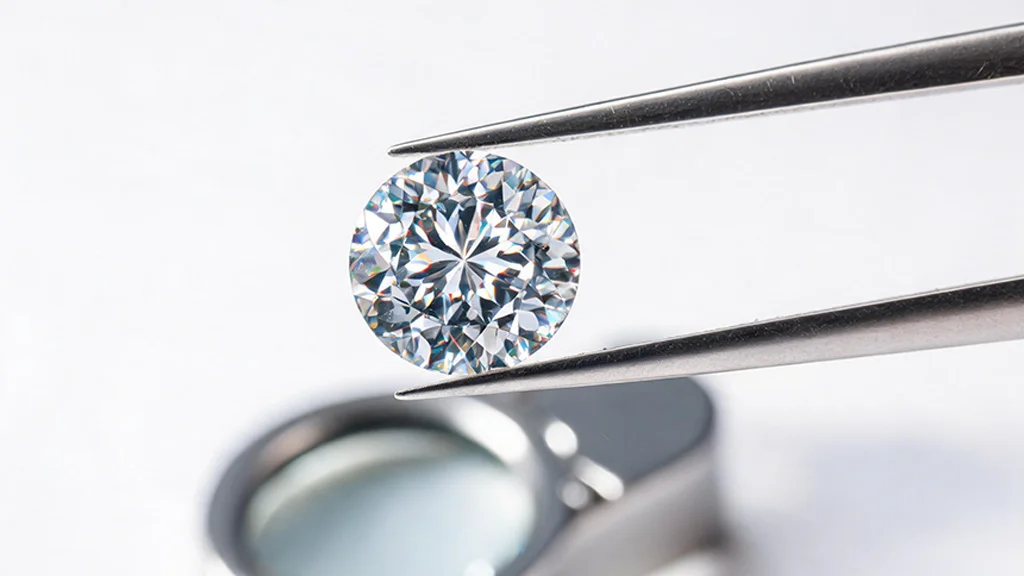
Table of Contents
Of the Four Cs — cut, color, clarity, and carat — clarity is the one buyers misunderstand most. It sounds like a simple pass/fail purity test, but it's actually a nuanced, five-factor evaluation that determines how a diamond's inclusions and blemishes affect its beauty, durability, and price.
This guide walks through the full GIA diamond clarity chart from Flawless to Included, explains how professional graders actually assign a grade, and shows you how clarity interacts with shape, carat weight, and whether a diamond is lab-grown or mined. Whether you're a consumer choosing an engagement ring or a retailer sourcing stock, you'll leave knowing exactly what you're paying for.
What is Diamond Clarity?
Diamond clarity measures the visual purity of a stone — specifically, the absence (or presence) of internal characteristics called inclusions and external characteristics called blemishes. Nearly every diamond, lab-grown or mined, forms with some trace of these characteristics, because both are created under intense heat and pressure that leaves behind microscopic evidence of the process.
Graders assess clarity under 10x magnification, the industry-standard loupe or microscope power. A diamond graded as Flawless shows no inclusions and no blemishes at all at that magnification — a genuinely rare outcome, occurring in a very small fraction of gem-quality stones.
Clarity isn't just a purity score, though. It has a direct relationship to how a diamond performs optically. Inclusions can interrupt the path light takes as it travels through and reflects out of a stone, which is why very low clarity grades tend to look duller or cloudier than their higher-graded counterparts, even at the same size and color.
The Diamond Clarity Chart
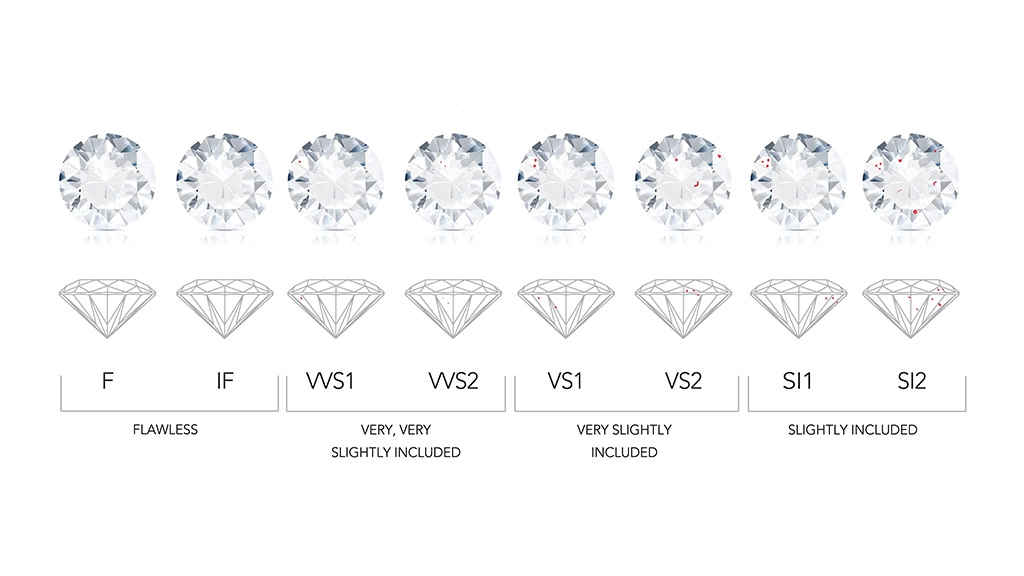
The clarity chart below reflects the GIA scale, the most widely referenced clarity standard in the global jewelry trade. It groups every diamond into one of six overall categories, split into eleven total grades, ranked from most to least pure.
|
Grade |
Category |
What It Means |
|---|---|---|
|
FL |
Flawless |
No inclusions or blemishes visible under 10x magnification. Exceptionally rare. |
|
IF |
Internally Flawless |
No inclusions visible under 10x; minor surface blemishes may be present. |
|
VVS1 |
Very, Very Slightly Included |
Inclusions extremely difficult to see under 10x, even for a trained grader. |
|
VVS2 |
Very, Very Slightly Included |
Slightly more visible than VVS1, still very minor. |
|
VS1 |
Very Slightly Included |
Minor inclusions, difficult to spot under 10x magnification. |
|
VS2 |
Very Slightly Included |
Minor inclusions, somewhat easier to see under 10x; typically still eye-clean. |
|
SI1 |
Slightly Included |
Inclusions visible under 10x; usually not visible to the naked eye in brilliant cuts. |
|
SI2 |
Slightly Included |
More noticeable inclusions under magnification; may be visible unaided in some stones. |
|
I1 |
Included |
Inclusions visible to the naked eye; may begin to affect brilliance. |
|
I2 |
Included |
Obvious inclusions that noticeably affect transparency and brilliance. |
|
I3 |
Included |
Significant inclusions that can affect durability as well as appearance. |
Quick Read
- FL–VVS2: Virtually undetectable inclusions, even under magnification. Premium pricing.
- VS1–VS2: The 'eye-clean' sweet spot most buyers land in — minor inclusions invisible without a loupe.
- SI1–SI2: Best value zone; check photos/plots carefully, especially in step cuts.
• I1–I3: Inclusions visible to the naked eye; generally not recommended for center stones.
How Diamonds Are Graded: The 5 Clarity Factors
A clarity grade isn't a single measurement — it's the outcome of weighing five interacting factors. Understanding them explains why two diamonds with the same grade can look noticeably different in person.
1. Size
The larger an inclusion, the more it affects the grade — and the more likely it is to interfere with brilliance. Size is always judged relative to the diamond's own dimensions, not in absolute terms.
2. Number
More visible characteristics under magnification generally push a grade lower, though a diamond isn't penalized purely for a high inclusion count if none are individually significant.
3. Position
Inclusions near the table (the flat top facet) are more visible and impactful than those hidden near the girdle or under a prong setting. Inclusions that reach the surface can also pose a minor durability risk.
4. Nature
This refers to the type of characteristic and whether it's internal (inclusion) or external (blemish), along with its depth. Certain types, like feathers that reach the surface, weigh more heavily than others, like small internal pinpoints.
5. Relief
Relief describes how much an inclusion contrasts against the surrounding diamond. High-contrast inclusions (dark against a colorless stone) stand out more and impact the grade more than low-contrast, transparent ones.
GIA vs. IGI vs. AGS: Comparing Clarity Grading Systems
The GIA (Gemological Institute of America) created the clarity vocabulary the entire industry now uses, but it isn't the only lab issuing grading reports. IGI (International Gemological Institute) is especially prominent for lab-grown diamonds, while AGS (American Gem Society) uses its own numeric scale. All three assess the same underlying characteristics under 10x magnification — the difference is presentation, not methodology.
|
GIA / IGI Grade |
AGS Equivalent |
Notes |
|---|---|---|
|
FL / IF |
AGS 0 |
Flawless and Internally Flawless map to the top AGS tier. |
|
VVS1 / VVS2 |
AGS 1–2 |
Very, very slightly included range. |
|
VS1 / VS2 |
AGS 3–4 |
Inclusions extremely difficult to see under 10x, even for a trained grader. |
|
SI1 / SI2 |
AGS 5–7 |
Slightly included; value-conscious range. |
|
I1–I3 |
AGS 8–10 |
Included; visible inclusions, lower durability tolerance. |
For global buyers, this matters practically: a stone certified in Antwerp, Mumbai, or Hong Kong may carry an IGI report rather than a GIA one, particularly for lab-grown diamonds. The grading criteria are consistent, so a VS1 is a VS1 regardless of which of these three labs issued the certificate — always confirm which lab graded a specific stone before comparing price across listings.
Types of Inclusions and Blemishes
"Inclusion" and "blemish" are umbrella terms covering a range of specific characteristics. Recognizing them helps you read a grading report or clarity plot with more confidence.
Common Inclusions (Internal)
- Feather — a fracture inside the diamond, sometimes reaching the surface.
- Crystal (or pinpoint) — a trapped mineral or diamond crystal appearing as a small dot.
- Cloud — a cluster of tiny pinpoints creating a hazy area.
- Needle — a thin, elongated crystal inclusion.
- Graining — irregular crystal growth causing faint lines or a hazy streak.
- Knot — a crystal that reaches the surface and creates a raised bump.
Common Blemishes (External)
- Nick — small surface damage, often near the girdle.
- Pit — a tiny surface hole, sometimes left after a crystal is polished away.
- Scratch — a fine line on a facet.
- Polish lines — faint grooves left behind during polishing.
- Extra facets — additional facets cut for symmetry or to remove a blemish.
Clarity Plots: Reading a Diamond's Fingerprint
A clarity plot is a diagram on a grading report that maps the exact location, type, and approximate size of a diamond's inclusions and blemishes, using standardized symbols and colors (red for internal inclusions, green for external blemishes, in GIA reports). No two clarity plots are identical — each one is effectively a diamond's fingerprint.
Clarity plots are especially useful when comparing two stones with the same grade. A VS2 with its single inclusion tucked under where a prong will sit is a very different buy from a VS2 with an inclusion sitting dead-center under the table — even though both carry the identical grade.
Clarity, Shape, and Carat: How They Interact
Shape
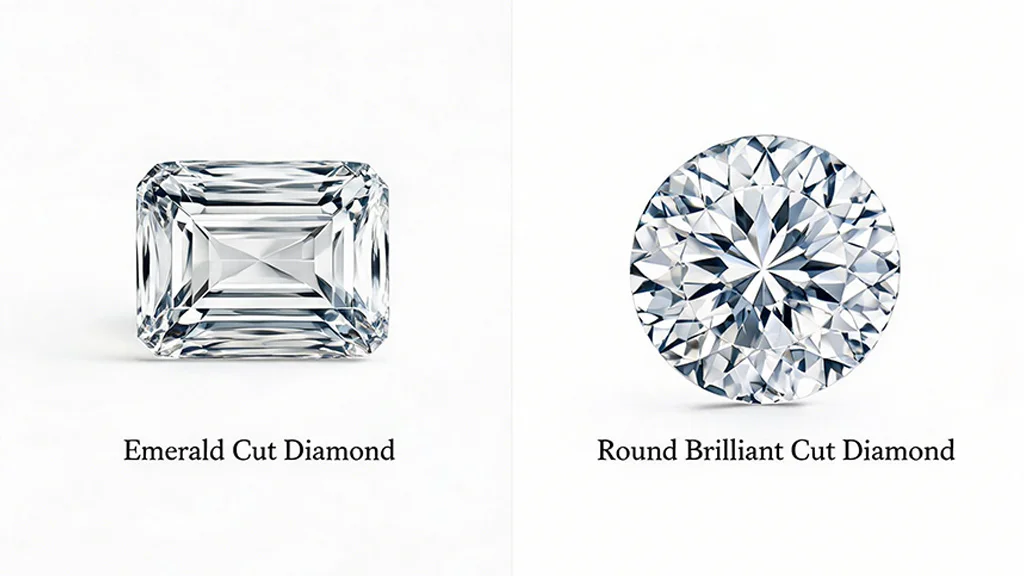
Brilliant cuts — round, cushion, oval, princess — have many small, angled facets that scatter light in a way that helps camouflage minor inclusions. Step cuts — emerald and Asscher in particular — have broad, flat, mirror-like facets that make inclusions far easier to spot. As a rule of thumb, step cuts benefit from a higher clarity grade (VVS–VS1) than brilliant cuts need.
Carat Weight
Larger diamonds have larger facets, which act like bigger windows into the stone — inclusions that would be invisible in a 0.5-carat diamond can become noticeable in a 2-carat diamond of the same clarity grade. As carat weight goes up, it's worth considering a step up in clarity grade as well, particularly for center stones over 1.5 carats.
Lab-Grown vs. Mined Diamond Clarity: A Manufacturing Perspective
Lab-grown and mined diamonds are graded on the identical clarity scale, by the same laboratories, using the same 10x-magnification methodology — clarity is clarity, regardless of origin. But the way inclusions form differs in ways worth understanding if you're comparing the two.
Mined diamonds form over enormous timescales in uncontrolled geological conditions, which tends to produce a wider spread of inclusion types and a broader distribution across the clarity scale. Lab-grown diamonds are produced in tightly controlled HPHT (high-pressure, high-temperature) or CVD (chemical vapor deposition) environments. That control doesn't guarantee flawlessness — inclusions still form from trace gases and growth irregularities — but it does tend to concentrate production in the higher clarity tiers (VS and above) more consistently than mined output, which is one reason eye-clean lab-grown stones are typically more accessible at a given price point.
From a manufacturing standpoint, this consistency also simplifies stone-matching for melee and side-stone work in production runs, where clarity uniformity across dozens or hundreds of small stones matters for a finished piece's overall appearance.
What Should You Pay for Clarity? A Global Price Guide
Clarity has one of the steepest price curves of the Four Cs once you move above the eye-clean threshold. The table below gives directional per-carat premium ranges for a well-cut, colorless (G–H) round brilliant, across the three currencies most relevant to our readers. Actual prices vary by supplier, carat weight, and market conditions — use this as a planning reference, not a quote.
|
Clarity Grade |
USD / ct (approx.) |
|---|---|
|
FL / IF |
Premium tier |
|
VVS1 / VVS2 |
High |
|
VS1 / VS2 |
Moderate–High (best value ceiling) |
|
SI1 / SI2 |
Moderate (best value zone) |
|
I1–I3 |
Lower (not generally recommended) |
As a practical rule: most global buyers get the best balance of beauty and budget in the VS1–SI1 range, where inclusions are already invisible or nearly invisible to the naked eye but pricing sits well below the VVS and Flawless tiers.
Regulatory Notes on Clarity Claims
Clarity grading isn't just a sales tool — it's also a regulated area of consumer protection in major markets, which matters for any retailer or brand making clarity claims in marketing or product listings.
- United States: The FTC's Jewelry Guides (16 CFR Part 23) require clarity grade representations to be accurate and substantiated, and prohibit implying a grading standard that wasn't actually applied to the stone.
- United Kingdom: Retailers should ensure clarity and grading claims comply with the Consumer Protection from Unfair Trading Regulations, avoiding any claim that could mislead a reasonable consumer about a stone's certified grade.
- European Union: Clarity claims fall under general EU consumer protection and unfair commercial practices rules, which require that grading representations be truthful, verifiable, and traceable to a recognized certificate.
For OEM and private-label partners, this is a good reminder to always sell against an actual certificate (GIA, IGI, or AGS) rather than in-house or generic grading language, and to keep grading reports on file to support any clarity claim made in packaging or marketing.
How to Choose Diamond Clarity for Your Ring
There's no universally "best" clarity grade — the right choice depends on your shape, carat weight, and budget.
- Round, cushion, oval, or princess cut, and prioritizing value: VS2–SI1 is usually the sweet spot.
- Emerald, Asscher, or another step cut: aim for VVS2–VS1 to keep the open facets clean-looking.
- Center stone over 1.5–2 carats: step up one clarity tier from what you'd choose at 1 carat, since larger facets reveal more.
- Buying without seeing the stone in person: always request the clarity plot and, where possible, a 10x video, not just the certificate grade.
From the Factory Floor: How Provence Jewellery Sources and Grades for Clarity
As an OEM and ODM manufacturer producing solid gold, lab-grown diamond, moissanite, and natural gemstone jewelry for brand partners across the US, UK, and EU, Provence Jewellery works with clarity specifications at production scale, not one stone at a time.
Every parcel of loose diamonds entering our workshop in Wuzhou is checked against its accompanying GIA or IGI certificate, then cross-verified under magnification by our in-house grading team before it's approved for setting. For side-stone and melee work, we match clarity and color consistency across dozens of stones per piece, so a finished ring, bracelet, or pendant reads as visually uniform rather than mismatched. For center stones, we can source and certify to a brand partner's exact clarity specification — whether that's a strict VS1-minimum consumer collection or a value-tier SI1 program — and provide the underlying grading documentation for every shipment.
This is also where lab-grown diamonds have become a meaningful advantage for our brand partners: because lab-grown stones trend toward more consistent clarity outcomes, we're able to hold tighter, more predictable clarity specs across large production runs than is typically possible sourcing only mined melee.
Frequently Asked Questions
Flawless (FL) is the highest possible grade, with no inclusions or blemishes visible under 10x magnification. It's also extremely rare and commands a significant price premium — most buyers get better value from the VS or SI range.
Both are "Very Slightly Included," but VS1 inclusions are more difficult to see under 10x magnification than VS2 inclusions. Both grades are typically eye-clean, meaning inclusions aren't visible without magnification.
It depends on the individual stone. SI2 diamonds can look completely clean to the naked eye if their inclusions are small and well-positioned, but they can also show visible inclusions in step cuts or larger carat weights. Always check the clarity plot and photos or video before buying an SI2.
Yes. Lab-grown diamonds form under heat and pressure just like mined diamonds and can develop the same range of inclusion types, though controlled growth conditions tend to concentrate lab-grown output in higher clarity tiers on average.
Most diamonds VS2 and above are reliably eye-clean. Many well-cut SI1 diamonds are eye-clean too, particularly in brilliant cuts — it comes down to the specific stone's inclusion size, type, and position rather than the grade alone.
Generally not recommended for a center stone. Inclusions at this level are visible to the naked eye and, in I2–I3 stones, can affect durability as well as appearance.