
Diamond Shapes Guide: 10 Types Explained
- Written by Provence Team
- Updated on August 7, 2026
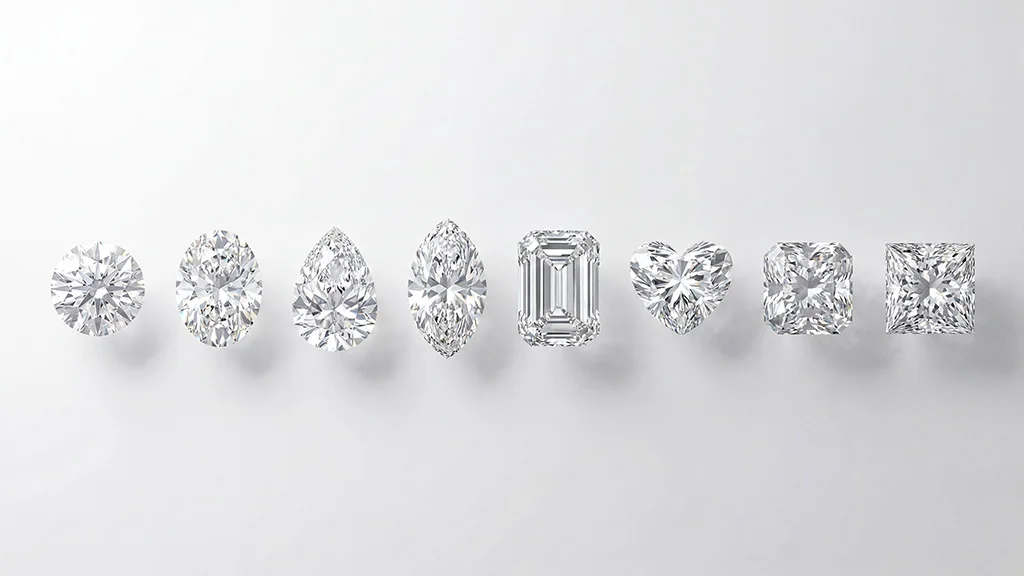
Table of Contents
When you start shopping for a diamond — whether it's a natural stone, a lab-grown diamond, moissanite, or cubic zirconia — the first real decision you'll make isn't color or clarity. It's shape.
Diamond shape is the outline of the stone when you look at it from above: round, oval, emerald, pear, and so on. It's the single biggest factor in how a diamond looks on the hand, and it's usually the first thing anyone notices about an engagement ring. Get the shape right, and everything else — the setting, the metal, the size — falls into place around it.
This guide covers all ten standard diamond shapes, how they compare on sparkle, price, and finger flattery, and how shape plays out differently across natural diamonds, lab-grown diamonds, moissanite, and cubic zirconia. Whether you're buying one stone or sourcing for a collection, here's everything you need to choose with confidence.
What Is Diamond Shape? (And How Is It Different From Cut?)
These two terms get mixed up constantly, so let's separate them clearly.
Diamond shape refers to the outline or silhouette of the stone — round, oval, princess, emerald, and so on. It's a visual, geometric description of the stone's form.
Diamond cut refers to how well the diamond's facets are proportioned and polished to interact with light. Cut is graded (Excellent, Very Good, Good, Fair, Poor) and determines how much brilliance, fire, and sparkle a diamond shows — regardless of its shape.
Here's the distinction in practice: two round diamonds can look completely different from each other if one has an Excellent cut grade and the other has a Fair one. The shape is the same; the cut quality is not.
|
Diamond Shape |
Diamond Cut |
|
|---|---|---|
|
What it describes |
The outline/silhouette |
How facets reflect light |
|
Examples |
Round, oval, emerald, pear |
Excellent, Very Good, Good, Fair |
|
Fixed once cut? |
Yes — permanent |
Graded on a scale |
|
Affects |
Style, finger flattery, setting options |
Brilliance, fire, scintillation |
Once you understand this distinction, the rest of your diamond search gets much easier: pick your shape first based on style, then evaluate cut quality within that shape.
Diamond Shapes Chart: Quick Comparison
Here's how the ten standard diamond shapes stack up at a glance. "Cutting yield" reflects roughly how much of the rough stone is typically retained during cutting — a factor that influences cost and availability, particularly relevant if you're sourcing at scale.
|
Shape |
Facets |
Popularity |
Best For |
Relative Price* |
Cutting Difficulty |
|---|---|---|---|---|---|
|
Round Brilliant |
57–58 |
#1 (~65-75% of sales) |
Maximum sparkle, timeless style |
Highest |
High (lowest rough yield) |
|
Oval |
56–58 |
#2 |
Elongating fingers, larger look |
High |
Medium |
|
Cushion |
58–64 |
#3 |
Vintage romance, soft glow |
Medium-High |
Medium |
|
Princess |
58–76 |
#4 |
Modern, geometric, budget-friendly |
Medium |
Low (efficient rough use) |
|
Emerald |
57 |
#5 |
Clarity-forward, art deco elegance |
Medium-Low |
Low |
|
Radiant |
70 |
#6 |
Brilliance + structure combined |
Medium |
Medium |
|
Pear |
58 |
#7 |
Distinctive, asymmetrical statement |
Medium |
Medium-High |
|
Asscher |
58–74 |
#8 |
Vintage, architectural |
Low-Medium |
Low |
|
Marquise |
58 |
#9 |
Dramatic, finger-lengthening |
Medium |
High |
|
Heart |
56–59 |
#10 |
Romantic, symbolic |
Medium |
Highest (hardest to cut symmetrically) |
*Relative price is per carat at equivalent color/clarity — round is the benchmark "highest" against which other shapes are typically discounted.
The 10 Standard Diamond Shapes
1. Round Brilliant Cut
The round brilliant is the shape most people picture when they think "diamond." With 57 or 58 precisely angled facets, it's engineered for one purpose: maximum light return. No other shape produces the same combination of brilliance, fire, and scintillation, which is why it's remained the top-selling shape for over a century.
The trade-off is cost. Because a round brilliant is cut from an octahedral rough diamond — the natural crystal shape diamonds form in — a significant amount of the rough stone is lost in cutting to achieve ideal proportions. That lower yield, combined with sustained demand, makes round the most expensive shape per carat across natural, lab-grown, and simulant materials alike.
Material notes: Round is the most common shape for moissanite and cubic zirconia too, since it's the easiest to source and best mimics the sparkle profile people expect. Lab-grown round diamonds offer the same brilliance as natural at a lower price point, since the lower rough-to-finished ratio matters less when the "rough" is grown to spec rather than mined.
Best for: Anyone prioritizing sparkle above all else. Flatters virtually every hand and setting style.
2. Oval Cut
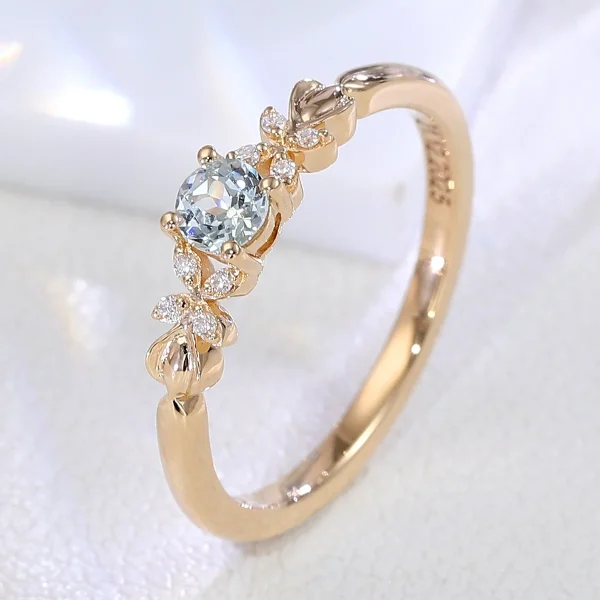
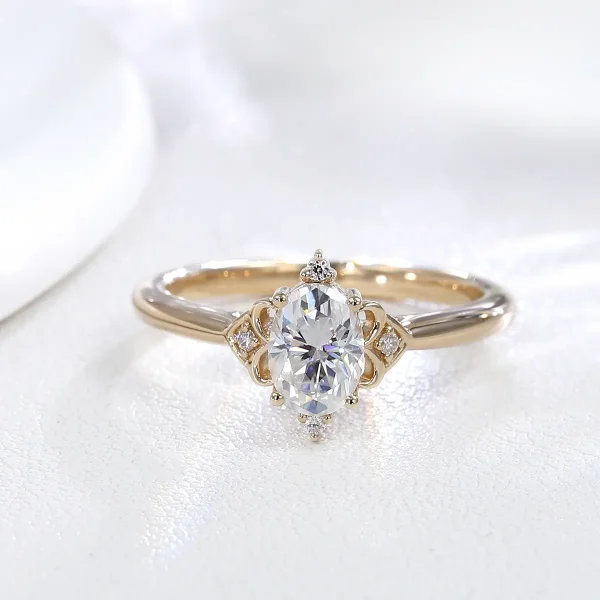
The oval is essentially an elongated round brilliant — same facet structure, same light performance, but stretched into a softer, more slender silhouette. It's the shape most associated with the "spread effect," where the diamond's larger surface area makes it look bigger than its carat weight suggests compared to a round stone of equal size.
Ovals have surged in popularity over the past several years, closing in on round as the most-requested fancy shape. One thing to watch for: the bow-tie effect, a subtle dark shadow that can appear across the center of the stone depending on cut proportions. A well-cut oval minimizes this significantly.
Material notes: Oval performs beautifully in lab-grown diamonds and moissanite, both of which handle elongated brilliant faceting well. In CZ, ovals are widely available and popular for their size-to-cost ratio.
Best for: Shorter or wider fingers — the elongated shape creates a visual lengthening effect.
3. Cushion Cut
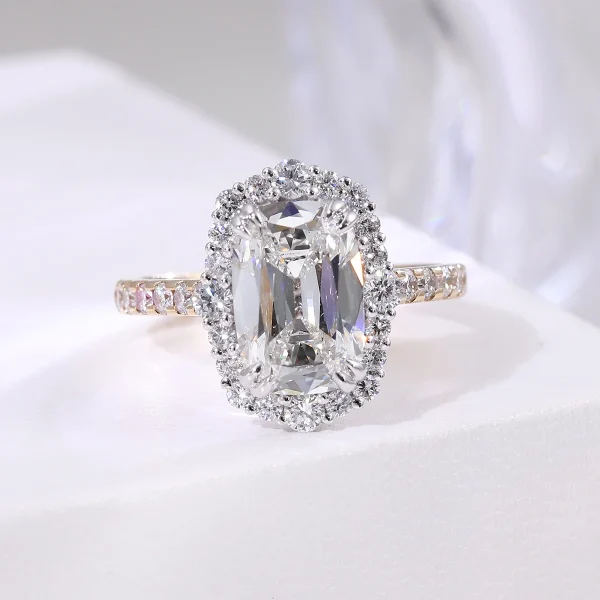
Cushion cuts combine a square or rectangular outline with softly rounded corners — think of it as a pillow shape. It's one of the oldest diamond shapes still in mainstream use, tracing back nearly 200 years, and it was actually the most popular cut in the world before the modern round brilliant was developed in the early 1900s.
Cushions can be cut in two distinct styles: a "chunky" cut with larger, fewer facets that produces bold flashes of light, or a "crushed ice" cut with a denser facet pattern that gives a sparkling, textural look. This flexibility makes cushion cuts appealing to a wide range of tastes, from classic to contemporary.
Material notes: Cushion is a strong performer in moissanite, since the extra facets help mask moissanite's naturally higher dispersion (the "rainbow flash" some people want to minimize). Available across all four materials with good consistency.
Best for: Vintage-inspired settings; flatters most hand shapes.
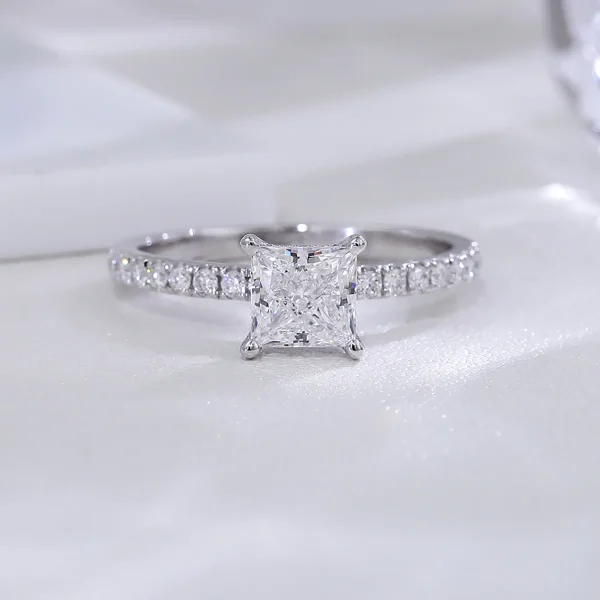
4. Princess Cut
The princess cut is a square or rectangular shape with sharp, pointed corners — the most popular non-round shape for decades, and typically the second-best-selling shape after round brilliant. With up to 76 facets, it delivers strong brilliance while maintaining clean, modern lines.
From a sourcing perspective, princess cuts are notable for their efficiency: the shape is cut close to the natural octahedral form of rough diamond, meaning less material is wasted compared to round. This typically makes princess cuts more affordable per carat than round diamonds of comparable quality — a meaningful factor for buyers optimizing for size and value.
Material notes: Because princess corners are pointed and more prone to chipping, this is a shape where prong protection matters more in natural and lab-grown diamonds. Moissanite's superior hardness (9.25 on the Mohs scale vs. diamond's 10) makes it a very durable choice in this shape as well.
Best for: Buyers wanting the brilliance of round at a lower price point; geometric, contemporary styling.
5. Emerald Cut
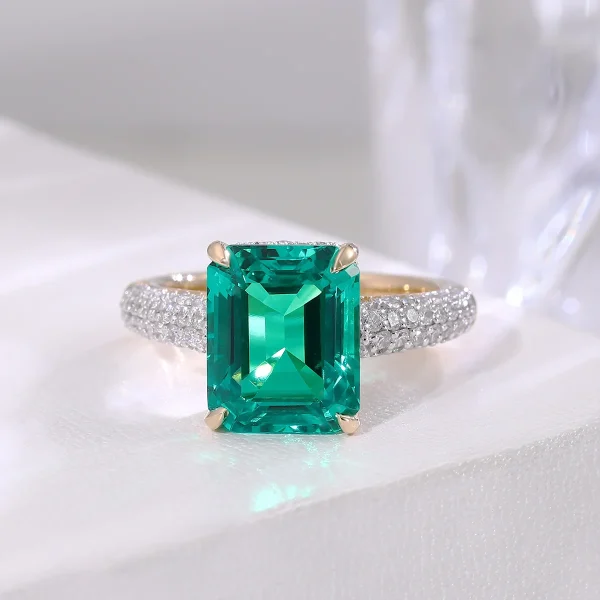
Emerald cuts are rectangular with trimmed corners and long, open step-cut facets rather than the small triangular facets used in brilliant cuts. This creates the shape's signature "hall of mirrors" effect — wide, flat planes of light and dark rather than scattered sparkle.
Because emerald cuts have fewer, larger facets, they show off a stone's clarity more prominently — and also reveal inclusions more readily than a brilliant cut would hide them. This makes clarity grade a more important consideration when choosing an emerald cut, whether in natural or lab-grown diamond.
Material notes: Emerald cuts are typically the least expensive shape per carat in natural and lab-grown diamond, thanks to lower cutting complexity and demand relative to round. In moissanite and CZ, the step-cut faceting produces a more understated, sophisticated flash rather than moissanite's typical high-fire sparkle — appealing to buyers who want a quieter look.
Best for: Elongating the finger; understated, architectural elegance over maximum sparkle.
6. Radiant Cut
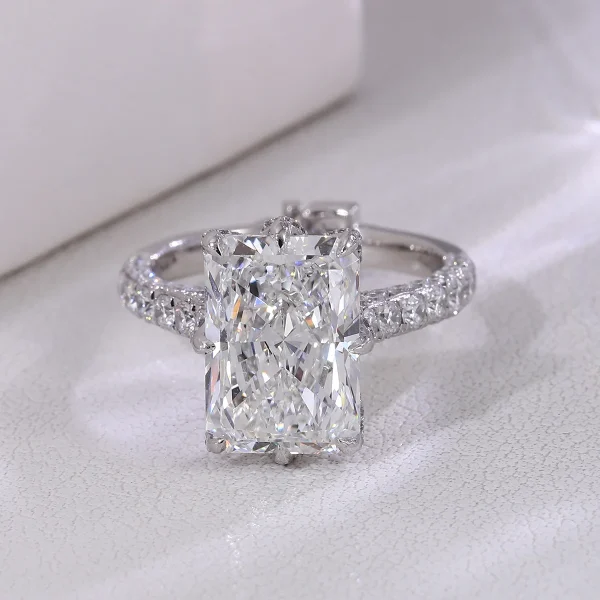
The radiant cut was developed in the 1970s specifically to combine the elegant rectangular or square outline of the emerald cut with the brilliant faceting of the round cut. With around 70 facets, it produces significantly more fire and sparkle than an emerald or Asscher cut while keeping a similar silhouette.
Radiant cuts also do a better job of hiding inclusions than step-cut shapes like emerald or Asscher, since the brilliant facet pattern breaks up light in a way that camouflages small imperfections. That makes it a practical middle-ground choice — sparkle plus forgiveness on clarity.
Material notes: A great fit across all four materials since the brilliant faceting works consistently well whether the stone is natural, lab-grown, moissanite, or CZ.
Best for: Buyers who want a rectangular/square silhouette without sacrificing brilliance.
7. Pear Cut
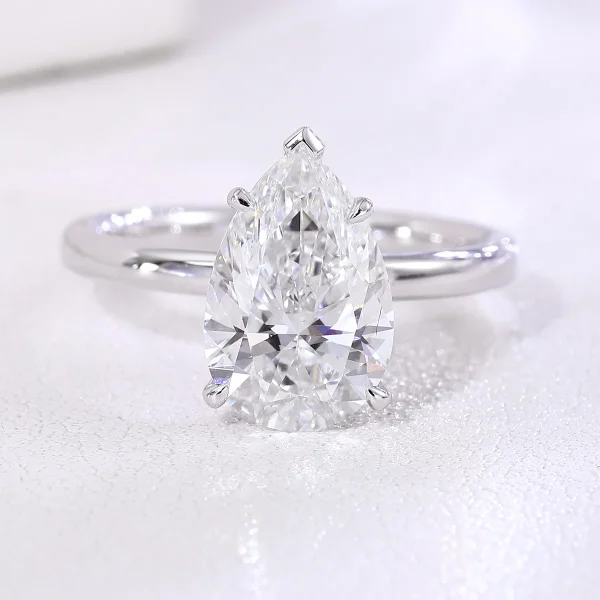
Also called the teardrop shape, the pear cut combines the rounded curve of a round brilliant on one end with the tapered point of a marquise on the other. It's an asymmetrical shape, which means proportion and symmetry matter enormously — a poorly cut pear can look lopsided or show a pronounced bow-tie effect.
Pear diamonds can be set with the point facing toward the wearer (a "west-facing" orientation many find slims the finger) or away, giving some styling flexibility not available with symmetrical shapes.
Material notes: Because precision cutting matters so much for pear shapes, quality control varies more here than with symmetrical shapes — this applies across natural, lab-grown, and moissanite alike. Sourcing from an experienced cutter matters more for pear than for round or princess.
Best for: Elongating fingers; a distinctive, slightly unconventional statement piece.
8. Asscher Cut
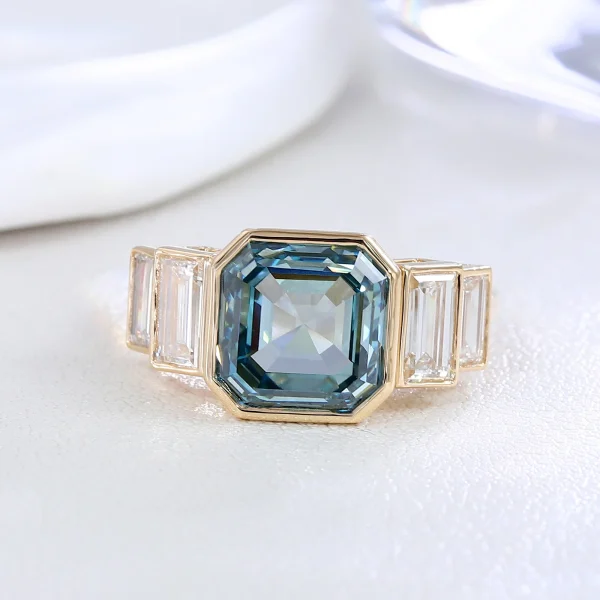
Developed in 1902 by the Asscher Brothers of Amsterdam, the Asscher cut is essentially a square version of the emerald cut — step-cut facets, cropped corners, but a more symmetrical, almost octagonal outline. Viewed from above, the concentric squares create a distinctive "windmill" pattern.
Like the emerald cut, Asscher emphasizes clarity and depth over maximum brilliance, giving it a cool, architectural elegance rather than a fiery sparkle. It experienced a strong revival in the early 2000s and remains a favorite for those drawn to art deco design.
Material notes: One of the more affordable shapes across natural and lab-grown diamond due to lower demand relative to brilliant-cut shapes. The clarity-revealing nature of the step cut is worth factoring in more heavily with CZ and moissanite, where internal characteristics differ from natural diamond.
Best for: Vintage and art deco aesthetics; longer fingers where its bold geometry reads clearly.
9. Marquise Cut
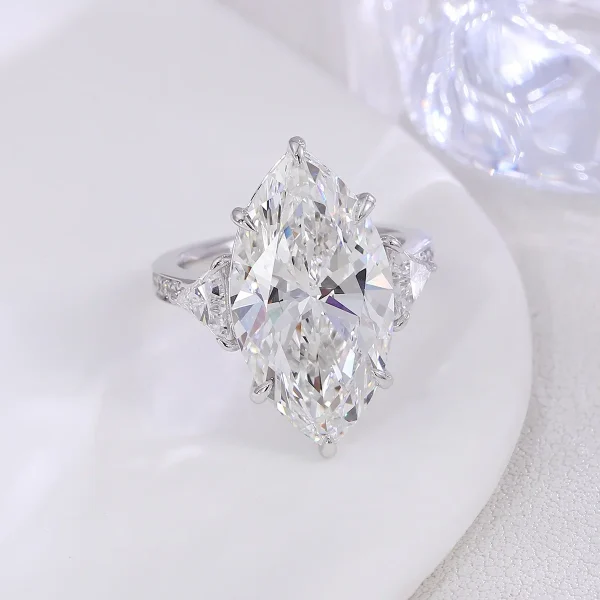
The marquise is an elongated shape with two pointed ends, said to have been commissioned in the 18th century by King Louis XV of France, allegedly to resemble the smile of his mistress, the Marquise de Pompadour. Whatever the origin story, the shape has one very practical advantage: because it maximizes surface area relative to carat weight, a marquise diamond typically looks larger than a round or princess diamond of the same weight.
The pointed tips require protective settings (V-prongs or similar) to prevent chipping — a detail worth confirming with any jeweler or manufacturer regardless of material.
Material notes: Marquise is one of the more difficult shapes to cut symmetrically, which affects consistency across natural, lab-grown, and moissanite sourcing. Buyers should pay close attention to length-to-width ratio and bow-tie effect regardless of material.
Best for: Maximizing apparent size per carat; dramatic, finger-lengthening effect.
10. Heart-Shaped Cut
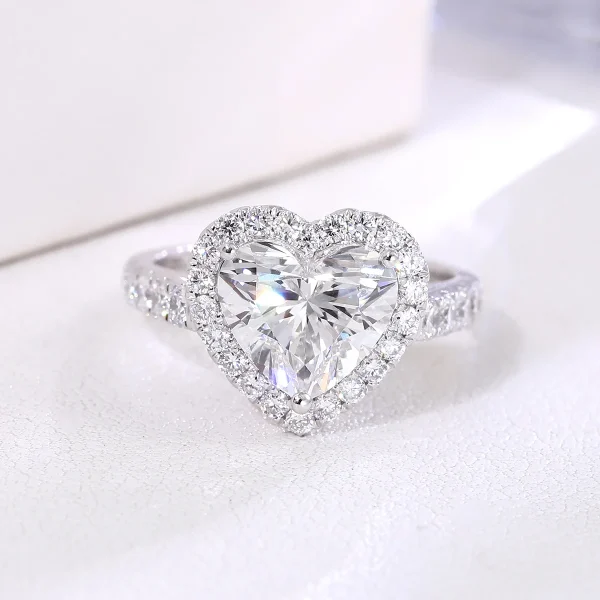
The most overtly romantic diamond shape, the heart cut is a modified brilliant with a cleft at the top and a single point at the bottom. It's widely considered the most difficult shape to cut well — achieving symmetrical lobes and a well-defined point requires exceptional skill, and the shape is unforgiving of any imperfection in execution.
Because of its complexity, heart-shaped diamonds are typically recommended above a certain minimum carat weight (often 0.75 ct and up) — below that, the heart outline can be difficult to distinguish at a glance.
Material notes: This is the shape where cutting expertise matters most, regardless of material. A well-made heart shape in moissanite or CZ requires the same precision as natural diamond to read clearly as a heart rather than a rounded triangle.
Best for: Sentimental, symbolic pieces — anniversaries, milestone gifts.
Beyond the Standard Ten: Specialty & Antique Shapes
A handful of less common shapes show up as accent stones or in vintage-inspired pieces:
- Trillion — a triangular shape with pointed or rounded corners, often used as a side stone
- Baguette — a narrow rectangular step cut, almost exclusively used as an accent stone in eternity bands or as side stones
- Old European Cut — the antique predecessor to the modern round brilliant, with a smaller table and higher crown
- Old Mine Cut — an antique cushion-style cut with a squarer outline and softer facet pattern
- Rose Cut — a flat-bottomed, domed-top cut with triangular facets and minimal brilliance, prized for its antique character
These specialty shapes represent a smaller but consistent share of demand, particularly for bridal sets, eternity bands, and vintage reproduction pieces.
How to Choose a Diamond Shape
By Finger Shape
Elongated shapes — oval, marquise, pear, and emerald — visually lengthen the finger, since the eye follows the diamond's length rather than its width. Round, princess, and cushion cuts read as more compact and work well for most hand shapes without a specific slimming or lengthening effect.
For maximum elongation, elongated shapes should be set with their long axis running along the finger (north-south) rather than across it (east-west).
By Budget
If cost-per-carat is the priority, emerald and Asscher cuts are typically the most affordable due to lower cutting complexity and demand. Round brilliant sits at the top of the price spectrum. If you want to maximize apparent size for your budget, marquise, oval, and pear shapes offer the best visual size-to-cost ratio, since their elongated outlines create more surface area per carat than round or princess shapes.
By Personality
- Classic and timeless: Round, oval
- Bold and modern: Princess, radiant
- Vintage and romantic: Cushion, Asscher, Old Mine
- Distinctive and unconventional: Pear, marquise, heart
- Understated elegance: Emerald
By Setting Compatibility
Pointed-corner shapes (princess, marquise, pear, heart, trillion) need protective prong or bezel settings to guard against chipping. Rounded shapes (round, oval, cushion) are more forgiving across a wider range of setting styles, from delicate pavé to substantial solitaires.
Diamond Shape and Price: A Material Comparison
Shape affects price differently depending on the material — and this is where the choice between natural, lab-grown, moissanite, and CZ becomes especially relevant.
Natural diamonds: Round commands the highest premium due to rough diamond loss during cutting and sustained demand. Fancy shapes (everything else) are typically priced 25–40% lower per carat than round of equivalent quality, with emerald and Asscher at the low end of that range.
Lab-grown diamonds: The same shape hierarchy generally holds, but the gap between round and fancy shapes narrows, since lab-grown rough isn't subject to the same natural-yield constraints as mined rough. Lab-grown diamonds overall run significantly below natural diamond prices across every shape — often 60–85% less per carat at equivalent grades.
Moissanite: Shape has a smaller effect on price than in diamond, since moissanite rough is grown to size rather than mined and cut from irregular crystals. Round moissanite still commands a modest premium due to demand, but the price spread across shapes is much flatter than with natural diamond.
Cubic zirconia: Shape has minimal impact on price, since CZ is inexpensive to produce in any form. Shape selection here is driven almost entirely by aesthetic preference rather than cost trade-offs.
This is worth keeping in mind if you're choosing a shape based on budget: the "expensive shape" logic that applies to natural diamonds doesn't carry over proportionally to lab-grown, moissanite, or CZ.
FAQs
There's no single "best" shape — it depends on personal style, budget, and hand shape. Round brilliant offers the most sparkle and remains the most popular choice, but fancy shapes each bring their own character and can offer better value or a more distinctive look.
Round brilliant is typically the most expensive per carat in natural and lab-grown diamond, due to lower cutting yield from rough stone and consistently high demand.
Emerald and Asscher cuts are usually the most affordable per carat, thanks to more efficient use of rough material and comparatively lower demand.
Shapes with more surface area relative to depth — marquise, oval, and pear — tend to look larger than round or princess diamonds of the same carat weight, because more of the stone's mass is spread across a wider visible face.
Oval, pear, marquise, emerald, and elongated cushion or radiant cuts are all considered elongated shapes. They create a slimming, lengthening effect on the finger and often appear larger than more compact shapes of equal carat weight.
The visual and stylistic effects of shape (elongation, brilliance style, finger flattery) are consistent across all materials. What changes is the price impact — natural diamond shows the widest price spread between round and fancy shapes, while moissanite and CZ show a much flatter price curve across shapes.
Diamond cutters begin by planning the cut based on the rough stone's crystal structure, then cleave or saw it into workable sections, bruting (grinding) it into a basic outline, and finally faceting and polishing the surface. The process balances maximizing carat retention with achieving ideal proportions and symmetry — a skill that varies meaningfully between cutters and directly affects the finished stone's quality.
Round brilliant, hands down — its facet pattern is specifically engineered to maximize light return. Princess and radiant cuts follow closely, since both use brilliant-style faceting.
Ten shapes are considered standard in the modern jewelry market: round, oval, cushion, princess, emerald, radiant, pear, Asscher, marquise, and heart. Beyond these, specialty and antique shapes like trillion, baguette, rose cut, and Old European cut are used less commonly, typically as accent stones or in vintage-style pieces.
 English