
How Are Lab Grown Diamonds Made? CVD & HPHT Explained
- Written by Provence Team
- Updated on June 9, 2026
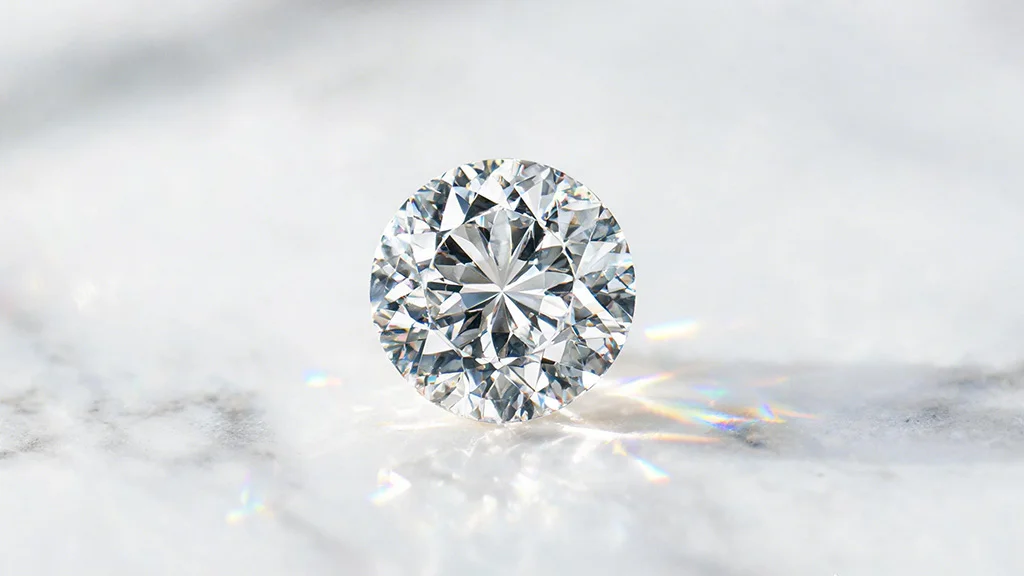
Table of Contents
A diamond that took billions of years to form beneath the Earth's crust can now be grown in a matter of weeks — in a laboratory, under controlled conditions, with results that are scientifically indistinguishable from the real thing. Because they are the real thing.
Lab grown diamonds are not imitations. They are not simulants like cubic zirconia or moissanite. They are genuine diamonds: pure crystallised carbon, sharing the exact same chemical composition, crystal lattice structure, and physical properties as any diamond pulled from the earth. The only difference is where — and how — they were made.
Two primary technologies are used to grow lab diamonds today: CVD (Chemical Vapor Deposition) and HPHT (High Pressure High Temperature). Each takes a different scientific approach, but both arrive at the same destination — a certified, facetable diamond ready to be cut, polished, and set into fine jewellery.
In this guide, we walk through the complete journey: the history of how lab grown diamonds were invented, exactly how each growth method works step by step, what happens after the crystal leaves the growth chamber, and what it all means when you are choosing or sourcing a lab grown diamond.
What is a Lab Grown Diamond?
A lab grown diamond is a diamond created in a controlled laboratory environment that replicates — or in some cases, reinvents — the conditions under which natural diamonds form. Every atom in a lab grown diamond is carbon. Every bond in its structure is the same tetrahedral carbon lattice that defines the hardest naturally occurring material on Earth.
On the Mohs hardness scale, lab grown diamonds score a perfect 10 — identical to their mined counterparts. Under a loupe, a spectroscope, or an X-ray diffractometer, a lab grown diamond is a diamond. The Gemological Institute of America (GIA) grades them. The Federal Trade Commission (FTC) classifies them as diamonds. A 2018 FTC ruling formally removed the qualifier "synthetic" from the definition, recognising that the term implied inferiority where none exists.
One detail worth noting — particularly for buyers who value exceptional purity — is diamond type classification. Natural diamonds typically contain trace amounts of nitrogen absorbed during their formation in the Earth's mantle. These nitrogen atoms replace carbon atoms in the lattice, classifying most natural diamonds as Type Ia. CVD lab grown diamonds, by contrast, grow in a nitrogen-free environment, making them Type IIA — the purest form of diamond known, representing less than 2% of all natural diamonds ever found. This is one of the ways gemologists can distinguish lab grown CVD diamonds from natural stones: not through visual inspection, but through spectroscopic analysis of what is absent.
If you are comparing lab grown and natural diamond options for a specific piece, our guide to lab grown vs natural diamonds goes deeper on what the differences mean practically.
A Brief History of Lab Grown Diamonds
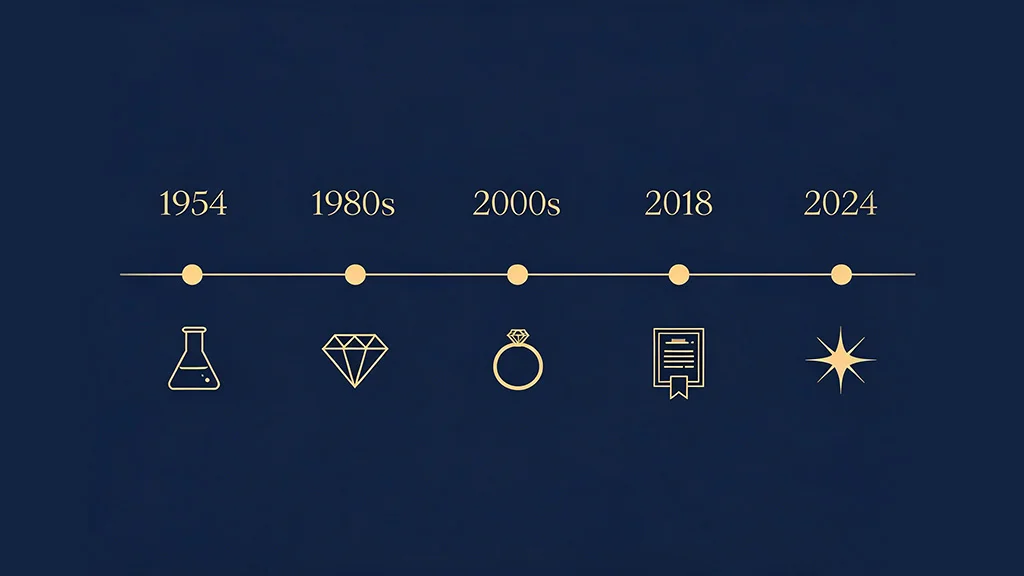
The story of lab grown diamonds begins not in a jewellery workshop but in a secret American laboratory in the early years of the Cold War.
In 1950, General Electric assembled a small team of scientists at their research facility in Schenectady, New York, and assigned them an audacious task: recreate the conditions deep inside the Earth and grow a diamond from carbon. The project was classified. Its internal name was Project Superpressure.
For several years the effort stalled — the conditions required were almost beyond what any machinery of the era could reliably produce. Then, on 16 December 1954, a physicist named Howard Tracy Hall arrived at his bench before his colleagues and ran his own experiment using a press of his own unconventional design, which he called the belt press. It worked. He had grown the first reproducible synthetic diamond.
Hall's achievement was initially kept secret by GE. When it was eventually published, it changed the trajectory of materials science. The immediate applications, however, were not jewellery — they were industrial. Lab grown diamonds were hard, durable, and cheaper to produce than sourcing natural diamonds for cutting tools, abrasives, and drill bits. For two decades, that remained the primary use.
Through the 1970s, researchers demonstrated that gem-quality lab grown diamonds — colourless, large enough to facet — were technically possible using HPHT. The 1980s brought the development of a second method entirely: Chemical Vapor Deposition (CVD), which required no extreme pressure and opened new possibilities for producing purer crystals.
By the 2000s, gem-quality CVD diamonds began entering the jewellery market at commercial scale. Grading laboratories developed protocols for testing and certifying them alongside natural stones. The FTC's 2018 ruling closed the definitional debate. Today, IGI and GIA both certify lab grown diamonds using the same 4Cs grading system used for natural diamonds — cut, colour, clarity, and carat weight — and both note the growth method on the certificate.
What began as a Cold War science project is now a mainstream component of the fine jewellery industry.
How are Lab Grown Diamonds Made? The Two Main Methods
All lab grown diamonds start the same way: with a diamond seed crystal — a thin slice of existing diamond that acts as a foundation for growth. From that point, the two methods diverge completely.
HPHT mirrors nature. It recreates the extreme heat and crushing pressure found in the Earth's mantle, coaxing carbon to crystallise around the seed over weeks of sustained force and temperature. It is the older method, the one Howard Tracy Hall pioneered in 1954.
CVD builds atom by atom. A vacuum chamber is filled with carbon-bearing gas, which is ionised into a superheated plasma. Carbon atoms liberated from the gas migrate downward and bond to the seed crystal's surface, assembling the diamond one atomic layer at a time — with no pressure required at all.
Both methods produce real diamonds. Both produce stones certifiable by IGI and GIA. The differences are technical in nature and relate to purity profiles, colour tendencies, inclusion types, and the scale at which each method operates most efficiently. Sections 4 and 5 below walk through each process in full detail.
HPHT Diamonds: Recreating The Earth's Mantel in a Laboratory
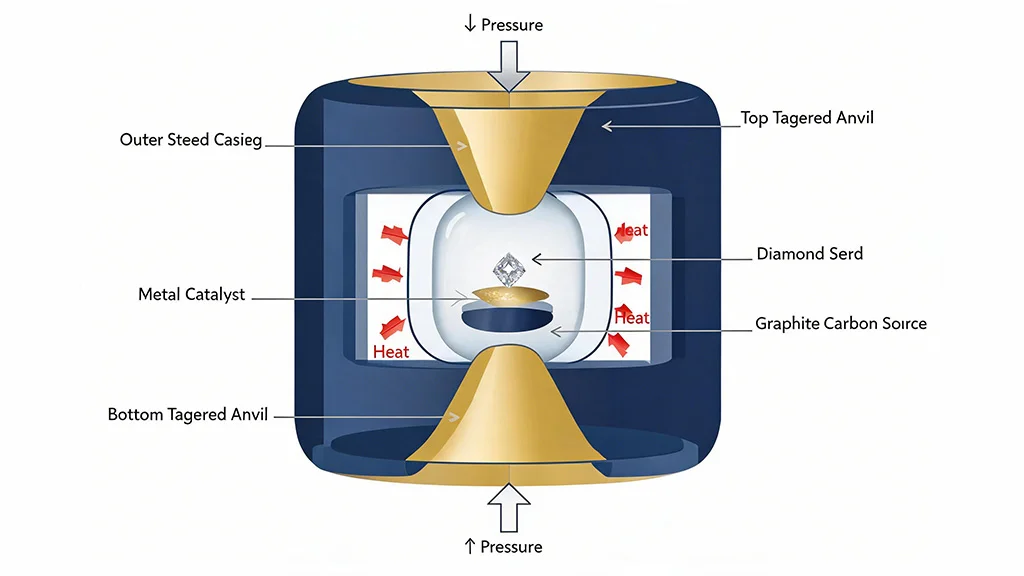
HPHT is the original method of lab diamond production — and its logic is beautifully straightforward. Natural diamonds form approximately 150 miles beneath the Earth's surface, where temperatures exceed 1,000°C and pressures are beyond anything we experience at the surface. HPHT simply recreates those conditions in a machine small enough to fit inside a laboratory.
The carbon source for HPHT growth is high-purity graphite or carbon powder — chemically the same element as diamond, just arranged differently. A tiny slice of an existing natural or lab grown diamond serves as the seed.
The HPHT growth process, step by step:
1. Seed Placement — The diamond seed crystal is positioned at the centre of a specially engineered press capsule, typically made of a refractory material that can withstand extreme conditions without contaminating the growth environment.
2. Carbon Loading — High-purity graphite (the carbon source) is packed around the seed along with a metal catalyst — usually a mixture of iron, nickel, or cobalt. The catalyst serves a critical function: it lowers the temperature at which carbon dissolves and migrates, making the process more efficient.
3. Pressure Application — The press generates pressures exceeding 870,000 pounds per square inch — approximately 5 to 6 GPa. To put that in context, it is roughly 1.5 million times the atmospheric pressure you feel standing at sea level.
4. Heat Application — Simultaneously, the capsule is heated to between 1,300°C and 1,600°C, replicating conditions found more than 150 miles below the Earth's surface.
5. Carbon Dissolution — At these conditions, the metal catalyst melts into a liquid. The molten metal dissolves the surrounding graphite, breaking it down into individual carbon atoms suspended in the metallic liquid.
6. Crystal Growth — A temperature gradient is established within the capsule: the seed is positioned at the cooler end, the graphite at the hotter end. Carbon atoms follow the gradient, migrating toward the cooler diamond seed and precipitating onto its surface — building the crystal layer by layer, hour by hour, over a period of two to four weeks.
7. Extraction — When growth is complete, the press is powered down. The rough diamond crystal — now significantly larger than the original seed — is extracted from the capsule and assessed for quality.
Three main press designs are used industrially for HPHT diamond production: the belt press (Tracy Hall's original design), the cubic press (which applies pressure from six directions simultaneously), and the split-sphere or BARS press (a Russian-developed design that achieves extremely stable pressure conditions). The choice of press affects crystal shape, size ceiling, and operational cost.
HPHT diamonds have a characteristic cubic crystal shape — unlike the octahedral shape typical of natural diamonds. Under magnification, a trained grader may detect metallic inclusions from the iron or nickel catalyst; these are not visible to the naked eye and do not affect a stone's brilliance or durability. HPHT stones can exhibit a faint yellow or blue tint from trace elements absorbed during growth, though post-growth colour treatment is available to correct this.
HPHT is particularly well-suited to growing larger stones and fancy coloured diamonds — especially fancy yellow, where the trace nitrogen naturally present in the process produces vivid, consistent colour.
Key characteristics of HPHT diamonds:
— Growth time: 2–4 weeks
— Crystal type: typically Type Ib (trace nitrogen present)
— Colour: near-colourless to faint yellow; fancy yellow possible
— Potential inclusions: metallic inclusions (iron/nickel) from catalyst
— Best suited to: larger stones (3 carat+), fancy colour production
CVD Diamonds: Growing Carbon Atom By Atom
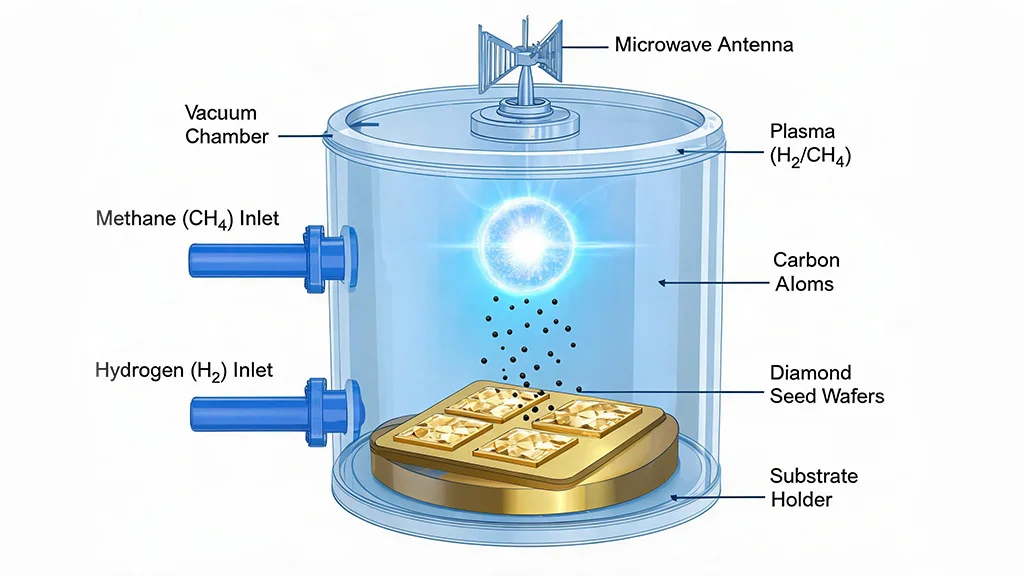
CVD diamond growth was developed in the 1980s and refined significantly through the 1990s and 2000s. Where HPHT replicates the geology of the Earth's interior, CVD is closer to a chemical manufacturing process — one that builds a diamond from gas, atom by atom, without any extreme pressure at all.
The seed for CVD growth is a thin wafer of Type IIA diamond — either natural or from a prior CVD growth cycle — polished to a precise thickness and surface finish. Multiple seed wafers, typically 15 to 30, are loaded into a single growth chamber simultaneously, which is what makes CVD commercially scalable.
The CVD growth process, step by step:
1. Chamber Preparation — The growth chamber — a cylindrical vacuum vessel — is evacuated to an extremely low pressure, typically below 10⁻⁶ torr. This near-total vacuum ensures the environment is free from contaminants that could interfere with crystal growth or introduce unwanted elements into the diamond lattice.
2. Seed Placement — The disc of diamond seed wafers is positioned on a substrate holder at the base of the chamber. The wafers are oriented so their surface is flat and uniform — this is the platform on which the new diamond will grow.
3. Gas Introduction — The chamber is partially backfilled with a precise mixture of hydrogen and methane gas. The ratio matters: typically 1 to 5 percent methane by volume, with hydrogen making up the balance. The methane supplies the carbon; the hydrogen plays a critical role in etching away non-diamond carbon forms (graphite, amorphous carbon) that would otherwise contaminate the growing crystal.
4. Plasma Activation — Microwave energy at 2.45 GHz is directed into the chamber — the same frequency used in a microwave oven, but orders of magnitude more powerful. This ionises the gas mixture, forming a superheated plasma ball that glows blue-white at approximately 2,000°C, suspended above the seed wafers.
5. Carbon Deposition — The intense energy of the plasma breaks down the methane molecules, liberating individual carbon atoms. These atoms descend from the plasma toward the cooler seed wafers below, where they bond to the diamond surface and begin assembling the crystal lattice.
6. Crystal Growth — Carbon atoms accumulate on the seed wafers at a rate of approximately 1 to 10 micrometres per hour, building the diamond one atomic layer at a time. The process runs continuously — 24 hours a day — for two to six weeks, depending on the target carat weight.
7. Removal and Post-Treatment — When the growth cycle is complete, the chamber is vented and the rough CVD diamonds are removed from the substrate. At this stage, they typically display a brownish colour — a result of internal lattice strain introduced during the growth process. A brief HPHT post-treatment is applied to relieve this strain and restore the diamond's natural colourless appearance. After treatment, CVD diamonds reliably achieve D-to-F colour grades — the colourless range at the top of the GIA scale.
Because CVD growth occurs in a nitrogen-free environment, every CVD diamond is Type IIA — the same classification given to the rarest and purest natural diamonds. Type IIA diamonds have no nitrogen impurities in their lattice, giving them exceptional optical transparency and a purity profile associated with the world's most historically significant gems, including the Cullinan and Koh-i-Noor.
Key characteristics of CVD diamonds:
— Growth time: 2–6 weeks
— Crystal type: Type IIA (no nitrogen — exceptional purity)
— Colour: D–F colourless after post-treatment, highly consistent
— Potential inclusions: needle or cloud inclusions from the gas phase; no metallic inclusions
— Best suited to: colourless precision stones, sub-3 carat gems, high-volume production
CVD vs HPHT Diamonds: What's The Difference?
Both methods create real, certified diamonds. The differences are technical — not about which is more valuable or which produces a superior stone for the wearer. Understanding them helps when selecting or sourcing.
Comparison Table:
|
Factor |
CVD |
HPHT |
|---|---|---|
|
Method |
Carbon gas deposited onto seed via plasma |
Extreme pressure and heat applied to carbon + seed |
|
Growth time |
2–6 weeks |
2–4 weeks |
|
Temperature |
~2,000°C (plasma) |
1,300–1,600°C |
|
Pressure |
Low pressure (vacuum, <10⁻⁶ torr) |
870,000+ PSI (5–6 GPa) |
|
Crystal type |
Type IIA (no nitrogen) |
Type Ib (trace nitrogen) |
|
Typical colour |
D–F colourless after post-treatment |
Near-colourless to faint yellow |
|
Inclusions |
Needle or cloud; no metallic inclusions |
May contain iron/nickel metallic inclusions |
|
Best for |
Colourless precision stones, sub-3 carat |
Larger stones, fancy colours |
|
Post-treatment |
Brief HPHT colour treatment common |
Usually none required |
|
Commercial scale |
Higher scalability (multiple seeds/cycle) |
Lower throughput per cycle |
Neither method is inherently superior. At Provence Jewellery, we source both CVD and HPHT lab grown diamonds, selecting the appropriate origin based on the specific quality target and design requirements for each piece.
From Rough Diamond to Finished Gem: What Happens After Growth
When a lab grown diamond crystal leaves the growth chamber — whether from a CVD reactor or an HPHT press — it is a rough stone. It may weigh several carats, but it bears little resemblance to the polished gem it will become. The post-growth journey is where science hands off to craft.
Stage 1: Rough Assessment
The rough crystal is examined by a diamond planner who evaluates its shape, weight, internal clarity characteristics (inclusions), and surface features. Using specialised software and decades of expertise, the planner maps the optimal cutting strategy — balancing yield (how much of the rough weight is preserved) against quality (the grade of the finished stone). A single planning decision can mean the difference between a 1.50 ct VS1 and a 1.20 ct VVS2.
Stage 2: Cutting and Shaping
The rough diamond is first cleaved or laser-sawn into a pre-form — a rough approximation of the final shape. From this point, skilled cutters facet the stone using precision lathes and diamond-tipped tools (only diamond is hard enough to cut diamond).
For a round brilliant — the most common diamond shape — 57 or 58 facets are cut to an exact mathematical specification designed to maximise light return, brilliance, and fire. Cut is widely regarded as the most important of the 4Cs: a well-cut stone of modest colour and clarity will outperform a poorly cut stone of superior grades in visual impact.
Stage 3: Polishing
Each facet is polished individually on a spinning cast-iron disc called a scaif, embedded with a paste of diamond powder and oil. Polishing removes micro-scratches from the cutting process and creates the smooth, flat facet surfaces that allow light to enter, reflect, and exit the diamond precisely. The polish grade on a certificate reflects the quality of this finish.
Stage 4: Grading and Certification
The finished, polished diamond is submitted to an independent gemological laboratory — most commonly IGI (International Gemological Institute) or GIA (Gemological Institute of America) for lab grown stones. The diamond is assessed by trained graders across all 4Cs:
— Cut: proportions, symmetry, and polish
— Colour: graded D (colourless) to Z (light yellow) on the GIA scale
— Clarity: presence, size, and position of inclusions
— Carat: weight measured to the nearest hundredth of a carat
Crucially, the certificate also identifies the growth method — CVD or HPHT — and notes that the stone is laboratory grown. A unique laser inscription is placed on the diamond's girdle (its widest edge), corresponding exactly to the certificate number, providing a permanent, non-removable link between stone and document.
IGI is currently the most widely used certifying laboratory for lab grown diamonds globally, processing high volumes and offering detailed reports that jewellers and consumers trust. GIA certification is also accepted across the industry and carries particular prestige with buyers familiar with natural diamond grading.
Fancy Color Lab Grown Diamonds: How Are They Made?
Natural coloured diamonds — the vivid pinks, blues, and yellows that command extraordinary prices at auction — owe their colour to trace elements or structural defects that occurred during their formation over billions of years. In the laboratory, those same effects can be deliberately induced, in a fraction of the time.
Lab grown coloured diamonds are produced in two ways:
During growth — By introducing specific trace elements into the growth environment. In a CVD chamber, adding nitrogen to the gas mixture during growth produces yellow colour. Adding boron produces blue (boron atoms replace carbon atoms in the lattice and absorb red and green light, transmitting blue). HPHT growth can similarly be modified to incorporate colour-producing elements into the carbon source.
Post-growth treatment — A colourless lab grown diamond (CVD or HPHT) can be subjected to irradiation — bombarding the crystal with electrons, neutrons, or gamma rays — which displaces carbon atoms and creates colour centres within the lattice. A subsequent annealing step (controlled heating) stabilises the colour. This process reliably produces fancy pink, fancy green, and other colours that are difficult to achieve during growth alone.
The full palette available in lab grown fancy colours includes fancy yellow, fancy blue, fancy pink, and fancy green — each graded by IGI or GIA using the same colour nomenclature applied to natural fancy colour diamonds. The certificate clearly identifies the stone as laboratory grown and notes any post-growth colour treatment.
For brands and designers working with coloured stones, lab grown fancy colour diamonds offer consistent, reliably graded alternatives to natural fancy colour diamonds at a fraction of the cost.
Are Lab Grown Diamonds More Ethical Than Mined Diamonds?
The ethical positioning of lab grown diamonds is frequently stated in absolute terms — "lab grown is always better." The reality is more nuanced, and the nuance is worth understanding.
Lab grown diamonds do eliminate certain well-documented concerns associated with mining. There is no land disruption, no open-pit extraction, no displacement of communities near mining sites. The risk of conflict diamonds — stones funding armed conflict — is removed entirely by virtue of not involving any mine at all.
However, both CVD and HPHT diamond production are energy-intensive processes. HPHT requires sustaining enormous pressure and high temperatures for weeks at a time. CVD requires running a plasma reactor continuously, often for over a month per batch. Neither is a low-energy undertaking.
What this means is that the ethical and environmental advantage of lab grown diamonds is real — but it is not unconditional. It depends significantly on the energy source powering the growth facility. A CVD lab running on certified renewable electricity in a country with a clean grid has a substantially lower carbon footprint than one running on coal-heavy industrial power. The same logic applies to HPHT facilities.
Responsible producers are transparent about their energy sourcing. When evaluating a lab grown diamond supplier — whether as a consumer or a jewellery business owner — the question to ask is not just "lab grown or mined?" but "where was this stone grown, and what was it grown on?"
At Provence Jewellery, we source lab grown diamonds from certified facilities with verified environmental and ethical standards. That is part of what responsible OEM manufacturing means to us.
FAQs About How Lab Grown Diamonds Are Made
Yes. Lab grown diamonds are chemically, physically, and optically identical to mined diamonds. They share the same carbon crystal structure, the same hardness (10 on the Mohs scale), and the same optical properties. The FTC and GIA both classify lab grown diamonds as real diamonds. The only difference between a lab grown diamond and a mined diamond is their origin — one formed over billions of years underground, the other grown in weeks in a controlled laboratory environment.
CVD lab grown diamonds take between 2 and 6 weeks to grow, depending on the target carat size. HPHT lab grown diamonds take between 2 and 4 weeks. Both methods are dramatically faster than the geological process that produces natural diamonds — a process that unfolds over billions of years under the Earth's crust. The finished rough crystal then requires additional time for cutting, polishing, and independent grading before it becomes a certifiable gem.
CVD (Chemical Vapor Deposition) builds a diamond atom by atom from a carbon-bearing gas mixture in a plasma chamber, requiring no extreme pressure. HPHT (High Pressure High Temperature) replicates the Earth's mantle using pressure exceeding 870,000 PSI and temperatures up to 1,600°C to crystallise carbon around a seed. Both methods produce genuine, certifiable diamonds with the same hardness and optical properties. CVD tends to produce Type IIA (nitrogen-free) stones ideal for colourless grades; HPHT is often favoured for larger stones and fancy colour production.
Not with the naked eye — and not with standard jeweller's tools. Even trained gemologists with years of experience require specialised spectroscopic equipment (such as a DiamondView or photoluminescence spectrometer) to distinguish lab grown from natural diamonds. In everyday wear, in a setting, and under normal viewing conditions, a lab grown diamond and a natural diamond are visually indistinguishable.
Lab grown diamonds are submitted to independent gemological laboratories and graded using exactly the same 4Cs system applied to natural diamonds — cut, colour, clarity, and carat weight. IGI (International Gemological Institute) is the most widely used certifying body for lab grown diamonds globally; GIA (Gemological Institute of America) also certifies lab grown stones. The certificate identifies the growth method (CVD or HPHT), confirms the stone is laboratory grown, and includes a laser inscription number matching the physical diamond.
Howard Tracy Hall, a physicist at General Electric, created the first reproducible lab grown diamond in December 1954, using an HPHT belt press of his own design. The breakthrough was achieved under a classified GE research initiative called Project Superpressure, based in Schenectady, New York. Hall's achievement was initially kept confidential; when it was published, it established the foundation for the entire synthetic diamond industry.
Lab grown diamonds have lower resale value compared to natural diamonds, largely due to increasing production capacity and falling market prices for lab grown stones over time. They offer excellent value at the point of purchase — typically 30 to 80 percent less than equivalent natural diamond prices — but they are not investment-grade assets in the same sense as natural diamonds, which have demonstrated long-term price stability in higher quality grades. Lab grown diamonds are best understood as exceptional value for jewellery, not as financial instruments.
Lab grown diamonds eliminate the land disruption, community displacement, and conflict diamond risks associated with mining — real and significant advantages. However, both CVD and HPHT growth processes are energy-intensive, and their environmental footprint depends substantially on the energy source used by the producing facility. Labs powered by renewable energy carry a meaningfully lower carbon footprint than those on fossil fuel grids. The ethical advantage of lab grown diamonds is real but not absolute — responsible sourcing still requires asking the right questions of your supplier.
Lab Grown Diamonds at Provence Jewellery
From a tiny diamond seed in a controlled chamber to a certified, faceted stone in a finished piece of jewellery — the journey of a lab grown diamond is one of the most remarkable intersections of science and craft in modern manufacturing.
CVD and HPHT have each earned their place in the industry. CVD delivers consistent, high-purity, colourless stones at commercial scale. HPHT excels in larger carat weights and fancy colour production. Neither method is inherently superior — the right choice depends on the design brief.
At Provence Jewellery, we source both CVD and HPHT lab grown diamonds, selecting based on the quality specifications of each collection and the requirements of each OEM client. As a fine jewellery manufacturer with direct access to certified lab grown diamond supply, we work with jewellery brands and business owners who need reliable, graded stones at the right quality tier — not just a brochure promise.
If you are building a lab grown diamond jewellery collection and need a manufacturing partner who understands the supply chain from growth method to finished piece, we would be glad to hear from you.
→ Explore our lab grown diamond jewellery collection
→ Enquire about Provence's lab grown diamond sourcing for your brand
 English