
How to Tell If a Diamond is Real (10 Tests That Actually Work)
- Written by Provence Team
- Updated on June 30, 2026
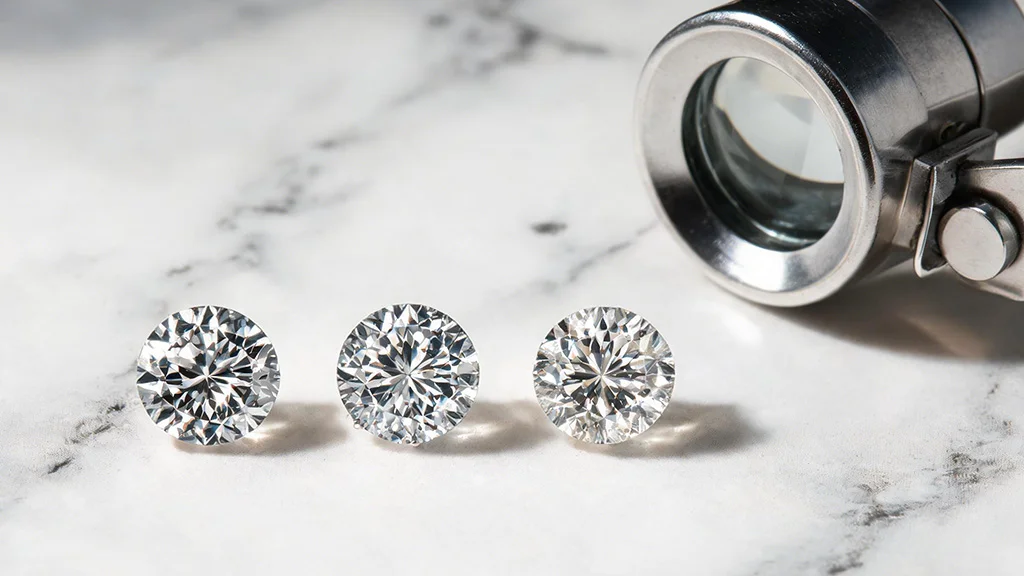
Table of Contents
Your grandmother left you a ring. The diamond looks real — it catches the light beautifully and feels substantial in your hand. But is it?
Or maybe you scored what looked like a deal of a lifetime on a secondhand marketplace. Before you celebrate, it's worth running a few checks. Fakes have never been more convincing. Cubic zirconia, moissanite, and lab-grown diamonds can all fool the naked eye — and some will even fool a basic diamond tester.
As an OEM fine jewellery manufacturer, Provence Jewellery works with diamonds at every stage — from grading loose stones to setting finished pieces for retailers across the US, UK, and EU. We've exhibited at JCK Las Vegas and the Hong Kong International Jewellery Show, and our team has verified hundreds of thousands of diamonds over the years. Here is what we actually check — and what you can do at home.
By the end of this guide, you'll know which tests work, which are myths, and exactly when you need to bring in a professional.
What Makes a Diamond "Real"? (The Answer Is More Nuanced Than You Think)
Before you start testing, it helps to understand what you're actually testing for — because "is my diamond real?" turns out to be two different questions.
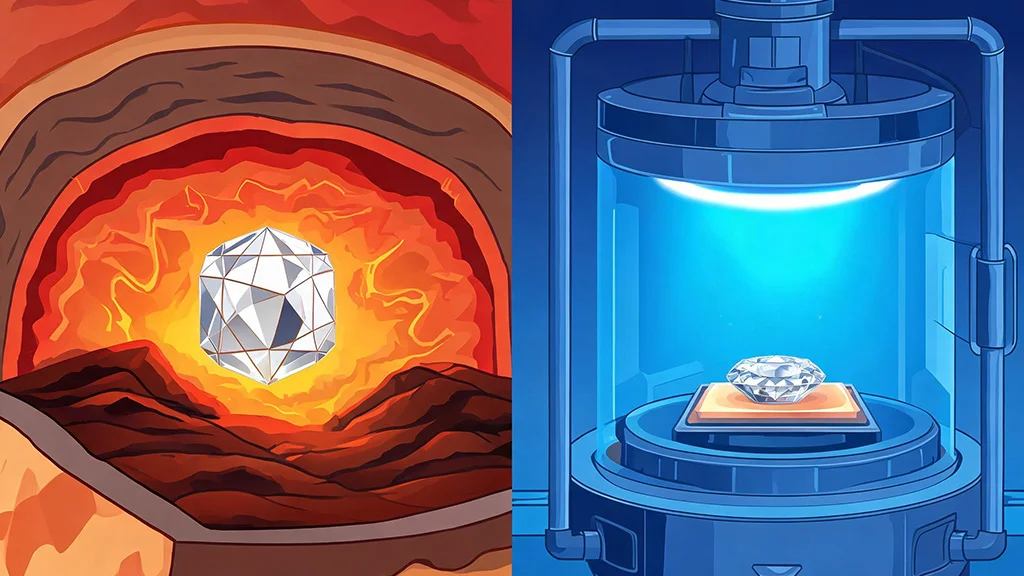
Natural mined diamonds are carbon crystals formed roughly 100 miles beneath the earth's surface over billions of years under extreme heat and pressure. They're brought to the surface through volcanic activity and contain unique inclusions that act like a fingerprint. No two are identical.
Lab-grown diamonds are chemically, optically, and structurally identical to mined diamonds. They're pure carbon in the same cubic crystal structure, created in weeks rather than billions of years using High Pressure High Temperature (HPHT) or Chemical Vapour Deposition (CVD) technology. They are not fake diamonds — they are real diamonds. According to IGI, lab-grown diamonds now account for approximately 40% of new diamond sales by weight. Every home test and most professional testers will confirm a lab-grown diamond as "real."
Diamond simulants are a completely different category. These are stones that look like diamonds but are made of different materials: cubic zirconia (ZrO₂), moissanite (silicon carbide), white sapphire, white topaz, and glass. When most people ask "is my diamond real?", they're trying to rule out simulants — not distinguish natural from lab-grown.
This distinction matters enormously for the tests below. We'll tell you clearly what each test can and cannot catch.
Stone Properties at a Glance
|
Stone |
Hardness (Mohs) |
Refractive Index |
Density (g/cm³) |
Thermal Conductivity |
Passes Home Tests? |
|---|---|---|---|---|---|
|
Natural Diamond |
10 |
2.42 |
3.51 |
Excellent |
All home tests |
|
Lab-Grown Diamond |
10 |
2.42 |
3.51 |
Excellent |
All home tests |
|
Moissanite |
9.25 |
2.65–2.69 |
3.22 |
Excellent* |
Most home tests* |
|
Cubic Zirconia (CZ) |
8.5 |
2.15–2.18 |
5.6–6.0 |
Poor |
Fails fog, sparkle tests |
|
White Sapphire |
9 |
1.76–1.77 |
4.0 |
Low |
Some visual tests |
|
Glass |
5–6 |
1.52 |
2.2–2.5 |
Poor |
Fails most tests |
*Moissanite disperses heat almost as rapidly as diamond, causing basic thermal testers to give a false positive. An electrical conductivity tester is required to distinguish it.
At-Home Tests (No Special Equipment Required)
These seven tests need nothing more than items you already own. Used in combination, they'll rule out cheap glass and most CZ — but no single test is definitive. Work through them as a sequence, not in isolation.
Test 1: The Fog (Breath) Test
Tools needed: Nothing
Difficulty: Easy
Accuracy: ★★★☆☆
Hold the stone with tweezers or between two fingers. Exhale a warm breath directly onto the surface, as if you were fogging a mirror.
A genuine diamond is one of the best heat conductors on earth. It disperses heat so rapidly that any fog clears in under one second. Glass and cubic zirconia retain heat — the fog will linger for two to five seconds.
What it catches: Glass, most cubic zirconia
What it misses: Moissanite dissipates heat almost as quickly as a diamond and will also clear in under a second. This test cannot distinguish the two. It's also unreliable on very small stones, which lose heat faster regardless of material.
Test 2: The Water / Density Test
Tools needed: A full glass of water
Difficulty: Easy
Accuracy: ★★☆☆☆
Drop the loose stone (unmounted only) into a full glass of water and watch what happens immediately.
A real diamond, with a density of 3.51 g/cm³, sinks to the bottom without hesitation. Some types of glass are less dense and may float or descend slowly.
What it catches: Very low-density glass
What it misses: Cubic zirconia is actually denser than diamond (5.6–6.0 g/cm³) and sinks faster. Moissanite (3.22 g/cm³) also sinks. This test cannot identify CZ or moissanite, and it's completely useless for mounted stones. Treat it as a quick preliminary filter only.
Test 3: The Newspaper / Dot / Read-Through Test
Tools needed: White paper, a pen
Difficulty: Easy
Accuracy: ★★★☆☆
Draw a small black dot on a piece of white paper. Place the stone table-side down (flat side facing the paper) over the dot. Look through the top of the stone, straight down.
A real diamond refracts light so aggressively that the dot becomes invisible or completely distorted — you won't be able to read through it. If the dot or any text is visible and legible through the stone, it's likely not a diamond.
What it catches: Glass, CZ, white sapphire
What it misses: This test only works reliably on loose, unmounted round brilliant cuts. Fancy cuts — particularly emerald and asscher cuts — are designed for clarity of view and may allow some read-through even in a genuine diamond. Mounted stones can't be tested this way at all.
Test 4: The Sparkle / Light Reflection Test
Tools needed: A direct light source (daylight or LED)
Difficulty: Medium
Accuracy: ★★★★☆
Hold the stone under a direct light source and tilt it slowly, watching how it reflects light both inside and from the surface.
A real diamond produces two distinct optical effects: brilliance (white and grey light reflected internally) and fire (rainbow flashes projected externally onto surrounding surfaces). What you should NOT see is an abundance of rainbow colours inside the stone itself. That disco-ball, spectral effect inside the stone is characteristic of moissanite, which has a higher refractive index (2.65–2.69 vs diamond's 2.42) and produces significantly more chromatic dispersion.
What it catches: Glass, white topaz, low-quality CZ
What it misses: Moissanite is actually more brilliant and more fiery than diamond — so an "almost too sparkly" stone is a red flag, not a green light. A dull stone may also simply be dirty rather than fake; clean it before drawing conclusions.
Test 5: The Setting and Hallmark Inspection
Tools needed: A magnifying glass or phone macro lens
Difficulty: Easy
Accuracy: ★★★★★
Examine the metal setting under a loupe or a macro lens. Genuine diamonds are almost never set in low-quality base metals — the economics simply don't work.
Look for stamped marks inside the band:
- Gold: 18K or 750 (75% pure gold), 14K or 585, 9K or 375
- Platinum: PT950, 950, or PLAT
- Silver: 925 or Sterling
In the UK, the Hallmarking Act 1973 requires that any gold, silver, or platinum article sold commercially must carry an assay office mark from one of the four UK Assay Offices (London, Edinburgh, Birmingham, Sheffield). An unmarked setting is a serious red flag.
In the EU, most member states mandate national hallmarking. Germany, France, Italy, and others each have their own stamp systems for precious metal purity.
What it catches: Cheap simulants set in base metal or plated settings
What it misses: Hallmarks confirm the metal quality, not the stone. A genuine diamond can technically be set in silver or 9K gold, though this is uncommon for higher-value stones. Conversely, a CZ can be set in 18K gold — hallmarks alone don't authenticate the gem.
Test 6: The Magnification / Inclusions Test
Tools needed: A 10x jeweller's loupe or smartphone macro lens
Difficulty: Medium
Accuracy: ★★★★☆
Under magnification and bright light, examine the interior of the stone carefully.
Natural diamonds almost always contain inclusions — internal characteristics formed during crystallisation. These might appear as tiny carbon spots, feather-like fractures, needle-like crystals, or wispy clouds. A stone that looks completely perfect under 10x magnification is either an extremely rare Flawless (FL) graded diamond, or it's a simulant.
Also examine the facet edges. Diamond's extraordinary hardness (Mohs 10) gives it razor-sharp, precise facet junctions. Simulants, being softer, often show slightly rounded or worn edges — especially at the culet and at facet intersections.
What it catches: Glass, CZ, and most synthetic simulants
What it misses: Lab-grown diamonds also contain inclusions — different types depending on the growth method (metallic inclusions in HPHT stones, pinpoint clouds or graining in CVD). A skilled gemologist can often distinguish growth type under magnification, but not untrained eyes. The loupe test cannot tell you natural vs lab-grown.
Test 7: The UV / Black Light Fluorescence Test
Tools needed: A UV / black light (widely available, £10–£20)
Difficulty: Easy
Accuracy: ★★☆☆☆
In a darkened room, hold the stone under a UV black light.
Approximately 30–35% of natural diamonds emit a blue glow under UV. A strong green or yellow fluorescence often suggests a simulant like CZ.
What it catches: Some CZ (which may fluoresce yellow or green)
What it misses: This is a supporting clue, not a test. The majority of genuine diamonds — 65–70% — show no fluorescence at all. Absence of glow is not evidence of a fake. Some lab-grown diamonds also fluoresce blue. Never use this test in isolation.
Tool-Assisted Tests (For Greater Accuracy)
If you're serious about authentication — for an inherited piece, an insurance claim, or a significant purchase — a modest investment in the right tools will give you far more reliable answers.
Test 8: Diamond Tester (Thermal Conductivity)
Tools needed: Diamond tester probe (£30–£120)
Difficulty: Easy
Accuracy: ★★★★☆
A diamond tester works by sending a small heat current through a probe tip pressed against the stone. Diamond conducts heat so efficiently that the device reads "diamond" almost instantly. Glass, CZ, white sapphire, and white topaz all fail.
These devices are widely available online and are a worthwhile addition to any jeweller's toolkit.
What it catches: Glass, CZ, white sapphire, white topaz
What it misses: Moissanite. Its thermal conductivity is almost identical to diamond's, and every basic diamond tester on the market will give a false "diamond" reading for moissanite. If there's any chance the stone is moissanite, you need the next test.
Test 9: Dual Thermal + Electrical Tester (The Moissanite Detector)
Tools needed: Dual-function diamond/moissanite tester (£80–£200)
Difficulty: Easy
Accuracy: ★★★★★
Advanced testers — such as the Presidium Duo Tester or GemOro Ultratester 3 — measure both thermal conductivity and electrical conductivity. Moissanite is weakly electrically conductive in a way that diamonds are not. A dual tester gives a definitive diamond vs moissanite reading in seconds.
For anyone testing stones professionally or for high-value purchases, the dual tester is the single best tool investment available to a non-gemologist.
What it catches: Simulants, CZ, and moissanite — definitively
What it misses: It still cannot distinguish a natural diamond from a lab-grown diamond. Both are chemically identical and both will read "diamond." For that determination, you need laboratory spectroscopy.
Test 10: The Double Refraction Check (Loupe Method for Moissanite)
Tools needed: 10x jeweller's loupe
Difficulty: Medium
Accuracy: ★★★★☆ (specifically for moissanite)
Diamonds are singly refractive — light passes through in one direction, and internal lines, facet junctions, and reflections all appear as single, sharp lines.
Moissanite is doubly refractive — light splits into two rays as it passes through, causing a distinctive "doubling" of internal features. Under a 10x loupe, look at the facet edges inside the stone from the side or from an oblique angle. In moissanite, you'll see those interior edges appear doubled or ghosted.
This is one of the fastest, most reliable ways to flag moissanite without any electronic equipment — and it's a skill that becomes quick and intuitive with a little practice.
What it catches: Moissanite, specifically
What it misses: This test is not useful for identifying CZ, glass, or white sapphire. It's a targeted moissanite check, not a general authentication test.
When Home Tests Are Not Enough
Here's the hard truth: if the stone in question is a lab-grown diamond, every single test above — from the fog test to the dual diamond tester — will confirm it as "diamond." Lab-grown diamonds are not fakes. They are genuine diamonds. But if what you need to know is whether a stone is natural or lab-grown — for insurance purposes, estate valuation, or resale — home testing cannot give you that answer.
For definitive natural vs lab-grown determination, you need laboratory spectroscopy: UV-Vis absorption testing and photoluminescence (PL) spectroscopy reveal the subtle growth signatures that distinguish HPHT and CVD lab-grown diamonds from natural ones. This is only available through a certified gemological laboratory.
Certification: The Only Certain Answer
GIA grading reports are the gold standard. Every GIA-graded diamond has its report number laser-inscribed on the girdle (the outer edge of the stone), visible under 10x magnification. You can verify this number against GIA's public report database at gia.edu/report-check. The report confirms natural vs lab-grown, the 4Cs, and any treatments.
IGI certificates are widely used for lab-grown diamonds and are a valid form of documentation, though it's important to compare like with like when evaluating stones across different labs, as grading standards vary.
Professional appraisers: When seeking an independent appraisal, look for appraisers holding the GIA Graduate Gemologist (G.G.) credential or, in the UK, the Fellowship of the Gemmological Association of Great Britain (FGA). These are the recognised professional benchmarks.
UK resources: HM Assay Offices — particularly Birmingham and Edinburgh — offer stone testing and authentication services for members of the public, not just the trade.
EU resources: For high-value stones, national gemological institutes such as the Deutsche Gemmologische Gesellschaft (DGemG) in Germany or the SSEF Swiss Gemmological Institute in Basel provide internationally recognised independent testing.
When buying from a reputable OEM or fine jewellery manufacturer like Provence Jewellery, every diamond comes with documentation. Ask to see the certificate before purchase, and verify it directly with the issuing laboratory.
Frequently Asked Questions
Diamonds score 10 on the Mohs hardness scale — the hardest naturally occurring material known. They can only be scratched by another diamond. This makes the popular "scratch test" (dragging the stone across glass) nearly useless as a verification method: it only tells you the stone is harder than glass, which is also true of moissanite (9.25), white sapphire (9), and CZ (8.5). You'll scratch the glass without confirming anything about the diamond.
A common misconception. Real diamonds reflect mostly white and grey light internally — this is called brilliance. The rainbow effect (called fire) is visible on external surfaces as brief coloured flashes. If you're seeing strong rainbow colours inside the stone itself, that's actually a sign of moissanite or CZ, not a diamond. Excess internal colour is a red flag.
Yes. Moissanite has nearly identical thermal conductivity to diamond and passes basic thermal testers every time, giving a "diamond" reading. To catch moissanite, you need a dual thermal and electrical tester. These are widely available for £80–£200 and are a worthwhile investment for anyone buying stones regularly.
Briefly. A genuine diamond disperses heat so rapidly that any fog from breath clears in under one second. If the fog lingers for two or more seconds, the stone is likely glass or CZ. That said, moissanite also clears quickly — so a fast clear doesn't confirm diamond, it only rules out cheap simulants.
Yes. The fog test, newspaper test, and sparkle test require no equipment. In combination, they reliably rule out cheap glass and most CZ. What they cannot rule out is moissanite or lab-grown diamonds. If you have any reason to suspect either of those, a dual tester or professional appraisal is the next step.
Yes. Lab-grown diamonds are chemically, structurally, and optically identical to natural mined diamonds. They are pure carbon in the same cubic crystal structure, with the same hardness, density, and refractive index. They pass all home tests and professional diamond testers. Only laboratory spectroscopy — UV-Vis or photoluminescence — can distinguish lab-grown from natural. A lab-grown diamond is a real diamond; it is not a simulant.
Professional jewellers use a combination of methods: a 10x loupe to examine inclusions and facet edges, a diamond probe for thermal conductivity, a dual tester to check for moissanite, and a UV light to observe fluorescence. For any question about natural vs lab-grown origin, they use UV-Vis absorption spectroscopy or photoluminescence spectroscopy, typically conducted by a certified gemological laboratory such as GIA or IGI.
Under the UK Hallmarking Act 1973, any gold, silver, or platinum article sold commercially must bear an assay office mark. For gold: 18K gold is stamped 750, 14K is 585, 9K is 375. Platinum is stamped 950 or PT950. The mark will also show which of the four UK Assay Offices (London, Edinburgh, Birmingham, Sheffield) hallmarked the piece. An unmarked precious metal setting should be treated as a significant red flag.
Final Thoughts
Working through these tests in sequence gives you a reliable authentication hierarchy:
- Fog test + newspaper test + water test — eliminates cheap glass and basic CZ quickly and without any equipment.
- Sparkle test + loupe inspection — catches most simulants and flags moissanite candidates through the double refraction check.
- Dual thermal + electrical tester — definitively eliminates moissanite and all remaining simulants.
- GIA or IGI certificate + laboratory verification — the only way to confirm natural vs lab-grown, and the only fully conclusive answer.
One important note before you go: if your tests confirm the stone is a "diamond" but you're unsure whether it's natural or lab-grown, that doesn't mean you've been deceived. Lab-grown diamonds are a legitimate, increasingly popular choice — they carry the same physical properties as mined diamonds at a lower price point. What matters is transparency. Any reputable jeweller or manufacturer should be able to tell you what you have and provide documentation to back it up.
 English