
Cubic Zirconia vs Lab Grown Diamond: The Complete Guide
- Written by Provence Team
- Updated on July 6, 2026
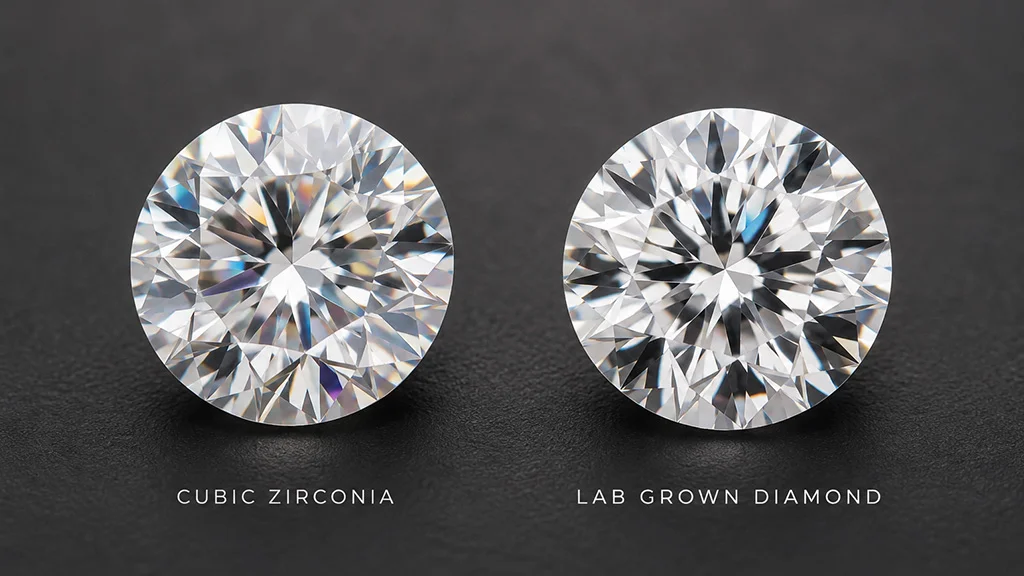
Table of Contents
Shoppers researching diamond alternatives online consistently run into two names that sound similar but describe fundamentally different materials: cubic zirconia and lab grown diamond. Both look convincingly like a natural diamond in a photograph. Only one of them actually is a diamond.
This guide breaks down the science, the cost, the durability, and — critically for buyers in the US, UK, and EU — the certification and regulatory landscape that most comparison articles skip entirely. As a manufacturer that produces both cubic zirconia and lab grown diamond jewelry for retail and wholesale partners across these markets, we're writing this from the production floor, not just the showroom counter.
Quick Answer
Cubic zirconia (CZ) is a synthetic crystal (zirconium dioxide) that only imitates a diamond's appearance. A lab grown diamond is chemically, optically, and physically a real diamond, grown in a controlled lab environment instead of mined from the earth. Lab grown diamonds cost more than CZ but pass as genuine diamonds under professional testing and carry real certification (GIA/IGI); CZ does not.
What Is Cubic Zirconia?
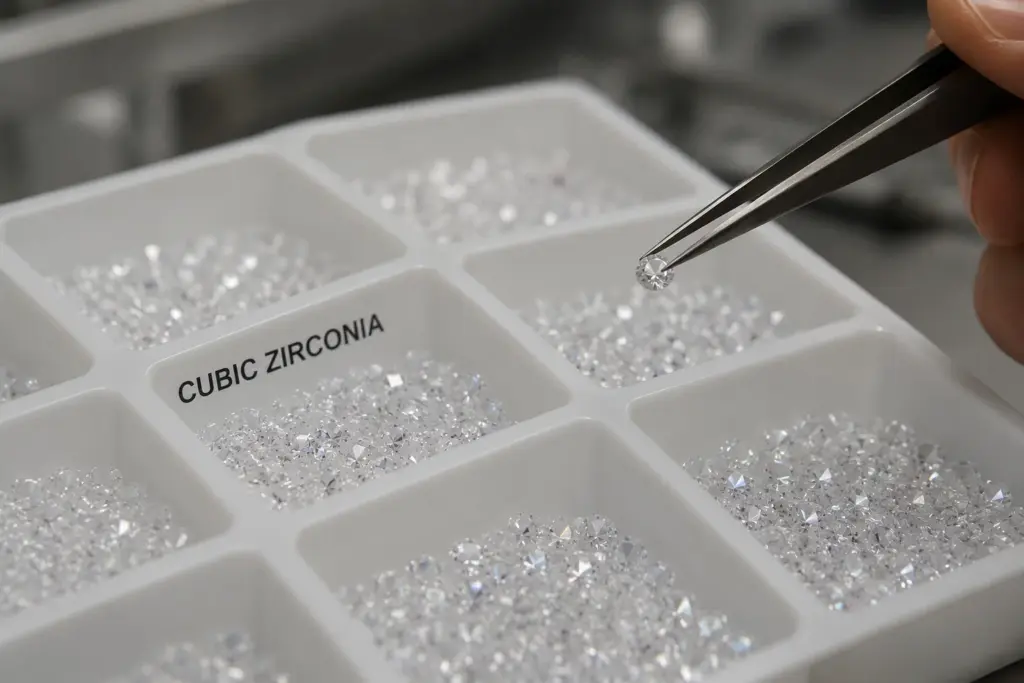
Cubic zirconia (CZ) is the cubic crystalline form of zirconium dioxide (ZrO2). It does not occur in nature in gem-quality form; virtually all CZ used in jewelry is synthesized. Production involves melting zirconium oxide powder at extremely high temperatures (around 2,750°C) using a skull melting process, then cooling it under controlled conditions to form clear, colorless crystals that are cut and polished into gemstone shapes.
Because CZ is manufactured rather than mined, output is consistent, inexpensive, and scalable — which is exactly why it has remained the dominant diamond simulant for costume and fashion jewelry for over 40 years.
- Composition: Zirconium dioxide (ZrO2), a synthetic oxide crystal
- Origin: 100% lab-manufactured; no natural form exists in gem quality
- Primary use: Diamond simulant for fashion jewelry, sterling silver pieces, and lower-cost fine jewelry lines
- Manufacturing cost: Low, enabling retail prices of a few dollars to a few hundred dollars per piece
What Is a Lab Grown Diamond?
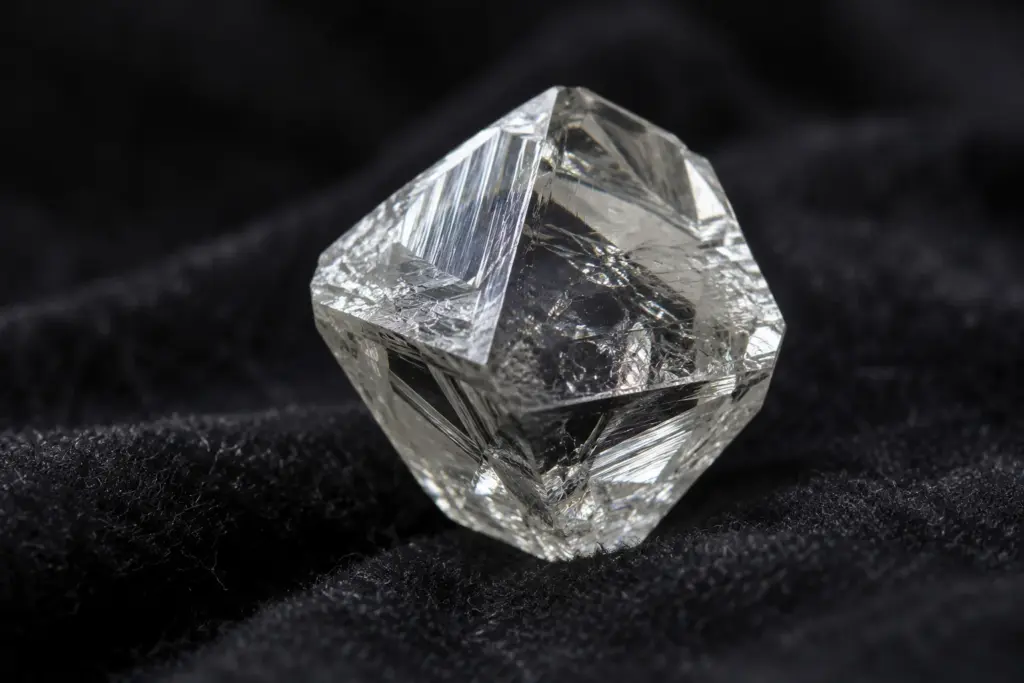
A lab grown diamond (LGD) is pure crystallized carbon, identical in atomic structure to a mined diamond. The only difference between a lab grown and a natural diamond is origin: one forms over billions of years under the earth's mantle, the other forms in weeks to months inside a controlled facility that replicates those same pressure and temperature conditions.
Two production methods dominate the industry:
- HPHT (High Pressure High Temperature): Mimics the earth's natural diamond-forming conditions using massive presses
- CVD (Chemical Vapor Deposition): Grows diamond layer by layer from carbon-rich gas in a vacuum chamber
Because a lab grown diamond is carbon, not an imitation, it carries the same hardness, brilliance, and thermal properties as a mined diamond — and it is graded using the same 4Cs (cut, color, clarity, carat) standards, typically by GIA or IGI.
Cubic Zirconia vs Lab Grown Diamond: Full Comparison Table
|
Property |
Cubic Zirconia |
Lab Grown Diamond |
|---|---|---|
|
Composition |
Zirconium dioxide (ZrO2) |
Pure carbon |
|
Hardness (Mohs scale) |
8 to 8.5 |
10 (hardest known natural material) |
|
Refractive index |
2.15 to 2.18 |
2.42 |
|
Dispersion (fire) |
0.058 to 0.060 |
0.044 |
|
Specific gravity (density) |
5.6 to 6.0 |
3.52 |
|
Thermal conductivity |
Low — fails a diamond tester |
High — passes a diamond tester |
|
Diamond tester result |
Reads as "not diamond" |
Reads as "diamond" (requires specialized equipment to distinguish from natural) |
|
Certification available |
None (no grading standard exists) |
GIA and IGI certification, same as natural diamonds |
|
Typical lifespan |
Clouds, scratches, and loses sparkle within 1 to 3 years of regular wear |
Retains brilliance indefinitely with normal care |
|
Price per carat (approx.) |
$5 to $50 |
$400 to $1,500 (1ct, good quality, 2026 retail) |
The dispersion figures explain a detail many buyers notice but can't name: CZ often throws more obvious rainbow-colored flashes than a diamond, which experienced jewelers recognize instantly as a simulant tell. Lab grown diamonds, like natural diamonds, produce a more balanced white-and-fire sparkle.
Cost Comparison
Lab grown diamond prices have fallen sharply since 2020 as production capacity has scaled, but they remain meaningfully more expensive than cubic zirconia, which has near-zero raw material cost. The table below reflects approximate 2026 retail ranges for a round brilliant stone at each carat weight.
|
Carat Weight |
Cubic Zirconia |
Lab Grown Diamond |
|---|---|---|
|
0.5 ct |
$10 |
$250–450 |
|
1.0 ct |
$20 |
$500–1,500 |
|
1.5 ct |
$35 |
$900–2,200 |
|
2.0 ct |
$50 |
$1,500–3,500 |
Even at the top of the lab grown range, a lab diamond typically costs 80–93% less than a comparable natural diamond, while a CZ of the same size costs a fraction of a percent of either. For budget-focused fashion pieces, CZ remains unmatched on price. For engagement rings and fine jewelry meant to last a lifetime, the price gap between CZ and lab grown diamond is smaller in perceived value than the raw numbers suggest, once durability is factored in.
Exchange rates fluctuate; figures above are indicative and should be confirmed at time of purchase.
Durability and Longevity
Hardness is the single biggest practical difference between these two stones. The Mohs scale measures scratch resistance from 1 (talc) to 10 (diamond). CZ sits at 8 to 8.5 — hard enough to resist casual scratching but soft enough that daily wear against other jewelry, countertops, and abrasive dust will visibly dull its facets within one to three years. Lab grown diamond sits at a full 10, identical to natural diamond, meaning normal wear does not scratch or cloud it over any realistic timeframe.
For everyday rings — engagement rings, wedding bands, and pieces worn daily for years — this durability gap has real cost implications. A CZ center stone in a daily-wear ring will typically need replacing within a few years to maintain its appearance, while a lab grown diamond does not.
How to Tell Cubic Zirconia and Lab Grown Diamonds Apart
Because both stones can look convincingly similar to the untrained eye, here are the practical tests jewelers and shoppers use:
- Weight test: CZ is roughly 55–65% heavier than a diamond of the same size due to its higher density. A loose stone that feels unusually heavy for its size is likely CZ.
- Fog test: Breathe on the stone. A diamond disperses heat instantly and clears within 1–2 seconds; CZ stays fogged for several seconds longer due to lower thermal conductivity.
- Sparkle color: Diamonds (natural or lab grown) produce a balanced mix of white and colored light. CZ tends to throw more rainbow-colored flashes.
- Diamond tester: A thermal or electrical conductivity tester will correctly identify a lab grown diamond as "diamond" and a CZ as "not diamond" — this is the only fully reliable at-home-adjacent method.
- Certification paperwork: A lab grown diamond sold at a legitimate retailer will include a GIA or IGI report. CZ has no equivalent grading system, so the absence of any certificate is itself a signal.
Certification and Grading
Lab grown diamonds are graded on the same 4Cs scale as natural diamonds — cut, color, clarity, and carat — by the same major laboratories. The Gemological Institute of America (GIA) and the International Gemological Institute (IGI) are the two most widely recognized authorities, with IGI grading the large majority of lab grown stones sold globally today.
Cubic zirconia has no comparable grading infrastructure. Because CZ is manufactured to near-flawless clarity by default, there is no meaningful quality spectrum to certify — one CZ of a given size and cut is essentially identical to another. This is a meaningful trust signal for buyers: a lab grown diamond purchase should always come with a certificate; a CZ purchase never will, and that absence is expected, not a red flag.
As a manufacturer, we provide IGI documentation on all certified lab grown diamond product lines supplied to our retail and wholesale partners, and we're happy to walk B2B buyers through certificate verification as part of onboarding.
Regulatory and Compliance Considerations
This is the section most comparison guides skip — and it matters more than most shoppers and even some retailers realize, especially for brands selling across borders.
United States: FTC Guidelines
The US Federal Trade Commission's Jewelry Guides (16 CFR Part 23) require that any stone described using the word "diamond" be a mined or laboratory-grown diamond — cubic zirconia and other simulants must be clearly disclosed as such and cannot be marketed using diamond terminology without a qualifying term like "simulated" or "synthetic." Retailers selling lab grown diamonds must also disclose that the stone is laboratory-grown, typically alongside the word "diamond" in product listings.
United Kingdom: Hallmarking Act 1973
The UK Hallmarking Act 1973 governs the precious metal content of a piece of jewelry, not the center stone itself — but it applies regardless of whether the stone is CZ or lab grown diamond. Any gold, silver, platinum, or palladium setting sold in the UK above the legal weight threshold must carry a valid UK hallmark from an assayed office. This applies equally to fashion CZ rings and fine lab grown diamond rings, and it's a common compliance gap for brands importing finished jewelry without verifying assay requirements.
European Union: REACH Annex XVII (Nickel Directive)
For jewelry sold into the EU, REACH Annex XVII Entry 27 restricts nickel release from any item in prolonged skin contact, including ring settings, earring posts, and clasps. This applies to the metal components of both CZ and lab grown diamond jewelry and is frequently overlooked by manufacturers sourcing base-metal or lower-purity alloy settings for the EU market. Non-compliant nickel release is one of the most common reasons jewelry shipments are rejected at EU customs.
For brands and retailers sourcing jewelry for multi-market distribution, working with a manufacturer that already builds FTC disclosure language, UK hallmarking, and EU nickel compliance into production — rather than treating them as an afterthought — meaningfully reduces compliance risk.
Ethical and Environmental Considerations
Both cubic zirconia and lab grown diamonds are considered more ethically straightforward than mined diamonds, since neither involves mining-related land disruption or the conflict-diamond concerns historically associated with some natural stone supply chains.
Cubic zirconia production uses less energy than diamond growing, since it does not require replicating the extreme pressure conditions of natural diamond formation. Lab grown diamonds require more energy-intensive HPHT or CVD processes, though production efficiency has improved significantly as the industry has scaled, and many producers now use renewable energy in their growing facilities. Buyers prioritizing minimal environmental footprint above all else may lean toward CZ; buyers wanting a genuine diamond with a smaller footprint than mining typically choose lab grown.
Resale Value and Market Trends
Neither stone should be purchased as an investment. Cubic zirconia has no meaningful resale market — it is priced for its decorative and fashion value only. Lab grown diamonds also carry limited resale value relative to their original purchase price, generally retaining only a modest fraction of retail cost if resold, since lab grown diamond supply has expanded rapidly and wholesale prices have fallen accordingly.
That price decline has driven adoption: lab grown diamonds now account for the majority of US engagement ring center stone purchases, a dramatic shift from a decade ago when they were a niche alternative. For buyers, this means lab grown diamonds are now a mainstream, well-supported choice — but like CZ, the value proposition should be framed around beauty and durability for daily wear, not resale value.
Frequently Asked Questions
No. A lab grown diamond is pure carbon, chemically and physically identical to a mined diamond. Cubic zirconia is a different mineral (zirconium dioxide) that only visually resembles a diamond. Lab grown diamonds can be certified by GIA or IGI; CZ cannot.
No. Diamond testers measure thermal or electrical conductivity, and CZ's conductivity profile is very different from diamond. A CZ will read as "not diamond," while a lab grown diamond will correctly read as "diamond" on the same test.
Lab grown diamonds retain more value than cubic zirconia, though both should be purchased primarily for their beauty and durability rather than as investments. CZ has essentially no resale market, while lab grown diamonds retain a modest percentage of original retail price.
Not with the naked eye or a standard loupe. Specialized equipment, such as spectroscopy tools used by gemological labs, is required to distinguish lab grown from natural diamonds. Both are visually and chemically identical diamonds.
The stone itself is not hallmarked, but the precious metal setting is. Any UK-sold ring, earring, or pendant with a gold, silver, platinum, or palladium setting above the legal weight threshold must carry a valid UK hallmark, regardless of whether the center stone is CZ or lab grown diamond.
Yes. Lab grown diamonds offer the same hardness, brilliance, and certification standards as natural diamonds at a significantly lower price point, making them a increasingly popular choice for engagement rings across the US, UK, and EU markets.
Provence Jewellery manufactures both cubic zirconia and lab grown diamond jewelry at scale from our Wuzhou, China production facility, with FTC-compliant labeling, UK hallmarking coordination, and EU REACH nickel-compliant alloys built into our standard production process. Contact our wholesale team to discuss private label or OEM/ODM production for your bridal or fashion jewelry line.
 English