
How to Stack Rings: Ring Stacking Guide in 2026
- Written by Provence Team
- Updated on July 8, 2026
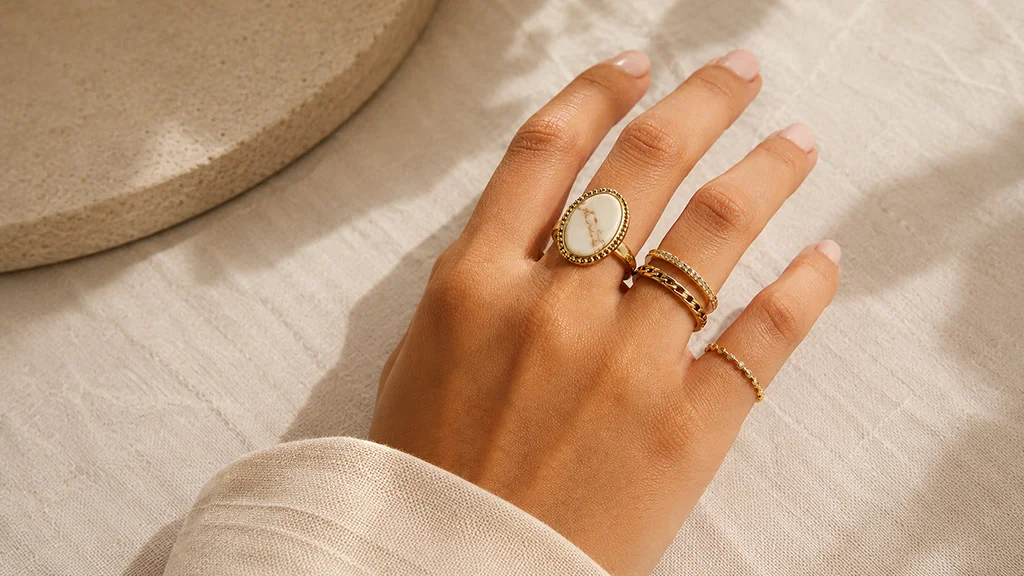
Table of Contents
Most ring stacking guides are written by stylists. This one is written with input from the people who actually make the rings. As a fine jewelry manufacturer producing stacking sets for brands across the US, UK, and EU, we see the mistakes before they leave the factory floor — rings sized too tight to layer, mismatched alloys that scratch each other within weeks, and stacks that photograph beautifully but never survive daily wear. This guide gives you the styling rules everyone agrees on, plus the sizing, metal, and durability details most stacking guides leave out.
What Is Ring Stacking?
Ring stacking is the practice of wearing multiple rings — on one finger or across several — combined intentionally by metal, width, texture, or gemstone to create a single cohesive look. It ranges from a simple two-ring pairing (an engagement ring and wedding band) to elaborate five- or six-ring combinations across multiple fingers. Unlike wearing rings at random, stacking follows a set of proportion and balance rules that keep the look intentional rather than cluttered.
How to Stack Rings: The 6-Step Method
Follow this sequence when building any stack, whether you're starting with an engagement ring and wedding band or building a stack from scratch.
1. Choose Your Ring Count and Placement
Most stylists recommend an odd number of rings per hand — three or five — because odd numbers photograph and read as more intentional than even ones. For a single finger, two to four rings is the practical maximum before rings begin to overlap knuckles and restrict movement. If you're stacking across multiple fingers, aim for a loose triangle formation: a statement piece as the visual anchor, with smaller rings flanking it on adjacent fingers.
2. Get Your Sizing Right — Before You Buy
This is the step most guides skip, and it's the one that determines whether your stack is comfortable to wear daily. Each ring you add to a finger effectively raises the finger's usable circumference, so rings that fit perfectly alone will feel tight once stacked.
- For 2 rings of standard width (2–2.5mm each): size up ¼ US size (about 0.4mm inner diameter) from your solo ring size
- For 3–4 rings: size up ½ US size (about 0.8mm) on the base ring
- For rings wider than 4mm: add an additional ¼ size per ring beyond the second, since wider bands consume more finger real estate
Always size the base/anchor ring last, after you know the width and count of the rings stacking against it.
US / UK / EU Ring Size Conversion Reference
|
US Size |
UK Size |
EU Size |
Inner Diameter (mm) |
|---|---|---|---|
|
5 |
J ½ |
49 |
15.7 |
|
5.5 |
K ½ |
50 |
16.1 |
|
6 |
L ½ |
51.5 |
16.5 |
|
6.5 |
M ½ |
53 |
16.9 |
|
7 |
N ½ |
54 |
17.3 |
|
7.5 |
O ½ |
55.5 |
17.7 |
|
8 |
P ½ |
57 |
18.1 |
Because this table crosses three sizing systems, it's worth noting for a US/EU stacking set specifically — conversions can shift by a half UK size depending on band width, so we recommend requesting a physical sizer from your jeweller before ordering a multi-ring set, rather than converting from a single reference ring.
3. Pick a Base or Anchor Ring
Every stack needs one ring that anchors the eye — typically the widest band, the piece with the largest stone, or the one with the most color contrast. Build outward from it, placing thinner and simpler rings on either side so the eye has a clear focal point.
4. Mix Metals Strategically
Mixed-metal stacking is on-trend, but it works best with a ratio rather than an even split. Let one metal tone dominate 60–70% of the stack and use the second (or third) tone as an accent — for example, four yellow gold rings and one white gold accent, rather than a 50/50 split that reads as uncoordinated.
The detail most guides don't cover is hardness compatibility. Different alloys wear against each other at different rates, and mismatched hardness is the single most common cause of scratching in a stack worn daily:
|
Metal / Alloy |
Approx. Vickers Hardness |
Stacks Safely With |
Caution |
|---|---|---|---|
|
Platinum (950) |
40–70 HV |
Platinum, 18k gold |
Softer than 18k gold — will show more surface wear over years |
|
18k Gold |
90–115 HV |
18k gold, platinum |
Mixing 18k with 14k causes uneven wear — the softer 18k marks firs |
|
14k Gold |
125–165 HV |
14k gold, sterling silver |
Harder than 18k — avoid direct daily contact with 18k pieces |
|
Sterling Silver (925) |
90–110 HV |
Sterling silver, 14k gold |
Softest common option — tarnishes and scratches fastest in a stack |
Rule of thumb: keep the same karat weight together where rings will directly touch, and reserve cross-karat or cross-metal pairing for rings on adjacent fingers rather than the same finger.
5. Layer Texture and Width
Combine at least one textured or patterned piece (twisted, hammered, or pavé) with plain polished bands. Vary width in small increments — a 1.5mm band, a 2.5mm band, and a 4mm band reads as deliberate; three identical 2mm bands can look accidental.
6. Leave Negative Space
Bare skin between stacked groupings is what keeps a five-ring look elegant instead of overwhelming. Leaving at least one finger bare, or gapping a stack across non-adjacent fingers, gives the eye room to rest.
Ring Stacking Ideas by Style
Engagement Ring + Wedding Band Stacks
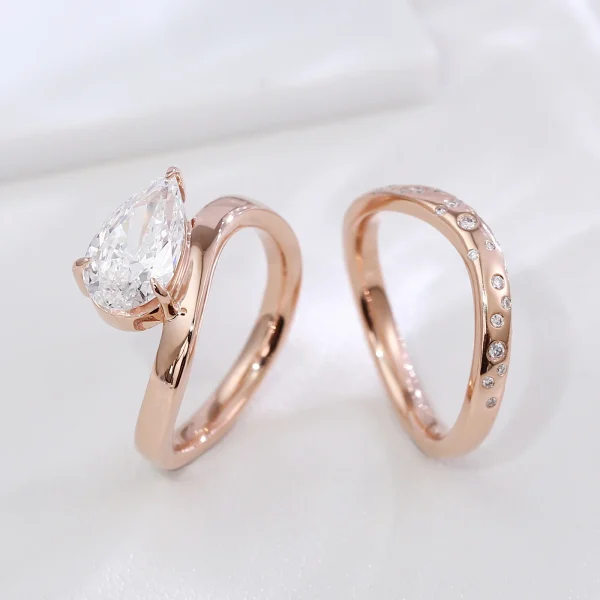
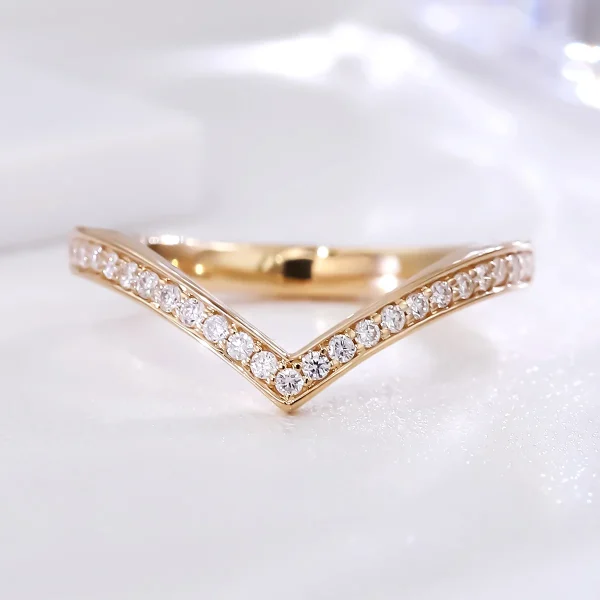
The most common stacking scenario. Choose a wedding band that either matches the engagement ring's metal and profile for a seamless line, or a contoured/curved band designed specifically to nest around a solitaire's prongs without gapping.
Mixed Metal Stacks
Apply the 60/70% dominant-metal rule above. Rose gold as a base with single yellow gold accent rings is currently the most requested combination among our wholesale partners.
Gemstone and Birthstone Stacks
Personal birthstone stacks — combining a wearer's stone with a partner's or children's birthstones — remain one of the highest-converting stacking categories for gifting occasions. Keep stone sizes graduated (largest on the anchor ring, smallest on outer rings) so the stack doesn't compete visually.
Minimalist and Dainty Stacks
Two to three ultra-thin bands (1–1.5mm) in a single metal tone, sometimes with one small pavé accent. This is the lowest-maintenance stacking style and the easiest entry point for first-time stackers.
Statement and Midi Combinations
One bold statement ring paired with a midi ring (worn above the knuckle) on an adjacent finger. This works best with an odd overall ring count across the hand to maintain balance.
What Shoppers Should Know Before Buying a Stack
Stacking multiple rings means more metal in prolonged contact with skin, which makes metal purity and nickel content more relevant than with a single ring. A few regulatory points worth knowing:
UK Hallmarking Act 1973
Any gold, silver, platinum, or palladium item sold in the UK weighing over the exemption threshold (1g for gold, 7.78g for silver) must carry a UK-recognized hallmark indicating metal purity. When buying a multi-ring stacking set from a UK retailer, each ring in the set should carry its own hallmark — not just the set as a whole.
EU REACH Regulation — Nickel Directive (Annex XVII, Entry 27)
Under the EU's REACH regulation, items intended for prolonged skin contact — including rings — are restricted to a nickel release rate of no more than 0.5 μg/cm²/week. Because a stack multiplies the metal surface area in contact with skin, this limit matters more for stacked sets than for a single ring, and it's worth confirming nickel-release testing with the manufacturer, particularly for white gold and gold-plated pieces where nickel is sometimes used in the alloy or plating layer.
US FTC Jewelry Guides (16 CFR Part 23)
For US buyers, the FTC's Jewelry Guides require accurate karat stamping and disclosure of any plating (e.g., "gold filled" vs. "gold plated" vs. "solid gold") — a distinction that matters in a stack where pieces of different constructions are worn together, since plated pieces will wear faster than solid or filled pieces stacked alongside them.
Common Ring Stacking Problems — and Fixes
- Rings spinning out of order: request or add ring guards/spacers — small clips soldered or fitted inside the band — to lock rings in sequence
- Green or dark marks on skin: usually a sign of a lower-karat or nickel-containing alloy reacting with skin oils; switch that specific ring to 18k gold or platinum rather than assuming it's an allergy to the whole stack
- Rings catching on fabric or hair: file down or request a rounded (comfort-fit) inner and outer edge profile, especially on pavé or textured bands
- Uneven wear/scratching between rings: revisit the hardness compatibility table above — this is almost always a metal-hardness mismatch, not a manufacturing defect
- Stack feels tight by end of day: fingers naturally swell 3–5% over the course of a day; size for afternoon/evening finger size, not morning
Frequently Asked Questions
Three to five per hand is the range most stylists recommend, though two (an engagement ring and wedding band) is the most common everyday stack. Odd numbers tend to look more intentional than even ones.
Any finger works, but the ring and middle fingers accommodate the widest stacks comfortably. The index finger works well for a single statement piece or midi ring.
Yes — mixed metal stacking is a major current trend. Follow the 60/70% dominant-metal ratio, and check the hardness table above if rings will be in direct daily contact.
It can, if metals of different hardness rub against each other directly. Same-karat gold pieces, or rings separated by a spacer, minimize this. Softer metals (sterling silver, 18k gold, platinum) show wear faster than harder ones (14k gold) when stacked against a harder alloy.
No — each ring should fit its own finger correctly, and if multiple rings sit on the same finger, the combined stack should be sized up from your single-ring size using the formula above, not simply matched to your standalone size.
Yes. Many brands work directly with OEM manufacturers to design private-label stacking sets — choosing metal, width, and gemstone combinations to match a specific brand aesthetic, often at lower per-unit cost than sourcing pieces individually.
MOQs vary by design complexity and metal, typically starting in the low hundreds of units per SKU for a standard stacking collection. Contact our wholesale team for a quote specific to your desired collection.
Build Your Ring Stack
Explore our stackable ring collection and use our sizing guide to build a stack that fits and lasts.
 English