
Diamond Color Chart: The Complete D-to-Z Grading Guide
- Written by Provence Team
- Updated on July 24, 2026
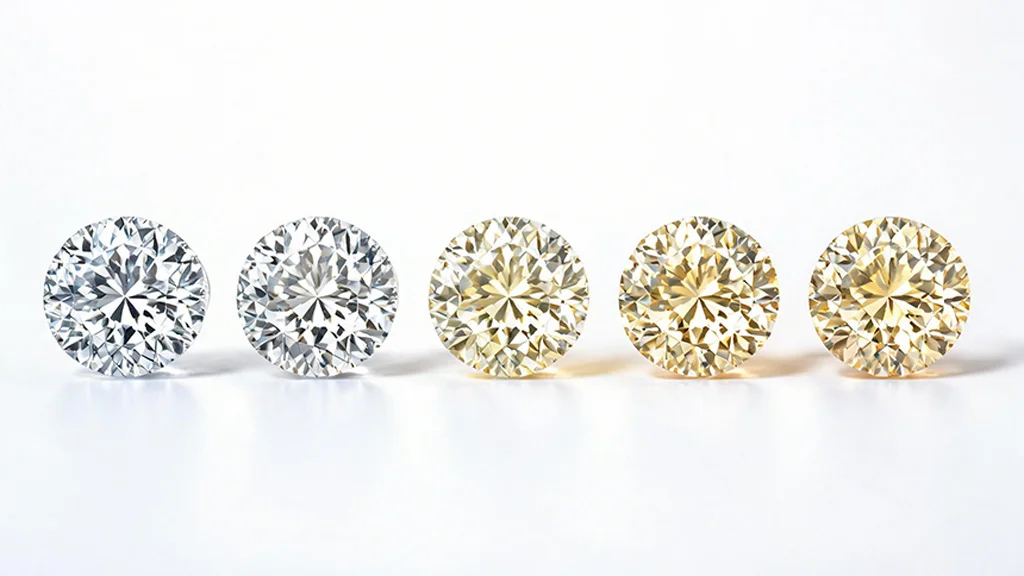
Table of Contents
Color is one of the four factors — alongside cut, clarity, and carat weight — that determines a diamond's value, and it is also the factor buyers misunderstand most. A diamond "color chart" looks simple: a row of letters from D to Z. But that letter grade only tells part of the story. The metal a diamond is set in, the shape it's cut into, and even the lighting in the room can all change how much color you actually see.
This guide breaks down the full GIA diamond color scale, shows what each grade looks like in practice, and explains how color grading differs for lab-grown diamonds, moissanite, and cubic zirconia — so you can choose a stone with confidence, wherever you're shopping from.
What Is a Diamond Color Chart?
A diamond color chart is a visual reference tool that maps the industry-standard color grading scale, developed by the Gemological Institute of America (GIA) in the 1950s. It runs from D (completely colorless) to Z (light yellow or brown), and it applies to white diamonds only — colored, or "fancy," diamonds are graded on a completely separate scale.
Before the GIA introduced the D-to-Z system, jewelers used a mix of letters, numbers, and even Roman numerals to describe diamond color, and none of it was standardized. GIA deliberately started at D rather than A so that its new scale could never be confused with the inconsistent systems that came before it.
Diamond "color," somewhat counterintuitively, actually refers to the absence of color. Nearly all natural white diamonds carry a faint tint of yellow or brown caused by trace amounts of nitrogen trapped in the crystal during formation. The less of that tint is visible, the higher — and rarer — the grade.
The Full GIA Color Scale, Grade by Grade
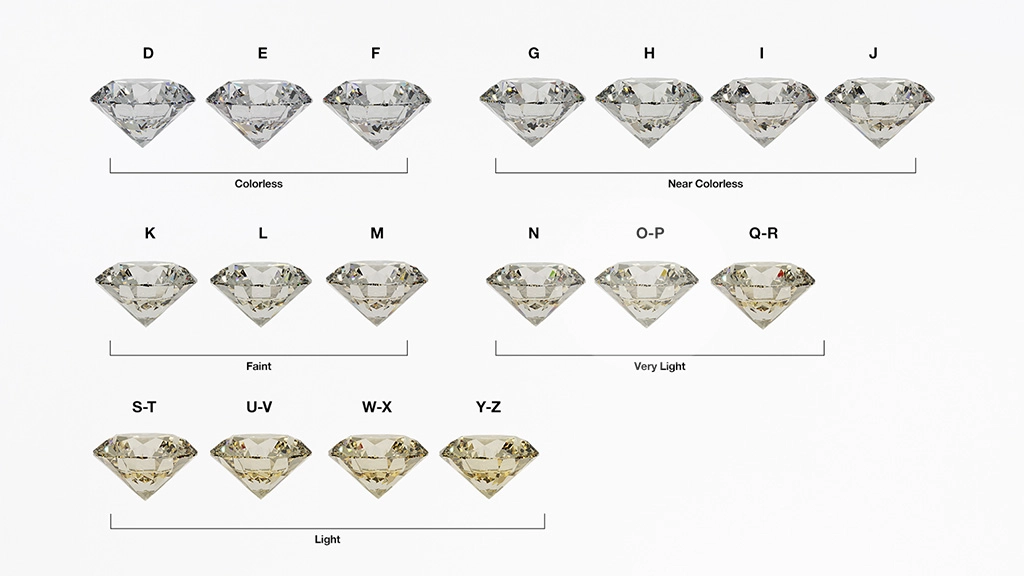
Gemologists determine a diamond's grade by comparing it, unmounted and face-down, against a "master stone set" — a reference set of diamonds with pre-verified color — under controlled lighting. The 23 letter grades are grouped into five categories:
|
Category |
Grades |
What You'll See |
|---|---|---|
|
Colorless |
D, E, F |
No detectable color, even to a trained eye. The rarest and most valuable tier. |
|
Near Colorless |
G, H, I, J |
Trace color visible only under magnification or side-by-side comparison. Best value-to-appearance ratio. |
|
Faint |
K, L, M |
A warm tint visible to the naked eye, more noticeable in larger stones. |
|
Very Light |
N, O, P, Q, R |
Yellow or brown tint clearly visible; rarely used in fine jewelry. |
|
Light |
S–Z |
Strong, visible tint; sits just below the fancy-color diamond threshold. |
Colorless (D, E, F)
D-color diamonds are the industry's benchmark for perfection — completely free of color under any lighting. Only a small fraction of diamonds on the market qualify. E and F diamonds carry a whisper of tint that is undetectable without gemological equipment. This tier commands the highest per-carat price of any color grade.
Near Colorless (G, H, I, J)
This is the range most fine jewelry — and most engagement rings — is actually built around. The color difference between a D and a G is essentially invisible to an untrained eye, particularly once the stone is mounted. G and H diamonds read as "white" in nearly every setting; I and J diamonds still look bright and clean, especially in yellow or rose gold, and cost noticeably less.
Faint (K, L, M)
K-M diamonds show a soft, warm tone that becomes more visible as carat size increases. Rather than a flaw, many buyers now choose this range intentionally — it pairs beautifully with yellow and rose gold settings and offers a meaningfully lower price point for the same carat weight and clarity.
Very Light (N–R) and Light (S–Z)
Diamonds in this range show a clearly visible yellow or brown tone and are uncommon in fine jewelry, though they occasionally appear in vintage or industrial contexts. Pricing differs little within this band, since none of these grades command a color premium.
Which Color Grade Is Right for You?
The "best" color grade isn't the highest one on the chart — it's the one that matches your priorities. Use this as a starting framework:
- Want zero visible color, no compromises, and budget isn't the deciding factor: D–F.
- Want the best balance of appearance and value — the choice most fine jewelers recommend first: G–H.
- Want a bright, clean look at a lower price, especially in white metal at smaller carat weights: I–J.
- Want a warm, vintage-inspired tone, or you're set on yellow or rose gold: K–M.
- Shopping for a larger stone (1.5ct+): move up one tier from your usual comfort zone, since color becomes more visible as diamonds get larger.
How Metal Setting Changes Perceived Color
A diamond's facets act like tiny mirrors, reflecting the metal around them back into the stone. That means the same diamond can look different depending on what it's set in:
- White gold or platinum settings make color more noticeable — they don't add any warm tone to compete with the diamond's own tint, so any yellow in the stone stands out more.
- Yellow gold and rose gold settings reflect warmth back into the diamond, effectively masking a grade or two of color. A J-color diamond in yellow gold can face up looking like a G.
- Two-tone settings (white gold or platinum prongs on a yellow gold band) let you keep a higher color grade looking crisp while still enjoying warm-metal styling.
This is one of the most overlooked variables in diamond shopping — and one reason a color chart alone should never be the final word. If you love yellow gold, you can often drop one or two color grades and redirect that savings toward carat weight or cut quality.
Diamond Color vs. Lab-Grown Diamonds, Moissanite, and Cubic Zirconia
The D-to-Z scale was built for natural diamonds, but color grading works a little differently across the alternatives now common in fine jewelry:
Lab-Grown Diamonds
Lab-grown diamonds are graded on the exact same D-to-Z scale as natural diamonds, using the same GIA or IGI standards, because they are chemically and optically identical to natural diamonds. The main practical difference is availability: colorless (D-F) and near-colorless (G-J) grades are far more affordable and more widely available in lab-grown stones, since the growing process gives more control over color than mining does.
Moissanite
Moissanite uses its own color scale, typically graded G-H-I equivalent for premium moissanite, and can carry a naturally warmer or occasionally grayish undertone compared to diamond, along with noticeably more fire (color flash) under light. It isn't measured on the D-Z scale, so "moissanite color grade" and "diamond color grade" aren't directly interchangeable claims.
Cubic Zirconia (CZ)
CZ is manufactured, so it is produced consistently colorless — comparable to a D or E diamond — as standard, without the natural rarity premium that makes colorless natural diamonds expensive. CZ doesn't use GIA gra
Related Reading
See our full comparisons: Lab-Grown vs. Natural Diamonds, and Cubic Zirconia vs. Lab-Grown Diamond, for a deeper breakdown beyond color.
AGS Numeric Scale vs. GIA Letter Scale
The American Gem Society (AGS) offers an alternative numeric color scale, running 0 (colorless) to 10 (light yellow/brown), designed to feel more intuitive than letter grades. It maps directly onto the GIA scale:
|
AGS Scale |
GIA Equivalent |
Category |
|---|---|---|
|
0 – 1.0 |
D – F |
Colorless |
|
1.5 – 3.0 |
G – J |
Near Colorless |
|
3.5 – 4.5 |
K – M |
Faint |
|
5.0 – 7.0 |
N – R |
Very Light |
|
7.5 – 10.0 |
S – Z |
Light |
Whichever scale a certificate uses, the underlying grading process — comparison against a master stone set — is the same. What matters most is that the diamond comes with a certificate from a recognized, independent laboratory rather than an in-house grade alone.
What About Fancy Color Diamonds?
Diamonds with color beyond Z — vivid yellows, pinks, blues, and greens — are graded on an entirely different system that evaluates hue, tone, and saturation rather than absence of color. Here, more color and more saturation generally means more value, the inverse of the D-to-Z scale. Fancy color diamonds are their own specialized category; we cover hue, saturation, and the rarest fancy colors in a dedicated guide.
How Diamond Color Is Actually Graded
Color grading is a controlled, comparative process, not a subjective glance:
- Diamonds are always graded loose (unmounted), since a metal setting can visually shift perceived color.
- Graders view the stone table-down against a master stone set — physical reference diamonds with pre-verified grades — under standardized daylight-equivalent lighting.
- Multiple graders typically cross-check borderline stones, and any grade in question defaults to the more conservative call.
- Fluorescence is noted separately, since strong fluorescence can affect how color appears in different lighting conditions.
At Provence Jewellery, every natural, lab-grown, and moissanite stone used in our OEM and ODM production is color-verified against certified standards before it enters a setting, so our manufacturing partners can rely on consistent grading across full production runs — not just a single sample piece.
Certification and Regulatory Standards
Because color grading directly affects price, buyers in every market should understand what backs up a stated grade:
- United States: The FTC's Jewelry Guides (16 CFR Part 23) require that color, clarity, and other quality claims be accurate and substantiated — a diamond cannot be marketed with an inflated color grade.
- United Kingdom: Fine jewelry sold with diamond grading claims should be accompanied by independent certification; the UK Hallmarking Act 1973 separately governs precious metal marking, which buyers should also check on the setting itself.
- European Union: Buyers should confirm that any nickel-containing white gold or plated settings comply with EU REACH Annex XVII nickel release limits, particularly relevant when color-grade decisions lead buyers toward white metal settings.
- Globally: Look for a certificate from GIA, IGI, or another independent (not in-house) gemological laboratory before purchasing a diamond above entry-level carat weights.
How to Choose the Best Color Grade for Your Budget
- Start with your setting metal. Yellow or rose gold buyers can comfortably drop to I-J or even K without losing visual brilliance.
- Factor in carat size. Color becomes more visible as stones get larger — size up a color grade for anything over 1.5 carats.
- Prioritize cut before color if budget is tight. A well-cut, lower-color diamond will out-sparkle a poorly cut, higher-color one.
- Compare, don't assume. Ask to see two adjacent grades side by side, mounted, in your chosen metal, before deciding.
- Always request certification. A stated color grade is only as reliable as the lab that issued it.
Sourcing Color-Graded Diamonds at Scale: A Manufacturer's Perspective
For jewelry brands and retailers sourcing diamond and moissanite pieces at volume, color consistency across a full production run matters as much as the grade on any single certificate. Provence Jewellery, based in Wuzhou, China, works as an OEM/ODM manufacturing partner for solid gold jewelry set with lab-grown diamonds, moissanite, cubic zirconia, and natural gemstones, supplying brand partners and retailers across the US, UK, and EU.
Our production process includes stone-by-stone color verification prior to setting, so partners placing bulk orders receive matched color grading across every piece in a collection — not just the sample. Whether you're building a private-label engagement line around G-H near-colorless stones or a warmer K-M collection for a specific market, we can source, grade-match, and manufacture to your specification.
Frequently Asked Questions
There is no single "best" grade — D is the highest on the scale, but G-H offers the best balance of appearance and value for most buyers, since the difference from D is nearly undetectable to the naked eye once mounted.
Yes — color affects how white or warm a diamond appears, and it's one of the four main factors (with cut, clarity, and carat) that determines price. That said, cut quality affects visible sparkle more than color does.
Both are in the colorless category and the difference is virtually undetectable without side-by-side comparison under gemological lighting. The price difference, however, can be significant, since D is the rarer, top grade.
GIA intentionally started its new scale at D in the 1950s so it would never be confused with the inconsistent A-B-C grading systems jewelers had used before, some of which used letters, numbers, or even Roman numerals interchangeably.
Yes. Shape, cut quality, fluorescence, metal setting, and lighting can all change how color reads to the eye, even between two diamonds with an identical certified grade.