
What is Diamond Symmetry? Grades, Flaws & Value
- Written by Provence Team
- Updated on October 6, 2026
Table of Contents
Diamond symmetry is a measure of how precisely a diamond’s facets are shaped, aligned and positioned relative to one another. It is a craftsmanship grade: it tells you how accurately the cutter carried out the diamond’s design, and it appears on every major grading certificate next to polish.
For most buyers the practical answer is straightforward. Choose Very Good or Excellent symmetry, make sure the diamond’s proportions and overall cut are strong, and avoid paying a large premium to move from one of those grades to the other. Below, we explain why, show what each flaw really looks like, and give you a clear framework for reading the symmetry line on a certificate.
What Is Diamond Symmetry?
Despite the name, symmetry does not mean that a diamond’s two halves are mirror images. A diamond is a three-dimensional object with dozens of facets, and symmetry asks a more specific question: do the facets that are meant to be identical actually match in size, shape and angle, and are features such as the table, culet and outline in exactly the right place?
A useful way to picture it: if polish describes the quality of a diamond’s surface, symmetry describes the quality of its geometry. A stone with a flawless surface can still have a table nudged slightly off-centre. A perfectly centred stone can still carry fine polishing marks. Laboratories grade each one separately.
Together, polish and symmetry are often called a diamond’s finish. Finish is the last stage of craftsmanship, and it shows how carefully the stone was brought to its intended design.
Why Diamond Symmetry Matters
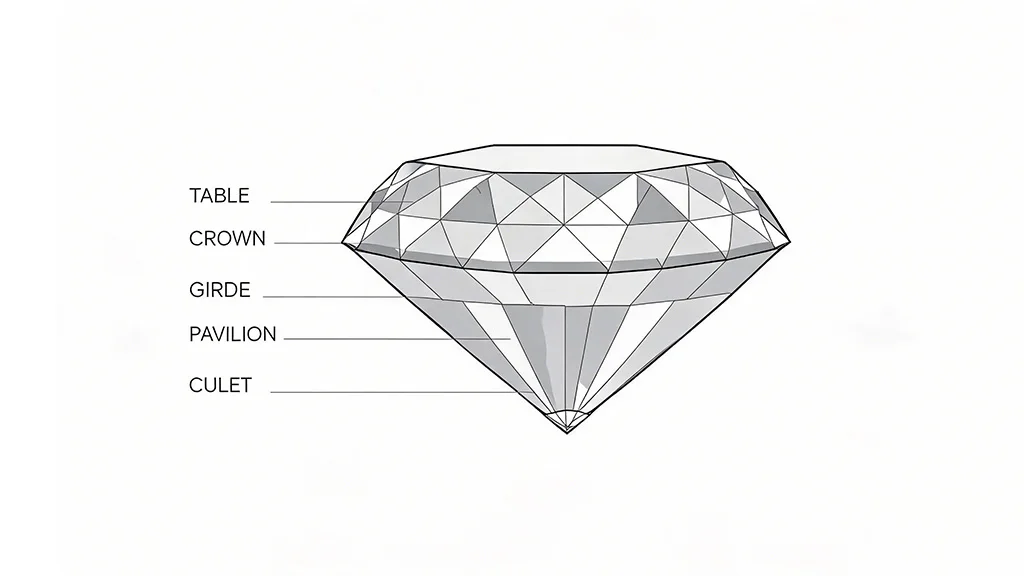
A well-cut diamond works like a precise set of mirrors. Light enters through the table and crown, travels down to the pavilion, reflects off the facets and returns to the eye as brilliance, fire and scintillation. Every facet has a job, and each one depends on its neighbours being at the right angle and in the right place.
When symmetry is poor, that choreography breaks down. Facets that are misaligned or unequal send some light out through the sides or bottom of the stone instead of back to the viewer. The result can be a duller diamond, uneven sparkle, or patchy dark areas that make inclusions and body colour easier to notice.
Symmetry also affects how a diamond looks and fits as part of a piece of jewellery. An out-of-round outline, a lopsided pear or a girdle that varies in thickness is visible face-up, and it can make a stone harder to set evenly in prongs, bezels or halos.
That said, minor deviations rarely change how a diamond performs to the naked eye. This is why the extremes of the scale matter most, and why we return to value later in this guide.
How Is Diamond Symmetry Graded?
Independent gemological laboratories assess symmetry under 10x magnification, the standard power of a jeweller’s loupe. The grader looks at the presence and visibility of deviations, then assigns a grade on a five-step scale: Excellent, Very Good, Good, Fair and Poor. The grade appears on the certificate, usually beside polish.
Grade | What the lab sees at 10x | Visible to the naked eye? | Our guidance |
Excellent | Very few deviations, if any, and they are hard to find even under magnification | No | The top finish. Ideal for round brilliants, heirloom pieces and buyers who want the strongest possible certificate |
Very Good | Minor deviations that need magnification to spot | Almost never | Outstanding value. Often visually identical to Excellent |
Good | Noticeable deviations at 10x that may slightly affect light return | Sometimes, especially in larger stones and fancy shapes | Acceptable only if proportions, images and price all support it. Inspect carefully |
Fair | Obvious deviations at 10x | Often | Not recommended for most jewellery |
Poor | Prominent deviations that affect the look of the stone | Usually | Avoid |
What if symmetry is “cumulative”?
Occasionally a certificate lists Cumulative under symmetry. This means the grade reflects the combined effect of several small deviations rather than one dominant flaw. For example, two minor deviations that each sit on the border between Very Good and Good can together pull the grade down to Good. If you see this, look at the listed deviations and the stone’s images before deciding.
Common Symmetry Flaws, Explained Simply
Certificates use abbreviations that can look like code. The table below translates the most common symmetry deviations into plain language, using the terminology of the Gemological Institute of America (GIA). Other laboratories use similar terms.
Deviation (abbreviation) | What it means | What you might notice |
Off-centre table (T/oc) | The table sits away from the centre of the crown | A lopsided look face-up and uneven reflections |
Off-centre culet (C/oc) | The culet is not at the centre of the pavilion | The tip of the diamond may be visible off-centre when viewed from the top |
Misalignment (Aln) | Crown and pavilion facets are displaced relative to each other | Disrupted light paths and an uneven sparkle pattern |
Out-of-round (OR) | A round diamond’s outline is not a true circle | A slightly oval or uneven outline, and gaps when set |
Uneven outline (UO) | Bumps or flat areas on the outline, often from a natural or extra facet | An irregular silhouette, mainly in round stones |
Extra facet (EF) | An added facet that the cutting style does not require | Usually minor. Mostly seen under magnification |
Missing facet (MF) | A facet is absent in an asymmetrical way | Uneven brilliance in that area |
Misshapen facet (Fac, MB, MS, MM) | One facet differs in shape or size from others of the same type | Slightly irregular facet patterns |
Non-pointing (Ptg) | Facets do not meet at precise points because they fall short or stay open | A softer, less crisp facet pattern |
Crown or pavilion angle variation (CV, PV) | Angles are unequal around the diamond | Uneven light return from one side to another |
Girdle thickness variation (GTV) | The girdle is thicker in some places than others | A wavy girdle edge, and a less even fit in a setting |
Non-octagonal table (T/oct, TEV) | The table of a round brilliant is not a regular octagon | Subtle changes to the face-up pattern |
Diamond Symmetry vs. Polish vs. Cut
These three terms are often mixed up, and some guides even treat them as the same thing. They are not.
Term | What it measures | Where it is graded | How visible is it? |
Symmetry | How accurately facets are shaped, aligned and positioned | All shapes, on a scale from Excellent to Poor | Rarely visible above Good |
Polish | The smoothness of the surface, including marks such as scratches, abrasion or polish lines | All shapes, on a scale from Excellent to Poor | Rarely visible above Good |
Cut grade | The overall quality of proportions and light performance, with finish taken into account | Standard round brilliants on GIA reports | Highly visible, because it drives sparkle |
A strong cut grade usually goes hand in hand with good finish, but you should still read the symmetry line separately. For round brilliants, a diamond with Excellent cut, Excellent polish and Excellent symmetry is often called Triple Excellent. It is a helpful shortcut, but it is not a guarantee of beauty. Two Triple Excellent diamonds can still look different, so always review images or video.
For fancy shapes such as oval, pear, cushion or emerald cuts, GIA does not issue a cut grade, which makes polish and symmetry two of the few finish indicators on the report. This is one more reason to look closely at them.
Symmetry Across Different Diamond Shapes
Symmetry matters for every shape, but where you see problems changes with the outline.
- Round brilliant.Facet alignment is tightly controlled, and flaws such as out-of-round outlines or off-centre tables are easiest to relate to light performance. Excellent symmetry is a sensible target here.
- Pear, oval, marquise and heart.Outline symmetry is visible at a glance. Look for even shoulders, balanced wings and lobes that match. A pear with one shoulder fuller than the other, or a heart with uneven lobes, shows its symmetry grade immediately.
- Step cuts (emerald and Asscher).Broad, parallel facets act like long mirrors, so misalignment shows up as lines that are not parallel or corners that do not match.
- Cushion and radiant.Outline balance and corner shape matter. Check that opposite corners and sides look equal.
In practice, many fancy shapes in Very Good symmetry look the same as those in Excellent, which makes Very Good a smart value choice for them.
How to Read Symmetry on a Diamond Certificate
On most reports, polish and symmetry sit together in a “finish” area, shown beside the cut grade for round brilliants. Here is how to read them in four steps.
- Find the grade.Look for the symmetry line and its grade from Excellent to Poor.
- Read the polish grade beside it.Both are part of the finish, and a stone with strong symmetry but weak polish (or the reverse) is not a complete finish.
- Check the comments and diagram.Some reports list the specific deviations behind the grade, using the abbreviations in the table above.
- Match the report to the stone.Confirm the report number, carat weight and measurements, and verify the report on the issuing laboratory’s website where that service exists.
Always buy against a certificate from a recognised independent laboratory. Grading scales and terminology can differ slightly between laboratories, so compare like with like when you shop.
Does Symmetry Affect Diamond Price?
Yes, but less than most buyers expect. Higher symmetry grades usually cost more because they reflect finer craftsmanship, and the premium is larger on round brilliants, where symmetry feeds into the overall cut grade. In practice, the step between Very Good and Excellent is often small, while the step down to Fair or Poor is significant.
Symmetry grade | Indicative price position (Excellent = 100%) | Value verdict |
Excellent | Baseline | Best choice for maximum finish and the strongest certificate |
Very Good | Often around 0 to 5% lower | Usually the best value. Little or no visible difference from Excellent |
Good | Often around 5 to 15% lower | Worth considering only with strong proportions and clear images |
Fair / Poor | Often 15% lower or more | The saving rarely makes up for visible flaws |
Experts also disagree on how much to pay for the top grade. Some say symmetry above Good is hard to tell apart without magnification, so extra spending is not needed. Others say a diamond’s finish should be taken seriously, especially when cut quality is a priority. The most useful position sits between the two: the top grade is a worthwhile target for round brilliants and heirloom pieces, while Very Good is a sensible value choice when the stone looks excellent in images and video.
Symmetry in Lab-Grown vs. Natural Diamonds
Lab-grown and natural diamonds are graded for symmetry using the same criteria, the same scale and the same list of deviations. Symmetry is a result of how the diamond is cut and polished, not of where it came from. A lab-grown diamond with Excellent symmetry and a natural diamond with Excellent symmetry have been cut to the same finishing standard.
So the advice in this guide applies equally to both. Whichever type you choose, filter by polish and symmetry, and review the images before you buy.
Checklist: How to Judge Symmetry Before You Buy
- Read polish and symmetry togetheron the certificate, and the cut grade too for round brilliants.
- Set a floor of Very Goodfor both, and move to Excellent for round brilliants where it fits your budget.
- Review any listed deviationsand the diagram, not just the grade.
- Watch a 360° video. Check that the table and culet look centred and the outline looks even.
- For rings and pendants, check that the outline suits the settingyou have chosen.
- For earrings and pairs, compare both stones for matching outline and finish.
- Confirm the certificate comes from a recognised independent laboratoryand verify the report number.
Frequently Asked Questions
Very Good and Excellent are both good choices. Excellent is the top grade and is ideal for round brilliants. Very Good usually looks the same to the naked eye and often costs less. Good can work if the stone’s images look clean, while Fair and Poor are best avoided.
For most buyers, yes. The deviations behind a Very Good grade are minor and normally need magnification to find. It is particularly sensible for fancy shapes, where Very Good often looks identical to Excellent.
Usually only at the lower grades. At Excellent and Very Good, deviations are very hard to see even with a loupe. At Fair and Poor, issues such as an off-centre table or an uneven outline can be seen face-up.
Symmetry measures the accuracy of a diamond’s geometry: facet shape, alignment and placement. Polish measures the smoothness of its surface. Both are graded separately and together describe the diamond’s finish.
It can. Misaligned or unequal facets may send light out through the sides or bottom of the stone instead of back to your eye. Minor deviations rarely make a visible difference, but significant ones can reduce brilliance and make the diamond look uneven.
It describes a round brilliant graded Excellent for cut, polish and symmetry. It is a strong sign of quality, but you should still review images and proportions, because two Triple Excellent diamonds can look different.
Not usually. Clarity, colour and carat weight tend to influence price and appearance more directly. Symmetry is a finishing factor that matters most when it falls to Fair or Poor, or when you want the highest possible quality in a round brilliant.