
The Complete Guide to Engagement Ring Styles & Setting Types
- Written by Provence Team
- Updated on May 29, 2026
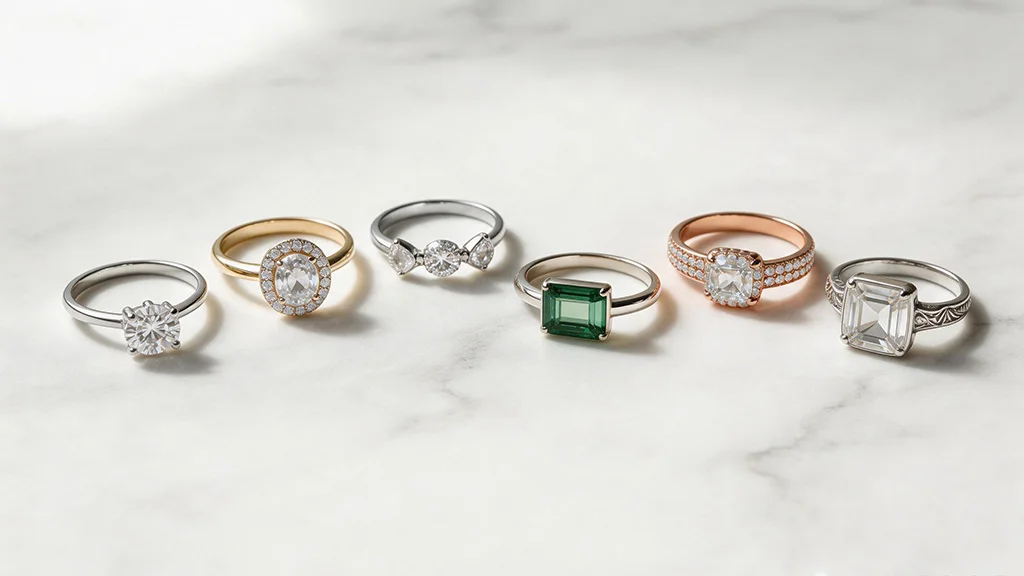
Table of Contents
Choosing an engagement ring is one of the most personal purchases you will ever make — and one of the most overwhelming. Walk into any jewellery boutique or browse any website and you are immediately met with dozens of combinations: round or oval, solitaire or halo, prong or bezel, platinum or gold.
The good news is that once you understand how engagement rings are actually structured, the decision becomes far clearer. Every ring is made up of three distinct dimensions: the shape of the centre stone, the style of the overall design, and the setting that physically holds the stone in place. Most guides blur these three things together. This one does not.
In the sections below, we will walk you through every major style, shape, and setting type — and then help you narrow down the right combination for your lifestyle, hand shape, and personality. By the end, you will have a clear picture of exactly what to look for.
The 3 Dimensions: Shape, Style & Setting
Before diving in, it helps to understand what these three terms actually mean — because they are not interchangeable.
Shape refers to the outline of the centre stone as viewed from above. Round, oval, emerald, pear — these are all shapes. The shape is the most visible element of the ring and has the greatest influence on its overall character.
Style refers to the design architecture of the ring as a whole. A solitaire, a halo, a three-stone ring — these are styles. The style determines how many stones the ring features, how they are arranged, and the general aesthetic it projects.
Setting refers to the mechanical method used to hold the stone in place. Prong claws, a bezel collar, channel rails — these are settings. The setting affects security, comfort, how much light reaches the stone, and how much maintenance the ring requires over time.
A single ring might be described as: oval shape, halo style, pavé-set band with a bezel-set centre stone. Once you can read a ring this way, shopping becomes much simpler.
Engagement Ring Styles
The style is the first thing most people notice. Here is a thorough breakdown of every major style you will encounter.
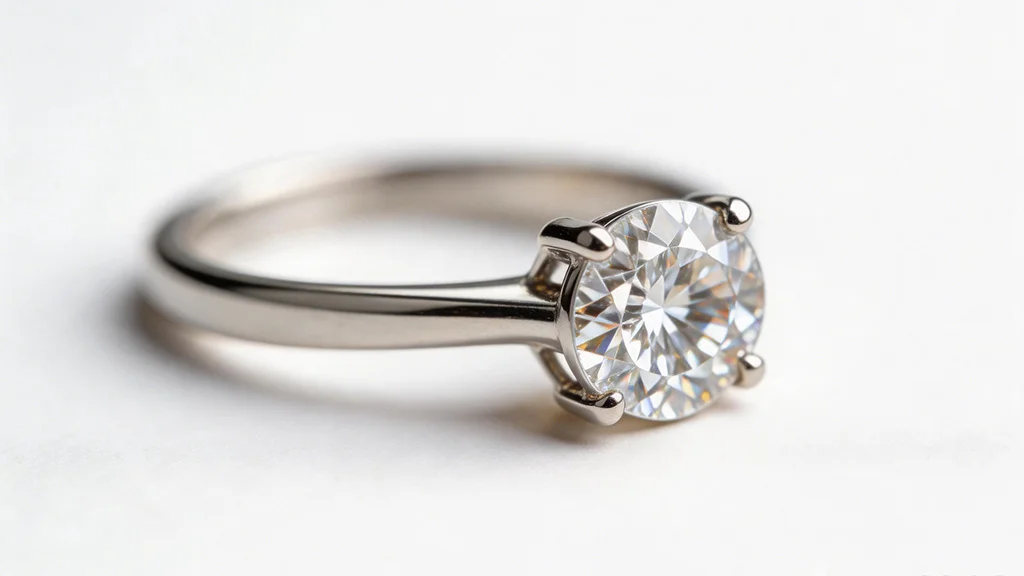
Solitaire
The solitaire is the most enduring engagement ring design in existence. A single centre stone sits on a plain or subtly tapered band, with nothing to distract from the stone itself. Tiffany & Co. popularised the six-prong solitaire in 1886, and it has never left fashion since.
Best for: Those who want the focus entirely on the diamond or gemstone. Minimalists, those who prefer clean lines, and buyers who want a ring that will feel just as contemporary in 50 years.
Pros: Timeless, easy to pair with any wedding band, centre stone appears at full size, lower overall cost since budget goes to the stone not additional design work.
Cons: Because all attention is on the centre stone, quality matters — any inclusions or colour grade will be more visible than in a more elaborate setting.
Halo
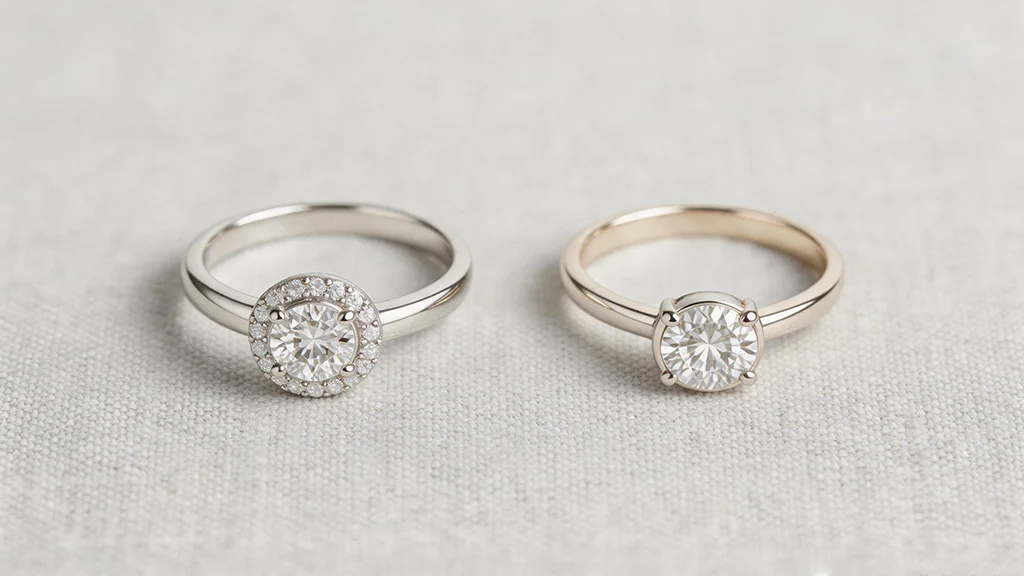
A halo ring features a centre stone encircled by a row of smaller diamonds or gemstones. The surrounding stones create the illusion of a larger centre stone and add significant sparkle.
Best for: Those who want maximum visual impact, love a glamorous aesthetic, or are working to a tighter budget on the centre stone (the halo makes a smaller stone appear considerably larger).
Pros: Exceptional brilliance, centre stone appears 0.25–0.5 carats larger than it actually is, offers a very distinctive bridal look.
Cons: The small surrounding stones require more maintenance — individual pavé or prong-set stones can loosen over time and need periodic checking.
Hidden Halo
A more recent evolution of the classic halo, the hidden halo places the ring of surrounding stones beneath the centre stone's girdle rather than alongside it. When viewed from above, the ring looks like a solitaire. When viewed from the side or at an angle, a glittering halo appears.
Best for: Those who love the idea of a halo but prefer a cleaner look from above. A wonderful choice for those who want a subtle "secret" detail.
Pros: Versatile — reads as minimal from above, dramatic from the side. Often slightly more affordable than a full halo.
Cons: The hidden stones can be harder to clean effectively; a jeweller's ultrasonic cleaner is recommended over at-home brushing.
Three Stone
Three-stone rings feature a centre stone flanked by two side stones, traditionally representing the past, present, and future of a relationship. Side stones may match the centre stone's shape or provide a complementary contrast — for example, a cushion-cut centre flanked by two tapered baguettes.
Best for: Those who value symbolism, love an heirloom-inspired look, or want a design that feels substantial without being overly ornate.
Pros: Rich in meaning, versatile across many stone shape combinations, the side stones add considerable carat weight for the price.
Cons: Choosing mismatched side stones requires careful guidance to ensure proportions look balanced.
Side Stone
Similar in concept to three-stone but typically featuring a row of smaller accent stones along the shoulders of the band, tapering toward the centre. The number and arrangement of side stones varies widely, from subtle tapered baguettes to a full pavé cascade.
Best for: Those who want a lush, full-fingered look with significant sparkle across the entire ring, not just the centre stone.
Pros: Extremely versatile in style, can be delicate or bold depending on the side stone size and arrangement.
Cons: More stones means more maintenance checkpoints.
Split Shank
A split shank ring features a band that divides into two strands as it approaches the centre stone, creating a frame effect. The split can be subtle or dramatic, plain metal or pavé-set.
Best for: Those who want a statement ring with architectural drama. The framing effect draws the eye toward the centre stone particularly effectively.
Pros: Very distinctive silhouette, the frame creates the appearance of a larger centre stone.
Cons: The split band profile can make some rings feel wider on the finger than expected — try before buying if possible.
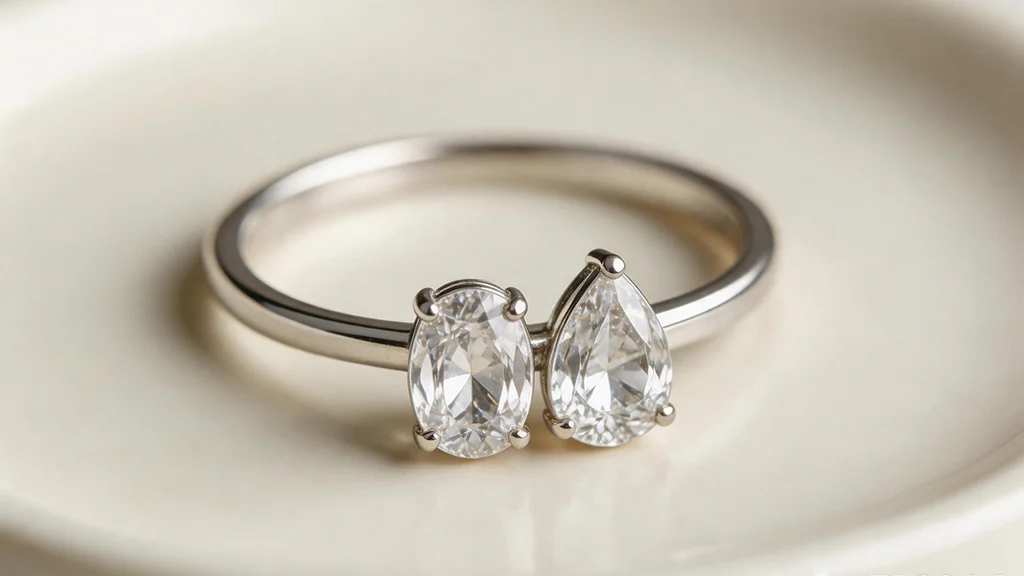
Toi et Moi
Meaning "you and me" in French, a toi et moi ring features two stones of equal or complementary size sitting side by side on a shared band. The two stones may be identical shapes or contrasting — a common modern pairing is oval and pear, or round and marquise.
Best for: Those who want something genuinely distinctive and non-traditional. Toi et moi rings have surged in popularity since high-profile celebrity pairings brought them back into cultural conversation.
Pros: Unique, romantic in symbolism, allows for creative stone combinations including mixing diamonds with coloured gemstones.
Cons: Finding a balanced, well-proportioned toi et moi design requires careful consideration — proportions between the two stones matter greatly.
Cluster
A cluster ring groups multiple smaller stones together to create the visual impression of a single large stone. Historically associated with Victorian and Edwardian jewellery, the cluster has returned strongly in contemporary design.
Best for: Those who love maximum sparkle and impact, those working to a budget who want the look of a large centre stone, and those drawn to vintage florette aesthetics.
Pros: Exceptional visual impact for the price, highly decorative.
Cons: The illusion works best when the cluster arrangement is tightly executed — less refined cluster designs can look unbalanced.
Diamond and Gemstone Shapes
The shape of the centre stone is the single most personal choice in the entire ring. Here are the most important shapes to understand, with guidance on what each one looks like on the hand.
Round Brilliant
The round brilliant is the most popular diamond shape by a significant margin — accounting for the majority of all engagement ring sales worldwide. It is cut with 58 facets specifically engineered to maximise the return of white light (brilliance) and the dispersion of spectral colour (fire).
Visual character: Classic, intensely brilliant, sparkles constantly in any light. Finger effect: Universally flattering — suits all hand shapes and finger lengths. What to know: Round brilliant diamonds are more expensive per carat than any other shape due to the amount of rough diamond lost during cutting — and because all attention falls on the stone, cut quality matters most here; refer to GIA's 4Cs of diamond quality for a full explanation of how cut grade is assessed.
Oval
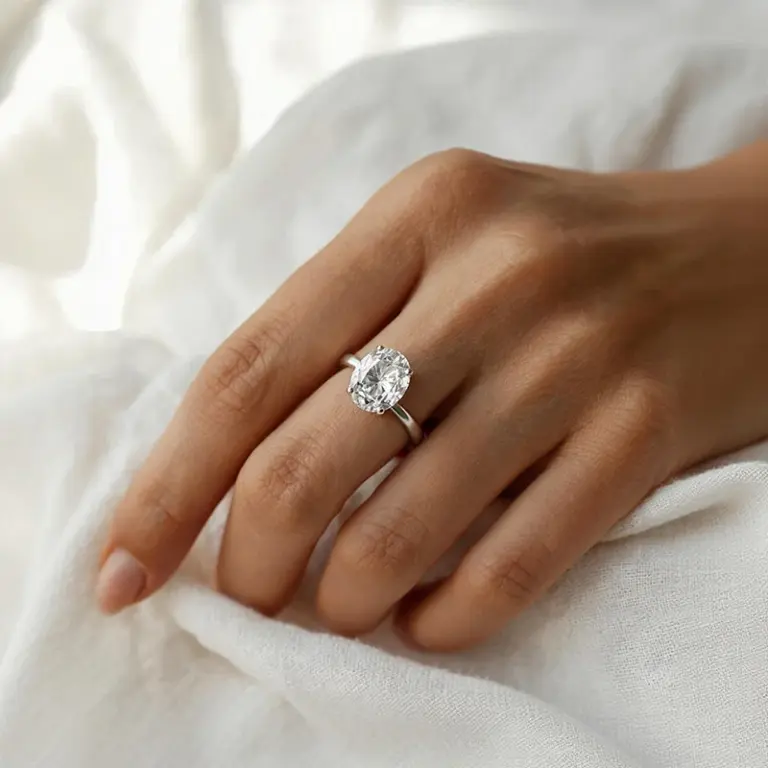
The oval has become the defining shape of the current decade in fine jewellery. Its elongated silhouette creates a slimming effect on the finger and it shares a similar brilliance level to a round cut, since both are brilliant-cut styles.
Visual character: Elegant, elongated, lively sparkle. Finger effect: Excellent for shorter or wider fingers — the elongation visually lengthens the hand. What to know: Look for ovals without a "bow-tie effect" — a dark shadow across the centre of the stone that some ovals exhibit. Always view in person or via video before purchasing
Emerald Cut
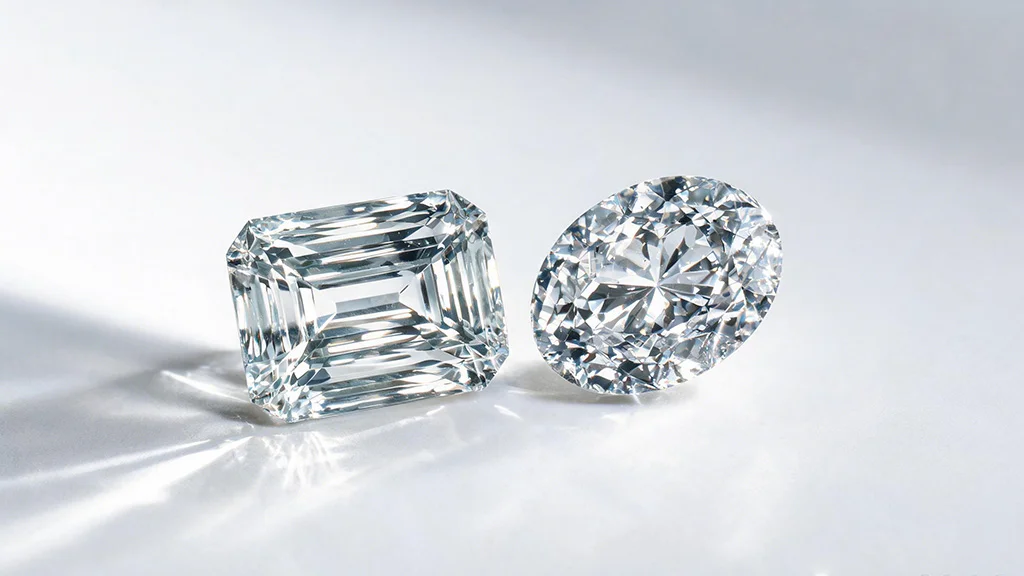
The emerald cut is a step-cut shape — rather than the multi-facet arrangement of a brilliant cut, it features broad, flat facets arranged in parallel steps. The result is a hall-of-mirrors visual effect: deep flashes of light and dark rather than the scintillating sparkle of a brilliant cut.
Visual character: Architectural, sophisticated, dramatic. Finger effect: The broad, flat table elongates the finger and creates a sleek, fashion-forward look. What to know: Step cuts are more transparent than brilliant cuts — inclusions and colour are more visible. Prioritise clarity (VS2 or better) and colour (G or above) for emerald cuts.
Cushion Cut
The cushion combines a square or rectangular outline with rounded corners and large facets that produce a soft, romantic sparkle. It is one of the oldest diamond shapes, popular throughout the Georgian and Victorian eras, and has remained consistently fashionable.
Visual character: Soft, romantic, warm. Finger effect: The rounded corners are forgiving on most hand shapes; square cushions look particularly elegant on slender fingers. What to know: Modern cushion cuts vary widely — "crushed ice" cushions have a glittery, fragmented look while "chunky" cushions have larger, more distinct facets. Decide which you prefer before shopping.
Princess Cut
A square brilliant-cut diamond with sharp 90-degree corners. The princess cut delivers brilliant-cut sparkle in a square form, making it a popular choice for those who want something different to the round but still maximally bright.
Visual character: Contemporary, geometric, high-sparkle. Finger effect: The square shape looks proportional on most hand types; wider on the finger than an oval or emerald of the same carat weight. What to know: The sharp corners are the most vulnerable part of a princess cut and should always be protected by prong tips placed directly at each corner.
Pear
The pear shape — also called a teardrop — combines a rounded base tapering to a point at the top. It is worn with the point either toward the fingertip (more traditional) or toward the hand (more contemporary).
Visual character: Romantic, feminine, graceful — and exceptionally elongating on the hand. Finger effect: One of the most flattering shapes for shorter fingers — the elongating effect is pronounced. What to know: Like ovals, pear shapes can exhibit a bow-tie shadow across the widest section. Proportions (length-to-width ratio) vary enormously — viewing in person is important.
Marquise
The marquise (mar-KEEZ) is an elongated shape with pointed ends at both the top and bottom. It has the most elongating effect on the finger of any diamond shape and also has the largest surface area per carat, making it appear larger than its actual weight.
Visual character: Bold, dramatic, vintage in inspiration, fashion-forward in execution. Finger effect: Creates one of the most dramatic lengthening effects of any shape — exceptional on shorter fingers. What to know: The two pointed tips are vulnerable and require prong protection at each point.
Radiant Cut
The radiant cut is a rectangular or square shape with cropped corners, combining the broad facets of the emerald cut with a brilliant-cut facet arrangement beneath them. The result is a step-cut outline with brilliant-cut sparkle.
Visual character: Vibrant, high-energy sparkle in a geometric form. Finger effect: Looks particularly striking on wider fingers; the cropped corners make it less fragile than princess cut corners. What to know: An excellent choice for coloured gemstones as well as diamonds — the brilliant-cut facets enhance colour saturation beautifully.
Asscher Cut
The asscher (ASH-er) is a square step cut with deeply cropped corners, creating an octagonal outline. It was created by the Asscher Brothers of Amsterdam in 1902 and became the defining cut of the Art Deco era. It remains one of the most architecturally distinctive diamond shapes.
Visual character: Geometric, vintage, deeply sophisticated — the concentric square reflections are unlike any other cut. Finger effect: The square form suits longer, slender fingers particularly well. What to know: Like the emerald cut, the asscher's step facets make inclusions more visible. Prioritise clarity.
Heart
The heart shape is the most overtly romantic diamond cut — two rounded lobes meeting at a central cleft, tapering to a point at the base. It requires exceptional cutting skill to achieve symmetrical lobes and a well-defined cleft.
Visual character: Romantic, playful, unambiguously symbolic. Finger effect: Best displayed in sizes of 0.75 carat and above — smaller hearts can lose their definition. What to know: Symmetry is critical with heart-shaped diamonds. View face-up from directly above before purchasing.
Trillion / Trilliant
A triangular brilliant cut with either straight or curved sides. The trillion is most commonly used as an accent stone flanking a round or emerald centre, but can be used as a statement centre stone in its own right.
Visual character: Distinctive, avant-garde, exceptional fire due to the triangular facet arrangement. Finger effect: The wide triangular table creates a bold, statement look. What to know: The three pointed tips require careful prong protection; the trillion is not a low-maintenance shape.
Ring Setting Types
If the style is the architecture of the ring, the setting is the engineering. Here are the primary setting types, with practical guidance on security, maintenance, and suitability.
Prong (Claw) Setting
The classic engagement ring setting — typically four or six metal claws grip the stone at its girdle, lifting it high above the band so light can enter from all sides.
Security rating: Good — but prong tips wear down over time and should be checked and re-tipped by a jeweller every 1–2 years. Light performance: Excellent — maximum light entry from all angles. Lifestyle suitability: Moderate — prongs can catch on knitwear, hair, and gloves. Those who work with their hands should consider alternative settings. Best for: Round, oval, cushion, princess, pear, heart shapes. Any stone that benefits from maximum brilliance.
Bezel Setting
A continuous rim of metal encircles the entire perimeter of the stone, holding it flush with or slightly above the band surface.
Security rating: Outstanding — the most secure setting available. Stones very rarely loosen in a well-made bezel. Light performance: Good — side entry of light is reduced, but face-up brilliance is largely maintained. Lifestyle suitability: Excellent — no prongs to catch, extremely low profile. The preferred choice for active lifestyles. Best for: Round, oval, marquise shapes particularly. Also used for coloured gemstones where security is a priority.
Channel Setting
Stones are set into a channel cut into the band itself, held in place by two parallel rails of metal. Channel settings are most commonly used for accent stones along the band rather than for a centre stone.
Security rating: Very good — stones are fully enclosed between the channel walls. Light performance: Moderate — light enters only from above. Lifestyle suitability: Excellent for band accent stones — the flush, smooth surface catches on nothing. Best for: Princess, baguette, and round accent stones along the shank.
Pavé Setting
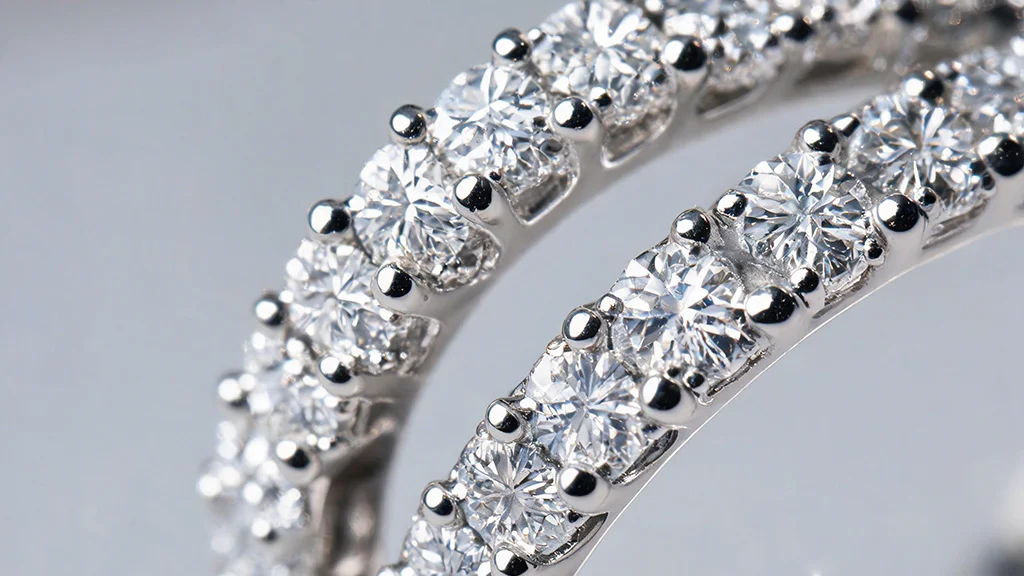
Tiny diamonds are set into drilled holes in the metal surface, held by microscopic beads of metal (rather than traditional prongs). The effect is a surface that appears entirely covered in diamonds.
Security rating: Moderate — the tiny beads of metal holding each stone can wear over time. Annual checking is advisable. Light performance: Excellent — each tiny stone is individually positioned to maximise light return. Lifestyle suitability: Moderate — fine pavé is delicate and can sustain damage from impact. Not ideal for very active or manual work lifestyles. Best for: Band decoration, halo surrounds, shoulder accents. A beautiful complement to almost any centre stone shape.
Tension Setting
The stone appears to float between two ends of the band, held in place entirely by the springlike pressure of the metal. A strikingly modern and architectural setting.
Security rating: Moderate — when well-made by an expert jeweller, tension settings are secure. However, significant impact to the side of the band can cause the stone to release. Not recommended for high-impact activities. Light performance: Outstanding — the stone is entirely unobstructed, so light enters from all angles including the base. Lifestyle suitability: Best for those with desk-based lifestyles who are careful with their hands. Best for: Round and princess cuts in particular.
Flush / Gypsy Setting
The stone is set into a drilled hole in the band so that its table sits level with, or just slightly above, the metal surface. The stone appears to emerge directly from the band itself.
Security rating: Excellent — the stone is entirely encased in metal. Light performance: Lower than prong settings — light enters only from above. Lifestyle suitability: Outstanding — completely smooth profile, catches on nothing. Best for: Used as accent stones along bands, or as a contemporary alternative for those who want maximum wearability.
Cathedral Setting
A cathedral setting features arched bridges of metal rising from either side of the band to cradle the centre stone, elevating it prominently. The arches are often engraved or pavé-set.
Security rating: Good. Light performance: Very good — the elevated position allows light in from all sides. Lifestyle suitability: Moderate — the raised profile can catch. Better suited to those who are not extremely active with their hands. Best for: Round, oval, cushion stones. Pairs beautifully with vintage and three-stone styles.
How to Choose by Lifestyle and Hand Shape
This is where most guides end. We are going further — because the "right" ring is not just the one that looks beautiful in a photograph. It is the one that works for your actual life.
Choosing by lifestyle
Very active lifestyle — sports, fitness, nursing, manual work, parenting young children: Your ring will take a beating. Prioritise a bezel or low-profile prong setting. Avoid pavé bands and high cathedral profiles. A sleek oval or round solitaire in a full bezel is practically indestructible compared to a pavé halo. Consider platinum over gold — it is more resistant to scratching and its prongs last longer.
Desk-based work, creative profession, occasional outdoor activity: You have more freedom. A pavé band, halo, or split shank will suit you beautifully. A four-prong solitaire is easy to maintain with an annual jeweller check. You can wear almost anything here — let aesthetic preference guide you.
Working in fashion, beauty, or jewellery — hands are always visible: Statement rings suit you well. Consider a toi et moi, a distinctive emerald-cut solitaire in yellow gold, a vintage-inspired Art Deco design, or an east-west marquise. You want something people ask about.
Travel frequently — ring goes everywhere: Avoid high-profile settings that can catch in luggage and fabric. A bezel or low-profile prong in platinum with a round or oval stone is your best friend. Avoid open clusters or intricate filigree.
Choosing by hand and finger shape
Shorter fingers: Choose elongating shapes — oval, pear, marquise, and elongated cushion all lengthen the appearance of the finger. Avoid very wide square stones (princess cut, asscher) which can make fingers appear shorter. A ring with a tapered band (narrower at the centre, wider at the shank) also elongates.
Longer, slender fingers: Almost any shape flatters a long finger. Round, cushion, asscher, and princess cuts look particularly proportional. Wider band styles and east-west settings look especially striking on longer fingers.
Wider fingers: Elongating shapes (oval, emerald, marquise) create the most flattering effect. A split-shank or tapered band draws the eye to the centre stone rather than across the width of the finger.
Small hands: Delicate settings in proportionate carat sizes tend to look best. A 1.5–2 carat round or oval solitaire will have great presence without overwhelming the hand. Very large halos can look disproportionate on smaller hands — view on hand before committing.
Choosing by personality
Classic and traditional: Round brilliant solitaire, four or six prong, platinum or white gold band. You cannot go wrong.
Romantic and sentimental: Three-stone design, or a cushion-cut solitaire in yellow gold. Consider engraving the inside of the band with a meaningful date or phrase.
Minimalist and modern: Oval or round in a full bezel, simple low-profile band, white gold or platinum. Or an east-west emerald cut with a plain shank.
Bold and fashion-forward: Marquise toi et moi, east-west radiant, oversized cushion halo in yellow gold, or an asscher in a geometric Art Deco setting.
Nature-lover and free spirit: Pear or oval with a nature-inspired band — floral or vine detailing, pavé-set leaves, or an organic sculpted shank. Coloured gemstone centres (sapphire, emerald, morganite) suit this personality particularly well.
Metal Choices and How They Work with Each Style
The metal you choose is not just about colour preference — it affects durability, maintenance, how the ring wears over decades, and how the stone's own colour appears.
Platinum
The most durable and prestigious metal for engagement rings. Platinum is naturally white and never needs rhodium plating (unlike white gold). It is denser than gold, which makes it heavier and also means its prongs are more resistant to wearing down.
Best with: Solitaires, three-stone rings, architectural and modern settings where the metal itself is a feature. Also the best choice for coloured diamond settings since its pure white colour does not affect stone colour. Skin tone: Universally flattering — the cool, bright white suits all skin tones. Maintenance: Develops a natural patina over time that many people prefer. Can be polished back to a bright finish at any time. Prongs are the most durable of any metal.
White Gold
White gold is yellow gold alloyed with white metals (typically palladium or nickel) and then plated with rhodium to achieve a bright white finish. The rhodium plating will wear over time — typically after 12–18 months of daily wear — and needs to be re-applied by a jeweller.
Best with: Halos, pavé settings, and any design where bright white brilliance is important. Also popular for vintage-inspired designs. Skin tone: Universally flattering; a slightly warmer finish than platinum once the rhodium plating begins to wear. Maintenance: Annual rhodium re-plating is advisable. Lower cost than platinum.
Yellow Gold
Yellow gold is experiencing a significant resurgence. 18-carat yellow gold (75% pure gold) is the preferred choice for fine engagement jewellery — rich enough in colour to be deeply warm and luxurious, but alloyed for durability.
Best with: Vintage and Art Deco designs, solitaires, toi et moi rings, and any style where you want the metal itself to be a strong visual feature. Yellow gold also enhances the warmth of near-colourless diamonds (I–J colour range) — a stone that might look slightly warm in platinum can look naturally warm and appealing in yellow gold. Skin tone: Particularly beautiful on medium, olive, and deeper skin tones. Also stunning on very fair skin as a high-contrast look. Maintenance: Cannot tarnish but will develop small scratches over time (all metals do). Annual polishing restores its surface.
Rose Gold
An alloy of gold and copper, rose gold has a warm, peachy-pink hue that has become enormously popular over the past decade. The copper content makes 18-carat rose gold slightly harder and more scratch-resistant than yellow or white gold of the same carat.
Best with: Vintage-inspired designs, nature-inspired settings, solitaires, and halo designs. The warm colour pairs particularly beautifully with morganite, champagne diamonds, and pale pink sapphires. Skin tone: Extraordinarily flattering on warm, olive, and golden skin tones. Also very striking on fair skin. Maintenance: The copper content means rose gold cannot be rhodium-plated, so the colour you see when you buy is the permanent colour (it may deepen very slightly over time as the copper oxidises gently).
Two-Tone
Two-tone rings combine two metal colours — most commonly yellow or rose gold for the shank with white gold or platinum for the setting that holds the stone. This is not merely an aesthetic choice: it is also a practical one, since a white metal setting means the stone appears as bright as possible, while a warmer band adds personality and warmth.
Best with: Three-stone designs, split shank settings, solitaires with contrasting bands. Skin tone: Versatile — the combination of warm and cool tones tends to suit most skin tones. Maintenance: Requires the care appropriate for each metal in the relevant area of the ring.
Gold in its purest form (24 carat) is too soft for daily-wear jewellery, so it is alloyed with other metals to add durability — the alloying process that creates white gold, yellow gold, and rose gold is explained in detail by the World Gold Council, the global industry body for gold.
Trending Styles at Provence in 2025–2026
While timeless designs like the round solitaire and the halo never truly go out of fashion, certain styles are having a particular cultural moment right now. At Provence Jewellery, here are the styles our clients are gravitating toward.
Oval solitaire in yellow gold. The combination of an elegant oval cut, a slim four-prong setting, and a warm yellow gold band has become the defining engagement ring look of the mid-2020s. It is sophisticated without being cold, distinctive without being eccentric.
Toi et moi with contrasting shapes. The two-stone ring has moved firmly from novelty to established classic. The most requested combination at Provence currently pairs a round brilliant with an elongated pear, set at a slight angle to each other on a plain platinum shank.
East-west emerald cut. The architectural drama of a horizontally-set emerald cut in white gold or platinum is attracting those who want something genuinely modern. The horizontal orientation feels fresh and deliberate.
Coloured gemstone centres. Sapphire, particularly in deep royal blue and soft cornflower tones, continues to be the most requested coloured centre stone. Morganite is popular for rose gold settings. Green sapphire and teal sapphire have emerged as distinctive, fashion-forward choices.
Low-profile bezel solitaire. Practicality and aesthetics are meeting in this quietly surging style. As more people prioritise active, full-life wearability, the clean security of a full bezel in platinum is resonating strongly.
Pavé with a twist — asymmetric and partial halos. The full halo is evolving into more asymmetric, irregular forms — a partial diamond surround on one side only, or an irregularly shaped inner halo. These feel contemporary and artisan rather than mass-produced.
Browse our current collection to see these styles in person or request a consultation to discuss a bespoke commission.
Care and Maintenance by Setting Type
A beautiful engagement ring deserves to stay beautiful. Here is what you need to know about caring for the most common setting types.
Daily wear tips (all settings)
- Remove your ring before applying hand cream, sunscreen, or perfume — product buildup dulls all stones and clogs pavé settings in particular.
- Remove before swimming in chlorinated pools or the sea — chlorine can damage alloy metals over time.
- Remove before any activity where you might strike the ring against a hard surface: gardening, gym, climbing, DIY.
- Store individually in a fabric-lined box — diamonds can scratch other jewellery.
Prong and claw settings
Have your prongs inspected by a jeweller every 12 months. Over time, the tip of each prong wears down through daily contact with surfaces. Re-tipping costs very little and prevents stone loss. If you ever feel a prong snag on fabric, take the ring in immediately rather than waiting for your annual check.
Pavé and halo settings
The tiny bead-and-stone arrangement of pavé work requires ultrasonic cleaning to keep it sparkling — household toothbrush cleaning reaches between the stones but does not remove the deep buildup that dulls pavé over time. Your jeweller can ultrasonic-clean the ring during your annual visit. If you notice a dark patch in your pavé band, that is almost always built-up product rather than a missing stone.
Bezel settings
The easiest setting to maintain. Wipe clean with a warm, damp, soft cloth. The enclosed nature of the setting means less product buildup than prong or pavé settings. The bezel collar can be polished back to a bright finish during any standard jewellery service.
Vintage and filigree settings
Intricate metalwork requires specialist cleaning — never use ultrasonic cleaners on antique or antique-inspired pieces with filigree work, as the vibration can weaken the fine metalwork. Warm water and a very soft brush, and professional cleaning by a jeweller who specialises in vintage jewellery, is the safest approach.
Frequently Asked Questions
The solitaire remains the most popular engagement ring style worldwide by sales volume, with the round brilliant solitaire being the single most-purchased design. However, the oval solitaire has closed the gap significantly over the past five years and currently rivals round in new sales, particularly in the 25–35 age bracket.
The bezel setting is the most durable and secure setting available. The full metal collar encasing the stone provides superior protection against impact and stone loss compared to prong, pavé, or tension settings. It is the recommended choice for active lifestyles, physical professions, and anyone who works frequently with their hands.
A halo places a ring of smaller diamonds around the circumference of the centre stone, visible from above and all sides. A hidden halo positions the small surrounding stones beneath the girdle of the centre stone — they are invisible when the ring is viewed from directly above, but appear as a glittering frame when viewed from the side or at an angle. A hidden halo offers the best of both aesthetics: clean from above, dramatic in profile.
The marquise cut has the largest surface area per carat of any diamond shape, meaning it appears largest face-up relative to its actual carat weight. Oval and pear shapes also appear larger than round diamonds of the same carat weight, while their elongating effect on the finger further adds to the impression of size. Round brilliant diamonds appear slightly smaller face-up than fancy shapes of the same carat weight due to their proportions.
Elongated shapes are the most flattering for shorter fingers — oval, pear, marquise, and elongated cushion cuts all create a lengthening visual effect. Avoid wide, square shapes (asscher, princess cut) which can visually shorten the finger. Setting on a tapered or knife-edge band also helps elongate the appearance of the finger.
Both are excellent choices. Platinum is more durable, never needs rhodium plating, and is better for those with nickel sensitivities (since white gold alloys often contain nickel). Gold (yellow, white, or rose) offers more colour options and is slightly lighter in weight. Platinum's higher density means its prongs last longer without needing re-tipping. For maximum durability and longevity, platinum is the preferred professional recommendation for a daily-wear engagement ring.
A prong setting uses individual metal claws to grip the stone at multiple points around its girdle, leaving the majority of the stone's surface exposed to light. A bezel setting encircles the entire perimeter of the stone with a continuous metal collar. Prong settings maximise brilliance and sparkle; bezel settings maximise security and wearability. The choice between them is primarily one of lifestyle and aesthetic preference.
Toi et moi (French for "you and me") is an engagement ring featuring two stones of equal or complementary sizes sitting side by side on a shared band, each in its own individual setting. The two stones can be the same shape and variety, or contrasting — mixing a diamond with a coloured gemstone, or pairing two different diamond shapes, is a popular contemporary approach. The style dates to the late 18th century and has experienced a strong revival since the early 2020s.
An annual inspection and service is the standard recommendation for all engagement rings with prong or pavé settings. During a service, a jeweller will inspect all prong tips and beads for wear, check for loose stones, clean the ring thoroughly (including ultrasonic cleaning of pavé and halo settings), and polish the metal. For bezel-set rings, every 18–24 months is generally sufficient. Think of it as the equivalent of a car service — inexpensive preventative maintenance that protects a significant investment.
Find Your Perfect Ring at Provence Jewellery
Understanding the language of engagement rings transforms the shopping experience from overwhelming to genuinely exciting. You now know the difference between a style and a setting, how to match a shape to your hand, which settings suit your lifestyle, and what each metal choice will look like and require over the years of your life together.
At Provence Jewellery, every ring in our collection is handcrafted by master jewellers. We offer complimentary consultations — in person or virtually — where our team will guide you through every decision based on your individual preferences, budget, and lifestyle. We also specialise in bespoke commissions for those who want something entirely their own.
Browse our engagement ring collection or book a consultation to speak with a Provence jewellery specialist.