
All Types of Blue Gemstones: A Complete Guide in 2026
- Written by Provence Team
- Updated on May 27, 2026
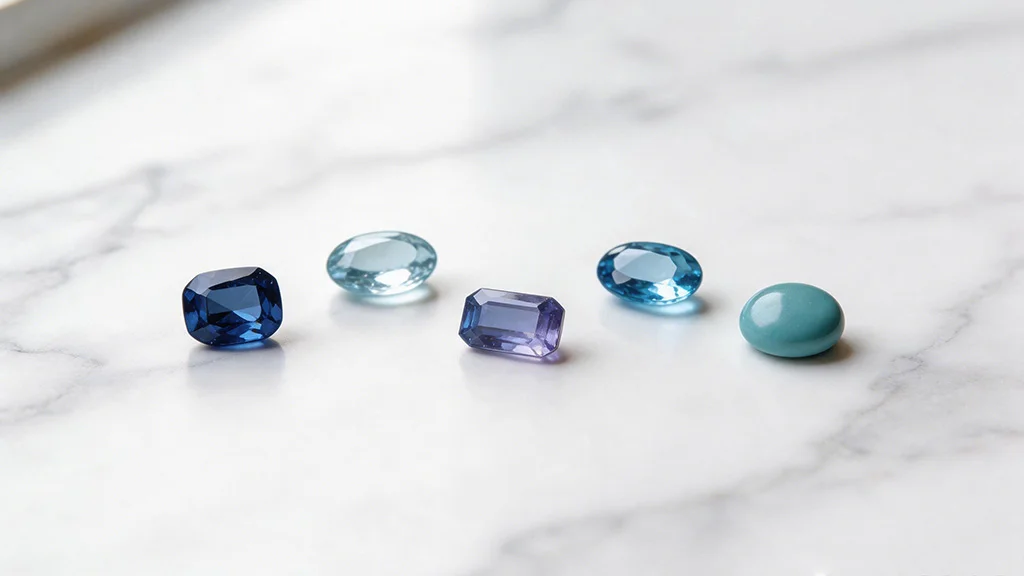
Table of Contents
Are you looking for a blue gemstone for a ring, pendant, or pair of earrings — and not sure where to start? You are not alone. Blue is one of the most requested colours in fine jewellery, and the choice of stone can feel overwhelming when you discover just how many beautiful options exist beyond sapphire.
At Provence Jewellery, we work with blue gemstones every day. This guide brings together our expert knowledge and in-depth research to give you everything you need: a full list of blue gemstone types, their shades and durability, how they perform in real jewellery settings, and practical advice on choosing the right stone for your piece and your budget.
Whether you are drawn to the deep midnight of a fine blue sapphire, the electric glow of Paraiba tourmaline, or the soft coastal calm of aquamarine, there is a perfect blue gemstone for you.
Quick-Reference: Types of Blue Gemstones at a Glance
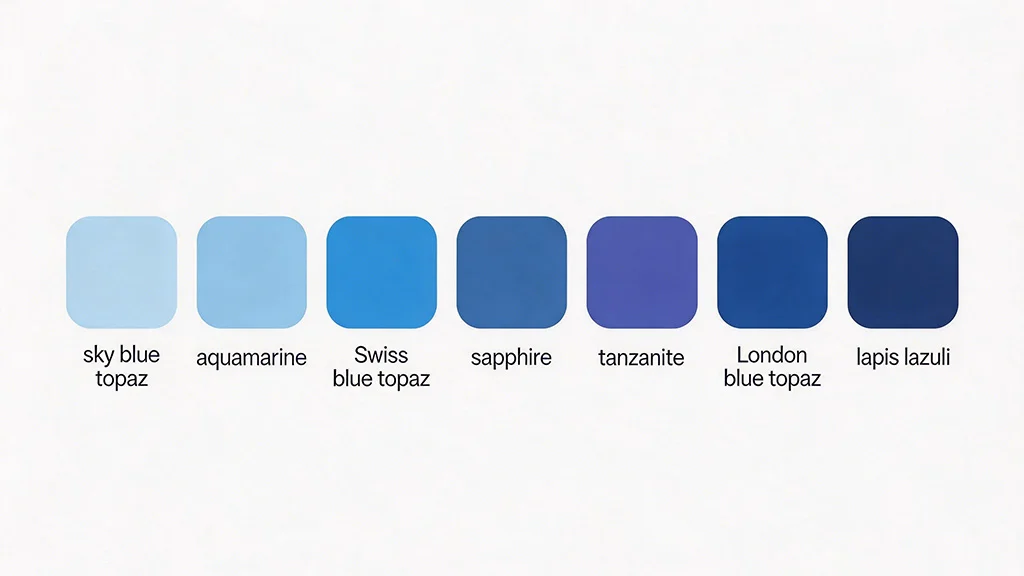
Use this table to compare the most popular blue gemstones at a glance. Full profiles for each stone follow below.
Price guide: $ = under £200 per carat, $$ = £200–800, $$$ = £800–2,500, $$$$ = £2,500+
|
Gemstone |
Shade of Blue |
Mohs |
Best For |
Price Range |
Rarity |
|---|---|---|---|---|---|
|
Blue Sapphire |
Deep royal / cornflower blue |
9 |
Rings, everyday wear |
$$$ – $$$$ |
Uncommon (fine quality) |
|
Aquamarine |
Pale sky to medium blue |
7.5–8 |
All jewellery types |
$$ – $$$ |
Available |
|
Tanzanite |
Blue-violet, trichroic |
6–7 |
Pendants, earrings |
$$$ – $$$$ |
Very rare (1 location) |
|
Blue Topaz (London) |
Deep inky blue |
8 |
Rings, versatile |
$ – $$ |
Widely available |
|
Blue Topaz (Swiss) |
Vivid medium blue |
8 |
All jewellery types |
$ – $$ |
Widely available |
|
Blue Topaz (Sky) |
Pale icy blue |
8 |
Delicate pieces |
$ |
Widely available |
|
Turquoise |
Sky to blue-green |
5–6 |
Pendants, earrings |
$ – $$$ |
Available–rare (fine) |
|
Iolite |
Blue-violet, pleochroic |
7–7.5 |
Pendants, earrings |
$ |
Available |
|
Kyanite |
Medium to deep blue |
4.5–7 |
Pendants, earrings |
$ |
Available |
|
Lapis Lazul |
Deep navy with gold flecks |
5–6 |
Pendants, earrings |
$ – $$ |
Available |
|
Blue Spinel |
Rich cobalt to vivid blue |
8 |
All jewellery types |
$$ – $$$ |
Uncommon |
|
Blue Zircon |
Vivid electric blue |
7.5 |
Pendants, earrings |
$ |
Available |
|
Labradorite |
Iridescent blue flash |
6–6.5 |
Pendants, earrings |
$ |
Available |
|
Paraiba Tourmaline |
Neon electric blue-green |
7–7.5 |
Statement pieces |
$$$$+ |
Extremely rare |
|
Grandidierite |
Blue-green |
7.5 |
Collector / pendants |
$$$+ |
Very rare |
|
Benitoite |
Vivid sapphire blue |
6.5 |
Collector pieces |
$$$$+ |
Exceptionally rare |
Tier 1: The Most Popular Blue Gemstones for Jewellery
These five stones dominate the market for good reason — they combine beauty, durability, and wide availability. They are the first stones to consider for any blue jewellery piece.
1. Blue Sapphire — The Timeless Classic
Provence Pick
Blue sapphire looks stunning in white gold or platinum settings, which amplify its cool depth. For a warmer look, rose gold creates a beautiful contrast with cornflower blue stones. Ideal for everyday rings due to its outstanding hardness.
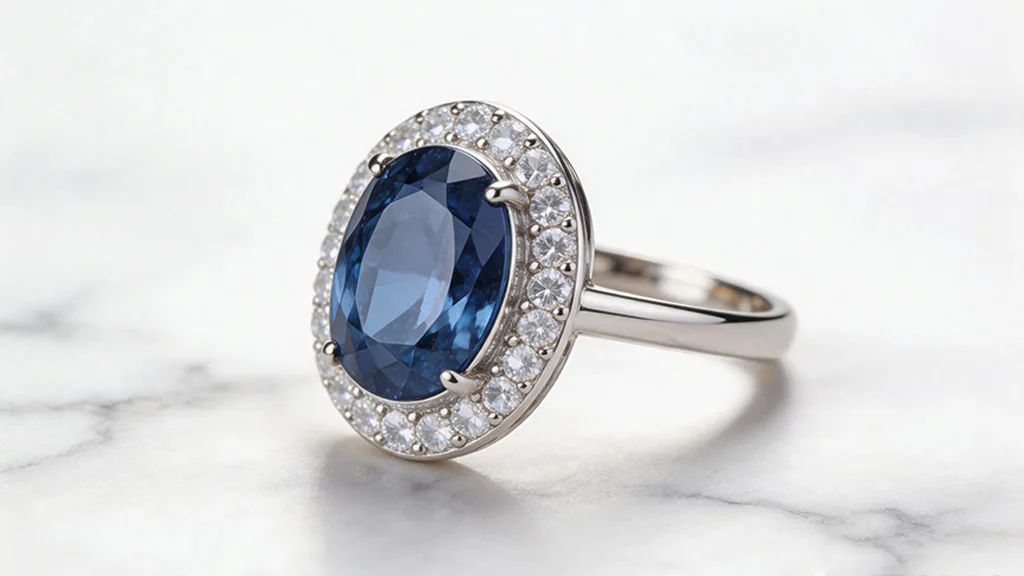
Hardness: 9 (Mohs) | Colours: Cornflower blue, royal blue, teal blue, midnight blue | Origin: Sri Lanka, Kashmir, Burma, Madagascar
Blue sapphire is the quintessential blue gemstone — prized for millennia by royalty, clergy, and collectors alike. With a Mohs hardness of 9, it is second only to diamond in durability, making it the single best choice for a blue engagement ring or any piece intended for daily wear.
The most desirable colour is 'cornflower blue' or 'royal blue': a vivid, medium-to-dark blue with excellent saturation and minimal grey or green secondary hues. Kashmir sapphires, with their legendary velvety blue colour, are among the most valuable gemstones in the world. Sri Lankan stones offer a beautiful range from pale to deep blue and are far more accessible.
The vast majority of blue sapphires on the market are heat-treated — a long-accepted industry standard that enhances colour and clarity. Unheated sapphires, confirmed by a gemological certificate (GRS, GIA, or Gübelin), command a significant premium. Always ask your jeweller for a treatment disclosure.
Sapphire buying tips
- Look for vivid colour with no excessive grey or brown undertones.
- For engagement rings, prioritise stones certified by GIA, GRS, or AGL.
- Ceylon (Sri Lankan) sapphires offer excellent quality at more accessible prices than Burmese or Kashmir.
Avoid stones described as 'diffusion-treated' — this is a surface coating, not a standard treatment
2. Aquamarine — The Sea-Blue Beryl
Provence Pick
Aquamarine's cool, pale tones are perfect for yellow gold settings — the contrast is striking and very on-trend. It suits all jewellery types beautifully: from delicate drop earrings to bold cocktail rings. Its March birthstone status makes it a popular and meaningful gift choice.
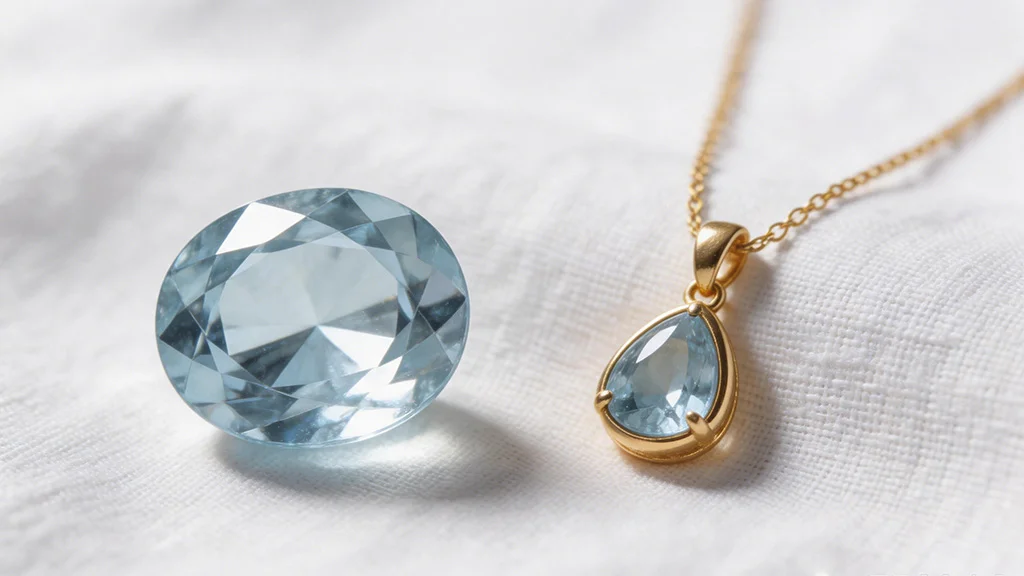
Hardness: 7.5–8 | Colours: Pale sky blue to medium sea blue | Origin: Brazil, Madagascar, Nigeria, Pakistan
Aquamarine belongs to the beryl family — the same mineral group as emerald — and takes its name from the Latin for 'sea water'. Its characteristic pale-to-medium blue is calming and effortlessly elegant. Unlike many blue gemstones, aquamarine is typically eye-clean (free from visible inclusions), which gives it exceptional clarity and brilliance.
The most prized aquamarines come from Minas Gerais in Brazil and display a deep, saturated blue sometimes described as 'Santa Maria blue'. Pakistani stones can also be exceptionally fine. Most aquamarines are heated to remove any greenish tints and improve the pure blue colour — this is a universally accepted treatment.
At Mohs 7.5–8, aquamarine is durable enough for most jewellery, though it should be protected from hard knocks in everyday rings. It excels in pendants, earrings, and occasional-wear rings.
Aquamarine buying tips
- Deeper blue stones are more valuable — look for intense colour, not washed-out pale grey.
- Aquamarine is almost always eye-clean; avoid stones with visible inclusions.
- Excellent value for money compared to sapphire: large stones are available at accessible prices.
- March's birthstone — a thoughtful and meaningful gift.
3. Tanzanite — The Rarest Blue on Earth
Provence Pick
Tanzanite's violet-blue hues look breathtaking in white gold or silver settings that allow its unique colour to take centre stage. Avoid ultrasonic cleaners and protect from hard knocks — tanzanite is best reserved for pendants, earrings, and special-occasion rings rather than everyday wear.
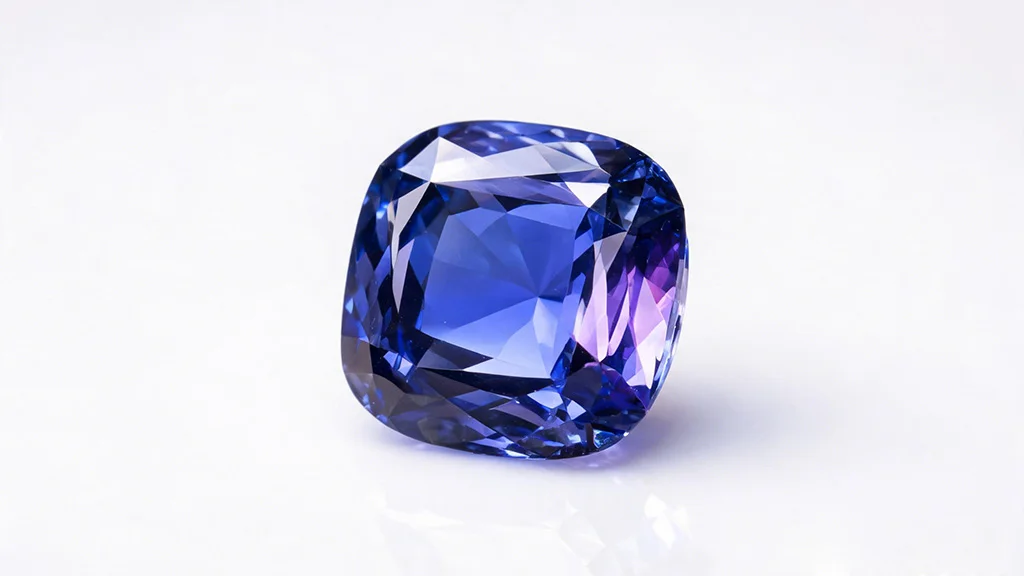
Hardness: 6–7 | Colours: Blue-violet to deep indigo, strongly trichroic | Origin: Exclusively: Merelani Hills, Tanzania
Discovered in 1967 at the foot of Mount Kilimanjaro, tanzanite is found in one place and one place only on earth — a 7km mining corridor in northern Tanzania. This extraordinary rarity, combined with its mesmerising colour, has propelled it into the top tier of coloured gemstones in just half a century.
Tanzanite is strongly trichroic, meaning it shows different colours depending on the viewing angle: blue, violet, and a deep burgundy. When cut correctly, the dominant colour is a rich blue-violet that seems to shift in different lighting — electric under daylight, deeply mysterious by candlelight. Some stones lean more blue; others more violet — personal preference determines which is more desirable.
Geologists estimate that tanzanite will be fully mined out within the next 20–30 years, which has led many buyers to consider it an investment as well as a beautiful gemstone. Unlike sapphire, tanzanite is not suitable for rough daily wear due to its lower hardness and perfect cleavage. It shines at its best in pendants, earrings, and occasional rings with protective settings.
Tanzanite buying tips
- AAA-grade tanzanite shows deep, vivid blue-violet with strong saturation — avoid pale or washed-out stones.
- A protective setting (bezel or halo) is strongly recommended for rings.
- Request a certificate of origin; reputable dealers source ethically from Tanzania.
- Consider tanzanite's rarity as part of its long-term value proposition.
4. Blue Topaz — The Accessible Blue
Provence Pick
Blue topaz is one of our favourite recommendations for clients who want a vivid, sparkling blue stone without the price of sapphire. London Blue's deep inky colour looks sensational in white gold; Sky Blue creates a delicate, ethereal feel perfect for gift jewellery. Topaz at Mohs 8 is durable and excellent value.
Hardness: 8 | Colours: Pale (Sky Blue), vivid medium (Swiss Blue), deep inky (London Blue) | Origin: Brazil, Nigeria, Sri Lanka (most treated)
Blue topaz is one of the most commercially popular blue gemstones in the world, largely because it offers excellent colour and sparkle at very accessible price points. Natural blue topaz is actually quite rare; almost all the blue topaz sold in jewellery has been irradiated and heat-treated — a safe, stable, and widely accepted process that creates its characteristic blue colour.
There are three principal varieties. Sky Blue is pale and icy, reminiscent of a clear winter sky — delicate and feminine. Swiss Blue is a vivid, medium-saturated blue with excellent brightness — the most popular and versatile variety. London Blue is the deepest and most dramatic of the three: a rich, inky blue with slight grey or green undertones that gives it a sophisticated edge prized for statement jewellery.
With a Mohs hardness of 8, blue topaz is tough and suitable for all types of jewellery, including everyday rings. It pairs beautifully with white metals for a crisp, contemporary look, or with yellow gold for a warmer contrast.
Blue topaz buying tips
- London Blue is the most sought-after variety for statement pieces; Swiss Blue offers the best all-round vibrancy.
- Treatment is the industry standard and does not affect value or durability.
- December's birthstone (alongside turquoise and tanzanite) — excellent gifting option.
Large stones at affordable prices make topaz ideal for bold, sculptural jewellery designs.
5. Turquoise — The Ancient Blue
Provence Pick
Turquoise works most powerfully in silver settings that complement its earthy, natural character. It is best reserved for pendants, earrings, and bracelets rather than rings — its lower hardness means it scratches with daily ring wear. Persian turquoise with an even, robin's-egg blue colour is the most prized.
Hardness: 5–6 | Colours: Sky blue to blue-green, often with natural matrix veining | Origin: Iran (Persia), USA (Arizona), China, Egypt
Turquoise is one of the oldest gemstones known to humanity. Ancient Egyptians adorned their pharaohs with it; the Aztecs inlaid it in ceremonial masks; Navajo artisans have elevated it to a defining element of Southwestern jewellery tradition. Few gemstones carry such cultural weight across so many civilisations.
The finest turquoise comes from the Nishapur mines of northeastern Iran — known as 'Persian turquoise' — and displays a pure, even robin's-egg blue with no matrix (the host rock veining that characterises many turquoise stones). American turquoise from Nevada and Arizona mines, while often featuring characteristic spider-web matrix, is prized in its own right and commands high prices from collectors.
Turquoise is an opaque stone with a waxy to sub-vitreous lustre. Its lower hardness means it requires more careful handling in jewellery settings, and most commercial turquoise is stabilised (impregnated with resin) to improve durability and colour. Untreated, naturally coloured turquoise commands a significant premium.
Turquoise buying tips
- Ask specifically whether turquoise is natural, stabilised, or dyed — price and value differ significantly.
- Avoid exposure to chemicals, perfumes, and prolonged sunlight, which can alter the colour.
- Persian (Iranian) turquoise commands the highest prices; look for certificates of origin for fine pieces.
- The most wearable setting for turquoise rings is a bezel (fully surrounding the stone) for protection.
Tier 2: Beautiful Blue Gemstones Worth Knowing
These six stones offer outstanding beauty, often at more accessible prices than the first tier. Each brings something unique — whether that is a distinctive optical effect, an unusual hue, or remarkable hardness for the price.
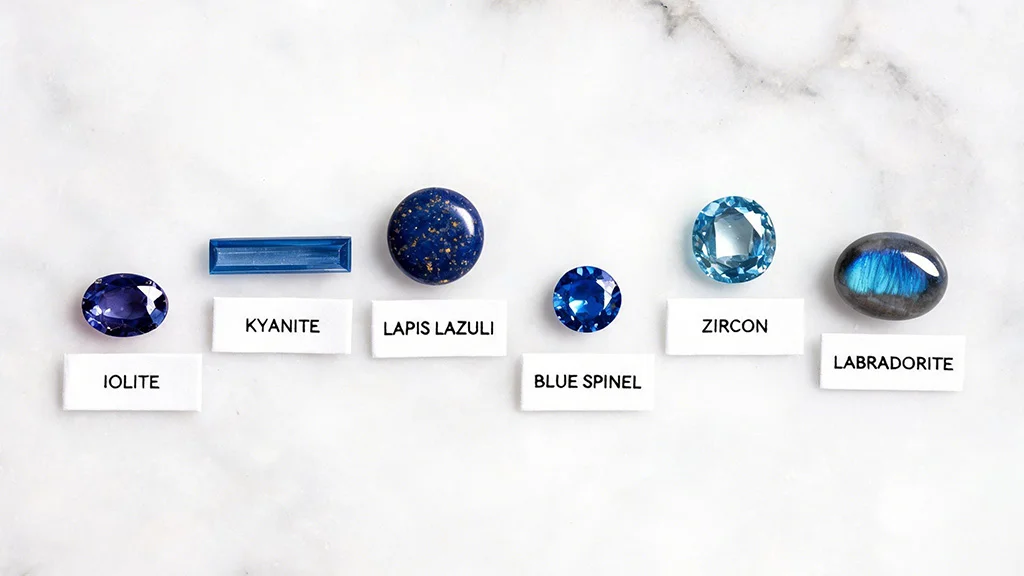
6. Iolite — The Poor Man's Sapphire
Provence Pick
Iolite is a hidden gem — literally. Its vivid blue-violet rivals tanzanite at a fraction of the price. Best in pendants and earrings where its pleochroism can be appreciated in movement. A wonderful choice for buyers who love tanzanite's colour but have a tighter budget.
Hardness: 7–7.5 | Colours: Deep blue-violet to indigo, strongly pleochroic | Origin: Sri Lanka, India, Madagascar, Namibia
Iolite is the gem-quality variety of the mineral cordierite and is remarkable for its strong pleochroism — it shifts between deep blue-violet, pale blue, and a warm yellowish-grey as you rotate it in the light. Viking navigators reportedly used thin slices of iolite as a polarising filter to locate the sun on overcast days, earning it the nickname 'Viking compass stone'.
At Mohs 7–7.5, iolite is suitable for protected rings and excellent for pendants and earrings. It offers a colour very similar to tanzanite at a fraction of the price, making it one of the best value propositions in coloured gemstones. It is rarely treated, which appeals to buyers who prefer natural, unenhanced stones.
7. Kyanite — The Variable Blue
Provence Pick
Kyanite's hardness varies dramatically by direction — hard along the length of the crystal, soft across it — which makes it challenging to cut but produces stones of unusual beauty. Best suited to pendants and earrings; not recommended for rings. The deep blue varieties rival sapphire in colour at a tiny fraction of the cost.
Hardness: 4.5–7 (strongly anisotropic) | Colours: Pale to deep cornflower blue, sometimes with colour zoning | Origin: Nepal, Brazil, Kenya, India
Kyanite is a fascinating and underappreciated gemstone with a hardness that varies significantly by direction — a property called anisotropy. This makes it challenging to cut and facet, which is part of why it remains relatively rare in jewellery despite its stunning colour. The finest kyanite can display a cornflower blue indistinguishable from expensive sapphire to the untrained eye.
Kyanite is almost never treated and is typically found at very accessible price points, making it an excellent option for those who appreciate natural, unenhanced stones with remarkable colour. It should be protected from knocks and is best suited to pendants and earrings rather than daily-wear rings.
8. Lapis Lazuli — The Royal Blue of Antiquity
Provence Pick
Lapis lazuli's opaque, intensely saturated deep blue is unlike anything else in the gem world. It works beautifully as a bold statement piece — carved pendants, wide bangles, or strong earring drops in silver. Avoid heat, chemicals, and ultrasonic cleaners. The golden pyrite flecks in natural lapis are a sign of authenticity — embrace them.
Hardness: 5–6 | Colours: Deep navy to ultramarine blue, often with golden pyrite inclusions | Origin: Afghanistan (finest quality), Chile, Russia
Lapis lazuli has been prized for over 6,000 years. Ancient Egyptians used it in the funeral mask of Tutankhamun; Renaissance painters ground it into 'ultramarine' pigment — the most expensive paint colour in history, worth more than gold. Its name means 'blue stone' in a blend of Latin and Persian, and it has never lost its association with royalty, wisdom, and truth.
The finest lapis lazuli comes from the ancient Sar-e-Sang mines in Afghanistan's Badakhshan province, where mining has continued for thousands of years. The ideal stone is an intense, even royal blue with minimal white calcite veining and a tasteful scattering of gold pyrite inclusions — never a stone that has been artificially dyed or has excessive pale patches.
Lapis is an opaque stone with a Mohs hardness of 5–6 and is typically carved or cut en cabochon. It is sensitive to acids and heat, so avoid cleaning with anything other than a soft, damp cloth.
9. Blue Spinel — The Connoisseur's Choice
Provence Pick
Blue spinel is one of the best-kept secrets in fine gemstones. At Mohs 8, it is as durable as topaz and harder than tanzanite, making it suitable for all jewellery types including rings. Its rarity and growing collector following make it an interesting choice for those who want something off the beaten path.
Hardness: 8 | Colours: Cobalt blue, vivid medium blue, grey-blue | Origin: Tanzania, Sri Lanka, Myanmar, Vietnam
Spinel spent centuries being misidentified as sapphire — the 'Black Prince's Ruby' in the British Imperial Crown is actually a red spinel, and many historic 'sapphires' have turned out to be spinels. Today, spinel is recognised and celebrated in its own right as one of the finest coloured gemstones available.
Blue spinel is rarer than blue sapphire and typically completely untreated — no heat enhancement, no irradiation, no filling. The most prized variety is 'cobalt spinel' from Tanzania and Sri Lanka, which displays an intensely vivid blue driven by cobalt rather than iron and titanium (as in sapphire). These exceptional stones can rival fine sapphires in brilliance while offering uniqueness that discerning buyers find compelling.
With a Mohs hardness of 8 and no cleavage (a structural weakness that can cause cracking), spinel is remarkably tough and suitable for everyday jewellery including engagement rings.
10. Blue Zircon — The Brilliant Underdog
Provence Pick
Blue zircon has a brilliance that rivals diamond — its high refractive index and strong fire create extraordinary sparkle. It is best in protected settings (pendants, earrings, halo rings) due to its brittleness. An excellent choice for buyers who love sparkle and want something beyond the ordinary.
Hardness: 7.5 | Colours: Vivid electric blue, sometimes with a slight green tint | Origin: Cambodia, Sri Lanka, Myanmar, Tanzania
Zircon is one of the oldest minerals on Earth — zircon crystals have been dated at over 4 billion years old — yet it remains surprisingly unknown to many buyers. Blue zircon is created by heat-treating zircon from Cambodia and other sources, and the resulting vivid electric blue is highly distinctive. Its brilliance is exceptional: zircon has one of the highest refractive indices of any gem, meaning it scatters light with remarkable sparkle that can rival diamond.
Note: zircon is completely unrelated to cubic zirconia, which is a synthetic diamond simulant. Natural zircon is a genuinely valuable gemstone with its own identity and beauty. Blue zircon is December's birthstone alongside turquoise and tanzanite. Its brittleness means it needs a protective setting — bezels and halos work well — and it should not be put in ultrasonic cleaners.
11. Labradorite — The Mystical Flasher
Provence Pick
Labradorite is beloved in contemporary and bohemian jewellery for its extraordinary labradorescence — the iridescent flash that appears as you move the stone in light. Each stone is completely unique. Best in silver settings and pendants where its optical magic can be displayed. A striking statement stone at very accessible prices.
Hardness: 6–6.5 | Colours: Grey-green base with vivid blue, teal, and gold labradorescent flash | Origin: Canada, Finland (spectrolite), Madagascar
Labradorite belongs to the feldspar family and is named after Labrador, Canada, where it was first described in 1770. Its defining characteristic is 'labradorescence' — a shimmering, iridescent optical phenomenon caused by light interacting with internal structural layers within the stone. When tilted in the light, labradorite can flash brilliant blues, teals, golds, and greens from a seemingly grey base.
The most spectacular variety is 'spectrolite' from Finland, which displays the full colour spectrum across a single stone. Finnish spectrolite commands premium prices. Madagascar produces beautiful, vivid blue-dominant labradorite that is widely available at accessible price points. Rainbow moonstone, technically a white variety of labradorite, displays a similar blue sheen across a white/grey background.
Tier 3: Rare & Collector Blue Gemstones
These three stones are among the rarest in the world. They are coveted by serious collectors, command exceptional prices, and represent the pinnacle of blue gemstone beauty. If you are looking for a truly unique, investment-grade piece, these are the stones to know.
12. Paraiba Tourmaline — The Neon Blue
Provence Pick
Paraiba tourmaline is, in our view, the most visually extraordinary gemstone on earth. Nothing else glows like this. If your budget allows, even a small, well-cut Paraiba in a simple setting will be the most commented-upon piece in any jewellery collection. Request origin certification — Brazilian Paraiba commands the highest premium.
Hardness: 7–7.5 | Colours: Electric neon blue, blue-green, vivid cyan — coloured by copper | Origin: Paraiba, Brazil (original); also Mozambique, Nigeria
Paraiba tourmaline was discovered in the Brazilian state of Paraiba in 1987 by geologist Heitor Dimas Barbosa, who spent years prospecting before uncovering the deposit. The stones he found were unlike anything previously seen: a vivid, electric neon blue and blue-green, coloured by the presence of copper — an element that had never before been associated with tourmaline's colour in nature.
The original Brazilian deposit is now largely exhausted, making Brazilian Paraiba extraordinarily rare and valuable — fine specimens can fetch tens of thousands of pounds per carat. Copper-bearing tourmalines from Mozambique and Nigeria share similar optical properties and are sometimes marketed as Paraiba; these are beautiful in their own right but typically command lower prices, and certificates of origin are important for establishing value.
The defining characteristic of all Paraiba tourmaline is its 'neon glow' — an intensity of colour saturation that appears almost self-luminous, as if the stone generates its own light. This quality, produced by the copper coloration, is unique in the gem world and unlike anything achievable through heat treatment of other stones.
13. Grandidierite — The Teal-Blue Rarity
Provence Pick
Grandidierite is a stone for those who know. If you want a gemstone that almost nobody else will have, yet which offers exceptional beauty, grandidierite is a superb choice. Its blue-green colour is unique; its rarity is genuine. Ideal as a collector's piece or a pendant centrepiece for a very special occasion.
Hardness: 7.5 | Colours: Blue-green to teal, strongly pleochroic (blue, green, white) | Origin: Madagascar (primary); Sri Lanka, Malawi
Named after French explorer Alfred Grandidier, grandidierite was considered one of the rarest gemstones on Earth until new deposits were discovered in Madagascar in the early 2000s. Even today, fine facetable material remains exceptional. The stone's teal, blue-green colour is completely unique in the gem world — a colour that sits between aquamarine and tourmaline but belongs entirely to itself.
Grandidierite is strongly pleochroic, showing blue, green, and almost white depending on the viewing angle. The finest faceted stones show a rich, saturated blue-green that rivals Paraiba tourmaline in intensity. Transparency in grandidierite is rare; most rough contains inclusions, making clean faceted material highly sought-after by collectors.
14. Benitoite — California's State Gem
Provence Pick
Benitoite is truly a collector's gemstone. It is available only in small sizes, only from one location in the world, and glows vivid blue under UV light — a unique party trick. If you want the rarest blue gemstone outside of blue diamond, this is it. Suitable for pendants and collector settings.
Hardness: 6.5 | Colours: Vivid sapphire blue, glows strongly under UV | Origin: Exclusively: San Benito County, California, USA
Benitoite is found in only one location on earth — the Benitoite Gem Mine in San Benito County, California, which is now largely open only to recreational collectors. It was designated California's official state gemstone in 1985. The stone's vivid blue colour, high dispersion (fire), and remarkable fluorescence under shortwave UV light (it glows an intense blue-white, appearing almost electric) make it exceptional to gemologists and collectors.
Because gem-quality benitoite rarely forms in sizes above 1 carat, large stones are extraordinarily rare and command prices that rival or exceed fine blue sapphire. Most available specimens are under 0.5 carats. Despite its modest hardness of 6.5, the rarity and beauty of benitoite make it one of the most coveted collector gemstones in the world.
How to Choose the Right Blue Gemstone: A Jewelry Buyer's Guide
Choosing a gemstone is about more than colour — it is about how the stone will perform in the jewellery you have in mind, how it fits your lifestyle, and what you value most. Here is a practical framework to guide your decision.
By Jewellery Type: Matching Stone to Setting
Everyday rings (daily wear)
For rings you intend to wear every day, hardness is paramount. The stone will face knocks, catches, and constant contact with surfaces. Prioritise these:
- Blue Sapphire (Mohs 9) — the gold standard for daily-wear rings
- Blue Topaz (Mohs 8) — excellent durability at accessible prices
- Blue Spinel (Mohs 8) — rare but outstanding durability
- Aquamarine (Mohs 7.5–8) — suitable with a protective bezel setting
Occasional rings and engagement rings
For rings worn regularly but not continuously (or with a halo/bezel setting to protect the stone):
- All of the above, plus Iolite and Blue Zircon in protective settings
- Tanzanite — beautiful in a halo or bezel setting, but requires mindful wear
Pendants and necklaces
Pendants experience far less mechanical stress than rings, opening up a wider range of stones:
- Any blue gemstone is appropriate for a pendant, including softer stones
- Labradorite, lapis lazuli, turquoise, kyanite, and tanzanite all shine as pendant centrepieces
- Rare stones like grandidierite and Paraiba tourmaline make exceptional pendant centrepieces
Earrings
Earrings experience minimal wear stress. Almost all blue gemstones are suitable, including those with softer hardness. This is where you can explore the most unusual and delicate options.
By Budget
$ — Under £200 per carat (Accessible luxury)
- Blue Topaz (Sky, Swiss, London Blue) — outstanding colour, excellent value
- Iolite — vivid blue-violet, rarely treated, superb value
- Labradorite — unique optical effect, widely available
- Blue Zircon — exceptional sparkle, budget-friendly
- Kyanite — underappreciated beauty at very low prices
$$ — £200–800 per carat (Mid-range quality)
- Aquamarine — beautiful clarity and colour in this range
- Blue Spinel — increasingly sought-after, excellent quality
- Lapis Lazuli (fine quality) — untreated, natural stones in this range
- Tanzanite (lower grades) — entry point to this extraordinary gem
$$$ — £800–2,500 per carat (Investment quality)
- Blue Sapphire — fine Sri Lankan and Madagascar stones
- Tanzanite (AAA grade) — deep, vivid blue-violet
- Aquamarine (Santa Maria quality) — the finest deep blue Brazilian stones
$$$$ — £2,500+ per carat (Collector & fine jewellery)
- Burmese or Kashmir Blue Sapphire with certification
- Paraiba Tourmaline (Mozambique or Nigerian origin)
- Brazilian Paraiba Tourmaline — among the most valuable gems on earth
- Grandidierite (fine faceted quality)
- Benitoite (any size)
Blue Diamond — the ultimate rarity
Treatments: What to Expect and What to Ask
Understanding treatments is essential for any gemstone purchase. Here is what is standard, what is acceptable, and what to avoid:
Universally accepted treatments
- Heat treatment of sapphire — improves colour and clarity; industry standard since ancient times
- Irradiation + heat of blue topaz — creates all commercial blue topaz; completely stable
- Heat treatment of aquamarine — removes green tones; universally accepted
- Heat treatment of tanzanite — enhances the blue-violet colour from brownish rough
Treatments requiring disclosure and affecting value
- Fracture filling of sapphire — fills surface-reaching inclusions with glass; reduces durability
- Beryllium diffusion of sapphire — creates colour at the surface only; significantly reduces value
- Stabilisation of turquoise — impregnation with resin to harden; acceptable if disclosed
- Dyeing of lapis lazuli — common in lower grades; should always be disclosed
What 'untreated' means and why it matters
For premium gemstones — particularly sapphire and tanzanite — an untreated stone certified by a reputable laboratory (GIA, GRS, AGL, Gübelin) commands a substantial premium (often 30–50% or more for fine quality sapphires). This reflects the rarity of natural colour without enhancement. Always ask for a treatment report for any significant purchase.
Certifications: What to Look For
- GIA (Gemological Institute of America) — the world's most widely recognised lab; excellent for sapphire and diamond
- GRS (Gem Research Swisslab) — highly respected for coloured stones, especially sapphire and ruby
- Gübelin Gem Lab — Swiss precision; exceptional authority on origin and treatment
- AGL (American Gemological Laboratories) — particularly strong on origin determination
For purchases above £500, a certificate from one of these laboratories is strongly recommended. For everyday gemstones such as blue topaz or labradorite, a certificate is less critical but a written treatment disclosure from your jeweller is always appropriate.
Lab-Grown Blue Gemstones: A Smart Guide to Cost Saving
Laboratory-grown gemstones have become one of the most talked-about topics in jewellery over the past decade. If you are working with a budget, or simply want the most stone for your money, understanding lab-grown alternatives is essential before you buy.
What Are Lab-Grown Gemstones?
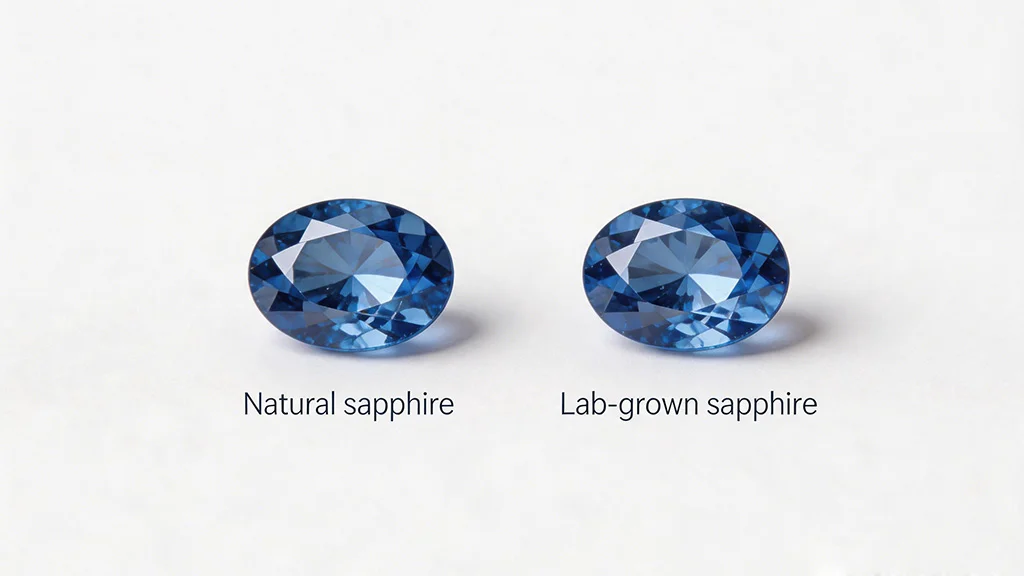
Lab-grown gemstones are real gemstones — chemically, physically, and optically identical to their mined counterparts — created in a controlled laboratory environment rather than forming over millions of years in the earth. They are not simulants or imitations. A lab-grown sapphire is a genuine sapphire: the same aluminium oxide crystal structure, the same hardness of 9 on the Mohs scale, the same brilliance and colour. The only difference is origin.
The key question for any buyer is not whether lab-grown stones are 'real' — they are — but what you personally value. If you prioritise the rarity and provenance of a stone formed by geological forces over millions of years, natural is the choice. If you prioritise maximum size, colour quality, and visual impact for a given budget, lab-grown is worth serious consideration.
Cost Saving Reality Check
Lab-grown blue sapphires typically retail for 70–90% less than equivalent natural stones. A natural 2-carat cornflower blue sapphire may cost £4,000–£8,000; a lab-grown equivalent with identical colour and clarity can be under £500. For buyers focused on aesthetics and daily wear rather than rarity or investment, the saving is substantial.
Which Blue Gemstones Have Lab-Grown Alternatives?
Not every blue gemstone is available in lab-grown form. Here is what exists and whether it represents genuine value:
Lab-Grown Blue Sapphire — Best value alternative
Lab-grown sapphires have been produced since the early 1900s and are the most established lab-grown coloured gemstone on the market. They are produced by three methods — flame fusion (Verneuil process), Czochralski pulling, and hydrothermal growth — each producing slightly different visual characteristics. Hydrothermal lab sapphires are the most convincing and closest to natural growth conditions. Lab sapphires offer the same Mohs 9 hardness, the same fire and brilliance, and the same vivid blue colour as natural stones, at a fraction of the price. Ideal for everyday rings where durability matters as much as beauty.
- Best for: engagement rings, anniversary rings, everyday wear pieces
- Cost saving vs natural: typically 75–90% less per carat
- What you give up: geological rarity, provenance, and investment appreciation
- What you keep: all the visual and physical properties of natural sapphire
Lab-Grown Blue Spinel — Emerging option
Lab-grown spinel has become increasingly available and offers the same vivid cobalt blue colour and Mohs 8 hardness as natural blue spinel. Since natural blue spinel is itself relatively unknown to the general public, a lab-grown version allows buyers to enjoy one of the most beautiful blues in the gemstone world — a colour that often surpasses sapphire in vividness — at very accessible prices. A strong option for those who want something visually distinctive without the price tag of a rare natural stone.
- Best for: cocktail rings, statement pendants, earrings
- Cost saving vs natural: 60–80% less per carat
Synthetic Blue Topaz — Already very affordable naturally
Blue topaz is already so affordable in its treated natural form (irradiation and heat treatment are universal for this stone) that lab-grown alternatives offer minimal practical advantage. Natural treated blue topaz — Sky, Swiss, and London Blue — remains one of the best value propositions in gemstones regardless. Unless you specifically seek a laboratory certificate confirming lab origin, natural treated topaz is already the budget-friendly choice.
What does NOT have a widely available lab-grown alternative
Several blue gemstones cannot currently be replicated in laboratory conditions — making their natural rarity part of their intrinsic appeal:
- Tanzanite — no commercially viable lab-grown tanzanite exists; its unique zoisite crystal structure has not been synthesised at scale
- Paraiba Tourmaline — not available in lab-grown form; the neon copper-bearing colour is not reproducible synthetically
- Turquoise — lab-created turquoise exists but is largely indistinguishable from stabilised natural turquoise; fine natural Persian turquoise remains the standard
- Labradorite, Iolite, Kyanite — no commercial lab-grown versions; these remain natural-only stones at affordable prices
Lab-Grown vs Natural: How to Make the Right Choice for You
|
Choose Natural if you... |
Choose Lab-Grown if you... |
|---|---|
|
Value geological rarity and provenance |
Want maximum size and colour for your budget |
|
Plan to resell or treat the piece as an investment |
Are buying for beauty and daily wear, not investment |
|
Want a GIA or GRS certified natural stone |
Prefer to put more budget into the setting or metal |
|
Are buying tanzanite, Paraiba, or collector gems |
Are buying a sapphire ring for everyday wear |
|
Are giving a heirloom piece across generations |
Want a vivid blue without compromising on quality |
The Meaning and Symbolism of Blue Gemstones
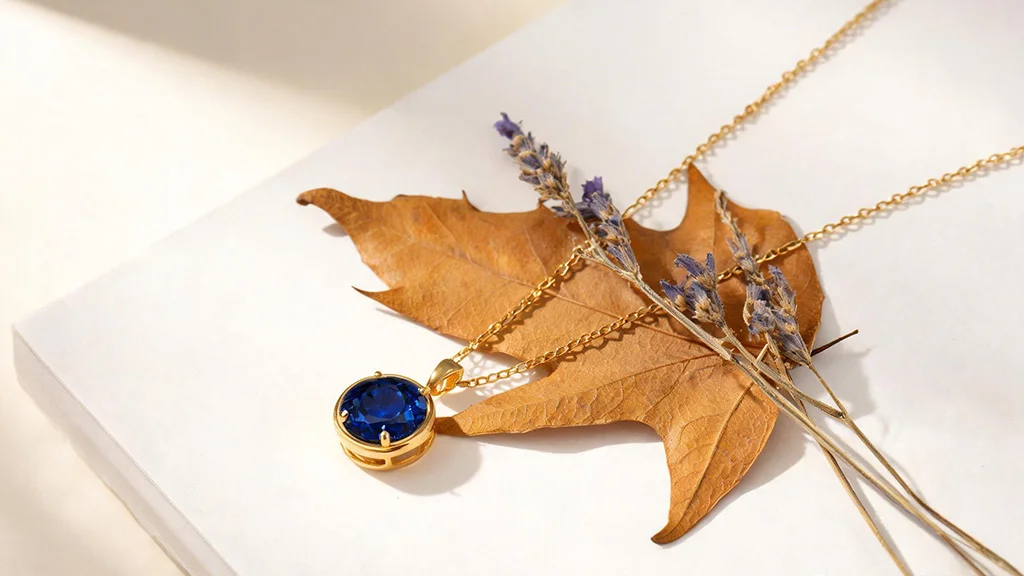
Blue has been the colour of heaven, royalty, and truth across almost every human culture in recorded history. Egyptian priests wore lapis lazuli to connect with the divine; medieval European kings set sapphires in their rings as symbols of wisdom and virtue; sailors carried aquamarine for protection at sea. The symbolism is ancient and deep.
Blue as a Colour: Universal Associations
- Trust and loyalty — blue is the most universally trustworthy colour across cultures
- Wisdom and clarity — associated with clear thinking and sound judgement
- Calm and serenity — evokes open skies and deep water
- Royalty and prestige — used by monarchs for millennia as a symbol of power
- Truth and honesty — sapphire was said to reveal the truth and expose treachery
Blue Gemstone Birthstones
September: Blue Sapphire — clarity, loyalty, and sincerity
March: Aquamarine — courage, health, and hope; the stone of sailors
December: Blue Topaz, Turquoise, and Tanzanite — friendship, wisdom, and good fortune
Royal Blue: Famous Blue Gemstones in History
- Princess Diana's 12-carat Ceylon sapphire engagement ring — now worn by Catherine, Princess of Wales — sparked a global revival of interest in sapphire engagement rings that continues today.
- Lapis lazuli formed the deep blue pigment 'ultramarine' used by Renaissance masters including Vermeer and Michelangelo in the Sistine Chapel — the most expensive paint colour in history.
- The Hope Diamond, at 45.52 carats, is the world's most famous blue diamond, displayed at the Smithsonian. Its deep blue colour is caused by trace amounts of boron.
- The Stuart Sapphire, part of the British Crown Jewels, is a 104-carat cushion-cut sapphire with a history stretching back to the 17th century.
Caring for Your Blue Gemstone Jewelry
How you care for a blue gemstone depends on its hardness, treatment history, and structure. Here is our complete care guide by stone type.
General care rules for all blue gemstones
- Remove jewellery before gardening, sport, household cleaning, or swimming.
- Apply perfume, hairspray, and cosmetics before putting on jewellery, not after.
- Store pieces individually in soft pouches or compartmentalised boxes to prevent scratching.
- Have prong settings checked annually by a jeweller — a loose prong is the most common cause of gemstone loss.
Safe for ultrasonic and steam cleaning
- Blue Sapphire (heat-treated only, no fracture fill) — durable and easy to clean
- Blue Spinel — excellent stability, can be professionally cleaned
- Aquamarine — generally safe; avoid if heavily included
- Blue Topaz — stable; avoid if heavily included
Warm soapy water only (soft cloth or soft brush)
- Tanzanite — sensitive to thermal shock; never steam clean or ultrasonic
- Iolite — can be cleaned gently with warm water; avoid harsh chemicals
- Blue Zircon — brittle; warm soapy water only, handle gently
- Kyanite — clean gently; avoid hard scrubbing due to directional hardness
- Labradorite — warm water; avoid acids and alcohol-based cleaners
- Blue Zircon — warm water; no ultrasonic due to brittleness
Specialist care required
- Turquoise — damp cloth only; avoid all chemicals, acids, and prolonged water exposure
- Lapis Lazuli — soft damp cloth only; acids and ultrasonic cleaners will damage the surface
- Paraiba Tourmaline — warm soapy water; no ultrasonic or steam
Frequently Asked Questions
Blue sapphire is by far the most popular blue gemstone for fine jewellery, followed by aquamarine and blue topaz. Tanzanite has grown rapidly in popularity since its discovery in 1967 and is now considered a prestige stone alongside sapphire. For fashion and silver jewellery, blue topaz and turquoise dominate by volume.
The rarest blue gemstones in the world are blue diamond, benitoite, and grandidierite. Brazilian Paraiba tourmaline is the rarest commercially traded blue gemstone, with fine specimens commanding prices that rival or exceed Kashmir sapphire. Benitoite is found only in one mine in California and rarely forms in sizes above 1 carat.
Blue spinel, iolite, and blue zircon all offer a colour comparable to sapphire at significantly lower prices. Blue topaz (London Blue) provides a deep, vivid blue at very accessible prices. Kyanite can closely mimic cornflower sapphire colour at a tiny fraction of the cost, though its hardness limits it to pendants and earrings.
Blue sapphire is the undisputed best choice for a blue engagement ring, with a Mohs hardness of 9 — second only to diamond. Blue spinel and blue topaz (both Mohs 8) are excellent alternatives. Aquamarine (Mohs 7.5–8) is suitable in a protective bezel or halo setting.
Blue sapphire is a corundum (aluminium oxide) with a Mohs hardness of 9, making it extremely durable and ideal for daily wear. It occurs in multiple locations worldwide. Tanzanite is a variety of zoisite, softer at Mohs 6–7, found exclusively in Tanzania. Tanzanite has a unique blue-violet trichroism that sapphire does not share. Sapphire is more durable for everyday jewellery; tanzanite offers rarity and a unique colour character that sapphire cannot replicate.
Yes, blue topaz is a natural gemstone — but almost all blue topaz sold in jewellery has been irradiated and heat-treated to create its blue colour. Natural blue topaz does occur but is extremely rare. The treatment process is safe, stable, and completely accepted throughout the jewellery industry. It does not affect the stone's durability or long-term colour stability.
The gemstone itself does not cause allergic reactions — it is the metal setting that matters. If you have a nickel allergy, request jewellery set in platinum, 18ct or 22ct yellow gold, or palladium, all of which are nickel-free. 9ct gold and some white gold alloys may contain nickel. The choice of blue gemstone does not affect this consideration.
Find Your Perfect Blue Gemstone at Provence Jewellery
At Provence Jewellery, we source and hand-select blue gemstones from trusted suppliers and ethical origins around the world. Whether you are looking for a classic blue sapphire engagement ring, a tanzanite pendant for a special occasion, or something rare and completely unique, our team can guide you to the perfect stone and setting.