
Engagement Ring vs Wedding Ring: Key Differences Explained
- Written by Provence Team
- Updated on June 11, 2026
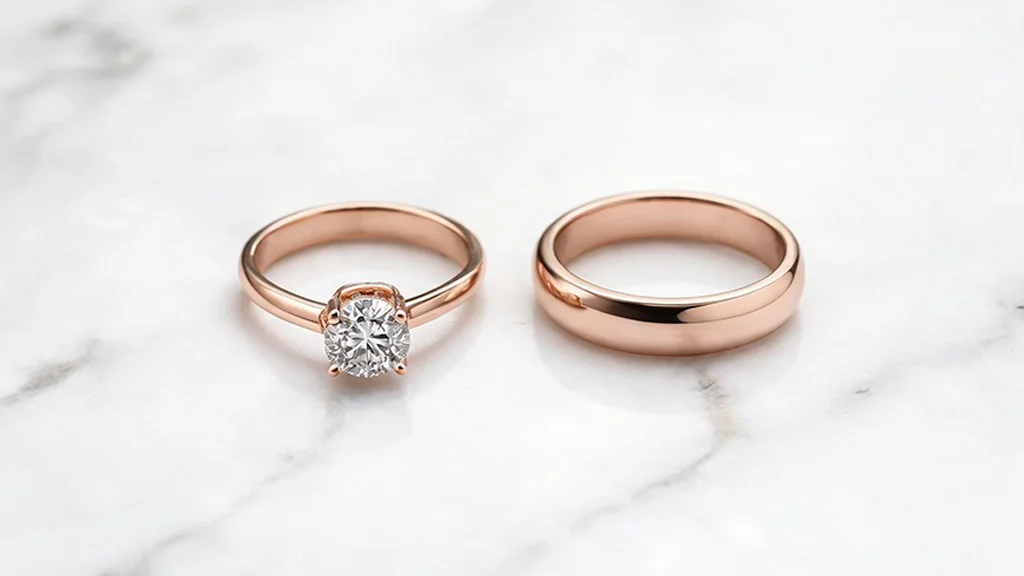
Table of Contents
You've said yes — or you're about to. You walk into a jewellery store and the sales associate asks: 'Are you looking for an engagement ring, a wedding band, or both?' And for a moment, you pause.
It's one of the most common points of confusion in bridal jewellery. The terms are often used interchangeably, and yet the two rings are quite different in purpose, timing, design, and meaning. Getting clear on the distinction helps you make better decisions — about budget, design, stacking, and what each ring will represent for the rest of your life together.
In this guide, the Provence Jewellery team breaks down everything you need to know: the definitions, the symbolism, how they're worn, what to expect to pay, and whether you actually need both. We'll also cover multicultural wedding ring traditions — something you won't find in most ring guides.
Quick Answer
An engagement ring is presented at the time of a proposal. It typically features a prominent gemstone — most often a diamond — and symbolises your intention to marry.
A wedding ring (also called a wedding band) is exchanged during the wedding ceremony itself. It marks the formal beginning of the marriage and is usually a simpler, more understated band designed to be worn every day for life.
Most couples in Western and modern Asian traditions wear both rings on the left ring finger, with the wedding band placed closest to the heart and the engagement ring stacked above it.
What Is an Engagement Ring?
An engagement ring is given at the moment of a proposal. It is a physical expression of the promise to marry — a declaration worn on the finger for the duration of the engagement period and, for most people, for the rest of their married life.
Unlike a wedding band, which is exchanged in a shared ceremony, an engagement ring is a gift from one partner to the other. It is traditionally given by the person proposing, though modern couples increasingly shop for the ring together, or the recipient chooses their own stone and setting.
A Brief History of Engagement Rings
The tradition of a betrothal ring dates back to ancient Rome, where iron rings were exchanged as a sign of ownership and legal contract. By the Renaissance, gold and gemstone rings had become associated with romantic commitment among European nobility.
The modern diamond engagement ring — and the expectation that it should feature a large centre stone — owes much of its cultural dominance to De Beers' famous 1947 marketing campaign, which coined the phrase 'A Diamond is Forever.' Within a generation, the diamond solitaire became the default symbol of an engagement across much of the Western world, and that influence has spread deeply into Southeast Asian markets.
Today, couples have far more choice. While diamonds remain the most popular option, sapphires, emeralds, rubies, and moissanite have all grown significantly in popularity — whether for their colour, symbolism, or the more accessible price point they offer.
Engagement Ring Design: What to Expect
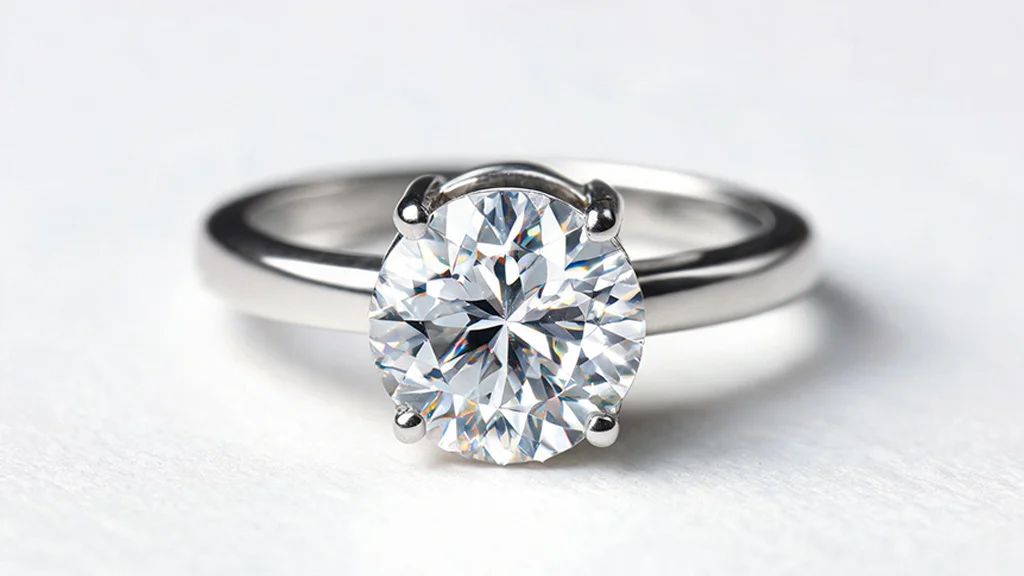
Engagement rings are typically the more elaborate of the two rings. The design centres on a gemstone, held in place by a setting, mounted on a metal band.
Centre stone options: Round brilliant diamonds are the most popular globally. Oval, pear, cushion, emerald cut, and marquise shapes are widely favoured. Beyond diamonds, blue sapphires (famously worn by Princess Diana and now Kate Middleton), pink sapphires, rubies, and moissanite are common alternatives.
Setting styles: The prong (claw) setting is the classic choice — it holds the stone with minimal metal contact, maximising light exposure and brilliance. Bezel settings (where metal wraps the stone) offer a more modern, secure look. Halo settings surround the centre stone with a ring of smaller diamonds for added sparkle. Pavé and channel settings embed small diamonds along the band itself.
Metal choices: 18K gold in yellow, white, or rose is the most popular choice globally. 18K gold (marked 750 or 18K) contains 75% pure gold, offering a good balance of durability and richness. Platinum (950 or 950Pt) is heavier, naturally white, and hypoallergenic — preferred by many who want a long-lasting white metal without the need for rhodium re-plating.
Popular Engagement Ring Styles
- Solitaire: A single stone on a plain or simply tapered band. Timeless, elegant, and versatile — pairs easily with almost any wedding band.
- Halo: A centre stone surrounded by a ring of smaller diamonds. Creates a larger, more brilliant appearance without requiring a large centre stone.
- Three-stone (trilogy): Three stones representing the past, present, and future of a relationship. Often a larger centre stone flanked by two smaller ones.
- Split shank: The band splits into two strands as it approaches the setting, framing the centre stone and creating a distinct profile.
- Vintage / Art Deco inspired: Intricate milgrain edges, geometric patterns, and filigree detailing. Popular with couples who want something unique and non-conventional.
- Pavé band: Small diamonds set into the band itself — adds sparkle along the full length of the ring, not just the centre stone.
What Is a Wedding Ring?
A wedding ring — or wedding band — is exchanged between both partners during the wedding ceremony. The moment the ring is placed on the finger is, in most traditions, the physical act that seals the vow. Unlike the engagement ring, which is a gift given privately at the proposal, the wedding band is exchanged mutually and publicly.
The design philosophy behind a wedding band is almost the opposite of an engagement ring: simplicity and wearability take priority over spectacle. A wedding band needs to sit comfortably on the finger during every kind of daily activity — from washing dishes to typing at a keyboard to sleeping — for decades. This is why most wedding bands are slim, low-profile, and free of large protruding stones.
Types of Wedding Bands
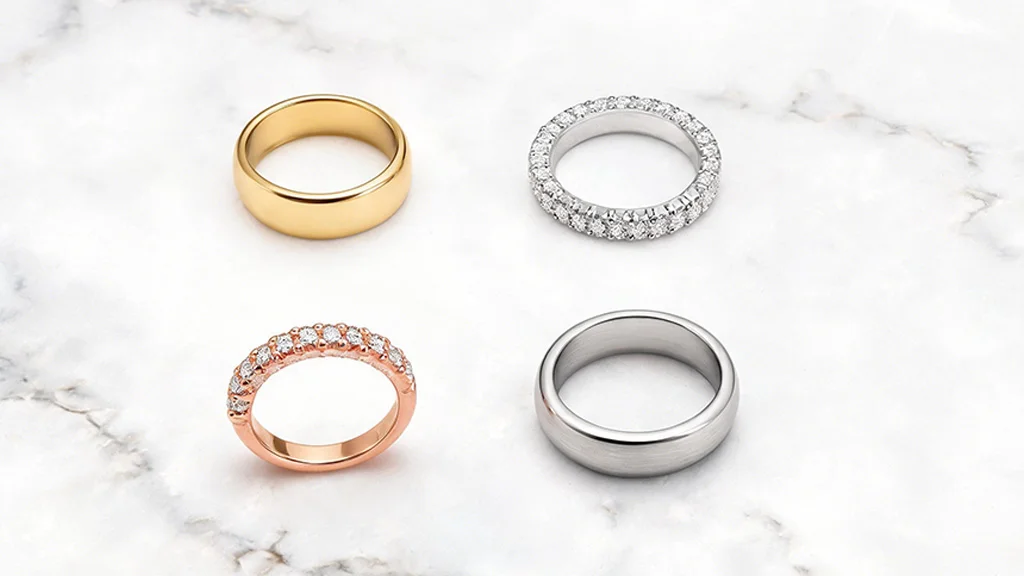
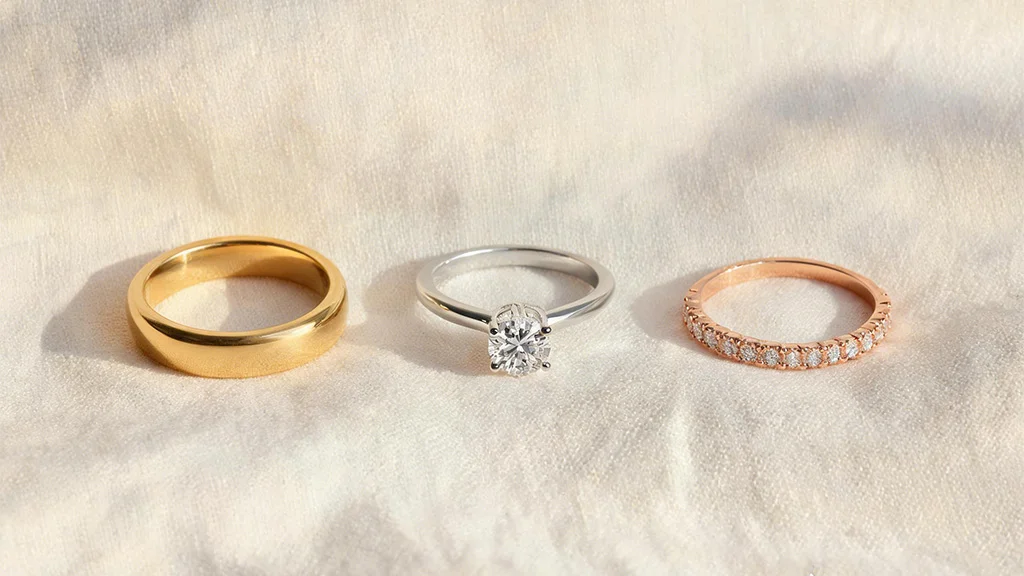
- Plain metal band: The most traditional and enduring choice. A simple ring of gold or platinum with a smooth, rounded profile. Comes in varying widths (1.5mm to 6mm) and finishes — polished, brushed (matte), hammered, or satin.
- Diamond eternity band: Diamonds or gemstones set all the way around the band. Symbolic of unending love, and visually striking. The full-eternity style cannot be resized, so sizing precision is critical at purchase.
- Half eternity band: Diamonds set on the top half of the band only. More affordable than a full eternity, easier to resize, and more comfortable for some wearers. Very popular as a wedding band for women.
- Channel-set band: Stones set into a channel within the band — flush with the metal surface, making it snag-proof and ideal for active wearers.
- Curved / contoured / shaped band: Designed to curve around and nest against a specific engagement ring. This is particularly important when the engagement ring has a pronounced shape (like a marquise or oval stone in a raised setting) that would leave a gap if paired with a straight band.
Men's Wedding Bands
Most bridal jewellery guides are written almost exclusively from a female perspective — which means men's wedding bands are frequently underserved. In reality, the wedding band is often the only piece of jewellery a man will wear daily for the rest of his life, and it deserves just as much consideration.
Men's wedding bands tend to be wider (4mm–8mm is common), with a heavier feel. The most popular choices include:
- Classic polished yellow gold: 916 (22K) or 750 (18K) gold — a traditional and culturally significant choice, particularly for Chinese and Malay ceremonies.
- Brushed white gold: A modern, masculine aesthetic. The matte finish hides minor scratches better than a polished surface.
- Two-tone bands: White gold or platinum with yellow gold edges — bridges traditional and contemporary tastes.
- Platinum: Heavier, naturally white, and extremely durable. A premium choice that develops a soft patina over time rather than scratching.
- Diamond-set men's bands: A single row of channel-set or bezel-set diamonds. Growing in popularity as men's fine jewellery expands beyond purely utilitarian design.
Engagement Ring vs Wedding Ring: Side-by-Side Comparison
For a clear visual reference, here is how the two rings compare across the most important factors — including pricing benchmarks for that most ring guides overlook.
|
Feature |
Engagement Ring |
Wedding Ring / Band |
|---|---|---|
|
Purpose |
Given at proposal — symbolises the promise of marriage |
Exchanged at ceremony — symbolises the formal, lifelong union |
|
Timing |
Worn from the proposal to the wedding, and after |
Added on the wedding day; worn daily for life |
|
Typical Stone(s) |
Diamond, sapphire, moissanite, coloured gemstones |
Often none; optional diamonds for eternity or channel bands |
|
Metals |
18K gold (yellow/white/rose), 950 platinum |
18K gold, 950 platinum, 925 silver |
|
Placement |
Left ring finger; worn alone until the wedding day |
Left ring finger, closest to the heart; engagement ring stacked above |
|
Price |
$1000 - $20000+ |
$300 - $2500+ |
|
Custom / OEM? |
Yes — Provence offers full custom design & OEM manufacture |
Yes — matching bands crafted to complement your engagement ring |
Note: Gold and diamond prices fluctuate with global commodity markets. Figures above reflect approximate mid-2025 market rates. Contact Provence for a current quote.
Do You Need Both an Engagement Ring and a Wedding Ring?
The short answer is: there's no rule that says you must have both. But most couples choose to wear both, and for good reason — each ring marks a distinct chapter of the relationship. Here's how to think through the decision:
Option 1: Buy Both as a Matched Set
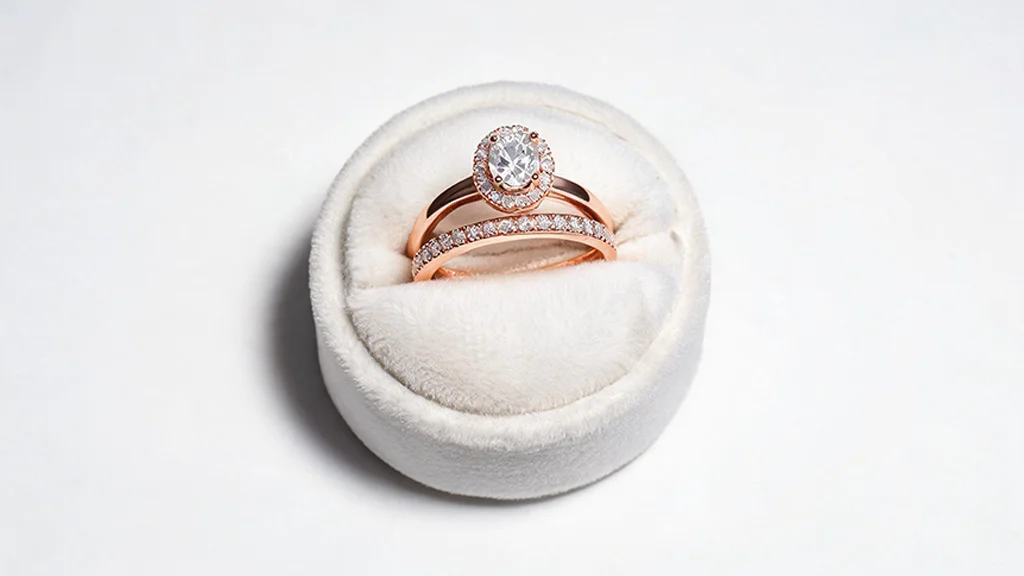
This is the most popular path for couples who want the full symbolic story — engagement ring at the proposal, wedding band exchanged at the ceremony, both worn together thereafter. The visual and emotional impact of a well-matched pair is hard to replicate with a single ring.
If budget allows, this is the option we recommend — especially if you commission the wedding band at the same time as the engagement ring (or shortly after), as the jeweller can ensure the metals, finishes, and profiles are designed to complement each other perfectly.
Option 2: Buy an Engagement Ring Only
Some couples choose to use the engagement ring as the only ring going forward, skipping the wedding band entirely. This works well when the engagement ring is a plain or simply-set band that can function as both a symbol of the proposal and the ceremony. It is also a practical choice when the engagement ring is designed to be worn alone — for example, a wide, flat-profiled ring that would look cluttered with an additional band.
Option 3: Buy a Wedding Band Only
In many cultures and traditions — including some Chinese, Malay, and Indian wedding customs — only a wedding band is exchanged, without a prior engagement ring. This is also common among couples who prefer minimalism, same-sex couples who skip the traditional proposal format, and second marriages where the conventions feel less relevant.
A plain gold or platinum wedding band on its own is a perfectly complete symbol of commitment.
Option 4: Bridal Set (Engagement Ring + Matching Band Together)
A bridal set is an engagement ring and a matching wedding band sold and designed together as a pair. The wedding band is typically curved or shaped to nest flush against the engagement ring's setting, creating a seamless stacked look. Bridal sets are popular because they remove the guesswork of finding a band that complements an existing ring.
The trade-off is slightly less flexibility — if you later want to wear the engagement ring on its own (for example, on a trip or during a physically demanding activity), the curved wedding band may look odd without it. This is worth considering before purchasing a highly contoured set.
Option 5: Skip the Engagement Ring, Go Bigger on the Wedding Band
A growing number of couples — particularly in millennial and Gen Z demographics — are choosing to invest in a single statement wedding band rather than a traditional engagement ring with a prominent centre stone. A wide, diamond-set eternity band can carry both the symbolism of the proposal and the ceremony, and tends to be more practical for daily wear.
How to Wear an Engagement Ring and Wedding Ring Together
Once you have both rings, there's a right (and a wrong) way to wear them — though ultimately, the 'right' way is whatever feels meaningful and comfortable to you.
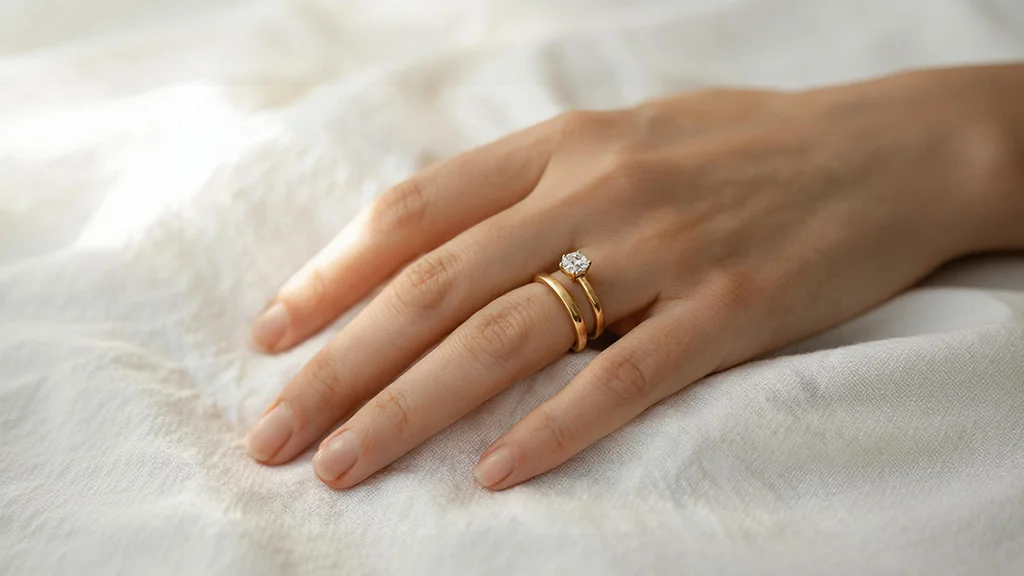
The Stacking Order
Wedding band goes on first — closest to the heart. The engagement ring is then worn above it. The logic is symbolic: the wedding band, exchanged on the day of the ceremony, should be closest to the heart. In practical terms, this means the wedding band is between the engagement ring and your palm.
Some people find this arrangement feels counterintuitive after years of wearing only the engagement ring. A small adjustment period is normal.
The Ceremony Transfer Trick
On the wedding day, you'll want the wedding band to go on the ring finger directly — but your engagement ring is already there. The solution is simple: before the ceremony, move your engagement ring to your right hand's ring finger. After the wedding band has been placed on your left hand during the vows, you can slide the engagement ring back on above it.
This is a widely practised tradition and one worth planning for ahead of the ceremony — don't leave it to improvise on the day.
Alternative Wearing Styles
Not everyone follows the standard convention, and that's perfectly fine:
- Engagement ring on the right hand: Some married people choose to permanently wear their engagement ring on their right hand after the wedding, reserving the left ring finger exclusively for the wedding band. This creates a cleaner look and distinguishes the two rings visually.
- Stacking order reversed: Some people prefer to wear the engagement ring closer to the palm, with the wedding band above. There's no symbolic rule that overrides personal comfort.
- Wearing just the wedding band on weekdays: Given that many engagement rings feature a raised, prong-set stone that can snag on fabric or scratch surfaces, some people choose to wear only the plain wedding band at work or during physical activity, reserving the full stack for evenings and weekends.
Soldering both rings together: Some couples choose to have their jeweller permanently solder the engagement ring and wedding band into a single piece. This eliminates spinning and misalignment. The downside is that resizing becomes more complex — think carefully before doing this.
Wedding Ring Traditions
Chinese Wedding Traditions
Gold holds deep cultural significance in Chinese wedding customs. Traditionally, the groom's family presents the bride with gold jewellery — including necklaces, bangles, and earrings — during the guo da li (betrothal ceremony) and on the wedding day itself. This gold is considered both a gift and a symbol of prosperity for the marriage.
Diamond engagement rings in the Western style have become increasingly common among younger Chinese couples, particularly in urban areas. 916 gold (22K) is the traditional preference for wedding bands, valued for its warmth and depth of colour. Some couples opt for 999 gold (24K) for its purity, though it is softer and more prone to scratching.
In more traditional ceremonies, the focus is on the full suite of gold jewellery rather than a single ring — so the ring is often a simpler band rather than the focal point.
Malay Wedding Traditions
The exchange of rings (cincin) is a recognised part of the Malay wedding ceremony, though the customs vary by region and family. During the akad nikah (the solemnisation), the groom typically receives a ring from the bride's family as part of the hantaran (gift exchange).
Plain gold bands are the most common choice, particularly in more traditional ceremonies. Among urban Malay couples, diamond solitaire engagement rings and more elaborate wedding sets are increasingly popular — particularly following the Western timeline of a proposal and then a separate ceremony ring.
The colour gold remains strongly preferred over white gold or platinum in many Malay communities, as it carries cultural resonance and is viewed as more auspicious.
Indian Wedding Traditions
Indian wedding jewellery is extraordinarily diverse, varying widely across Tamil, Telugu, Malayalam, Punjabi, and other communities. As a broad generalisation:
- Engagement rings are becoming common across many Indian communities in Malaysia and Singapore, particularly in Tamil and Telugu families influenced by both Western and North Indian customs.
- In some Hindu ceremonies, the ring — when worn — is traditionally placed on the right handrather than the left. This varies by community and individual family practice.
- Wedding rings (as distinct from the thali or mangalsutra, which remain the primary marital symbols in many South Indian traditions) are increasingly exchanged as an additional modern gesture.
Gold is the dominant metal, often in 22K (916) for its richness. White gold and platinum engagement rings are gaining ground among younger, cosmopolitan couples.
The Eternity Ring: A Third Milestone Worth Knowing
Most ring guides mention eternity bands only as a subcategory of wedding band. But the eternity ring deserves its own recognition as a distinct piece in the jewellery journey of a marriage.
An eternity ring is typically given to mark a significant milestone after the wedding — a major anniversary (most commonly the first, fifth, or tenth), the birth of a child, or simply as a gift between partners to mark a chapter of life together. It is not a substitute for the engagement ring or the wedding band; it is its own third milestone.
- Full eternity band: Diamonds or gemstones set all the way around the band. Visually stunning and symbolically complete — the unbroken circle of stones represents endless love. Cannot be resized, so the ring size must be exact at the time of purchase.
- Half eternity band: Stones on the top half only. More affordable, easier to resize, and more comfortable for many wearers. Often indistinguishable from a full eternity when stacked with other rings.
Eternity rings are commonly stacked with the engagement ring and wedding band, creating what is sometimes called a three-ring stack. The most elegant stacks typically share the same metal and a compatible stone size — your jeweller (or manufacturer) should advise on proportions.
The Three-Ring Stack
Position 1 (closest to heart): Wedding band — plain or lightly set
Position 2 (middle): Engagement ring — your statement piece
Position 3 (furthest from heart): Eternity ring — a milestone gift, often diamond-set
Caring for Your Engagement Ring and Wedding Band
A ring you wear every day for the rest of your life will encounter a lot. Here's what you need to know about keeping both rings in excellent condition.
Day-to-Day Care
- Remove rings before applying hand cream, sunscreen, or perfume — product build-up dulls stones and clogs settings over time.
- Take rings off before swimming, particularly in chlorinated pools. Chlorine weakens gold alloys over time and can damage certain gemstones.
- Remove rings during heavy physical work — gardening, gym weights, or heavy lifting can bend prongs and loosen stones.
- Store rings individually in a soft-lined box or pouch when not wearing them. Diamonds and sapphires are hard enough to scratch other metals and softer stones.
Cleaning at Home
- Gold rings: Warm water, a small drop of mild dish soap, and a soft toothbrush. Rinse thoroughly and pat dry with a lint-free cloth.
- Platinum rings: Same as gold — warm soapy water and a soft brush. Platinum develops a natural patina (a subtle satin-like texture) over time, which many owners appreciate as a sign of age and wear. It can be re-polished to a high shine at any time.
- White gold rings: White gold is yellow gold alloyed with white metals (typically palladium or nickel) and coated with rhodium to give it its bright white appearance. White gold is yellow gold alloyed with white metals and coated with rhodium — but the rhodium plating will gradually wear off, and professional re-plating every 12–24 months keeps white gold looking its best.
- Diamond rings: Diamonds attract grease and oils. A soak in warm soapy water followed by a gentle scrub with a soft brush will restore brilliance. Professional ultrasonic cleaning (available at most jewellers) is effective but should be avoided for rings with certain softer gemstones or fragile settings.
Professional Servicing
We recommend having both rings professionally inspected once a year. A skilled jeweller will check prong integrity, look for micro-fractures in the shank, and ensure the stone is still secure in its setting. A small investment in annual servicing prevents the much larger cost — and heartbreak — of losing a stone.
Resizing
Bodies change over time — pregnancy, weight fluctuation, and age all affect ring size. Here's what you need to know about resizing:
- Plain gold or platinum bands: Straightforward to resize up or down by 1–2 sizes. A skilled jeweller can do this without leaving any trace.
- Paved or channel-set bands: Can usually be resized but requires more skill, as stones near the cut must be removed and reset. Add cost and complexity.
- Full eternity bands: Cannot be resized — the stones run all the way around. It's worth buying a half eternity band for this reason if you anticipate size changes.
- Engagement rings with intricate settings: Complex settings (pavé shank, wrap-around halo) may require the stone to be removed before resizing. Always use a trusted jeweller or the original manufacturer.
Frequently Asked Questions
No. An engagement ring is given at the time of a proposal and symbolises the promise to marry. A wedding ring is exchanged during the wedding ceremony itself and marks the formal beginning of the marriage. The two rings have different purposes, different timings, and typically different designs — the engagement ring is more elaborate, while the wedding band is designed for simple, everyday wear.
The wedding band goes on first, positioned closest to the palm (and symbolically closest to the heart). The engagement ring is then worn above it. If you're wearing both after the ceremony, slide the wedding band on first, then the engagement ring on top. Many people move the engagement ring to the right hand during the ceremony so the wedding band can be placed directly on the left hand during the vows, then transfer the engagement ring back afterwards.
Yes. There is no rule that says you must have both. Some couples choose a single ring to serve both purposes — particularly if the engagement ring has a plain or low-profile design that works well as an everyday ring. Some also choose to wear only the wedding band after the ceremony and save the engagement ring for special occasions. The symbolic meaning is in the intention, not in the number of rings.
No. While wearing both is the most common Western and modern Asian convention, many couples wear only a wedding band — this is perfectly valid and common in many Chinese, Malay, and Indian wedding traditions. Others skip the wedding band and wear only the engagement ring. What matters is what the ring means to you, not how many you wear.
Yes — men's engagement rings are a growing trend globally, and increasingly common in Malaysia and Singapore. A man's engagement ring is typically a plain or simply-set band in gold or platinum, distinct from but complementary to the partner's ring. Provence can manufacture men's engagement rings in any width, metal, and finish.
An eternity ring is a band set with diamonds or gemstones all the way around (full eternity) or on the top half (half eternity). Unlike a wedding band, which is exchanged at the ceremony, an eternity ring is typically given later — to mark an anniversary, the birth of a child, or another significant milestone. It is often stacked with the wedding band and engagement ring as a third ring.
Final Thoughts
The engagement ring and the wedding ring are two of the most significant pieces of jewellery most people will ever own — not because of their monetary value, but because of what they represent at two distinct moments in a relationship. The engagement ring marks the beginning of a promise. The wedding band marks its fulfilment.
Understanding the difference between the two helps you make a more considered decision — whether you're choosing a single ring that does both jobs, a matched bridal set that tells the complete story, or a custom pair that reflects your specific culture and personal aesthetic.