
Jewelry Packaging Ideas: 14 Options for Every Budget
- Written by Provence Team
- Updated on July 16, 2026
Table of Contents
The first thing a customer touches is never the jewelry. It's the box, the pouch, or the wrap it arrives in — and that moment shapes how they feel about everything inside it.
The data backs this up. Research on e-commerce unboxing found that customers with a positive unboxing experience are roughly 50% more likely to make a repeat purchase than those with a neutral one, and premium packaging has been linked to repeat-purchase increases as high as 40–61%. On the flip side, damage does lasting harm: a Shorr Packaging survey found that 73% of consumers are less likely to buy from a brand again after receiving a damaged product. For jewelry specifically — a category built entirely on perceived value and craftsmanship — packaging isn't decoration. It's part of the product.
This guide covers 14 packaging ideas spanning budget kraft boxes to premium magnetic-closure presentation, with real cost ranges in USD, GBP, and EUR so you can plan for whichever market you sell into. We've also added two sections most packaging guides skip entirely: how to source custom OEM packaging at scale, and what US, UK, and EU sellers need to know about packaging regulations before their next shipment goes out.
14 Jewelry Packaging Ideas for Every Budget
1. Recycled Kraft Boxes— Budget-friendly, sustainable, endlessly brandable
Kraft paperboard boxes remain the workhorse of jewelry packaging — sturdy enough to protect a ring or pendant, fully recyclable, and cheap enough to use at volume. They're also the easiest packaging to make on-brand: a single custom stamp or foil logo turns a plain box into something that feels intentional.
- Cost: roughly $0.30–0.60 / £0.24–0.48 / €0.28–0.55 per box in bulk.
- Best for: rings, earrings, pendants, and small charm pieces.
- Elevate it: custom rubber stamp in gold or black ink, or a belly band instead of shrink wrap.
2. Drawer-Style Rigid Boxes with Ribbon Pull— Premium, gift-ready unboxing
The ribbon-pull drawer box has become the signature of modern DTC jewelry brands — it opens like a small reveal rather than a lid lift, and the extra half-second of anticipation does real work for perceived value.
- Cost: $1.00–2.50 / £0.80–2.00 / €0.92–2.30 per box.
- Best for: necklaces, bracelets, and gift-tier pieces sold direct-to-consumer.
- Elevate it: velvet or satin insert, foil-stamped logo on the drawer face.
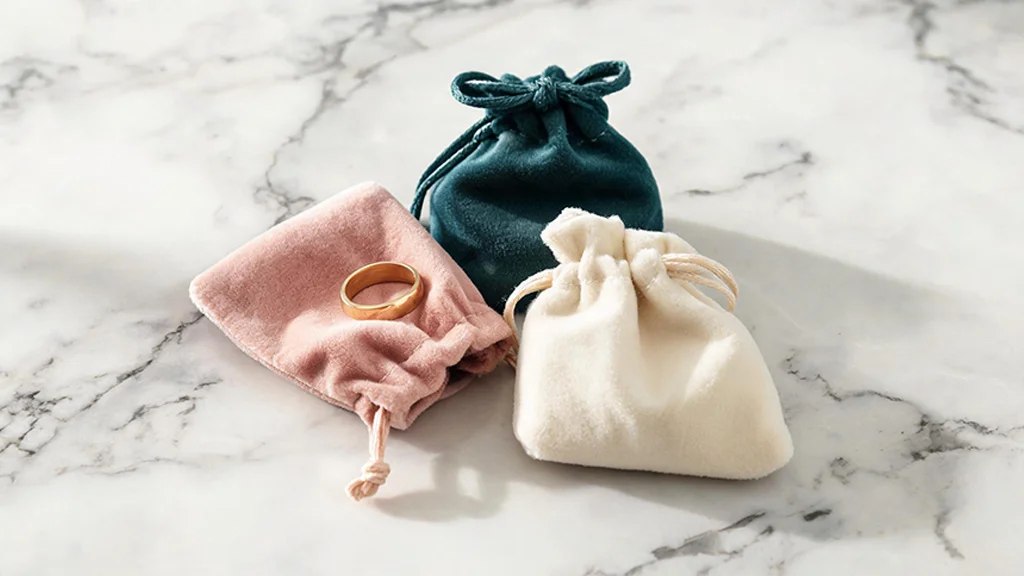
3. Velvet Pouches— Soft, reusable, and endlessly giftable
Velvet pouches double as storage long after the sale, which makes them one of the highest-value packaging touchpoints per dollar spent — customers keep them, which means your brand name stays in a jewelry drawer for years.
- Cost: $0.40–0.80 / £0.32–0.64 / €0.37–0.73 per pouch.
- Best for: earrings, rings, charms, and delicate chains.
- Elevate it: drawstring in a contrasting cord color, foil-stamped or embroidered logo.
4. Magnetic Closure Boxes — Sleek, sturdy, and satisfying to open
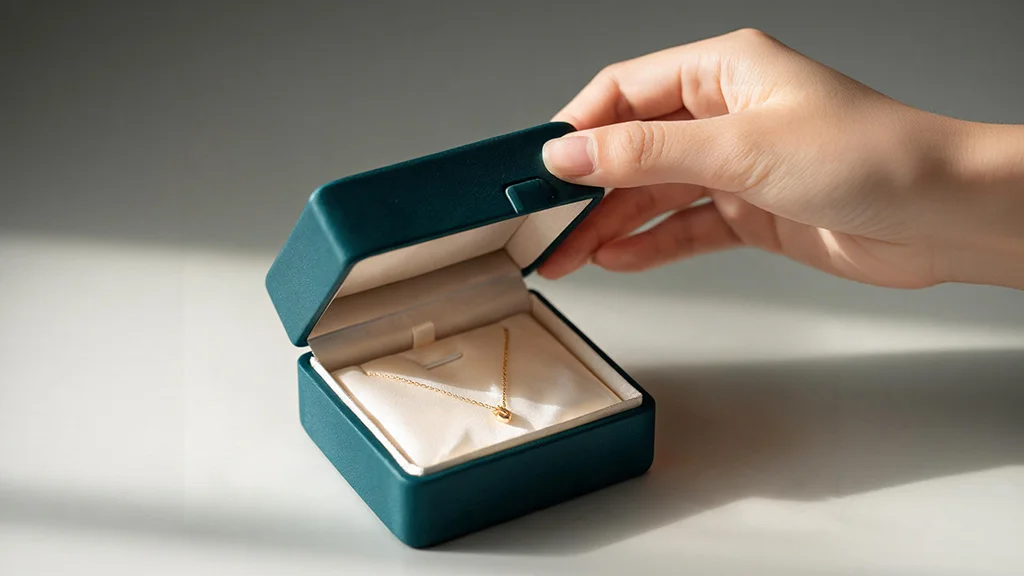
The soft click of a magnetic lid is a small sensory detail that customers consistently associate with premium brands. These boxes photograph well for social unboxing content, which matters given how much organic reach jewelry brands get from customers sharing their orders.
- Cost: $2.00–4.00 / £1.60–3.20 / €1.85–3.70 per box.
- Best for: bracelet and necklace sets, higher-ticket gift pieces.
- Elevate it: matte or soft-touch finish with velvet/satin lining and foil logo.
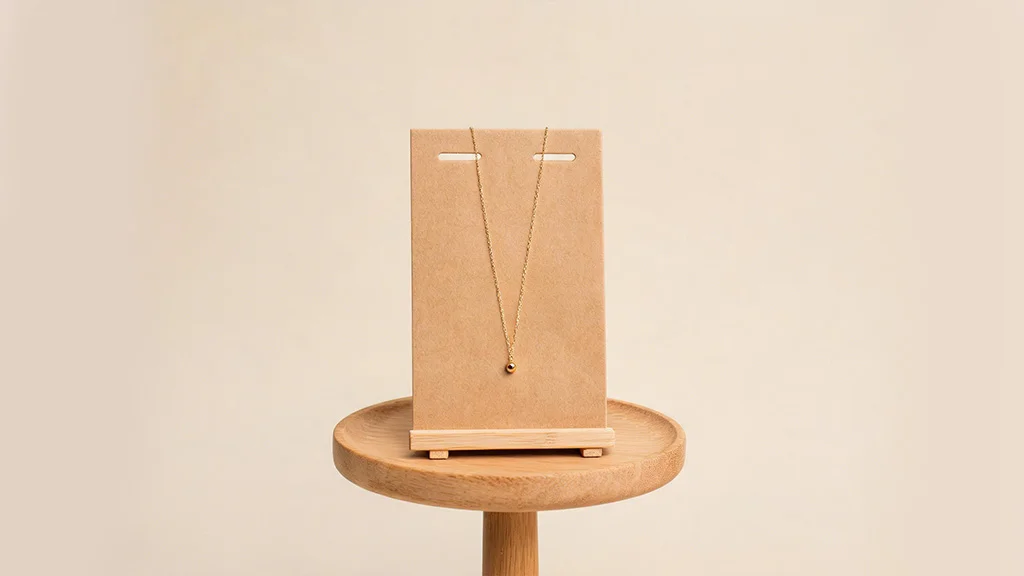
5. Jewelry Display Cards — Affordable, practical, retail-ready
Cards with pre-punched slits or holes keep necklaces and earrings from tangling in transit and double as a retail display fixture at markets or in wholesale accounts.
- Cost: $0.10–0.20 / £0.08–0.16 / €0.09–0.18 per card in bulk.
- Best for: earrings, necklaces, and bracelets sold on cards rather than in boxes.
- Elevate it: die-cut shapes beyond the standard rectangle, kraft stock with a stamped logo.
6. Stamped Kraft Envelopes — Lightweight, low-cost, fast to brand
For flat or carded pieces — polishing cloths, care instructions, small charms — a stamped kraft envelope adds a branded touch without the cost or lead time of custom printing.
- Cost: $0.06–0.12 / £0.05–0.10 / €0.06–0.11 per envelope.
- Best for: care cards, receipts, small flat inserts, and wholesale packing slips.
- Elevate it: second stamp on the flap for a sealed, finished look.
7. Organic Cotton & Hemp Pouches — Reusable and sustainability-forward
Natural fiber drawstring bags read as more premium and more sustainable than synthetic velvet, and they hold up well to repeated reuse as jewelry storage — a genuine bonus for brands leaning into an eco-conscious story.
- Cost: $0.35–0.70 / £0.28–0.56 / €0.32–0.65 per pouch.
- Best for: earrings, rings, and small stackable pieces.
- Elevate it: custom embroidery or stamping instead of printed ink to keep the material fully biodegradable.
8. Plant-Based & Compostable Inserts — Zero-microplastic protection
Bamboo pulp trays and sugarcane bagasse (a byproduct material) can replace foam inserts entirely, holding rings and earrings securely while breaking down naturally at end of life.
- Cost: $0.20–0.45 / £0.16–0.36 / €0.18–0.41 per insert.
- Best for: boxed sets, especially multi-piece gift boxes.
- Elevate it: pair with a compostable cellulose film instead of a plastic protective wrap.
9. Seed Paper Tags & Wraps — A keepsake the customer can plant
Seed paper hang tags are biodegradable and embedded with wildflower or herb seeds, giving customers a genuinely memorable post-purchase moment: plant the tag instead of throwing it away.
- Cost: $0.15–0.30 / £0.12–0.24 / €0.14–0.28 per tag.
- Best for: gift-tier pieces, seasonal collections, and brand storytelling moments.
- Elevate it: print jewelry care instructions directly on the tag for a dual-purpose piece.
10. Glass Tubes with Cork Lids — Minimal, modern, display-ready
Clear glass tubes let the jewelry itself be the packaging design — popular for delicate earrings and pendants that benefit from visibility rather than concealment. The cork lid adds warmth and doubles as a small reusable storage container.
- Cost: $0.60–1.20 / £0.48–0.96 / €0.55–1.10 per tube.
- Best for: small earrings, delicate pendants, and chain jewelry.
- Elevate it: twine-wrapped cork with a small branded tag.
11. Felt Pouches — Protective, tactile, and DIY-friendly
Felt cushions jewelry from scratches while offering a texture that reads as handmade — a good fit for craft-forward or small-batch brands, and easy to produce in-house at low volume.
- Cost: $0.25–0.50 / £0.20–0.40 / €0.23–0.46 per pouch.
- Best for: rings, earrings, bracelets, and delicate necklaces.
- Elevate it: stitched compartments for multi-piece sets.
12. Upcycled & Natural Materials — Conversation-starting and genuinely unique
Reclaimed wood, walnut shells, and seashells turn packaging into part of the keepsake. Not practical at full production scale, but powerful for limited runs, collabs, or a signature hero SKU.
- Cost: highly variable — often $0.50–2.00+ depending on sourcing and labor.
- Best for: limited editions, coastal or nature-themed collections.
- Elevate it: laser-engrave reclaimed wood boxes with your logo for a timeless, non-generic finish.
13. Minimalist No-Waste Wraps — The least packaging, done well
Sometimes the strongest move is using less: a furoshiki-style fabric wrap, a single paper belly band, or a QR code linking to care instructions instead of a printed booklet. Minimal packaging also lowers material costs and shipping weight.
- Cost: under $0.20 / £0.16 / €0.18 per unit for a band or wrap.
- Best for: brands prioritizing low waste and low per-unit cost at scale.
- Elevate it: a QR code linking to a digital care guide or brand story instead of printed inserts.
14. Custom OEM Branded Packaging — Built for growing and wholesale brands
Once a brand moves past small-batch volumes, sourcing packaging directly from a manufacturer — rather than assembling it from multiple suppliers — becomes the more efficient path. A jewelry OEM/ODM partner can develop a fully branded box, pouch, or presentation set alongside the jewelry itself, matched in color, material, and finish, with consistent quality control across every production run.
- Cost: varies by MOQ and finish, but per-unit cost typically drops 20–40% versus assembling packaging from separate suppliers at the same volume.
- Best for: brands scaling past 500–1,000 units per SKU, or wholesale/private-label accounts.
- Elevate it: request a packaging + product sample kit before committing to a full production run.
Packaging for Global E-Commerce: Shipping & Compliance
Selling into the US, UK, and EU from a single production base means packaging has to satisfy three different sets of expectations at once: it needs to survive international transit, and it increasingly needs to meet region-specific packaging regulation. Here's what matters right now.
EU: The Packaging and Packaging Waste Regulation (PPWR)
The EU's Packaging and Packaging Waste Regulation (2025/40) enters into application on 12 August 2026, replacing the older Packaging Directive. It applies to all packaging placed on the EU market, regardless of material, and covers manufacturers, importers, distributors, and online sellers alike — there's no small-business exemption.
- Empty space in e-commerce parcels cannot exceed 40% from August 2026, so oversized boxes with excess void-fill will need to be resized.
- Packaging must be designed to be recyclable in principle from 2026, moving to a minimum 70% recyclability threshold (Grade C or above) by 2030.
- PFAS ('forever chemicals') are banned in food-contact packaging above strict concentration limits from August 2026 — relevant if you package jewelry alongside cosmetics or fragrance samples.
- Brands placing packaging on the EU market take on Extended Producer Responsibility obligations, including registration in each member state and fees weighted by recyclability.
UK: Plastic Packaging Tax
The UK's Plastic Packaging Tax applies to any plastic packaging component manufactured in or imported into the UK containing less than 30% recycled content. The rate rose to £228.82 per tonne from 1 April 2026, and the registration threshold remains 10 tonnes of plastic packaging per year — a volume some growing jewelry brands using plastic poly-mailers or blister packaging can reach faster than expected. From April 2027, pre-consumer manufacturing offcuts will no longer count toward the 30% recycled-content threshold, tightening the definition further.
The practical takeaway for most jewelry sellers: paperboard, kraft, and fabric packaging sit outside the scope of the Plastic Packaging Tax entirely, which is one more reason the eco-friendly materials covered above are worth prioritizing for UK-bound shipments.
Shipping Durability Checklist
- Use a rigid insert or interior structure for any box traveling by international post — soft pouches alone rarely survive cross-border transit undamaged.
- Avoid loose glitter, seed paper confetti, or other filler that can trigger customs inspection delays.
- Choose packaging materials and adhesives that are declared on customs paperwork consistently — mismatches between declared contents and packaging materials can cause hold-ups at EU and UK borders.
For B2B/wholesale shipments, request pre-shipment samples to confirm packaging survives the actual freight method (air vs. sea) rather than testing only with small parcel carriers.
DIY Packaging vs. Custom OEM Sourcing: Which Fits Your Stage?
The right packaging approach depends less on taste and more on volume. Here's a practical way to think about it.
If you're a small or growing maker (under ~500 units/month)
Stick with off-the-shelf kraft boxes, velvet pouches, or cards from a packaging supplier, and brand them yourself with a custom stamp or small print run of stickers. This keeps upfront costs low and lets you change designs quickly without holding excess inventory.
If you're scaling toward wholesale or private label
At higher volumes, sourcing packaging directly from your jewelry manufacturer — rather than juggling a separate packaging supplier — usually reduces both cost per unit and the number of vendors you manage. A manufacturer that handles jewelry production and packaging together can match materials, colors, and branding across the full presentation, and typically offers more consistent quality control across large production runs than piecing packaging together from multiple sources.
Provence Jewellery works with both retail brands and wholesale/B2B partners on custom-branded packaging alongside jewelry production — from box and pouch design through bulk manufacturing. If you're evaluating whether to keep sourcing packaging separately or consolidate it with your production partner, we're happy to walk through sample options and minimum order quantities.
Frequently Asked Questions
Recycled kraft boxes and stamped kraft envelopes are typically the least expensive options, often costing well under $0.50 per unit in bulk, while still allowing for simple branding through a custom stamp or small sticker.
Not necessarily. Materials like kraft paperboard and organic cotton pouches are often comparable in price to their conventional counterparts, and in some cases cheaper than plastic alternatives once regional plastic taxes and EU recyclability requirements are factored in.
For small makers, ordering a 3–6 month supply based on current sales velocity avoids overcommitting capital to inventory. For wholesale or growing brands, working with an OEM packaging partner usually unlocks better per-unit pricing at higher minimum order quantities — typically starting around 500–1,000 units per design.
The EU's PPWR applies with no small-business exemption, so even modest EU-bound sellers should review packaging design and materials ahead of the August 2026 application date. The UK's Plastic Packaging Tax only applies once a business handles 10 tonnes of plastic packaging annually — a threshold most small jewelry sellers using minimal plastic packaging won't reach.
Yes. Matte-finish recycled paperboard, soft-touch water-based coatings, embossed logos, and organic cotton pouches with foil branding all deliver a premium feel without relying on virgin plastic or excess material.
Generally, yes. Rings and small studs do well in compact boxes with foam-free inserts (bamboo pulp or felt), while necklaces need enough interior space and a hook or card to prevent tangling during transit.