The Complete List of Green Gemstones with Names and Best Uses
- Written by Provence Team
- Updated on October 26, 2026
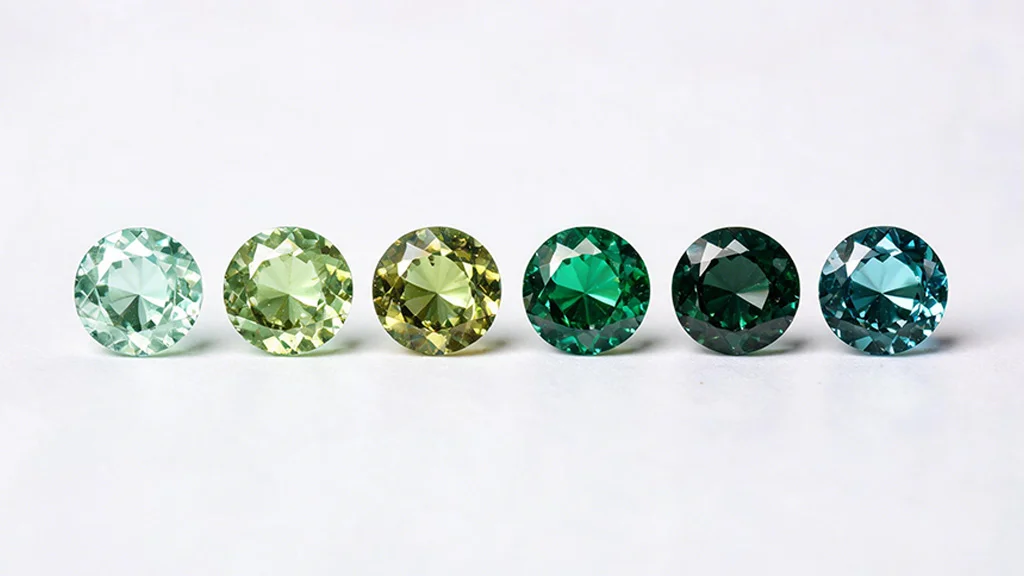
Table of Contents
Green is one of the most loved colours in fine jewelry, and the family of green gemstones is wider than most people expect. From the deep, saturated glow of emerald to the soft mint of prehnite and the lively fire of demantoid garnet, green stones come in every shade, hardness and price level.
This guide is a complete list of green gemstones: more than 40 stones, each with its typical shade, Mohs hardness, rarity, relative price tier and the jewelry it suits best. You will also find a master comparison table, a shade guide, explainers on treatments and lab-grown stones, a care cheat sheet and a manufacturer’s view on which green stones perform best on the bench and on the hand.
Most green gems get their colour from a handful of trace elements. Chromium and vanadium produce the vivid greens of emerald, tsavorite, chrome tourmaline and chrome diopside. Iron gives peridot, green sapphire and many olive tones. Copper creates the greens of malachite and turquoise, and nickel colours chrysoprase and gaspeite. In diamonds, green can come from natural radiation exposure.
Master Comparison Table of Green Gemstones
Use this table to compare every stone in this guide at a glance. Price tiers are relative guides for typical quality: $ is budget, $$ moderate, $$$ premium, $$$$ high-value and $$$$$ exceptional. Actual prices vary widely with size, colour, clarity, origin and treatment.
Gemstone | Shade range | Mohs | Rarity | Price tier | Best for | Everyday wear? |
Green Sapphire | Mint to forest green, olive, teal-green | 9 | Uncommon | $$–$$$ | Rings, bracelets, everyday jewelry | Yes |
Tsavorite Garnet | Vivid mint to deep emerald green | 7–7.5 | Rare | $$$–$$$$ | Rings, earrings, pendants | Yes, with care |
Green Spinel | Mint to deep green, bluish-green | 8 | Rare | $$$ | Rings and all jewelry types | Yes |
Green Chrysoberyl | Pale yellow-green to mint and olive | 8.5 | Uncommon | $$ | Rings, pendants, earrings | Yes |
Green Tourmaline (Verdelite and Chrome Tourmaline) | Mint to deep green, bluish-green | 7–7.5 | Uncommon (chrome: Rare) | $$ (chrome $$$) | Rings, earrings, pendants | Yes, with care |
Green Diamond | Pale to vivid green with blue, yellow or grey overtones | 10 | Very rare | $$$$$ | Rings, collector pieces | Yes |
Jade (Jadeite and Nephrite) | Pale to deep emerald green | 6–7 | Uncommon (fine jadeite: Very rare) | $–$$$$$ | Bangles, pendants, cabochon rings, carvings | Yes |
Green Zircon | Olive to mint, bluish-green | 6.5–7.5 | Rare | $$ | Earrings, pendants, protected rings | Occasional |
Green Topaz | Light green to teal | 8 | Rare (natural); treated stones common | $$ | Rings, pendants, earrings | Yes, with care |
Prasiolite (Green Quartz) | Pale leek or mint green | 7 | Common (usually heat-treated) | $ | Rings, earrings, pendants | Yes |
Green Aventurine | Sage to forest green with glitter | 6.5–7 | Common | $ | Beads, cabochon rings, pendants | Yes |
Chrysoprase | Apple to mint green | 6.5–7 | Uncommon | $–$$ | Cabochons, beads, pendants | With care |
Emerald | Bluish-green to pure green | 7.5–8 | Rare | $$$–$$$$$ | Protected rings, pendants, earrings | With care |
Alexandrite | Bluish-green in daylight, red-purple in incandescent light | 8.5 | Very rare | $$$$$ | Rings, collector pieces | Yes |
Demantoid Garnet | Yellowish to rich green with strong fire | 6.5–7 | Very rare | $$$$–$$$$$ | Pendants, earrings, careful rings | Occasional |
Peridot | Yellowish-green to olive green | 6.5–7 | Common | $ | Earrings, pendants, occasional rings | Occasional |
Chrome Diopside | Deep forest to intense green | 5.5–6 | Uncommon | $ | Earrings, pendants | Occasional |
Green Fluorite | Mint to deep green, often banded | 4 | Common | $ | Beads, pendants, carvings | Light use |
Moss Agate | Translucent with green moss-like inclusions | 6.5–7 | Common | $ | Cabochon rings, pendants, beads | Yes |
Green Jasper | Opaque green, often patterned | 6.5–7 | Common | $ | Cabochons, beads, carvings | Yes |
Bloodstone (Heliotrope) | Dark green with red spots | 6.5–7 | Common | $ | Signet-style rings, cabochons, cameos | Yes |
Green Opal | Pale to apple green, jade-like | 5.5–6.5 | Uncommon | $$ | Cabochons, pendants | Occasional |
Malachite | Banded light to dark green | 3.5–4 | Common | $ | Beads, pendants, cabochons | Display / light use |
Green Apatite | Yellow-green to blue-green, sometimes neon | 5 | Uncommon | $$ | Earrings, pendants | Occasional |
Prehnite | Pale apple to olive, translucent | 6–6.5 | Uncommon | $ | Cabochons, pendants, earrings | With care |
Serpentine | Olive to yellow-green, mottled | 2.5–5.5 (varies) | Common | $ | Carvings, beads, cabochons | Display |
Variscite | Pale mint to apple green, often veined | 3.5–4.5 | Uncommon | $$ | Beads, cabochons | Light use |
Amazonite | Blue-green to mint with white streaks | 6–6.5 | Common | $ | Beads, cabochons, pendants | With care |
Green Calcite | Pastel to mint green | 3 | Common | $ | Carvings, tumbled stones | Display |
Seraphinite | Green with silvery feather patterns | 2–2.5 | Uncommon | $ | Decorative cabochons | Display |
Hiddenite | Pale to emerald-like green | 6.5–7 | Rare | $$$ | Pendants, earrings | Occasional |
Green Diaspore (Zultanite) | Kiwi green to champagne or pink colour-change | 6.5–7 | Rare | $$$ | Pendants, protected rings | With care |
Green Turquoise | Apple green to blue-green | 5–6 | Uncommon | $$ | Cabochons, beads | With care |
Chrysocolla | Blue-green to teal | 2–4 (higher in silica-rich stone) | Common | $ | Cabochons | Display |
Maw Sit Sit | Vivid green with black veining | 6–7 | Rare | $$ | Cabochons, carvings | With care |
Moldavite | Olive to bottle green, textured surface | 5.5–6 | Rare | $$–$$$ | Pendants, raw pieces | Light use |
Kornerupine | Emerald-like to bluish-green | 6–7 | Very rare | $$$ | Pendants, earrings | Occasional |
Chrome Sphene (Titanite) | Emerald green with intense fire | 5–5.5 | Very rare | $$$$ | Pendants, earrings | Occasional |
Brasilianite | Yellow-green to lime | 5.5 | Rare | $$$ | Pendants, earrings | Occasional |
Ekanite | Olive to green | 4.5–5 | Very rare | $$$ | Collector only | Display |
Gaspeite | Apple to light green | 5.5 | Rare | $$ | Cabochons | Light use |
How to Read This List
Hardness (Mohs scale) measures scratch resistance on a scale from 1 to 10. Stones around 7 or above resist everyday dust, which is largely quartz. Toughness is resistance to chipping and breaking, which depends on cleavage, fractures and crystal structure. Jade is only 6 to 7 on the Mohs scale yet is one of the toughest gems, while topaz is hard but can split along cleavage. Stability covers sensitivity to heat, light, chemicals and moisture.
Rarity is a general guide to how easy it is to find good-quality stones in jewelry sizes, and everyday wear summarises how well a stone suits regular ring use. Throughout the guide, you will also see these common treatment terms:
- Heat treatment:improves or changes colour and clarity, common in sapphire, tourmaline and quartz.
- Oil or resin filling:hides fractures, standard in emerald.
- Irradiation:alters colour in diamonds, topaz and other stones.
- Dyeing:adds colour to porous stones such as agate, jade and quartz.
- Impregnation or stabilisation:hardens porous material such as turquoise and lower-grade jade.
- Coating:adds a surface colour layer, as on “mystic” topaz.
What Determines Green Gemstone Quality and Value
Gemologists judge coloured stones by hue, tone and saturation. Green is the main hue, but secondary hues shift value. Pure green or slightly bluish green is generally the most prized, while strongly yellow-green stones usually cost less, although peridot and demantoid are valued precisely for their yellow-green character.
Tone matters because green shows its strongest saturation at medium to medium-dark tones. Stones that are too dark look almost black, and very light stones can look washed out, although pastel greens such as mint sapphire and prasiolite are loved for their softness.
Clarity expectations differ by stone. Emerald almost always contains inclusions, so judge it by how visible they are, whereas tourmaline, peridot, sapphire and spinel are expected to be much cleaner. Avoid stones with large fractures or prominent central inclusions, which can weaken the stone and draw the eye.
Cut and size also matter. Precision cutting reveals the brilliance of tsavorite and demantoid, while clean large stones in rare varieties carry steep price premiums. Peridot, prasiolite and green tourmaline are far easier to find in large sizes. Finally, origin and treatment can influence price for emerald, jade and tsavorite, but clear treatment disclosure matters even more for long-term value.
The Full List of Green Gemstones
Below are over 40 green gemstones grouped by how they perform in jewelry. Each entry shows shade, hardness, rarity, price tier and suitability for everyday wear, followed by a jeweler’s note with a practical tip.
A. Durable Green Gemstones for Everyday Rings
These stones combine good hardness with good toughness, so they handle daily wear best. They are the ones we point to first when a customer wants a green ring that will be worn constantly.
Green Sapphire
Shade: Mint to forest green, olive, teal-green | Mohs: 9 | Rarity: Uncommon | Price tier: $$–$$$ | Everyday wear: Yes
Green sapphire is corundum coloured mainly by iron. Shades run from soft mint through olive to deep forest, often with blue or yellow overtones, and blue-green “teal” tones are increasingly popular. It shares the hardness and toughness of blue sapphire and ruby, yet usually costs less because demand is lower. Heat treatment is common and widely accepted when disclosed.
Jeweler’s note: The safest coloured stone to set and wear daily, and usually fine in an ultrasonic cleaner. Our default suggestion for a green stone in an everyday ring.
Tsavorite Garnet
Shade: Vivid mint to deep emerald green | Mohs: 7–7.5 | Rarity: Rare | Price tier: $$$–$$$$ | Everyday wear: Yes, with care
Tsavorite is the green grossular garnet, coloured by vanadium and chromium. Its brilliance is outstanding thanks to a high refractive index, and it is normally untreated. Clean stones in larger sizes are scarce, so prices rise steeply with carat weight.
Jeweler’s note: Facet edges can nick if knocked hard, so well-formed prongs or a snug bezel matter more than the Mohs number suggests.
Green Spinel
Shade: Mint to deep green, bluish-green | Mohs: 8 | Rarity: Rare | Price tier: $$$ | Everyday wear: Yes
Spinel is hard, brilliant and has no cleavage, which makes it a strong all-rounder. Natural green spinel is far less common than red or pink, and lab-created spinel is widely sold, so clear labelling matters. Colour comes from trace elements such as iron, chromium or vanadium.
Jeweler’s note: A very good ring stone. Ask whether the stone is natural or lab-created before comparing prices.
Green Chrysoberyl
Shade: Pale yellow-green to mint and olive | Mohs: 8.5 | Rarity: Uncommon | Price tier: $$ | Everyday wear: Yes
Chrysoberyl is one of the hardest gem minerals after corundum and diamond. Green varieties are less famous than alexandrite or cat’s-eye, but they offer real brilliance and toughness at moderate prices. Some cut as cabochons show a sharp cat’s-eye band.
Jeweler’s note: An under-appreciated, durable choice for a soft mint-green look, and often good value.
Green Tourmaline (Verdelite and Chrome Tourmaline)
Shade: Mint to deep green, bluish-green | Mohs: 7–7.5 | Rarity: Uncommon (chrome: Rare) | Price tier: $$ (chrome $$$) | Everyday wear: Yes, with care
Verdelite is the green elbaite tourmaline. Chrome tourmaline gets its intense, emerald-like green from chromium and vanadium and costs more. Tourmaline typically offers better clarity and larger sizes than emerald at a lower price, which makes it a popular emerald alternative.
Jeweler’s note: Tourmaline can react badly to sudden heat, so use warm soapy water rather than steam. Protect the corners of elongated cuts.
Green Diamond
Shade: Pale to vivid green with blue, yellow or grey overtones | Mohs: 10 | Rarity: Very rare | Price tier: $$$$$ | Everyday wear: Yes
Natural green diamonds owe their colour to natural radiation exposure over geological time and are among the rarest coloured diamonds. Many stones on the market are colour-treated by irradiation, where the colour can be shallow, and some are lab-grown. An independent laboratory report is essential.
Jeweler’s note: Tell the jeweler about the treatment status before any repair that involves heat or recutting.
Jade (Jadeite and Nephrite)
Shade: Pale to deep emerald green | Mohs: 6–7 | Rarity: Uncommon (fine jadeite: Very rare) | Price tier: $–$$$$$ | Everyday wear: Yes
Jade is two different minerals, jadeite and nephrite. Hardness is modest, but toughness is exceptional because of interlocking fibrous crystals, so jade resists breaking better than most gems. Quality ranges from inexpensive to extremely valuable for translucent, vivid jadeite. Bleaching, polymer impregnation and dyeing are common in lower grades.
Jeweler’s note: Always ask whether jade is untreated. Avoid ultrasonic and steam for impregnated pieces.
Green Zircon
Shade: Olive to mint, bluish-green | Mohs: 6.5–7.5 | Rarity: Rare | Price tier: $$ | Everyday wear: Occasional
Natural zircon is a very old mineral with high brilliance and fire. It is not the same as cubic zirconia, which is a lab-made simulant. Green zircon is a collector’s colour, usually olive-toned, and it is brittle at the facet edges.
Jeweler’s note: Pavilion and crown edges chip easily, so we recommend bezel or other protective settings for rings.
Green Topaz
Shade: Light green to teal | Mohs: 8 | Rarity: Rare (natural); treated stones common | Price tier: $$ | Everyday wear: Yes, with care
Topaz is hard, clear and available in large sizes, but it has perfect cleavage and can split with a hard knock. Natural green topaz is uncommon, and many green topaz stones are colour-treated. Coated “mystic” topaz carries a surface layer that can wear over time.
Jeweler’s note: Prefer protective settings and avoid ultrasonic cleaning on coated stones.
Prasiolite (Green Quartz)
Shade: Pale leek or mint green | Mohs: 7 | Rarity: Common (usually heat-treated) | Price tier: $ | Everyday wear: Yes
Prasiolite is green quartz, nearly always produced by heating certain amethyst or quartz. Natural green quartz is rare. The colour is delicate and the stone is clean, durable and available in large sizes at low cost.
Jeweler’s note: A budget-friendly way to get a big, clean, pale green statement stone.
Green Aventurine
Shade: Sage to forest green with glitter | Mohs: 6.5–7 | Rarity: Common | Price tier: $ | Everyday wear: Yes
Green aventurine is a quartz-rich stone whose colour and sparkle come from tiny mica inclusions (often fuchsite), a glitter effect called aventurescence. It is translucent to opaque and almost always cut as beads or cabochons. Do not confuse it with “goldstone”, which is glass.
Jeweler’s note: Affordable and tough enough for everyday cabochon rings.
Chrysoprase
Shade: Apple to mint green | Mohs: 6.5–7 | Rarity: Uncommon | Price tier: $–$$ | Everyday wear: With care
Chrysoprase is a nickel-coloured chalcedony with a bright, translucent apple-green colour, often used as a jade alternative. Some material can fade with prolonged heat or strong sunlight.
Jeweler’s note: Keep it away from strong heat and wipe with a damp cloth.
B. Classic and Precious Green Gemstones
The best-known names in green, each with a distinct personality.
Emerald
Shade: Bluish-green to pure green | Mohs: 7.5–8 | Rarity: Rare | Price tier: $$$–$$$$$ | Everyday wear: With care
Emerald is the most famous green gem: a beryl coloured by chromium and sometimes vanadium. Fine stones have vivid, saturated colour, and internal fractures and inclusions (often called jardin) are expected. Most are clarity-enhanced with oils or resins. Hardness is good but toughness is lower, so emerald rings need thought.
Jeweler’s note: Choose a bezel or halo setting, remove the ring for heavy tasks, and avoid ultrasonic and steam, which can disturb the filling.
Alexandrite
Shade: Bluish-green in daylight, red-purple in incandescent light | Mohs: 8.5 | Rarity: Very rare | Price tier: $$$$$ | Everyday wear: Yes
Alexandrite is colour-change chrysoberyl, green by day and reddish under lamplight. Natural stones with a strong colour change are extremely rare. Most alexandrite sold today is lab-created, which can be excellent but should be labelled and priced accordingly. It is a June birthstone.
Jeweler’s note: Judge colour change under both daylight-style light and warm light before buying.
Demantoid Garnet
Shade: Yellowish to rich green with strong fire | Mohs: 6.5–7 | Rarity: Very rare | Price tier: $$$$–$$$$$ | Everyday wear: Occasional
Demantoid is a rare green andradite garnet with dispersion higher than diamond, which creates flashes of rainbow fire. Fine “horsetail” inclusions are a hallmark of natural stones. It is usually untreated but fairly soft for a garnet and sensitive to heat.
Jeweler’s note: Avoid ultrasonic and steam, and protect it in a bezel.
C. Affordable and Fashion-Friendly Green Gemstones
Colourful, accessible stones that work beautifully in earrings, pendants and cabochon designs, with a little extra care in rings.
Peridot
Shade: Yellowish-green to olive green | Mohs: 6.5–7 | Rarity: Common | Price tier: $ | Everyday wear: Occasional
Peridot is gem-quality olivine and occurs only in green, coloured by iron. Fine stones show a lively olive-lime glow. It is the August birthstone and has even been found in meteorites.
Jeweler’s note: It scratches and chips with daily knocks and dislikes acids and sudden heat, so earrings and pendants are the safer choice.
Chrome Diopside
Shade: Deep forest to intense green | Mohs: 5.5–6 | Rarity: Uncommon | Price tier: $ | Everyday wear: Occasional
Chromium gives chrome diopside a rich, emerald-like green at a fraction of the price, and colour stays strong even in small stones. It is relatively soft and has cleavage.
Jeweler’s note: Great in earrings and pendants. In a ring, choose a bezel.
Green Fluorite
Shade: Mint to deep green, often banded | Mohs: 4 | Rarity: Common | Price tier: $ | Everyday wear: Light use
Fluorite forms in beautiful green, often zoned crystals, but it is soft and has perfect cleavage.
Jeweler’s note: Avoid heat, acids and ultrasonic cleaning. Ordinary dust can scratch it.
Moss Agate
Shade: Translucent with green moss-like inclusions | Mohs: 6.5–7 | Rarity: Common | Price tier: $ | Everyday wear: Yes
Moss agate is translucent chalcedony with green mineral inclusions (often chlorite) that form moss or tree patterns. The colour is in the inclusions, and no two stones look alike.
Jeweler’s note: Tough and affordable, ideal for natural-look cabochon designs.
Green Jasper
Shade: Opaque green, often patterned | Mohs: 6.5–7 | Rarity: Common | Price tier: $ | Everyday wear: Yes
Jasper is opaque microcrystalline quartz coloured by mineral inclusions. Green varieties include rainforest or “jungle” jasper, often with speckled or swirled patterns.
Jeweler’s note: Stable and easy to care for, good for bold, earthy designs.
Bloodstone (Heliotrope)
Shade: Dark green with red spots | Mohs: 6.5–7 | Rarity: Common | Price tier: $ | Everyday wear: Yes
Bloodstone is dark green chalcedony speckled with red iron-oxide spots. It is a traditional March birthstone and has long been associated with courage.
Jeweler’s note: Works well in engraved or signet-style pieces.
Green Opal
Shade: Pale to apple green, jade-like | Mohs: 5.5–6.5 | Rarity: Uncommon | Price tier: $$ | Everyday wear: Occasional
Common opal, meaning opal without play-of-colour, occurs in soft green tones, often translucent with a gentle luster. Opal contains water and can crack or craze from sudden dryness or heat. Some stones sold as “green opal” are dyed or a different material altogether.
Jeweler’s note: Avoid ultrasonic, heat and long dry storage. Clean with a damp cloth.
D. Soft or Delicate Green Gemstones for Pendants and Earrings
These stones are lovely but scratch or chip easily. They suit lower-impact jewelry and usually need protective handling.
Malachite
Shade: Banded light to dark green | Mohs: 3.5–4 | Rarity: Common | Price tier: $ | Everyday wear: Display / light use
Malachite is an opaque copper carbonate with signature concentric banding. It is soft, absorbent and sensitive to acids and heat.
Jeweler’s note: Keep away from acids, perfume and ultrasonic. Wipe with a damp cloth only.
Green Apatite
Shade: Yellow-green to blue-green, sometimes neon | Mohs: 5 | Rarity: Uncommon | Price tier: $$ | Everyday wear: Occasional
Apatite offers bright, saturated colour in a soft stone that scratches easily. Yellow-green stones are sometimes nicknamed “asparagus stone”.
Jeweler’s note: Pendants and earrings only, with a protective setting.
Prehnite
Shade: Pale apple to olive, translucent | Mohs: 6–6.5 | Rarity: Uncommon | Price tier: $ | Everyday wear: With care
Prehnite is a calm pastel green with a velvety, slightly waxy luster. It is sometimes sold as “new jade”, which it is not. Cabochons are most common.
Jeweler’s note: Handle gently as it can chip at edges, and keep exposure to knocks low.
Serpentine
Shade: Olive to yellow-green, mottled | Mohs: 2.5–5.5 (varies) | Rarity: Common | Price tier: $ | Everyday wear: Display
Serpentine is a group of soft, often translucent green minerals widely carved and sometimes used as a jade imitation.
Jeweler’s note: Scratches readily, so keep it as a pendant or decorative piece.
Variscite
Shade: Pale mint to apple green, often veined | Mohs: 3.5–4.5 | Rarity: Uncommon | Price tier: $$ | Everyday wear: Light use
Variscite is a phosphate mineral used for beads since ancient times. It is soft and often shows a brown or black matrix.
Jeweler’s note: Protect from knocks and chemicals.
Amazonite
Shade: Blue-green to mint with white streaks | Mohs: 6–6.5 | Rarity: Common | Price tier: $ | Everyday wear: With care
Amazonite is a green-to-blue-green feldspar with pale, web-like lines. Cleavage means it can split if struck.
Jeweler’s note: Prefer pendants and protected settings.
Green Calcite
Shade: Pastel to mint green | Mohs: 3 | Rarity: Common | Price tier: $ | Everyday wear: Display
Calcite is a very soft carbonate used mostly for carvings and decorative objects. It reacts to acids.
Jeweler’s note: Not suitable for regular wear.
Seraphinite
Shade: Green with silvery feather patterns | Mohs: 2–2.5 | Rarity: Uncommon | Price tier: $ | Everyday wear: Display
Seraphinite is a trade name for patterned green clinochlore. It is extremely soft and can be scratched by a fingernail.
Jeweler’s note: Treat as a display or lightly worn pendant material.
Hiddenite
Shade: Pale to emerald-like green | Mohs: 6.5–7 | Rarity: Rare | Price tier: $$$ | Everyday wear: Occasional
Hiddenite is the green variety of spodumene (kunzite is the pink one). Perfect cleavage makes it risky to cut and wear, and colour can fade with long exposure to strong light.
Jeweler’s note: Reserve it for protected pendants or evening wear.
Green Diaspore (Zultanite)
Shade: Kiwi green to champagne or pink colour-change | Mohs: 6.5–7 | Rarity: Rare | Price tier: $$$ | Everyday wear: With care
This colour-change gem moves from green in daylight to warmer champagne or pink tones under incandescent light. It has good brilliance, but cleavage and rarity limit its use.
Jeweler’s note: Use protective settings and avoid hard knocks.
Green Turquoise
Shade: Apple green to blue-green | Mohs: 5–6 | Rarity: Uncommon | Price tier: $$ | Everyday wear: With care
Turquoise is usually blue, but green varieties are common, often with a dark matrix. It is porous, and many pieces are stabilised with resin or dyed, which should be disclosed.
Jeweler’s note: Perfume, oils and cleaners can change colour. Keep it dry and clean with a soft cloth.
Chrysocolla
Shade: Blue-green to teal | Mohs: 2–4 (higher in silica-rich stone) | Rarity: Common | Price tier: $ | Everyday wear: Display
Chrysocolla is a copper silicate with vivid blue-green colour. Pure material is very soft, while quartz-rich “gem silica” is the more durable form.
Jeweler’s note: Prefer gem silica for jewelry and avoid abrasion.
E. Rare and Collector Green Gemstones
Scarce, unusual or sometimes fragile stones that appeal mostly to collectors and designers looking for something different.
Maw Sit Sit
Shade: Vivid green with black veining | Mohs: 6–7 | Rarity: Rare | Price tier: $$ | Everyday wear: With care
Maw sit sit is a rock made of several minerals including jadeite and kosmochlor, coloured by chromium. It is valued as a jade alternative and documented only in the modern era.
Jeweler’s note: Look for even colour and minimal cracking.
Moldavite
Shade: Olive to bottle green, textured surface | Mohs: 5.5–6 | Rarity: Rare | Price tier: $$–$$$ | Everyday wear: Light use
Moldavite is a natural glass formed by a meteorite impact, found in limited deposits and often sold as textured raw pieces. Imitations are common.
Jeweler’s note: Ask for identification, since green glass is often passed off as moldavite.
Kornerupine
Shade: Emerald-like to bluish-green | Mohs: 6–7 | Rarity: Very rare | Price tier: $$$ | Everyday wear: Occasional
Kornerupine can resemble fine emerald and shows strong pleochroism. Cleavage and scarcity make it a collector’s stone.
Jeweler’s note: Handle with care and use protective settings.
Chrome Sphene (Titanite)
Shade: Emerald green with intense fire | Mohs: 5–5.5 | Rarity: Very rare | Price tier: $$$$ | Everyday wear: Occasional
Chrome sphene combines emerald-like colour with dispersion stronger than diamond. It is soft and brittle, so it is mainly for collectors.
Jeweler’s note: Best as a protected pendant stone.
Brasilianite
Shade: Yellow-green to lime | Mohs: 5.5 | Rarity: Rare | Price tier: $$$ | Everyday wear: Occasional
Brasilianite is a rare phosphate mineral, brittle and prized by collectors for its vivid yellow-green colour.
Jeweler’s note: Not recommended for regular ring wear.
Ekanite
Shade: Olive to green | Mohs: 4.5–5 | Rarity: Very rare | Price tier: $$$ | Everyday wear: Display
Ekanite is a rare gem that contains uranium and thorium and is naturally radioactive. It is a curiosity for collectors and not a stone for routine wear.
Jeweler’s note: We do not recommend it for jewelry. Follow gemological safety guidance for radioactive stones.
Gaspeite
Shade: Apple to light green | Mohs: 5.5 | Rarity: Rare | Price tier: $$ | Everyday wear: Light use
Gaspeite is a nickel carbonate with a bright light-green colour. Because it contains nickel, cutting dust and skin contact need care, and nickel can affect people who are sensitive to it.
Jeweler’s note: Wear gloves and a dust mask when cutting. Never grind or polish it without ventilation.
Green Gemstones by Shade
Many people search by shade rather than by stone name. Use this guide to match the look you want with the stones that offer it.
Shade | What it looks like | Gemstones to consider |
Mint and pale green | Soft, light, fresh | Mint green sapphire, prasiolite, green chrysoberyl, prehnite, pale green fluorite, variscite, hiddenite |
Lime and yellow-green | Bright with a yellow lean | Peridot, green apatite, brasilianite, demantoid, yellow-green sapphire and chrysoberyl |
Apple green | Fresh, translucent, vivid | Chrysoprase, green turquoise, gaspeite, light tsavorite, jade |
Olive | Warm, earthy, muted | Olive peridot, green sapphire, green zircon, moldavite, serpentine, ekanite |
Emerald and vivid green | Deep, saturated, slightly cool | Emerald, tsavorite, chrome tourmaline, chrome diopside, chrome sphene, fine jadeite |
Forest and dark green | Deep and rich | Bloodstone, green jasper, malachite, deep green sapphire, dark verdelite |
Blue-green and teal | Cool, oceanic | Teal sapphire, amazonite, chrysocolla, green apatite, green turquoise, blue-green tourmaline |
Natural, Lab-Grown and Simulant Green Stones
A single green colour can come from very different materials. Natural stones form in the earth, lab-grown stones have the same chemistry and structure but are made in a laboratory, and simulants only imitate the look of another stone. None of these is automatically better or worse, but each should be clearly labelled and priced accordingly.
Material | What it is | What to know |
Lab-grown emerald | Chemically and physically the same as natural emerald, grown in a laboratory | Often cleaner, with fewer inclusions. Should be sold as lab-grown and priced well below natural stones of a similar look. |
Lab-grown green sapphire | Real corundum, grown in a laboratory | Hardness 9, excellent clarity and a strong-value, durable option. |
Lab-created alexandrite and spinel | Colour-change and green stones made in labs | Priced lower than natural. Check the labelling, since both are sold with natural-sounding names. |
Green moissanite | Lab-grown silicon carbide with strong fire | Hardness around 9.25. A distinct material rather than an imitation, and very durable for daily wear. |
Green cubic zirconia | A lab-made simulant | Hardness around 8 to 8.5. Affordable and sparkly, but less durable over time than moissanite or sapphire. |
Treated green diamond | Natural diamond coloured by irradiation, sometimes coated | Colour may be shallow. Request a laboratory report. |
Dyed stones | Quartz, chalcedony, jade, onyx or howlite coloured green | Colour can fade or rub off. Usually inexpensive. |
Glass and other imitations | Green glass sold as emerald, moldavite or other gems | Look for gas bubbles, “too perfect” colour and low prices. Identification testing helps. |
As a manufacturer working with natural gemstones, moissanite and cubic zirconia, we see buyers choose each for different reasons: natural stones for rarity and tradition, moissanite for durability and fire, and cubic zirconia for budget flexibility. The right choice depends on how the jewelry will be worn and what matters most to the buyer.
Common Treatments Explained
Stone | Common treatment | What it means for you |
Emerald | Oil or resin filling of fractures | Improves clarity appearance. Filling can be disturbed by heat, ultrasonic and some cleaners. |
Green sapphire | Heat treatment | Widely accepted and stable. Ask whether other treatments such as diffusion are present. |
Jade | Bleaching and polymer impregnation, dyeing | Lowers durability and value. Look for “untreated” documentation for fine pieces. |
Green tourmaline | Occasional heating or irradiation | Usually stable. Colour is generally permanent. |
Green diamond | Irradiation, sometimes coating | Affects value and repair options. Laboratory reports are essential. |
Prasiolite | Heat treatment of amethyst or quartz | Standard in the trade and generally stable. |
Green topaz | Irradiation or surface coating | Coatings can wear and need gentle care. |
Turquoise and chrysoprase | Stabilisation, dyeing | Should be disclosed. Colour may change over time. |
Choosing Green Gemstones by Jewelry Type
Rings (engagement and daily wear): Choose green sapphire, spinel, chrysoberyl or alexandrite, tsavorite, green tourmaline or green diamond. These combine hardness and toughness. Emerald is possible in a protective setting, while moissanite offers extra durability.
Rings (occasional and cocktail): Peridot, demantoid, green zircon and chrome diopside are beautiful but are best for pieces worn occasionally or set in a bezel.
Cabochon and statement rings: Jade, moss agate, aventurine and bloodstone give earthy, bold looks with good toughness.
Earrings: Nearly any green stone works because earrings face fewer knocks. Peridot, chrome diopside, apatite and demantoid are excellent choices here.
Pendants and necklaces: Even soft stones such as malachite, prehnite, serpentine and fluorite are suitable, since pendants sit protected against the body.
Bracelets and bangles: Jade bangles are traditional. Choose harder stones, as bracelets take more knocks than any other jewelry type.
Best Metals and Settings for Green Gems
Yellow gold warms yellow-green and olive stones such as peridot, demantoid and green sapphire, and gives emerald a rich, classic look. White gold and platinum cool the colour palette, making emerald, tsavorite and blue-green stones look crisper. Rose gold offers a gentle contrast with mint and sage greens and suits vintage-inspired designs.
Karat also matters. Higher-karat gold such as 18K has a richer colour but is softer than 14K, so many gemstone designs use 14K or 18K depending on how protective the setting needs to be.
- Bezel:the best choice for emerald, peridot, demantoid, apatite and other fragile stones, because it protects the girdle.
- Halo:adds a protective frame and makes the centre stone appear larger.
- Prong:shows more of the stone but exposes corners and edges. Use V-prongs on pointed cuts such as pear and marquise.
- Cabochon bezel:ideal for jade, moss agate and other opaque stones.
Frequently Asked Questions About Green Gemstones
Natural green diamond is among the rarest, along with top-quality alexandrite and demantoid garnet. Among more familiar stones, fine tsavorite in larger sizes is also scarce. Rarity depends on size and quality, so no single stone is the rarest in every case.
Fine natural green diamonds can reach the highest prices, followed by top-quality emerald, imperial-quality jadeite and fine alexandrite. Prices depend heavily on size, colour, clarity and treatment.
Green diamond is the hardest at 10 on the Mohs scale, followed by green sapphire at 9. Lab-grown green moissanite, at about 9.25, is also extremely hard.
Green sapphire, spinel, chrysoberyl or alexandrite, tsavorite and green diamond are the most durable choices. Emerald can work in a protective setting if the owner is willing to take extra care.
Traditionally, diamond, ruby, sapphire and emerald are called precious, and stones such as peridot, tourmaline, garnet, jade, malachite and aventurine are called semi-precious. Many gemologists consider the term outdated because it says little about beauty or price.
No. Green sapphire and green diamond are also in the classic precious categories, and several other green stones are highly valuable.