
Halo vs Hidden Halo Engagement Rings: The Complete Guide
- Written by Provence Team
- Updated on June 25, 2026
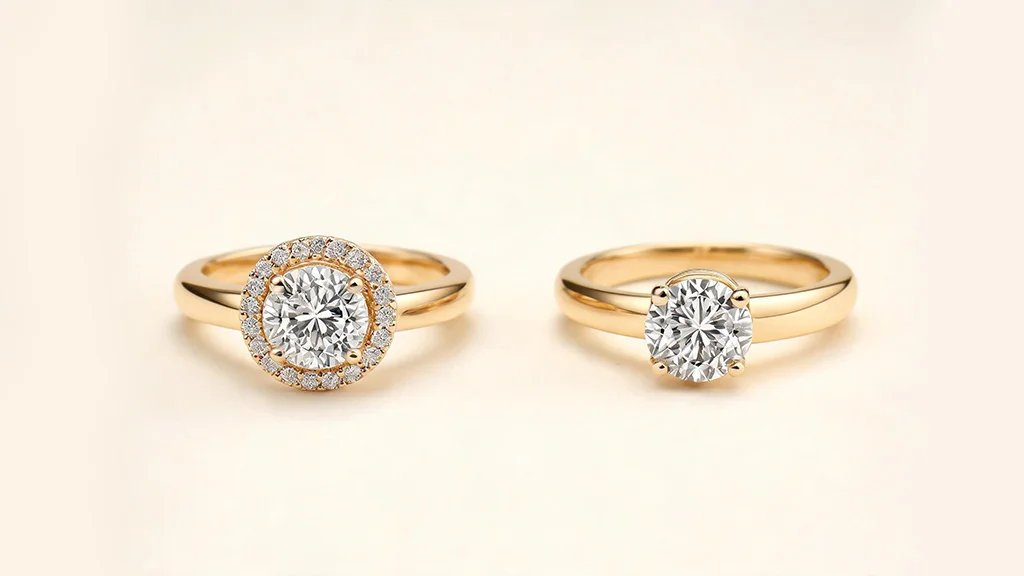
Table of Contents
A halo ring frames the center stone in a visible circle of diamonds. A hidden halo tucks that circle underneath, where it only shows from the side. That one design decision changes how the ring photographs, how it pairs with a wedding band, how much it costs to make, and — if you have sensitive skin — how comfortable it is to wear every day.
This guide walks through every meaningful difference between the two settings, with pricing shown in US dollars, British pounds, and euros, a diamond-shape compatibility table, and a section most engagement ring guides skip entirely: what nickel-release regulation in the EU and UK means for halo-style settings specifically. We'll also show you what each setting actually looks like under construction, because how a ring is built on the bench tells you a lot about how it will wear over decades.
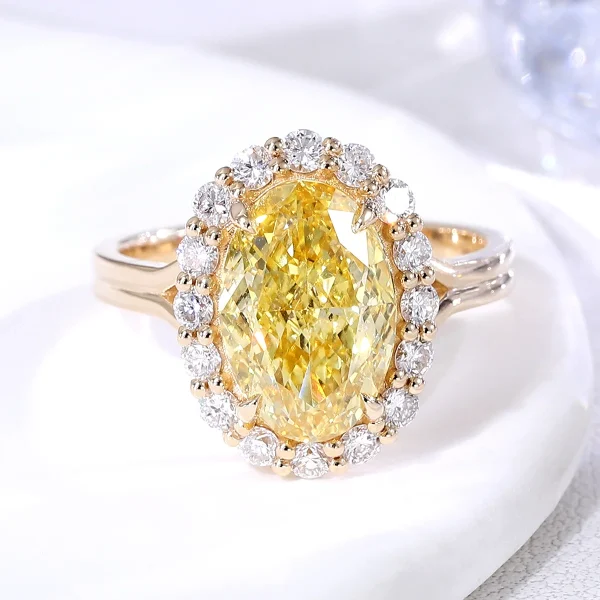
A halo setting surrounds the center gemstone with a ring of smaller accent diamonds, set directly on the same plane as the stone and fully visible from above. Look straight down at the ring and you see the center stone framed in its own circle of sparkle. That frame can be a single row, a double row, or a more elaborate floral or geometric arrangement built from multiple rows of graduated stones.
The design has real history behind it. Halo-style settings date to the Georgian era (1714–1837), when jewelers clustered smaller colored gemstones or diamonds around a larger center stone, often in floral patterns. The Victorian era refined the technique with more intricate metalwork, and the halo had its biggest resurgence during the Art Deco period of the 1920s, when the era's love of geometric symmetry made the circular frame a natural fit. It has remained one of the most consistently popular engagement ring styles ever since.
Halo Variations
- Single halo: one row of accent diamonds around the center stone — the most common version
- Double halo: two concentric rows, which further increases the apparent size of the center stone
- Floral halo: accent stones arranged in a flower-like pattern rather than a plain circle
- Halo with pavé band: accent diamonds continue down the band as well as around the stone
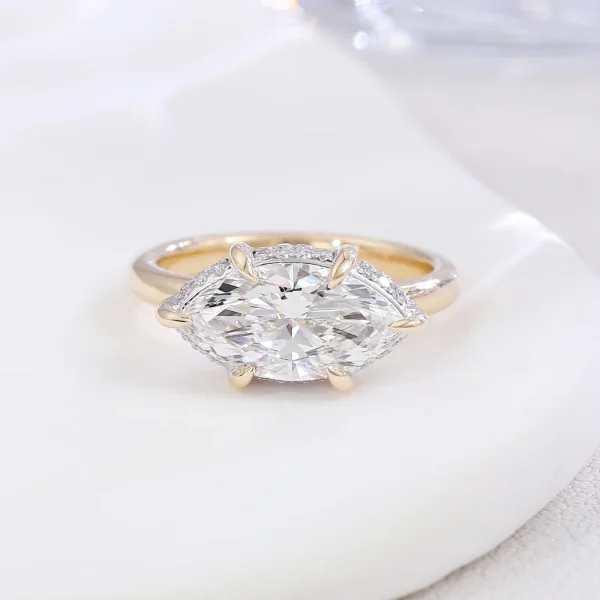
A hidden halo (sometimes called a secret halo or under-halo) places that same ring of accent diamonds underneath the center stone instead of around it, set into the gallery or basket that holds the stone in place. Looking down at the ring, you see what reads as a clean solitaire. Tilt it to the side, and a row of diamonds catches the light from beneath the crown.
The hidden halo is a much newer style than the traditional halo. It became popular over roughly the last decade as a way to combine a halo's added sparkle with the cleaner silhouette of a solitaire. It has found a particular following among buyers who want a ring that looks understated in everyday situations but rewards a closer look — and among those who've seen it on red carpets and engagement announcements; it's become a recognizable choice in recent celebrity engagement rings.
Hidden Halo Variations
- Single hidden halo: one row of accent diamonds at the base of the prongs — the standard version
- Double hidden halo: two rows for additional side-view sparkle
- Hidden halo with cathedral setting: the band rises to support the center stone, with the halo detail tucked beneath
Hybrid halo: a visible halo on top combined with a second hidden halo underneath, for sparkle from every angle
Halo vs Hidden Halo: The Master Comparison Table
Here's every major difference between the two settings in one place.
|
Feature |
Halo |
Hidden Halo |
|---|---|---|
|
Accent diamond placement |
Around the center stone, on the same plane |
Beneath the center stone, in the gallery |
|
Top-down appearance |
Visible ring of sparkle around the stone |
Reads as a clean solitaire |
|
Side-profile sparkle |
Visible, but secondary to the top view |
The defining feature — diamonds catch light from beneath |
|
Perceived center stone size |
Looks noticeably larger |
Looks close to its actual size |
|
Overall aesthetic |
Glamorous, vintage-inspired, maximalist |
Modern, minimalist, with a hidden detail |
|
Accent stones exposed to wear |
More — set on the outer profile |
Fewer — tucked beneath the crown |
|
Snag risk on clothing/hair |
Slightly higher |
Slightly lower |
|
Cleaning and upkeep |
Standard; periodic prong checks recommended |
Can trap oils beneath the stone; needs thorough cleaning |
|
Wedding band fit |
May need a contoured or custom band |
Usually sits flush with a standard straight band |
|
Typical price position |
Higher, due to more visible accent stones |
Lower to comparable, depending on design complexity |
|
Best photographed |
From directly above, in close-up |
From an angle, in motion |
Which Diamond Shapes Work Best With Each Setting
Both settings work with nearly every diamond shape, but some pairings are stronger than others.
|
Diamond Shape |
With a Halo |
With a Hidden Halo |
|---|---|---|
|
Round brilliant |
Classic pairing; halo reads as a flower-like frame |
Excellent; emphasizes the cut's natural brilliance |
|
Oval |
Halo elongates the visual line of the stone |
Very good; clean profile flatters the elongated shape |
|
Cushion |
Strong vintage pairing; halo softens the corners |
Good; modern twist on a traditionally vintage cut |
|
Emerald cut |
Halo softens the geometric step-cut facets |
Excellent; preserves the architectural lines step cuts are known for |
|
Princess |
Square halo mirrors and reinforces the shape |
Good; sleek, minimalist effect |
|
Pear |
Halo outlines and emphasizes the teardrop shape |
Good; balances the shape's natural asymmetry |
|
Radiant |
Halo adds extra fire to an already brilliant cut |
Excellent; angular sparkle reads well from the side |
|
Marquise |
Halo softens the pointed ends |
Good; clean profile complements the elongated shape |
|
Asscher |
Halo adds brilliance to the step-cut facets |
Excellent; keeps the cool, architectural feel intact |
As a general rule: step cuts like emerald and Asscher tend to look most at home in a hidden halo, because the setting adds detail without competing with the cut's clean geometric lines. Brilliant and modified-brilliant cuts (round, oval, cushion, radiant) perform well in either setting, so the choice comes down more to aesthetic and lifestyle than to the diamond shape itself.
Lab-Grown vs Natural Diamonds in Halo and Hidden Halo Settings
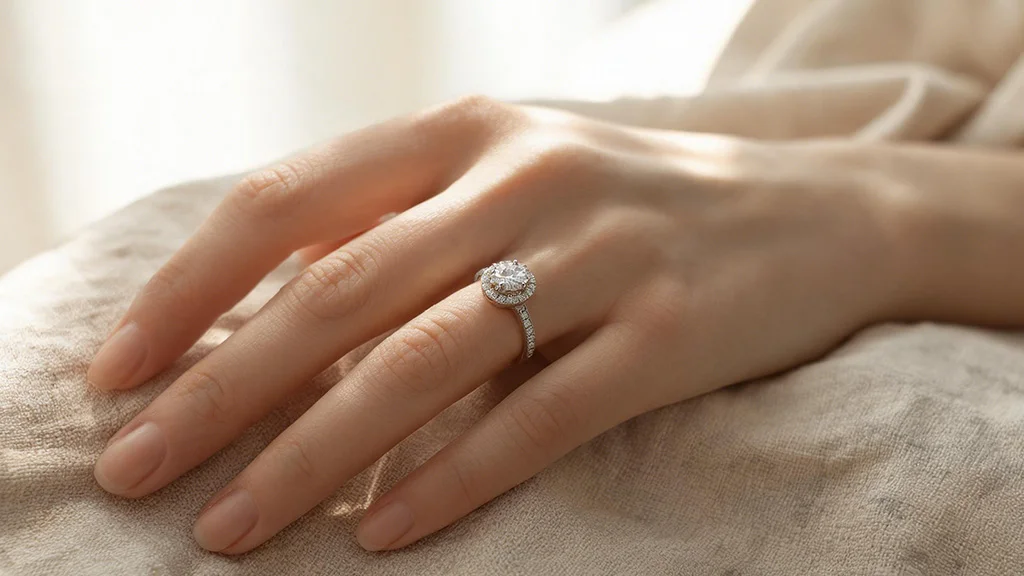
Both settings work equally well with lab-grown and natural diamonds, in both the center stone and the accent stones. The setting style itself doesn't favor one diamond origin over the other — the decision is independent.
There are a couple of practical points worth knowing either way. Because a halo or hidden halo uses several small accent diamonds in addition to the center stone, choosing lab-grown diamonds for the accents (even if the center stone is natural) is a common way to add visual size and sparkle without a steep price increase, since lab-grown diamonds typically cost meaningfully less per carat than natural diamonds of comparable quality. Some buyers mix origins this way deliberately: a natural center stone for resale and sentimental value, with lab-grown accents in the halo.
If resale value matters to you, it's worth knowing that lab-grown diamonds generally carry lower resale value than natural diamonds of the same specifications, largely because they aren't rare in the same way. That consideration applies to the center stone specifically — accent diamonds in either setting rarely factor meaningfully into a ring's resale value regardless of origin.
For a deeper comparison of how the two are graded and certified, see our guide: IGI vs GIA
The EU Nickel Directive and Setting Choice
This is a section most engagement ring guides skip, and it's directly relevant to halo-style settings specifically — more so than to a plain solitaire.
Nickel allergy is the most common cause of contact dermatitis in Europe, affecting roughly 1 in 10 people in Western Europe and North America, and it disproportionately affects women — partly because women are more likely to have had early exposure through pierced jewelry. Once someone is sensitized to nickel, even brief contact with a nickel-releasing item can trigger a reaction: redness, itching, dryness, or blistering at the point of contact.
The European Union regulates this directly. What's still commonly called the "Nickel Directive" (originally Directive 94/27/EC) has been folded into the EU's REACH Regulation, specifically Annex XVII, Entry 27. It sets a strict migration limit — the maximum amount of nickel a piece of jewelry is allowed to release — of 0.5 micrograms per square centimeter per week for items in prolonged skin contact, tested using a standardized method (EN 1811) that simulates a week of contact with sweat. The limit is even stricter, 0.2 micrograms per square centimeter per week, for anything inserted into pierced skin.
Why This Matters More for Halo-Style Settings
A solitaire ring has one stone, a small number of prongs, and a comparatively small surface area in prolonged contact with skin. A halo or hidden halo setting has all of that, plus a ring of additional prongs or shared-prong settings holding the accent diamonds — meaningfully more total metal surface area touching the finger, especially with the halo sitting directly against the skin on the underside of the ring.
This doesn't mean halo settings are inherently risky. White gold, platinum, and properly alloyed yellow or rose gold can all be made compliant with REACH limits, and reputable manufacturers test for this. But it does mean the setting style is a relevant question to ask, specifically for anyone with known nickel sensitivity or anyone buying for someone who has reacted to jewelry before.
What to Ask Before You Buy
- What alloy is the white gold made with? Some white gold is alloyed with nickel for hardness and whiteness; nickel-free white gold alloys (using palladium instead) exist and are increasingly standard, but it's worth confirming directly.
- Is the piece tested to EN 1811, or does it carry a REACH compliance statement? This is the standard EU test method referenced above.
- If you're outside the EU/UK, does the manufacturer test to EU nickel-release standards anyway? Many manufacturers serving international markets do, since it's a meaningful quality signal even where it isn't legally required.
- Is platinum or 18k gold an option instead? Pure platinum and high-karat gold naturally contain less base-metal alloy by volume, which generally — though not always — correlates with lower nickel content.
Wedding Band Pairing
Halo + Wedding Band
Because a halo extends outward from the center stone on the same plane as the band, it can leave a visible gap when paired with a flat, straight wedding band — the halo's outer edge sits higher and wider than the band beneath it. Three common solutions: a contoured or curved wedding band shaped to nest around the halo's profile; a wedding band with a small notch or "guard" cut to fit around the setting; or a fully custom-built wedding band designed specifically to match the engagement ring. Many couples buying a halo engagement ring choose to purchase the wedding band at the same time, so a jeweler can confirm fit before either piece is finalized.
Hidden Halo + Wedding Band
A hidden halo sits flush against a standard straight wedding band, because the accent diamonds are tucked beneath the center stone rather than extending outward from it. This is one of the most practical day-to-day advantages of the style: you get the added sparkle without having to plan around band compatibility, and it leaves more flexibility to add eternity or anniversary bands later without a custom-fit requirement.
Certification & Resetting
If you ever reset a center stone — upgrading to a larger diamond, switching settings, or repairing damage — the setting style affects how that process goes.
A solitaire or hidden halo with a simple prong head is generally the easiest to reset, since the center stone sits in a self-contained setting that can be removed and replaced without disturbing the rest of the ring. A traditional halo is more involved: because the center stone's prongs are integrated closely with the surrounding halo structure, removing and replacing the center stone requires more careful bench work to avoid disturbing the accent diamonds around it.
Certification follows the stone, not the setting — a GIA or IGI grading report for your center diamond remains valid regardless of which setting it's in, since the report describes the loose stone's characteristics. What does change is practical: a stone in a hidden halo can usually be pulled for re-inspection or appraisal more easily than one secured deep inside a built-up halo structure, simply because there's less surrounding metalwork to navigate.
Beyond Engagement Rings
The halo and hidden halo concept extends well past engagement rings. Both versions appear regularly in stud earrings, pendants, and three-stone designs.
- Stud earrings with a hidden halo add side-view sparkle without making the stud look oversized from the front — a popular middle ground between plain studs and a full halo earring
- Halo pendants intensify the perceived size and saturation of a center stone, which is especially effective with colored gemstone centers
- Three-stone halo rings combine the past-present-future symbolism of a three-stone design with the added brilliance of a halo around each stone, or around the center stone only
For retailers and wholesale buyers, this is also where the OEM/ODM side of the business becomes relevant: the same halo or hidden halo construction techniques used in a one-off engagement ring scale directly into earring and pendant production runs, which is worth knowing if you're sourcing a coordinated bridal collection rather than a single piece.
How to Choose: A Decision Framework
Run through these five questions. By the end, your preference is usually clear.
- Top-down or side-view sparkle? If you want the sparkle visible the instant you look at your hand, choose a halo. If you'd rather it stays a quiet surprise, choose a hidden halo.
- How important is making the center stone look larger? A halo (especially a double halo) does more to visually increase apparent size. A hidden halo lifts and brightens the stone without changing its apparent size much.
- What's your wedding band situation? If you already own or want a simple straight band, a hidden halo will sit flush. If you're open to a contoured or custom band, a halo opens up more design freedom.
- Vintage and glamorous, or modern and minimal? Halos read as classic and statement-making. Hidden halos read as contemporary and understated.
- Any known metal sensitivity? If nickel allergy is a factor, ask about alloy composition and REACH/EN 1811 compliance before committing to either style — see the nickel section above.
|
If you want.. |
Choose |
|---|---|
|
Maximum visible sparkle and size |
Halo |
|
A solitaire look with a side-view surprise |
Hidden Halo |
|
Easiest fit with a flat wedding band |
Hidden Halo |
|
Maximum design freedom for custom bands |
Halo |
|
The lowest-maintenance daily-wear profile |
Hidden Halo (slightly) |
|
Sparkle from literally every angle |
Hybrid halo (both styles combined) |
Frequently Asked Questions
Neither is objectively better — they suit different priorities. A halo maximizes visible sparkle and perceived size; a hidden halo offers a cleaner top-down look with a side-view detail. The right choice depends on your aesthetic preference, wedding band plans, and budget.
It can lift and brighten the stone by reflecting light up from beneath it, but it doesn't increase the stone's apparent diameter the way a visible halo does. If maximizing perceived size is the priority, a traditional halo (particularly a double halo) does more visual work.
Both settings are secure when properly constructed. A traditional halo offers slightly more physical protection for the center stone's edges, since the surrounding ring of metal and diamonds acts as a buffer against knocks. A hidden halo doesn't add this edge protection, but its accent stones are themselves more sheltered from direct impact than a halo's are.
A halo produces more total visible sparkle, since its accent diamonds are exposed and catch light from nearly every angle, including straight on. A hidden halo's sparkle is more selective — strongest from an angle or in motion, and essentially invisible from directly above.
A hidden halo places accent diamonds beneath the center stone, invisible from above. A reverse halo places a larger accent stone (or stones) around a smaller center stone in a way that inverts the usual size hierarchy — it's a distinct design choice, not another name for the same thing.
The setting style itself doesn't cause a reaction — the alloy does. But because halo-style settings (hidden or visible) involve more total metal surface in skin contact than a plain solitaire, the alloy composition matters more in absolute terms. If you have nickel sensitivity, ask about alloy composition and EN 1811/REACH compliance regardless of which halo style you choose.
In many cases, yes — a jeweler can rebuild the basket beneath an existing center stone to incorporate a hidden halo, provided the setting has enough clearance underneath. It's a more involved repair than adding a visible halo, since the work happens beneath the stone rather than around it, so get a bench jeweler's assessment of your specific ring before assuming it's possible.
Certification value (the grading report itself) isn't affected by resizing or by the setting style — it describes the loose stone. What changes is the practical ease of removing and re-inspecting the stone. A hidden halo or solitaire-style setting is generally easier to work with during resizing than a built-up traditional halo, simply because there's less surrounding metalwork to disturb.