
What is Diamond Fire? Full Guide to Diamond Sparkle
- Written by Provence Team
- Updated on September 7, 2026
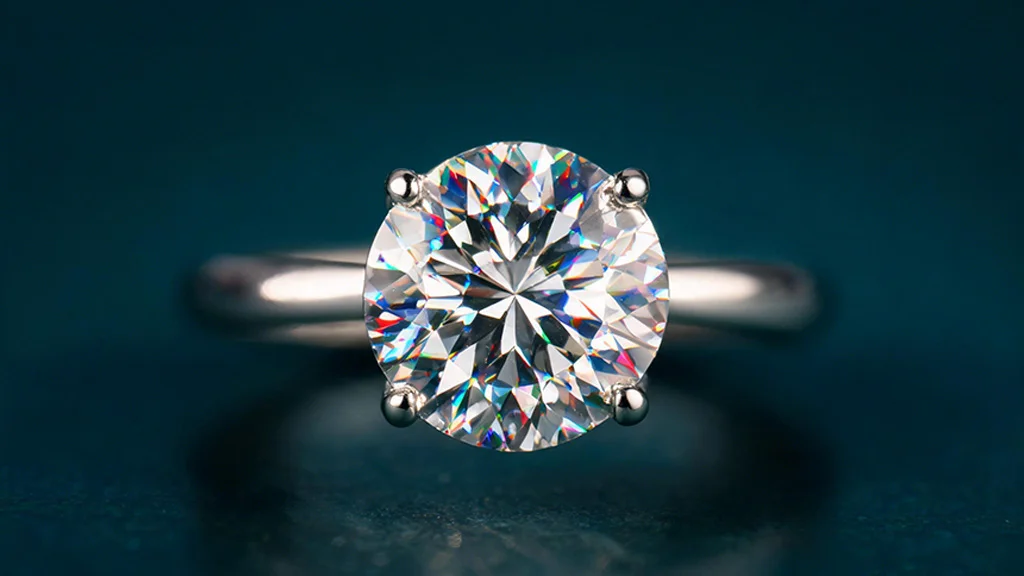
Table of Contents
Tilt a well-cut diamond under a restaurant light and, for an instant, it throws off a spark of red, blue, or green before flashing back to white. That colored flash is diamond fire — one of the three optical effects (alongside brilliance and scintillation) that define how a diamond looks in the hand and on the finger. Diamond fire is the dispersion of white light into spectral colors as it passes through and exits a diamond's facets, caused by the diamond's high refractive index bending different wavelengths of light at different angles.
Understanding fire matters because it's one of the most visible — and most misunderstood — signals of cut quality. This guide breaks down the physics, shows how it differs from brilliance and scintillation, explains how labs grade it, and gives you a practical framework for evaluating it when buying a diamond anywhere in the world.
Diamond Fire vs Brilliance vs Scintillation
These three terms get used interchangeably by shoppers, but gemologists treat them as distinct optical effects. Knowing the difference helps you talk to a jeweler — and read a lab report — with more precision.
|
Effect |
What It Is |
What Causes It |
What It Looks Like |
|---|---|---|---|
|
Brilliance |
Total white light returned to the eye |
Light reflecting internally off facets and exiting through the crown |
Overall brightness; a bright vs. dull diamond |
|
Fire |
Colored flashes of spectral light |
Dispersion — white light splitting into rainbow wavelengths as it refracts |
Flashes of red, blue, green, or violet, usually seen under a single point-light source |
|
Scintillation |
Pattern of light/dark flashes as the stone, light, or observer moves |
Contrast between reflecting and shadowed facets |
The 'sparkle' or flicker you see when a diamond moves |
The Science: How Light Becomes Fire
Visible light is a mix of wavelengths, each corresponding to a color our eyes perceive. When white light passes from air into a denser transparent medium — water, glass, or diamond — it slows down and bends, a process called refraction. Because different wavelengths slow by slightly different amounts, they separate, or disperse, into the individual colors of the spectrum. That's the same principle behind a rainbow after rain or the colors thrown by a glass prism.
Diamond has one of the highest refractive indices of any naturally occurring gem material, at roughly 2.42. Because dispersion potential rises with refractive index, diamond has an unusually strong theoretical capacity for fire. But that potential is only ever fully realized when the stone is cut with precise facet angles and proportions — cut, not the raw material, ultimately decides how much fire reaches the eye.
Why lighting conditions change what you see
Fire only becomes visible under the right lighting. A single, small, high-intensity light source — a spotlight, a candle, direct sunlight, or a small LED — produces strong, distinct color flashes. Large, diffuse light sources, like an overcast sky or a bank of fluorescent office tubes, spread light out so evenly that dispersion is smoothed over and the colored flashes disappear, even in a beautifully cut stone. This is why diamonds often look their most fiery in restaurants, boutique retail lighting, or direct outdoor sun — and comparatively flat under flat office lighting.
Why the observer matters too
The final ingredient is the viewer. As dispersed light exits a diamond, the separated colors fan out; whether your eye catches red, green, or blue at any given moment depends on your viewing angle, distance, and even your pupil size, since a narrower pupil is more likely to isolate a single wavelength out of the color fan. This is part of why fire reads as fleeting and dynamic rather than a fixed, constant glow.
The Role of Cut: Proportions & Virtual Facets
Cut is the single largest lever a diamond has over its own fire. A diamond's facets aren't just flat cuts on the surface — each one also creates 'virtual facets,' the mirrored reflections of other facets seen through the crown. Because a single physical facet can reflect light from many different internal surfaces, the number of virtual facets on a diamond is far greater than its physical facet count, and the size and arrangement of those virtual facets determine how large and colorful the fire flashes appear.
Facet geometry has to sit inside a fairly narrow range of proportions for strong fire to be possible in the first place. Outside that range, light escapes through the pavilion or sides instead of dispersing back through the crown, producing a diamond that looks 'dull,' 'glassy,' or shows a visible dark or washed-out zone known as a window or fisheye.
|
Proportion |
Recommended Range (Round Brilliant) |
Effect Outside Range |
|---|---|---|
|
Table Width |
54% – 60% |
Too large mutes fire; too small over-concentrates it into a narrow zone |
|
Total Depth |
59% – 63% |
Too shallow leaks light through the pavilion; too deep absorbs light and darkens the stone |
|
Crown Angle |
33° – 35° |
Shallow crowns wash out fire; steep crowns can trap too much light and reduce brightness |
|
Pavilion Angle |
40.6° – 41.8° |
Deviation causes light leakage instead of internal reflection back to the eye |
|
Girdle Thickness |
Thin to slightly thick |
Overly thick girdles absorb light and add unproductive weight |
Faceting precision — how accurately each facet is cut and polished relative to the others, sometimes called optical symmetry — is just as important as the target angles themselves. Even diamonds cut to ideal proportions on paper can under-perform if facets are misaligned in three dimensions, breaking large virtual facets into a chaotic scatter of tiny ones that produce weaker, less organized fire.
Fire by Diamond Shape
Shape has a major, and often overlooked, influence on how much fire a diamond shows — independent of cut grade. Brilliant-cut shapes with many small facets are engineered to maximize dispersion; step-cut shapes are engineered to showcase clarity and a hall-of-mirrors brilliance instead.
|
Shape |
Facet Style |
Fire Level |
Why |
|---|---|---|---|
|
Round Brilliant |
58 facets, brilliant-cut |
Highest |
Facet pattern is mathematically optimized for maximum dispersion and light return |
|
Oval / Marquise / Pear |
Brilliant-cut, elongated |
High |
Similar facet structure to round, with a bow-tie effect that can vary fire distribution |
|
Princess |
Brilliant-cut, modified square |
High |
Many small facets produce lively fire, though less than round due to corner light leakage |
|
Cushion |
Brilliant or modified brilliant |
Medium–High |
Larger facets produce broader, more visible color flashes ('crushed ice' look in some cuts) |
|
Radiant |
Brilliant-cut, cropped corners |
Medium–High |
Combines brilliant faceting with a rectangular or square outline |
|
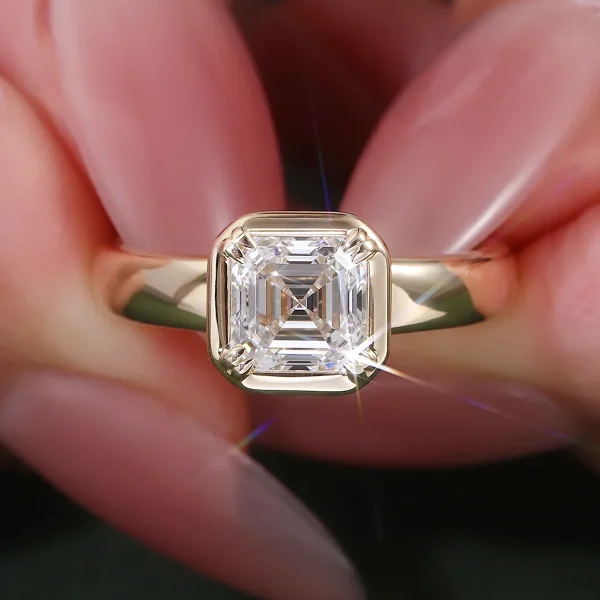
Emerald / Asscher |
Step-cut, rectangular facets |
Low |
Long, flat facets emphasize brilliance and clarity ('hall of mirrors') over dispersion |
This is a key point competitors' guides tend to skip: two diamonds with identical color, clarity, and carat weight can show noticeably different fire purely because of shape. If fire is a priority, round, oval, and princess cuts are the strongest starting points; step cuts like emerald and Asscher will always show less, regardless of cut grade, because their broad flat facets are designed for a different optical effect.
Grading & Certification: AGS, GIA, IGI, and HRD
Fire is difficult to grade because it depends on lighting and viewing angle rather than a fixed physical measurement — unlike carat weight or clarity. Even so, several laboratories have built systems that quantify light performance, including fire, using computer ray-tracing models.
AGS Light Performance
The American Gem Society Laboratories (AGS) is the primary body offering a peer-reviewed light performance grade. A 3D scan of the diamond is used to mathematically ray-trace tens of thousands of simulated light rays, and the diamond is scored on brightness, contrast, light leakage, and dispersion (fire). The results can be visualized as ASET maps and dedicated fire maps showing exactly where on the stone fire is being produced.
GIA Cut Grade
The Gemological Institute of America (GIA) incorporates light performance — including fire — into its overall Cut grade (Excellent through Poor) for standard round brilliants, though it does not issue a separate numeric fire score the way AGS does.
IGI and HRD for International Buyers
Shoppers outside North America will more commonly encounter certificates from the International Gemological Institute (IGI), widely used across Europe, the Middle East, and Asia, and HRD Antwerp, a leading European laboratory. Both grade cut quality using proportion- and symmetry-based standards broadly comparable to GIA's, and are widely accepted by UK and EU jewelers and appraisers. When comparing a diamond's fire potential across certificates, focus on the cut grade and proportions listed rather than the lab name alone, since methodologies vary slightly between GIA, AGS, IGI, and HRD.
Diamond Fire vs Moissanite vs Cubic Zirconia
Because fire is the most visually dramatic of the three optical effects, it's also the most common point of comparison between diamonds and diamond simulants.
|
Material |
Refractive Index |
Dispersion |
Visual Character |
|---|---|---|---|
|
Diamond |
2.42 |
0.044 |
Balanced mix of white brilliance and moderate, elegant color flashes |
|
Moissanite |
2.65–2.69 |
0.104 |
More fire than diamond — a rainbow-heavy, highly colorful sparkle some buyers find too intense |
|
Cubic Zirconia |
2.15–2.18 |
0.058–0.065 |
Noticeable fire when new, but softer material dulls with wear, reducing sparkle over time |
Moissanite's dispersion is more than double that of diamond, which is why moissanite jewelry often shows a more intense, more colorful sparkle at a glance — a trait some shoppers love and others find less refined than a diamond's characteristically whiter light. Cubic zirconia starts with respectable fire but is considerably softer than diamond, so its facets abrade and dull with everyday wear, diminishing its sparkle over time in a way that diamond and moissanite do not.
From the Cutting Floor: How Manufacturers Optimize Fire
Fire isn't decided by a formula alone — it's the outcome of consistent, disciplined execution on the cutting and polishing floor. As an OEM/ODM manufacturer producing solid gold jewelry set with lab-grown diamonds, moissanite, cubic zirconia, and natural gemstones for brand partners across the US, UK, and EU, Provence Jewellery's production process places the same emphasis on faceting precision that AGS and GIA reward in their grading systems:
- Computer-guided bruting and faceting to hold angle tolerances within fractions of a degree across every stone in a production run
- In-house optical symmetry checks before stones are set, so facet misalignment is caught before it reaches a finished piece
- Final polish inspection under controlled point-light sources to visually confirm fire and brilliance match the batch standard
- Consistent proportion targets maintained across large production volumes, so a brand partner's 500-piece order performs the same as its sample
For brand partners sourcing engagement rings, eternity bands, or fine jewelry collections at scale, this consistency is what turns a strong lab report on a single stone into a strong showroom or e-commerce experience across an entire product line.
How to See Diamond Fire When Buying
Because fire depends so heavily on lighting, the way you evaluate a diamond in-store or online can meaningfully change what you perceive. A few practical habits:
- Ask to view the diamond under a single point-light source (a jeweler's spotlight or a small halogen/LED bulb) rather than only broad overhead lighting
- Step outside into direct sunlight if possible — natural daylight is one of the most reliable environments for observing genuine fire
- Gently rock or tilt the stone rather than holding it still; fire is a dynamic effect that reveals itself with movement
- Compare two diamonds side by side under identical lighting rather than judging one stone in isolation
- Request an ASET or Ideal-Scope image, or an AGS light performance report, if you want an objective, lab-verified reference rather than relying on a single in-store impression
Avoid judging fire under diffuse fluorescent office lighting or heavy overcast conditions — even an exceptionally cut diamond will look comparatively muted in that environment, which can lead to an unfairly low impression of a well-made stone.
Frequently Asked Questions
Diamond fire is the flashes of spectral color — red, orange, yellow, green, blue, violet — that appear when white light disperses as it passes through a diamond's facets. It is distinct from brilliance (white light return) and scintillation (light/dark flicker with movement).
Not necessarily. Fire is one of several factors in overall light performance, alongside brilliance and scintillation. A diamond needs a healthy balance of all three rather than fire alone; extremely high dispersion (as in moissanite) can look less refined to buyers who prefer diamond's characteristically whiter light.
Yes. Brilliant-cut shapes like round, oval, and princess are engineered for strong fire, while step-cut shapes like emerald and Asscher prioritize clarity and a mirror-like brilliance over color dispersion, and will show noticeably less fire even at a high cut grade.
Yes. Lab-grown diamonds share the same crystal structure, refractive index, and dispersion as natural diamonds, so fire is determined by cut quality in both — not by whether the diamond is lab-grown or mined.
You can evaluate it informally by viewing the stone under a single point-light source and in natural daylight, then comparing it to another diamond side by side. For an objective reference, ask for an AGS light performance report or an ASET/Ideal-Scope image from the seller.
Broad, diffuse light sources like fluorescent office tubes spread light evenly and suppress the visibility of dispersion. This is normal and doesn't necessarily indicate a lower-quality cut — try viewing the same diamond under a single small light source or in direct sunlight instead.