
10K vs 14K Gold: Which is Right for You? (2026 Guide)
- Written by Provence Team
- Updated on July 30, 2026
Table of Contents
If you've shopped for a gold ring, necklace, or bracelet, you've probably seen the stamps "10K" and "14K" inside the band — and wondered what they actually mean for the piece you're about to buy. The short answer: karat measures how much pure gold is in your jewelry, and that single number quietly determines its color, strength, hypoallergenic properties, and price. 10K gold contains 41.7% pure gold and is the harder, more affordable option; 14K gold contains 58.3% pure gold and delivers a richer color with a slightly higher price tag. Neither is "better" in absolute terms — the right choice depends on your lifestyle, budget, skin sensitivity, and where in the world you're buying.
This guide goes further than most karat comparisons you'll find online. Beyond the basic purity breakdown, we'll cover how 10K and 14K gold are legally defined in the US, UK, and EU (the rules are not the same), how manufacturers actually decide which karat to use for a given design, and a simple framework to help you choose with confidence — whether you're buying one ring or sourcing a full collection.
What Does Karat Actually Mean?
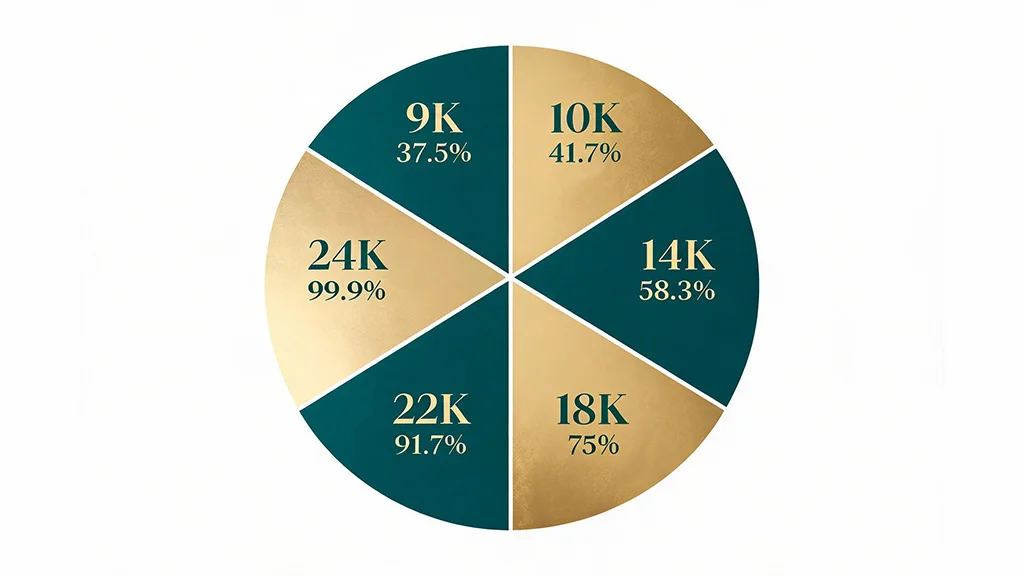
Karat (abbreviated "K" or "Kt") measures the proportion of pure gold in an alloy, expressed as parts out of 24. Pure gold is 24K — 100% gold. Because pure gold is soft and scratches, bends, and wears down quickly, it's rarely used in fine jewelry. Instead, jewelers mix pure gold with stronger metals like copper, silver, zinc, palladium, or nickel to create an alloy that can withstand daily wear while still being called "gold."
This is also a good moment to clear up a common mix-up: karat measures gold purity, while carat measures the weight of a diamond or gemstone. They sound identical but describe completely different things.
|
Karat |
Pure Gold % |
Alloy % |
Common Hallmark Stamp |
|---|---|---|---|
|
9K |
37.5% |
62.5% |
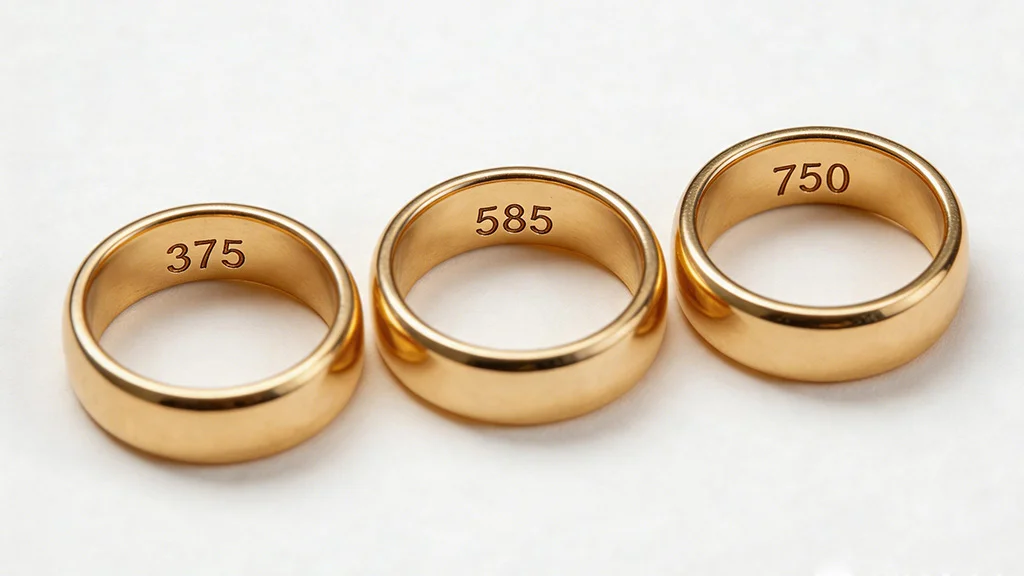
375 |
|
10K |
41.7% |
58.3% |
417 |
|
14K |
58.3% |
41.7% |
585 |
|
18K |
75.0% |
25.0% |
750 |
|
22K |
91.7% |
8.3% |
916 |
|
24K |
99.9% |
0.1% |
999 |
10K vs 14K Gold: Full Side-by-Side Comparison
Once you're comparing just these two, the differences come down to five practical factors: gold content, durability, color, price, and skin sensitivity. Here's how they stack up directly:
|
Factor |
10K Gold |
14K Gold |
|---|---|---|
|
Pure gold content |
41.7% |
58.3% |
|
Alloy content |
58.3% (copper, silver, zinc, nickel) |
41.7% (copper, silver, zinc, nickel) |
|
Hallmark stamp |
"10K" or "417" |
"14K" or "585" |
|
Relative hardness |
Hardest of the common karats — most scratch-resistant |
Softer than 10K, harder than 18K |
|
Color (yellow gold) |
Pale, slightly muted yellow |
Warm, rich yellow |
|
Color (rose gold) |
Strongly pink — higher copper content |
Balanced pink, less orange/copper-heavy |
|
Color (white gold) |
Bright white after rhodium plating, same as 14K |
Bright white after rhodium plating |
|
Typical price vs. the other |
Most affordable of the two |
Roughly 15–35% more than equivalent 10K piece* |
|
Skin sensitivity risk |
Higher — more alloy metal, may include nickel |
Lower — more pure gold, still check for nickel |
|
Best suited for |
Budget-conscious buyers, heavy daily wear, active lifestyles |
Fine jewelry, engagement rings, gifting, resale value |
|
US legal minimum for "gold" |
Yes — 10K is the US floor for the word "gold" |
Exceeds the minimum |
10K Gold: Strengths and Trade-Offs
10K gold's higher alloy content makes it the most scratch- and dent-resistant option among common karats, which is why it holds up well for people who work with their hands, exercise frequently, or simply want a ring they never have to think about. The trade-off is color: 10K yellow gold looks noticeably paler than 14K, and 10K rose gold leans heavily pink because of its higher copper ratio. It also carries a somewhat higher risk of skin irritation, since a larger share of the metal is non-gold alloy — always confirm whether a specific piece is nickel-free if you have sensitive skin.
14K Gold: Strengths and Trade-Offs
14K gold is the most widely used karat for fine jewelry in the US, and for good reason — it strikes a workable balance between a rich, convincing gold color and enough durability for daily wear. It costs more than 10K gold and is a little softer, meaning it can scratch more easily over years of wear, but most buyers find the trade-off worthwhile for the improved appearance and slightly better resale/scrap value, since it contains more pure gold per gram.
Global Hallmarking & Legal Standards: US, UK, and EU
Here's what almost no 10K vs 14K comparison covers: the legal definition of "gold jewelry" is not the same everywhere. If you're buying across borders, sourcing for a multi-market brand, or simply curious why 9K is common in the UK but rare in the US, this section is for you.
United States
Under FTC guidance (16 CFR Part 23, the Guides for the Jewelry, Precious Metals, and Pewter Industries), 10K is the minimum purity that can legally be marketed as "gold" in the US. Anything below 10K cannot be stamped or sold as gold jewelry. This is a major reason 10K and 14K dominate the American market, while 9K — legal in the UK — is essentially absent from US shelves.
United Kingdom
The UK Hallmarking Act 1973 requires an independent assay office to test and stamp gold jewelry above a minimum weight threshold before sale. Crucially, 9K (375) is a fully legal and extremely popular standard in the UK — it's often the entry-level gold option in British jewelry shops, whereas in the US it isn't sold as "gold" at all. UK hallmarks typically show the metal fineness, the assay office mark, and a date letter.
European Union
The EU does not have one unified hallmarking law — standards are set at the national level, and expectations vary by country. Several EU countries (notably France, under its poinçon system) effectively expect 18K as the standard for retail gold jewelry, making 10K and even 14K far less common on EU shelves than in the US or UK. Buyers and sourcing brands operating across the EU should check the specific national requirement rather than assuming one EU-wide rule.
Why This Matters for Buyers and Brands
- A 10K piece bought in the US is legally "gold" — the same purity sold as costume or vermeil jewelry in an 18K-standard EU market.
- Nickel content in alloys is separately regulated: the EU REACH Regulation, Annex XVII restricts nickel release in items with prolonged skin contact, which affects how 10K and 14K alloys are formulated for EU-bound jewelry.
- Brands sourcing internationally need to confirm both the karat expectation and the nickel-release compliance for each target market — not just the purity percentage.
Color Comparison by Alloy Type
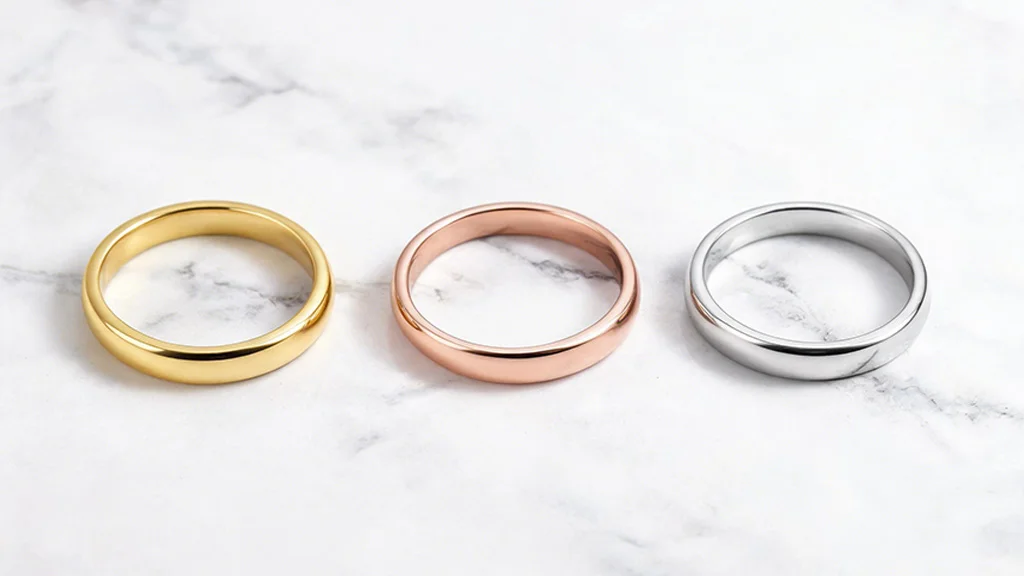
Karat tells you how much gold is present; the specific alloy metals mixed in determine the color. Yellow, white, and rose gold all start from the same pure gold — the difference is what's blended in.
|
Gold Color |
10K Alloy Mix |
14K Alloy Mix |
Visual Effect |
|---|---|---|---|
|
Yellow gold |
Copper, silver, zinc (higher ratio) |
Copper, silver, zinc (lower ratio) |
10K reads paler/muted; 14K reads warm and rich |
|
Rose gold |
Higher copper ratio |
Balanced copper-to-gold ratio |
10K looks noticeably pinker; 14K looks softer, warmer pink |
|
White gold |
Palladium and/or nickel, rhodium-plated |
Palladium and/or nickel, rhodium-plated |
Nearly identical appearance once rhodium-plated; underlying gold content still differs |
One clarification worth making since other guides get this backwards: 14K gold is not automatically more hypoallergenic than 10K gold. Both can contain nickel unless a piece is specifically labeled nickel-free. What's true is that 14K contains a smaller alloy share overall, so if the alloy does include nickel, less of it is present per gram — but the safest approach for sensitive skin is always to check the specific alloy formulation, not assume based on karat alone.
Durability and Everyday Wear
Both 10K and 14K gold will scratch and develop surface wear over time — that's true of every karat, since gold itself is a relatively soft metal. The practical differences show up over months and years, not on day one.
- Active lifestyles (manual labor, gym, sports): 10K's higher alloy content resists dents and deformation slightly better.
- Everyday wear (office, daily rings/necklaces): 14K balances durability with a noticeably richer color — the most common choice for engagement and wedding rings in the US.
- Occasional wear (special-occasion jewelry): either karat holds up well; color and budget become the deciding factors instead of durability.
- Humid or high-sweat climates: both karats are stable, but pieces with higher copper content (10K yellow/rose) can show a faint patina slightly sooner — a quick polish restores the finish.
Price and Value: What You're Actually Paying For
Gold jewelry pricing is driven primarily by the current spot price of gold, multiplied by the actual gold weight in the piece, plus labor, design complexity, and any stones. Because 14K contains roughly 40% more pure gold by weight than 10K, a 14K piece will generally cost more than an identical design in 10K — though the exact gap moves with the spot gold price, so treat any fixed percentage as a snapshot, not a constant.
Indicative Pricing Comparison
The table below illustrates directional pricing for a simple 5-gram plain band, using approximate relative positioning rather than live spot rates (always check current gold prices for exact figures):
|
Karat |
Approx. USD |
|---|---|
|
10K gold band (5g) |
$180–$220 |
|
14K gold band (5g) |
$240–$290 |
|
18K gold band (5g) |
$300–$370 |
Value isn't only about the sticker price, though. A 14K piece typically holds better resale/scrap value gram-for-gram because it contains more actual gold. But "value" should also account for how often you'll wear the piece — a more affordable 10K ring you wear daily for years often delivers better value-per-wear than a pricier piece that sits in a drawer.
From the Factory Floor: How Manufacturers Choose Karat
Most buying guides are written from the retail side. As an OEM/ODM fine jewelry manufacturer producing solid gold pieces for brands across the US, UK, and EU, we approach the 10K vs 14K decision a little differently — starting with the target market and the piece's function, not just the metal itself.
Alloying and Casting
Karat selection happens before a single piece is cast. Our metallurgy team formulates the alloy mix (gold plus copper, silver, zinc, or palladium) to hit the target karat precisely, then verifies purity via assay testing before casting begins. Getting the ratio exactly right matters for both compliance (hallmark stamps must match actual content) and consistency across a production run — a batch that drifts even slightly off-spec can fail assay testing in hallmarking-regulated markets like the UK.
Why Brands Offer Both Karats
- Market fit: a brand selling primarily into the UK may lead with 9K or 10K price points, while a US-only brand defaults to 14K as the expected standard.
- Product tiering: many brands offer an entry-level 10K line alongside a premium 14K or 18K line, using karat as a built-in price ladder.
- Design constraints: pieces with fine detail, pavé settings, or intricate filigree often perform better in 14K, since the added durability reduces the risk of prong or detail damage during setting and wear.
- Compliance: nickel-release limits (EU REACH Annex XVII) can shape which alloy recipe is used for EU-bound 14K pieces versus US-bound 10K pieces.
Quality Control
Every batch we produce is assay-tested to confirm actual gold content matches the intended karat before hallmark stamping — the same rigor a UK assay office would apply, checked proactively rather than reactively. This is the kind of detail that matters far more to a sourcing partner than to an end consumer, but it's exactly why the karat stamped inside a ring can be trusted.
Which Should You Choose? A Simple Decision Framework
If you're still deciding, work through these questions in order — the first one that applies to you usually points to your answer:
- Do you have a known nickel or metal allergy? → Look for nickel-free 14K or 18K, and confirm the specific alloy — don't rely on karat alone.
- Is this for daily, heavy-wear use (manual work, gym, kids)? → 10K's extra durability is a practical advantage.
- Is this an engagement ring, gift, or piece meant to last generations? → 14K's richer color and better resale value make it the more common choice.
- Are you shopping or sourcing in the UK? → 9K and 10K are both mainstream, legal options — don't assume 14K is the default.
- Are you shopping or sourcing in the EU? → Check the national standard; 18K may be the retail expectation in some countries.
- Is budget the deciding factor? → 10K delivers genuine, legally defined solid gold at the most accessible price point.
Frequently Asked Questions
Neither is universally better — 10K is harder and more affordable, while 14K has a richer color and slightly better resale value. The right choice depends on your budget, lifestyle, and skin sensitivity.
Yes, in the UK and much of Europe, 9K (37.5% pure gold) is a fully legal gold standard. In the US, however, 10K is the legal minimum for jewelry to be marketed as "gold" — 9K is not sold as gold there.
The UK commonly sells 9K and 18K, with 14K less prevalent. The US market is centered on 10K and 14K, with 18K positioned as a premium option. Always check local hallmarking expectations when buying or selling across borders.
No. Higher karat means more pure gold, but purity isn't the same as craftsmanship or durability. An 18K piece is more prone to scratching than a well-made 14K piece; quality depends on alloy precision, casting, and finishing as much as karat.
Not automatically. Both can contain nickel unless specifically labeled nickel-free. 14K has a smaller overall alloy share, but the safest approach for sensitive skin is checking the specific alloy formulation rather than assuming based on karat.
It's uncommon in fine jewelry because assay testing and hallmarking require a single verifiable karat per piece. Multi-tone designs typically use the same karat across all colors (yellow, white, rose) with different alloy blends for color only.
14K generally retains slightly better scrap and resale value than 10K, since it contains more pure gold per gram. 18K holds even more value by this measure, though it's softer and shows wear more easily.
Look for a hallmark stamp inside the band or clasp — "10K"/"417," "14K"/"585," or "18K"/"750" are the most common. If there's no visible stamp, a jeweler can verify karat with an acid test or electronic gold tester.