Diamond Ratio Guide: Ideal Length-to-Width by Shape
- Written by Provence Team
- Updated on October 27, 2026
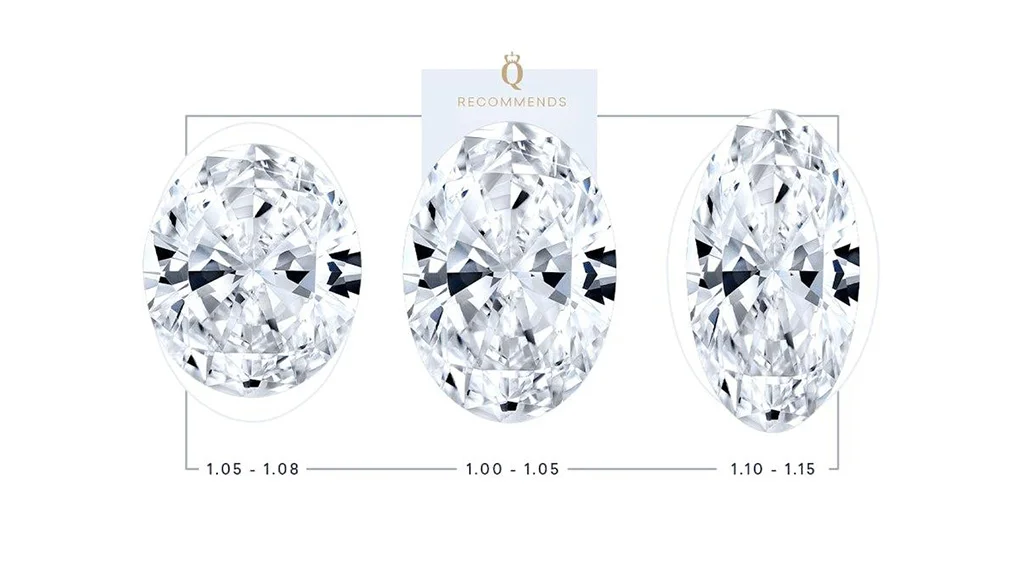
Table of Contents
Two diamonds can weigh exactly the same, share the same color and clarity grades, and still look completely different on the hand. One looks soft and full. The other looks long and slender. The difference is often the diamond ratio: the relationship between a stone’s length and its width.
This guide explains what diamond ratio is, how to calculate it in seconds, and which ranges suit each popular shape. You’ll also see why published “ideal” numbers don’t always agree, how ratio affects apparent size and price, and what to check beyond the number before you choose a stone.
What Is a Diamond Ratio?
A diamond’s length-to-width ratio is a single number that describes its outline. It compares how long the stone is with how wide it is. A lower number means a shorter, fuller, more compact look. A higher number means a longer, more slender look.
Ratio matters most for fancy shapes: the elongated and rectangular outlines such as oval, emerald, radiant, cushion, pear and marquise. Two stones of the same shape can look very different depending on their ratio. Round diamonds are designed to sit very close to 1.00, so the concept is less useful for them (more on that below).
It helps to be clear about what ratio is not. It isn’t a grade, it isn’t part of the 4Cs, and a “better” number doesn’t make a better diamond. Ratio describes shape. Cut quality, symmetry and light performance determine how the stone actually performs.
How to Calculate Diamond Ratio
The formula is simple. Measure the length and the width of the diamond in millimeters, then divide:
Length ÷ Width = Length-to-Width Ratio
Here are a few worked examples:
Measurements | Calculation | Ratio | What it looks like |
10.0 × 7.0 mm | 10.0 ÷ 7.0 | 1.43 | Gently elongated, a balanced oval or emerald outline |
6.5 × 6.5 mm | 6.5 ÷ 6.5 | 1.00 | Perfectly square or round |
8.0 × 6.0 mm | 8.0 ÷ 6.0 | 1.33 | Soft and full, at the shorter end of oval and emerald |
9.0 × 6.0 mm | 9.0 ÷ 6.0 | 1.50 | Long and slender oval, or a fuller pear |
12.0 × 6.0 mm | 12.0 ÷ 6.0 | 2.00 | A classic marquise proportion |
Common sizes and their ratios
Many fancy-cut stones, including lab-grown diamonds, moissanite and other gemstones, are sold in standard millimeter sizes. That means you can read the ratio straight from the size:
Size (L × W) | Ratio | Typical reading |
9 × 7 mm | 1.29 | Soft and rounded, just below the usual oval range |
8 × 6 mm | 1.33 | Fuller oval or emerald |
7 × 5 mm | 1.40 | Balanced oval or emerald |
9 × 6 mm | 1.50 | Long oval, or a fuller pear |
10 × 6 mm | 1.67 | A longer, more dramatic pear |
8 × 4 mm | 2.00 | Classic marquise |
Where to Find the Ratio on a Diamond Report
Grading reports list a fancy-shape diamond’s measurements in millimeters, usually length first, then width, then depth. Many reports don’t print the ratio itself, so you take the first two numbers and divide them. A stone reported as 9.00 × 6.30 mm, for example, has a ratio of 9.00 ÷ 6.30 = 1.43.
If you’re looking at a stone without a report, a digital caliper gives you the same two numbers. If the stone is already set in a ring, ask for the measurements taken before mounting, because prongs and bezels can hide part of the outline. For more on reports, see our comparison of GIA and IGI certification.
Diamond Ratio Chart by Shape
Use this chart as a starting point. Each shape has a typical range, a “classic” zone that most people find balanced, and a longer end that looks more dramatic.
Shape | Typical range | Classic look | Longer, more dramatic |
Oval | 1.30–1.50 | 1.35–1.45 | 1.46–1.50+ |
Emerald | 1.30–1.50 | About 1.40 | 1.45–1.50+ |
Radiant | 1.00–1.05 (square), 1.20–1.35 (rectangular) | About 1.25 (rectangular) | 1.36–1.50 |
Cushion | 1.00–1.20 | 1.00–1.05 (square) | 1.10–1.20+ (elongated) |
Pear | 1.45–1.75 | 1.50–1.65 | 1.70+ |
Marquise | 1.75–2.25 | About 2.00 | 2.01–2.25 |
Princess | 1.00–1.05 | 1.00 | Above 1.05 reads as rectangular |
Asscher | 1.00–1.05 | 1.00 | — |
Heart | 0.90–1.10 | About 1.00 | — |
Round | About 1.00 | About 1.00 | — |
Why you’ll see different “ideal” ratios
Compare a few diamond guides and you’ll notice the numbers don’t always match. Radiant and cushion cuts show it most. Some guides give a radiant cut a range up to 1.20, while others list the rectangular range as 1.20–1.35. Some give cushions 1.00–1.10, others up to 1.20 or beyond.
The reason is that there is no single official standard for fancy-shape ratios. The ranges reflect long industry practice and buyer preference, radiants and cushions come in both square and rectangular versions, and guides draw the line between “balanced” and “elongated” in different places. Rather than chasing one correct number, pick your shape, decide whether you want a fuller, classic or longer look, and then judge the actual stone.
Ideal Ratio for Each Diamond Shape
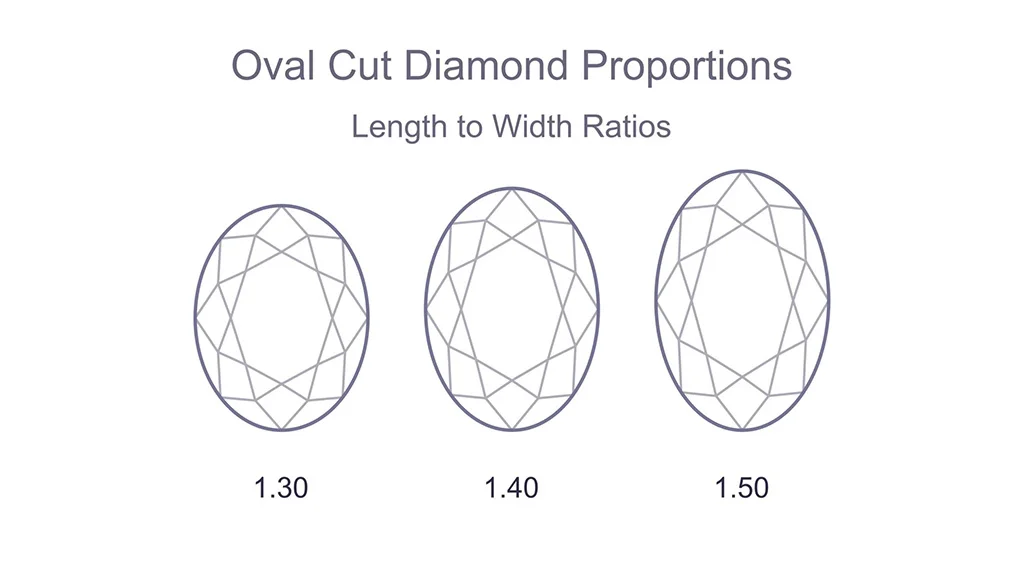
Oval diamond ratio: 1.30–1.50
Oval is the shape where ratio changes the look most. Around 1.30 the stone looks soft and rounded; closer to 1.50 it looks longer and more slender. Ratios above about 1.50 can start to look thin and may emphasize the bow-tie, the dark shadow that can run across the center of an oval. GIA notes that many buyers prefer ovals between 1.30 and 1.50; see its oval cut diamond guide. Beyond the number, look for full, even shoulders. A long oval with flat shoulders can look thin or uneven.
Emerald cut ratio: 1.30–1.50
Emerald cuts use long step facets rather than brilliant-style faceting, which creates broad flashes of light and a clean, architectural look. A ratio near 1.40 is often considered the sweet spot. Lower ratios can look boxy, while higher ones can look stretched or narrow. Because the long facets make clarity characteristics easier to see, as GIA explains in its emerald cut guide, check that the steps look balanced and the corners even.
Radiant cut ratio: 1.00–1.05 or 1.20–1.35
Radiant cuts combine a rectangular or square outline with brilliant-style faceting, so they come in two common versions. Square radiants sit at 1.00–1.05. Rectangular radiants typically run 1.20–1.35, with about 1.25 often seen as a flattering middle. Radiant faceting varies widely between stones, so the best ratio is the one that comes with a strong facet pattern and an even outline.
Cushion cut ratio: 1.00–1.20
Cushion diamonds range from square to clearly elongated. A square cushion sits at 1.00–1.05 and has a vintage feel that works well in halo settings. An elongated cushion, around 1.10–1.20 and sometimes longer, is popular because it combines soft corners with more finger coverage. Corner shape and facet pattern change the look a lot, so the same cushion ratio can produce very different results.
Pear diamond ratio: 1.45–1.75
A pear’s ratio decides whether it looks full, balanced or dramatically long. Around 1.50 is considered balanced, while 1.70 and above gives a longer teardrop. GIA’s pear diamond guide notes that many experts prefer ratios in this range. Check that the shoulders are even, the wings curve smoothly into the point, and the point sits centrally.
Marquise diamond ratio: 1.75–2.25
Marquise diamonds are designed to look long and elegant. A ratio of about 2.00 is widely seen as classic: sleek without looking stubby or too narrow. GIA’s marquise guide notes that marquise stones submitted to its laboratory commonly range from about 1.60 to 2.20. Very long, narrow marquise stones need extra care: they can show a more visible bow-tie and weaker light return, and the two points are vulnerable, so the setting must protect both ends.
Princess cut ratio: about 1.00
Princess cuts are chosen for their square look, so the closer to 1.00 the better. A ratio up to about 1.05 still reads as square, and GIA’s princess cut guide says a square princess should not exceed roughly that figure. Above 1.05 the stone looks rectangular, which can be a deliberate choice but should be matched by the design.
Asscher cut ratio: about 1.00
Like the princess cut, the Asscher is meant to be square, with an ideal ratio of 1.00 and minor variation up to about 1.05. A higher ratio can cost the stone its signature concentric-square pattern.
Heart diamond ratio: 0.90–1.10
A heart looks best at around 1.00, with even lobes and a well-defined point. A heart that is too wide or too narrow can look distorted or unbalanced, so this is a shape where you should always view the outline closely.
Round diamond ratio: about 1.00
A well-made round brilliant sits extremely close to 1.00, and a figure of 1.02 or higher can make it look slightly out of round. For round diamonds, ratio is a quick roundness check rather than a buying criterion. Cut grade, angles, table, depth, symmetry and polish matter far more. Our guides to table and depth and diamond cut grades cover those.
Same Ratio, Different Look
Ratio is a starting point, not a verdict. Imagine two oval diamonds, both at 1.42. One has full, rounded shoulders and a smooth outline. The other has flatter sides or slightly pointed ends. They share a number but look like different stones. The facet pattern can differ too: one may look bright and lively while the other shows a strong dark bow-tie across the center.
So when you’ve narrowed your search by ratio, check these points on the actual stone:
- Outline and shoulders:do they look even and full, or flat and uneven?
- Symmetry from the top:both sides should mirror each other (see our guide to diamond symmetry).
- Bow-tie:a dark band across the center of ovals, pears and marquise stones.
- Corners, wings and points:even corners on emerald, radiant and cushion cuts; smooth wings and a central point on pears.
- Lighting:view the stone in more than one type of light.
Does Diamond Ratio Make a Stone Look Bigger?
Carat tells you how much a diamond weighs. Millimeter measurements tell you how large it looks. Elongated shapes tend to spread their weight across the top surface instead of carrying it deep in the stone, so a longer ratio can give more finger coverage and a bigger-looking face for the same weight.
That doesn’t mean a longer stone is automatically larger or better. A shallow or poorly cut diamond can look long yet lose brightness. The goal isn’t the longest possible stone, but the best balance of spread, beauty and light performance. Always compare millimeter dimensions, not just carat weight.
Does Ratio Affect Sparkle and Price?
Sparkle
Not on its own. Ratio influences the outline and how facets are arranged, but sparkle comes from cut quality, proportions and light performance. A stone with an attractive ratio can still look dull if it is poorly cut, and a stone outside a popular range can still be brilliant.
Price
Less than most buyers expect. Cut quality, carat, color and clarity have a much greater effect than L/W ratio. Ratios in high demand, and stones with uncommon but desirable ratios, can be priced slightly higher. Cutting toward ideal proportions also usually means losing more of the rough crystal, which is one reason well-proportioned stones tend to cost more.
Because pricing varies by market and changes over time, compare stones of the same shape, grades and certification rather than judging value by ratio alone.
How Ratio Is Decided in Manufacturing
Ratio isn’t chosen at the sales counter. It is set at the cutting stage, and once a stone is cut, it can’t be changed. A cutter working from rough has to balance the target outline against yield, symmetry and light performance, and those goals pull against each other.
For a jewelry manufacturer, ratio is also a production specification. It affects several things buyers rarely see:
- Matched pairs.Earring stones need to be the same shape and close in ratio, or they look mismatched even when both are well cut.
- Side stones and three-stone designs.Center and side stones should echo each other’s outline for the design to look intentional.
- Calibrated sizes.Standard millimeter sizes carry a known ratio, so settings can be made in advance and stones swapped without redesigning the mount.
- Setting fit.Prongs, bezels and heads are built around the stone’s outline, so a ratio that drifts from the specification can leave gaps or force a custom head.
Diamond Ratio for Lab-Grown Diamonds, Moissanite and Other Gemstones
The same ratio principles apply whatever the stone is made of. A lab-grown oval and a natural oval can both be short, balanced or elongated, and both still need to be judged for symmetry and light performance. The shape should be chosen by eye, not by origin. If you’re comparing the two, see our guide to lab-grown vs natural diamonds.
The same goes for moissanite and other fancy-cut gemstones. Divide length by width and compare the result with the chart above. Because gemstones are often sold in calibrated sizes, the ratio is easy to read straight from the size: an 8 × 6 mm oval is 1.33, and a 7 × 5 mm oval is 1.40.
How Ratio Affects Ring and Jewelry Design
The same diamond can look different depending on how it’s set. A long oval can look even more elongated on a slim solitaire band, while a wider band or a three-stone design can balance it. Emerald cuts pair well with tapered baguette side stones, and pear and marquise stones need claws or prongs that protect the points without interrupting the outline. For more on settings, see halo vs hidden halo and bezel vs prong.
Ratio also changes how the stone sits on the hand. A higher ratio gives a slimming, elongated look, while a lower ratio looks wider and more compact. Because the stone and the setting work together, many people choose the diamond first and design the setting around it.
Diamond Ratio FAQ
A diamond ratio, or length-to-width (L/W) ratio, is the stone’s length divided by its width, measured in millimeters. A ratio near 1.00 means a square or round outline, and a higher number means a longer, narrower stone.
Divide the length by the width. A diamond measuring 10.0 mm by 7.0 mm has a ratio of 10.0 ÷ 7.0 = 1.43. The measurements are on the grading report.
Most guides place the ideal oval range at about 1.30–1.50. Around 1.30–1.38 looks softer and fuller, about 1.39–1.45 is a balanced middle, and above 1.46 looks longer and more dramatic. Which is best depends on your taste.
Emerald cuts typically fall between 1.30 and 1.50, with about 1.40 often considered the sweet spot. Lower ratios can look boxy and higher ones can look stretched.
Pear diamonds are typically 1.45–1.75, with about 1.50–1.65 looking balanced. Marquise diamonds are typically 1.75–2.25, with about 2.00 considered classic.
Not by itself. Ratio influences shape and facet arrangement, but sparkle depends on cut quality, proportions and light performance.
Yes. Shoulder shape, corners, symmetry and facet pattern can make two stones with the same ratio look very different, which is why you should judge the actual stone.